 by Tom Gurney
Tom Gurney BSc (Hons) is an art history expert with over 20 years experience
Published on June 19, 2020 / Updated on October 2, 2026
Email: tomgurney1@gmail.com / Phone: +44 7429 011000
A closer look
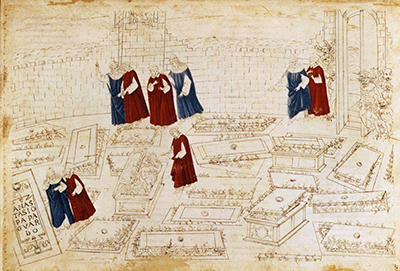
Stone walls enclose a cemetery of open tombs. Between the rectangular graves, two small travellers recur: Dante in red and Virgil in blue. Botticelli has not pictured a single instant. He lets the pair move through a place, meet its inhabitants and reach its edge, all within one drawing. The Vatican Apostolic Library catalogues the sheet as an illustration of Inferno X. Its own detailed commentary traces the action from the entry into the City of Dis in canto IX through the first moments of canto XI.[1][2]
This is folio 100r of the Vatican Library’s Reg. lat. 1896 pt. A, the surviving Vatican part of Botticelli’s illustrated Divine Comedy. The folio belongs to a late fifteenth-century Florentine manuscript. Its scene is the sixth circle of Hell, where the poem places heretics among burning, uncovered sepulchres. Botticelli turns a conversation about Florence, belief and exile into a route through a drawn landscape.[1][2]
At a glance
- SubjectDante and Virgil in the City of Dis, among the tombs of the sixth circle; primarily Inferno X, with episodes from IX and XI
- ArtistSandro Botticelli, as identified in the Vatican manuscript catalogue
- Date and placeLate fifteenth century, Florence, according to the Vatican Library
- ObjectA drawing on folio 100r of illustrated Divine Comedy manuscript Reg. lat. 1896 pt. A, Biblioteca Apostolica Vaticana
- MaterialDrawing on parchment. The accessible owner description used here does not settle the precise drawing media or dimensions of this individual folio.
- Image statusThe Library’s digital image is available for personal use or study; online publication requires permission.[1]
This work in Botticelli’s career
Fortitude
1470Inferno X Drawing
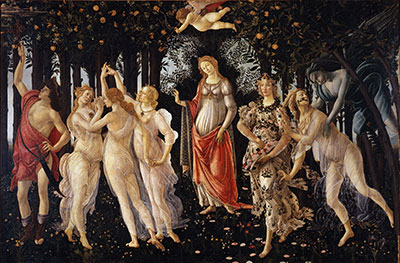
late 15th centuryPrimavera
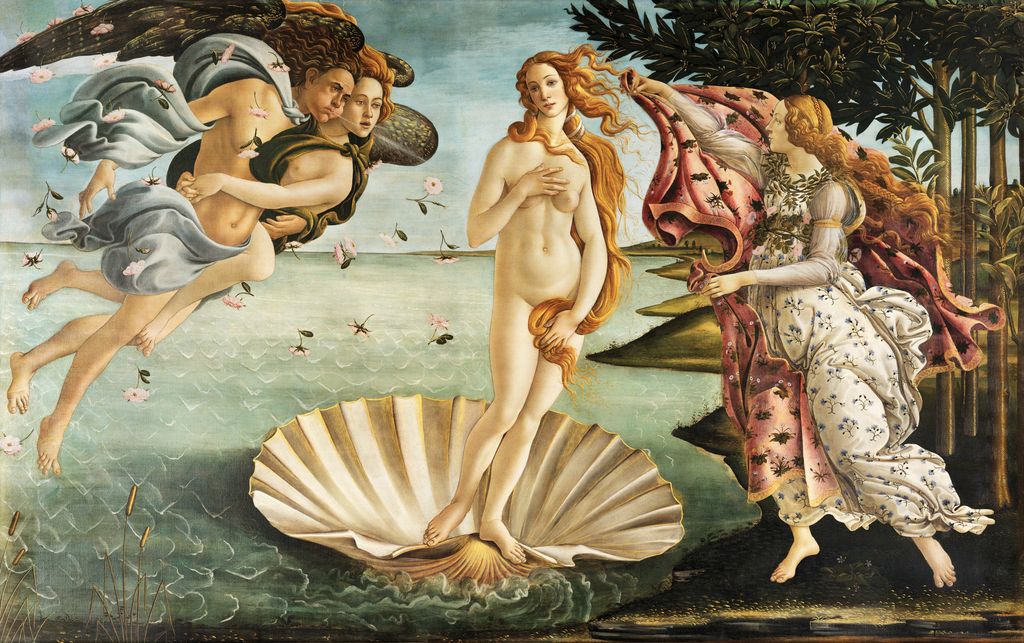
c. 1480Birth of Venus
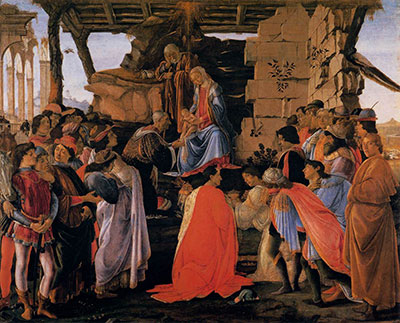
c. 1485Mystic Nativity
1500Contents
- At a Glance
- A Cemetery That Becomes a Story
- Farinata Rises From the Tomb
- Cavalcante Interrupts
- The Tomb at the Edge of Canto XI
- A Folio, a Chart and a Printed Image
A Cemetery That Becomes a Story
The open graves establish the place before any figure needs a name. Their long, nearly repeated stone forms make a patterned field inside the walls. Dante’s text calls this the burial ground of those who held the soul to die with the body. The tombs are uncovered now; their flames and occupants make the punishment present rather than a remote warning. The Vatican’s commentary locates Dante and Virgil’s arrival just after a heavenly messenger has opened the gates of Dis.[2]
On the sheet, repeated figures show the two poets at successive stops. Botticelli uses their recognisable colours and partnership as visual guides through a crowded setting. We follow an itinerary instead of reading the cemetery as a still arrangement of isolated portraits. The Vatican commentary even describes their movement along the inner side of the wall toward the right. Such repetition compresses several lines of verse into one surface: the walkers can appear more than once because the drawing maps elapsed time as well as space.[2]
The architecture holds that sequence together. Wall, gate and tomb rows keep the scene recognisably within Dis while the action changes. The sharp divisions between graves also make the human exchanges feel unusually exposed. A voice can rise from one stone chest into the travellers’ path, interrupt them, then disappear again. This particular drawing is not the celebrated overview of the whole underworld. Its scale of attention is a single district and a few consequential encounters.[1][2]
Farinata Rises From the Tomb
In canto X, Farinata degli Uberti recognises Dante’s Florentine speech and rises to address him. Virgil directs Dante’s attention to the figure emerging from the sepulchre. Farinata was a prominent Ghibelline; the talk quickly becomes an argument about Florence’s rival factions. The conversation brings Dante’s living civic world into the supposedly separated realm of the dead. Farinata’s upright posture makes the speaker appear defiant even in punishment.[2][3]
The Vatican commentary identifies this exchange on Botticelli’s sheet. In the small legacy reproduction, the open tombs and the two travellers can be followed, but individual facial expressions and every participant’s hand gesture cannot be confirmed with the same confidence. The secure reading comes from the Library’s folio-level annotation in combination with the composition, not from an invented close inspection of indistinct pixels. Farinata’s position in the poem supplies the reason the encounter matters: Dante is made to confront a political enemy while standing in a landscape of theological punishment.[2][3]
Farinata also tells Dante that exile awaits him. That prediction changes the force of the scene. The man in the tomb speaks about a future that the travelling poet has not yet lived. Botticelli’s continuous arrangement suits such a crossing of times. The pair can be shown approaching, stopping and moving on, while a single conversation points beyond the depicted journey to Florence itself. The sheet’s order does not require a viewer to know every episode first; the recurring travellers and repeated graves provide a way in.[2][3]
Cavalcante Interrupts
A second voice rises from the same tomb. Cavalcante de’ Cavalcanti asks why his son Guido, Dante’s friend, is not travelling beside Dante. In the poem he appears only to the chin, questions Dante anxiously and sinks back when he fears Guido has died. The Vatican annotation names the smaller emergence and the collapse; Princeton’s Dante commentary explains the concern behind the interruption.[2][4]
Farinata and Cavalcante make a deliberately uneven pair. One sustains a proud political argument; the other breaks in with a parent’s urgent fear. The interruption is brief but not decorative. It interrupts Farinata’s exchange just as a figure breaking the level of a tomb interrupts the orderly cemetery. The two men share a place of punishment yet speak from different preoccupations. When Cavalcante withdraws, Farinata resumes and brings the conversation back to Florentine events and Dante’s exile.[2][3][4]
Their different reactions also reveal a rule of this circle that a picture cannot state on its own. Later in canto X, Farinata explains that the dead can make out distant future events but know nothing of the present on earth unless someone tells them. His prediction of Dante’s exile and Cavalcante’s mistaken fear that Guido is already dead therefore belong together: knowledge of one future event does not give either speaker news of the living. Dante eventually asks Farinata to tell Cavalcante that Guido still lives. The Vatican annotation identifies the two encounters on the sheet, while the poem and Princeton’s commentary supply the explanation of their unequal knowledge. Botticelli makes the interruption visible; it remains useful to read the words to understand why it hurts.[2][3][4][6]
That alternation is a useful way to read Botticelli’s crowded drawing. Rather than assigning a separate picture to each utterance, he places several stages of travel and dialogue in one coherent space. The graveyard can be scanned repeatedly, as the poem itself returns from Cavalcante to Farinata. The figures are not simply repeated to fill empty ground; their changes of position allow a written sequence to be seen at once.[2]
The Tomb at the Edge of Canto XI
The drawing reaches beyond the episode named in the catalogue. At the lower edge, the travellers halt beside a tomb with an inscription. The Vatican Library identifies it as the grave of Pope Anastasius II and reads the segmented lettering as “ANAS/TASIO / PAPA / GUAR/DO.” Dante and Virgil hold their noses against the stench rising from the seventh circle. Their pause corresponds to the opening movement of Inferno XI: they have come to the boundary of another region and must wait before descending.[2]
The inscribed tomb matters because it prevents the image from being treated as a generic “Inferno” scene or as a perfectly bounded picture of canto X alone. The Library’s manuscript catalogue uses the concise label “illustration of Inferno X,” while its annotation specifies IX–XI. Both descriptions can be true: canto X supplies the central encounter, and the continuous composition includes the arrival before it and the halt after it. The bottom-left tomb visible in the legacy image is therefore a narrative hinge, not just another stone rectangle.[1][2]
The drawing does not settle every interpretive question in Dante’s text. A viewer does not need a claim that Botticelli accurately recorded the historical pope’s beliefs, nor a claim that every grave has a separately identifiable occupant. What can be said is narrower and stronger: the Library identifies this tomb and its lettering, and the two poets’ gesture leads the eye out of the sixth circle. Botticelli gives the page an ending that is also a route onward.[2]
A Folio, a Chart and a Printed Image
Two other Botticelli-related Inferno images are easily confused with this drawing. In the same Vatican manuscript, folio 101r carries the Chart of Hell, the broad diagram of the underworld. That is a different physical folio and the subject of the separate Abyss of Hell page. Folio 100v, on the reverse of the drawing discussed here, carries text of Inferno IX according to the Library’s catalogue; it should not be silently labelled canto X merely because the recto illustrates that episode.[1]
There is also an Inferno X engraving in the 1481 Florentine printed Comedy. Oxford’s comparison places it beside the Vatican drawing, but the print and the manuscript folio are separate works. The engraving is conventionally linked, with a question mark, to Baccio Baldini. Its exact relationship to Botticelli’s designs remains a matter of scholarship; seeing a similar tomb scene does not prove that this Vatican sheet was the plate-maker’s direct model.[5]
The Vatican drawing’s distinction is the way it holds a passage together. It moves from a locked city to a cemetery, from Farinata’s political defiance to Cavalcante’s fear, and finally to the foul air at the next descent. The Library’s concise Inferno X label tells us where to start. The repeated travellers, inscribed tomb and Library’s detailed annotation show how much farther Botticelli asks the eye to go.[1][2]
Botticelli and related artworks
Discussion
Which detail changes how you read Inferno X Drawing?
Reader Insights
How do the open tombs frame Dante and Virgil?
Where do Farinata and Cavalcante appear?
How is this folio distinct from the chart of Hell?
Join the Conversation
Share a source-led observation or question below.
References
- Biblioteca Apostolica Vaticana, digitised manuscript Reg. lat. 1896 pt. A and manuscript catalogue, fol. 100r identification, folio sequence, date and place; accessed 1 October 2026 View source View source.
- Biblioteca Apostolica Vaticana, Viaggiare con Dante: annotation for fol. 100r, scene reading across Inferno IX–XI, Farinata, Cavalcante and Anastasius inscription; indexed Vatican text consulted 1 October 2026 View source.
- Princeton Dante Project, Inferno X, lines 29–36 and Farinata entry, encounter, factional history and exile prophecy; accessed 1 October 2026 View source View source.
- Princeton Dante Project, Cavalcante de’ Cavalcanti entry, Guido question and retreat into the tomb; accessed 1 October 2026 View source.
- Gervase Rosser, “The first printed and illustrated edition of Dante’s Comedy,” Oxford TORCH, 2021, fig. 5 and the comparison to the 1481 engraving; accessed 1 October 2026 View source.
- Princeton Dante Project, commentary on Inferno X.100–108 and Farinata entry, the souls’ knowledge of the distant future but ignorance of the present and Dante’s message for Cavalcante; accessed 1 October 2026. The commentary notes a scholarly disagreement over whether Farinata’s rule applies to all the damned or specifically to the heretics; this page makes no broader claim View source View source.