by Tom Gurney
Tom Gurney BSc (Hons) is an art history expert with over 20 years experience
Published on June 19, 2020 / Updated on October 2, 2026
Email: tomgurney1@gmail.com / Phone: +44 7429 011000
Purgatorio X
At first, this drawing can look almost empty. Its pale lines ask for slow looking. Along a broad wall, Botticelli has placed scenes that Dante and Virgil encounter on the first terrace of Mount Purgatory: the Annunciation, David before the Ark of the Covenant, and Emperor Trajan responding to a widow. Below them, the two travelers continue through the space while the proud begin their penance under heavy stones. The sheet illustrates a particular canto, Purgatorio X, rather than Purgatory as a whole.[1][3]
The drawing belongs to the Kupferstichkabinett in Berlin. Its current title names the marble reliefs and the penance of the proud; its inventory number is Botticelli, Purgatorio 10. The museum credits Sandro Botticelli and dates the sheet to about 1488–92. It is one part of a much larger attempt to give Dante's Divine Comedy a sequence of images on parchment. The faintness that first slows a viewer down is central to how the drawn scenes are discovered.[1][2]
At a glance
- Current titleLa Divina Commedia, Purgatorio X: The Marble Reliefs and Penance of the Proud
- ArtistSandro Botticelli in the current Berlin record
- Dateabout 1488–92 in the current Berlin record
- Mediummetalpoint and brown pen on parchment
- Dimensions32.2 × 47.0 cm, sheet size
- Current collectionKupferstichkabinett, Staatliche Museen zu Berlin
- Inventory numberBotticelli, Purgatorio 10
- Subjectthe first terrace of Purgatory in Dante's Divine Comedy
Where this work sits in Botticelli’s career
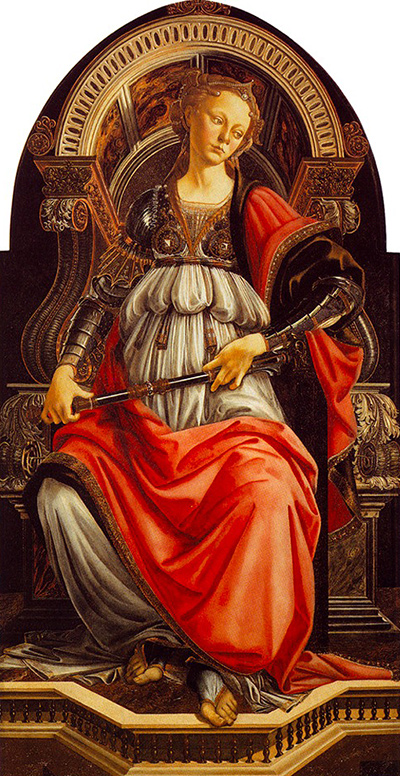
Fortitude
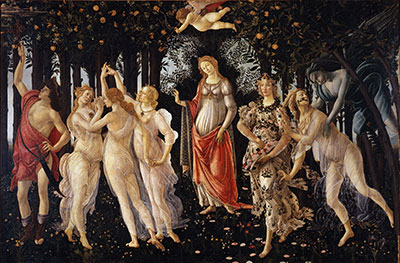
1470Primavera
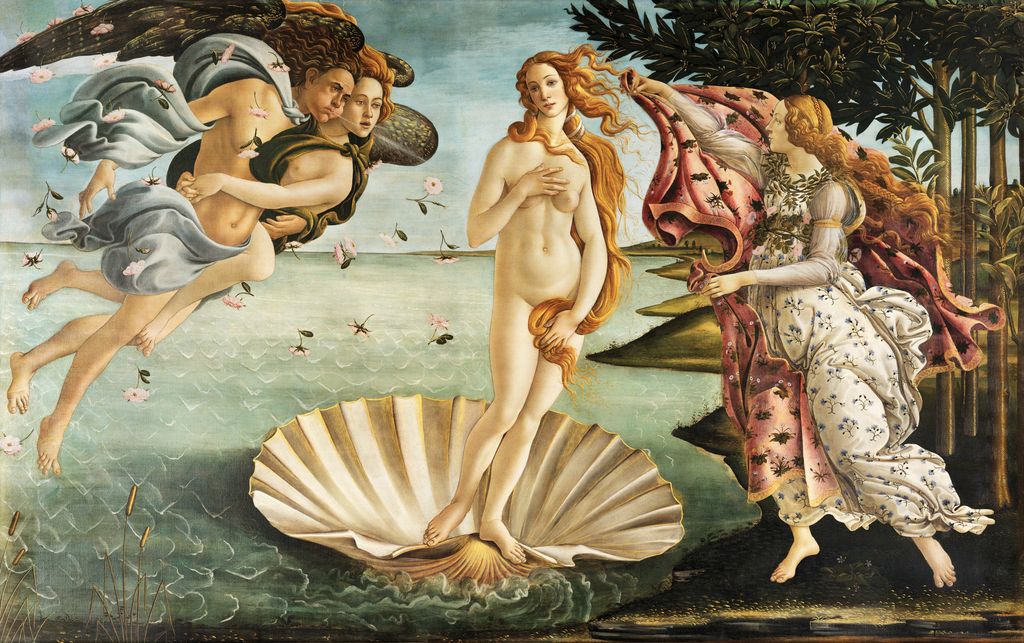
c. 1480The Birth of Venus
c. 1485Purgatorio X
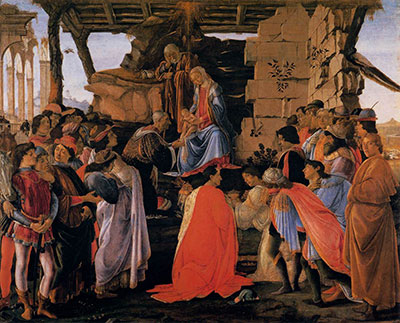
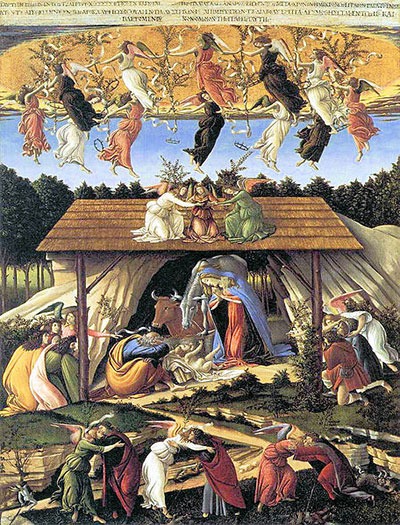
c. 1488–92The Mystical Nativity
c. 1500Contents
- The First Terrace and Its Three Lessons
- The Palace Behind David
- Finding Dante, Virgil and the Proud
- Why the Lines Are So Pale
- A Sheet from a Larger Dante Project
These facts follow the owning museum's current entry. Some older publications give different dates, measurements or material descriptions. They do not change the identity of the Berlin sheet.[1][3]
The First Terrace and Its Three Lessons
In Dante's poem, the first terrace is where pride is addressed. Before the travelers meet those bent by their burden, they see carved examples of humility in a marble wall. Botticelli translates that sequence into a broad picture. The wall offers a place for several episodes to appear together, while the moving figures of Dante and Virgil give the eye a route through them.[1][3]
Begin at the left. The Annunciation is the moment when Gabriel brings Mary the message that she will bear Christ. In the drawing, it occupies a relatively open area. A kneeling figure and an approaching angel can be picked out, but the architecture behind them remains exceptionally light. The space around this first encounter allows it to register before the denser scenes to the right.[3]
The central lesson concerns David and the Ark of the Covenant. A wheeled vehicle and oxen anchor the scene; figures and movement gather around them. Dante's example is David dancing before the Ark. On the sheet, the combination of vehicle, animals and bodies gives that middle passage a different rhythm from the stiller Annunciation. Botticelli does not need a separate frame around every event for us to sense a progression.[3]
At the right, a crowded relief turns to the justice of Emperor Trajan. In Dante's account, a widow asks the emperor to respond to the killing of her son. The episode is presented as an act of humility because an imperial ruler stops to hear someone with little power. Botticelli fills this part of the wall with horses, soldiers and figures pressing toward one another. It is the busiest field on the page, and its sharp change of density helps the viewer locate the third example.[3]
These are images of carvings within the story. Botticelli's actual object is a drawing on parchment, not a set of marble panels. That double status matters: he draws the fictional reliefs that Dante describes, then places Dante and Virgil before them as spectators. We, in turn, look at the whole scene from outside it. A poem about the power of images becomes an image about looking.[1][3]
The sequence of spectators is unusually exact. Herbert Horne's close reading begins at the gateway and follows Dante and Virgil up a zigzag path to the marble wall. In his account, Botticelli even draws Dante's upper body twice in one position as he turns across Virgil to look from the Annunciation toward the next relief. That small doubled contour records a change of attention within a continuous space. It is not an additional character or a mistake to be removed from the story. A viewer who notices it sees Botticelli solving a problem posed by Dante's text: how to make a sudden turn of the head and a shift of attention visible on a still sheet.[4]
The Palace Behind David
The central relief contains more than the Ark procession. In Dante's canto, Michal watches David dance from a “great palace” and regards him with disdain. Botticelli gives her a window above the scene, so her elevated position becomes a visible contrast with David's public humility. Dagmar Korbacher, curator at Berlin's Kupferstichkabinett, observes that Dante says little about the building's appearance; the artist had to invent much of the setting. Its arches, upper windows and roundels are drawn in especially faint metalpoint. The palace helps a viewer find Michal and understand why her height matters to the moral example.[5]
Korbacher compares the sketch with the courtyard vocabulary of fifteenth-century Florentine palaces, while warning against identifying it as a portrait of one surviving building. Earlier scholarship proposed correspondences with the Palazzo della Cancelleria, the Gondi Chapel and Bramante's Vatican loggia and dated the drawing very late as a result. Korbacher finds that late dating unpersuasive and describes a more general language of Renaissance architectural grandeur. That distinction matters here: a resemblance to an arch or roundel cannot by itself move the museum's approximate 1488–92 date to Botticelli's final years.[5][1]
The artist uses architecture to join three lessons. Mary kneels beneath a lightly sketched loggia, David and Michal occupy the middle palace scene, and a more strongly inked triumphal arch backs Trajan's crowded encounter. Korbacher reads the repeated arches as visual passages carrying the eye from left to right. She also notes exploratory construction lines and unresolved joins in the palace, evidence of design in progress rather than a finished architectural plan. A viewer need not accept every proposed symbolic meaning of the arches to see their practical work: they mark places within the wall and help the travellers' next step become legible.[5]
Finding Dante, Virgil and the Proud
Small pairs of robed figures stand below the wall. Their repeated appearances guide a viewer across the terrace rather than fixing all action at one instant. One pair gestures toward the reliefs; another appears lower on the sheet where the path changes level. The broad, comparatively empty ground around them helps separate the travelers from the densely worked scenes above.[1][3]
Near the lower part of the composition, the ground drops and bends. Faint strokes define ledges, steps and the rocky route. They are easy to miss beside the Trajan scene. Follow the hems of the two figures and then the nearby contour of the terrain; the movement becomes clearer. The same line can serve as an architectural edge, a route and a way of directing attention to the next part of the poem.[1]
Horne also compares the sheet's Annunciation with the Annunciation in the San Marco altarpiece predella, another work associated with Botticelli. The comparison is suggestive because the same artist could return to a familiar sacred encounter in a different medium and narrative purpose. Yet the drawn scene in Purgatorio X is meant to look like a relief on Dante's marble terrace, whereas the predella is part of a painted altarpiece. Resemblance does not establish that one was directly copied from the other or resolve the order in which they were made. It helps a reader ask what Botticelli kept and what he changed when he inserted a sacred image inside a poet's invented landscape.[4]
The proud are identified in the Berlin title as undergoing penance. At the right of the reliefs, low figures bend under stones. Their posture contrasts with the upright travelers and the mounted figures in Trajan's scene. The punishment is physical: a person accustomed to standing high is pressed down. Botticelli gives that idea a place within the continuous landscape rather than isolating it in a separate emblem.[1][3]
It is possible to pass over these small figures on a first viewing. The eye moves naturally to the right-hand crowd, where pen lines are darker and more numerous. Returning to the pale lower edge changes the balance of the image. The monumental lessons on the wall are encountered by bodies moving through a difficult landscape, and the proud must carry the lesson into action.[1][3]
Why the Lines Are So Pale
Berlin describes the sheet as metalpoint and brown pen on parchment. Metalpoint leaves a fine, restrained trace; the brown pen can make selected contours more emphatic. The contrast between faint and stronger passages is visible across the drawing. Around some structures, the first lines are barely there; in the crowd at the right, the form is easier to read. The current catalogue does not turn every pale passage into a firm claim about an unfinished plan.[1]
In a museum account of the wider Dante series, Berlin says Botticelli commonly worked in silverpoint and retraced parts in brown ink, leaving changes of mind visible. That description helps explain why the page rewards close inspection. The line is a record of decisions as well as a means of defining figures. A digital reproduction can reveal more when enlarged, but it still cannot replace examining the physical parchment and the subtle difference between its marks.[2]
The drawing's wide format also matters. At 47 centimetres across and 32.2 high, it allows the reliefs to unfold laterally. The eye can move from a relatively open Annunciation to the busier Ark episode and then the crowded Trajan scene. Botticelli gives the wall the length needed for a sequence, while the travelers and penitents keep that sequence tied to Dante's journey.[1][3]
A Sheet from a Larger Dante Project
Botticelli's Divine Comedy drawings were an ambitious late fifteenth-century undertaking. Berlin's institutional account describes images made on vellum with metalpoint and ink and notes that the surviving sheets show different degrees of working. The project joined a poet's extended journey to the visual problem of placing many moments on individual pages. This particular sheet makes that problem unusually clear: three exemplary reliefs, moving spectators and the start of a punishment coexist in one composition.[2]
The Kupferstichkabinett's account says Berlin acquired 85 drawings from the Hamilton collection in 1882. That is a documented later chapter in the group’s history, not a record of the circumstances in which Botticelli first made the sheet. It explains how this drawing became part of a museum collection where it can be compared with neighbouring cantos.[2]
The present image is Purgatorio X. Another Berlin drawing for Purgatorio XXVIII shows a different episode involving Dante and Matelda beside Lethe. Similar formats and the shared Dante subject should not make the two sheets interchangeable. Here the marble lessons of humility and the bowed proud identify the canto.[1]
Look once more from the light left-hand scene to the concentrated marks at the right. The change in line density is a way to navigate the story, not merely a difference in finish to be ignored. Botticelli lets a viewer discover one lesson, then another, before noticing the burdened figures beneath them. The drawing turns reading into a sequence of acts of looking.[1][3]
Botticelli and related artworks
Discussion
Look again at the details and evidence discussed above. Which part of the drawing changes most when you know its history?
These prompts invite close looking and source-led questions rather than a single settled interpretation.
Reader Insights
Which of the three relief scenes is easiest to find, and how does its line density help?
How do Dante and Virgil guide your eye across the terrace?
What becomes clearer when you open the museum image at full size?
Join the Conversation
Share an observation or question about the drawing below.
References
- Staatliche Museen zu Berlin, Kupferstichkabinett, “La Divina Commedia, Purgatorio X: Die Marmorreliefs; Buße der Hochmütigen,” inv. Botticelli, Purgatorio 10, current collection record updated 12 August 2026, accessed 29 September 2026 View source.
- Kupferstichkabinett, Staatliche Museen zu Berlin, “La Divina Commedia, Purgatorio X,” institutional contribution to Google Arts & Culture, accessed 29 September 2026 View source.
- Patricia Lee Rubin, “Purgatorio, Canto X, Punishment of the Proud,” image entry in Images and Identity in Fifteenth-Century Florence (Yale University Press, 2007), accessed 29 September 2026 View source.
- Herbert P. Horne, Alessandro Filipepi, Commonly Called Sandro Botticelli (1908), pp. 220–22 (PDF pp. 370–72), tracing the gateway, repeated Dante figure and a qualified visual comparison with the San Marco predella; consulted 1 October 2026 View source.
- Dagmar Korbacher, “Dante's ‘gran palazzo’ in Purgatorio X, re-visited by Botticelli”, Dante e l'arte 12 (2025), pp. 45–56, especially pp. 47–53; full open-access article consulted 1 October 2026. Its building comparisons and account of meaning are scholarly interpretations grounded in the faint drawing and Dante's text View source.
- Image credit. Sandro Botticelli, Purgatorio X, about 1488–92, Staatliche Museen zu Berlin, Kupferstichkabinett, inv. Botticelli, Purgatorio 10. Photo: Philipp Allard. Public Domain Mark 1.0. View the full-size museum image View source · View source · View source.