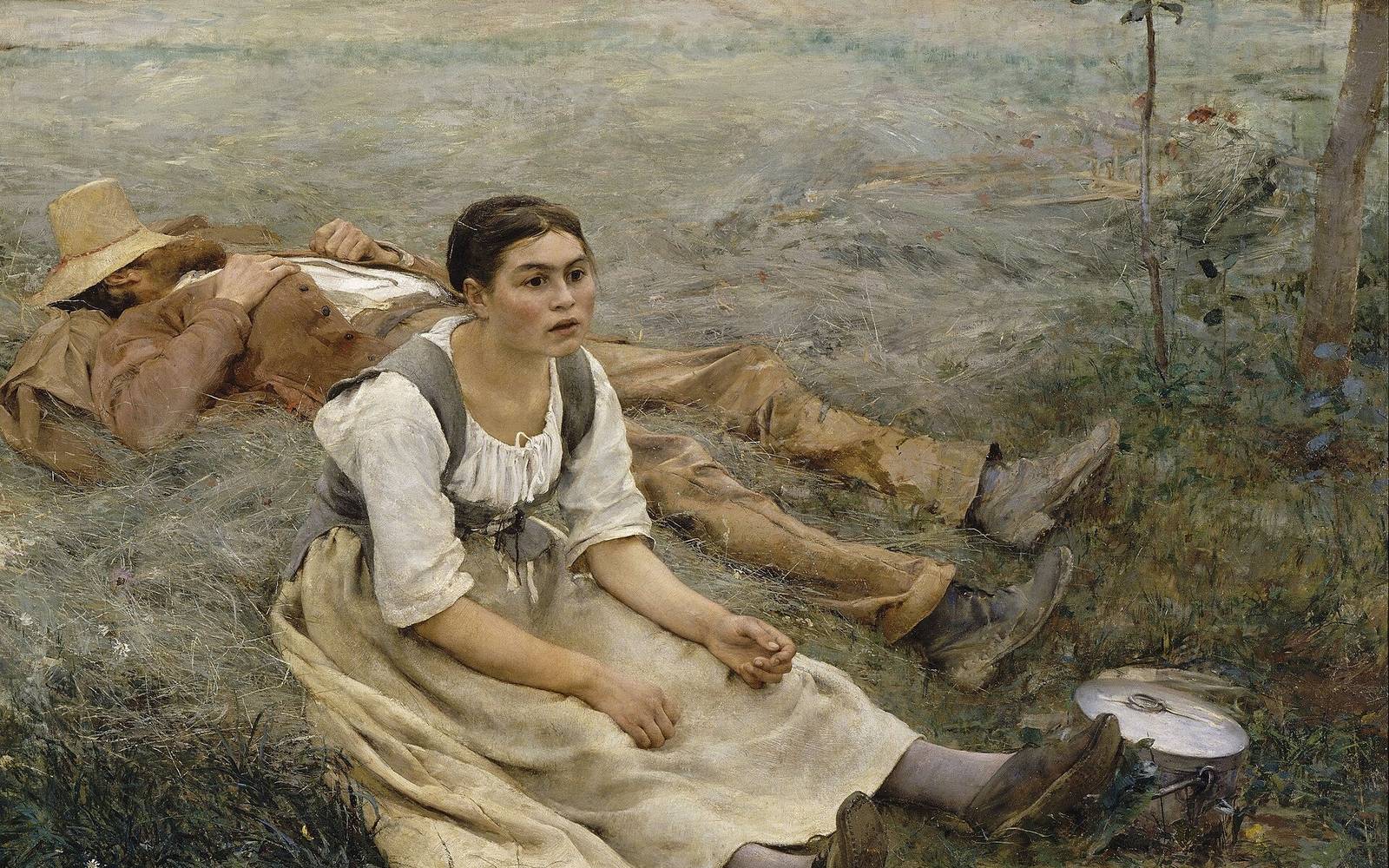
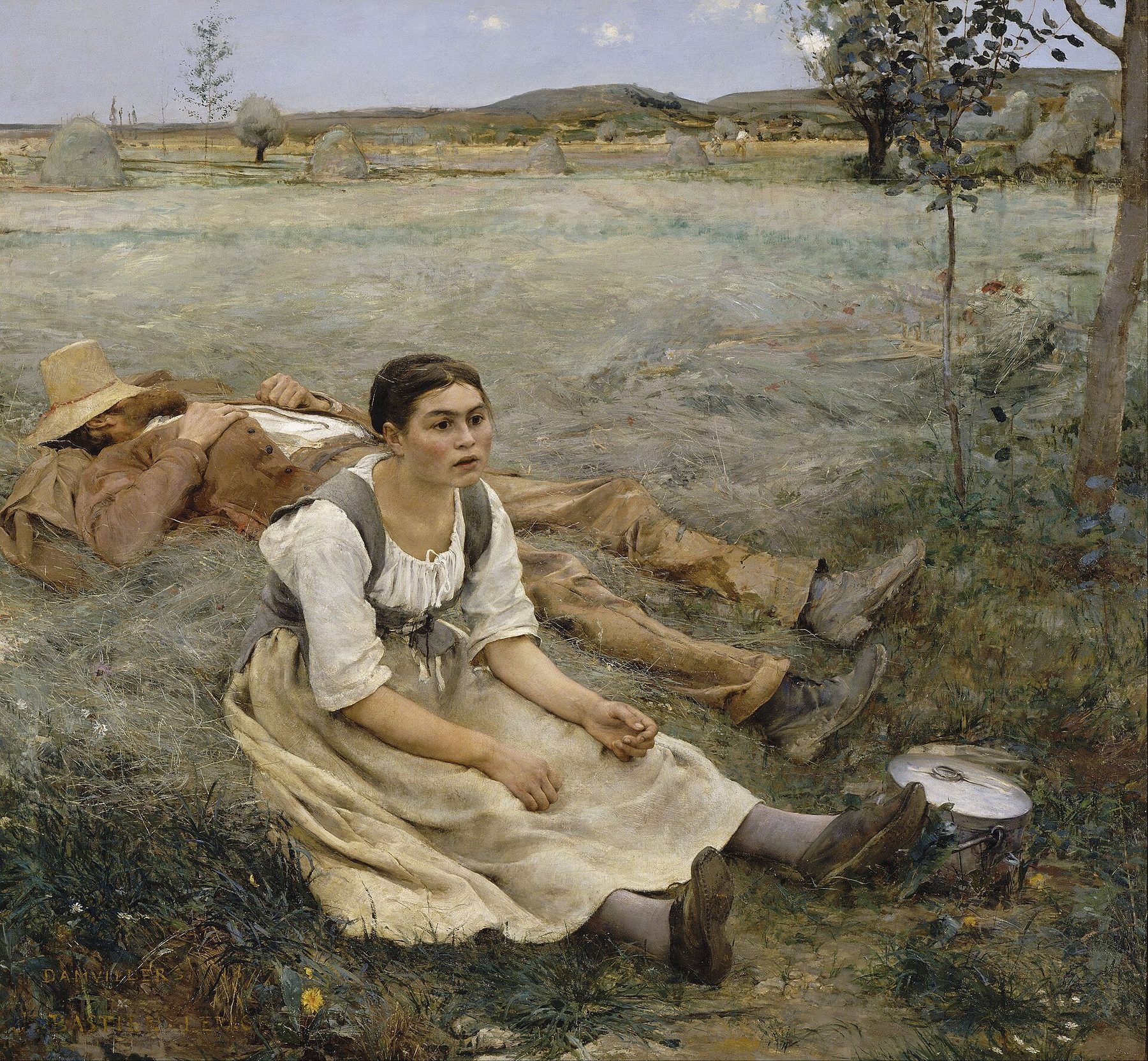
Image reference: Jules Bastien-Lepage's Haymaking, 1877.
At a Glance
- Core period1870s–1890s, with Realist foundations and twentieth-century afterlives
- Principal centresParis and the French Salon, with major networks across northern, eastern and southern Europe
- Known forobserved modern life, rural labour, social subjects, high horizons and mixed finish
- Key figuresJules Bastien-Lepage, Léon Lhermitte, Pascal Dagnan-Bouveret, Émile Friant, Marie Bashkirtseff and Joaquín Sorolla
- Major contextsRealism, Academic training, outdoor study, photography and literary Naturalism
- Social contextindustrialisation, rural change, urban poverty, public exhibition and the politics of representation
Contents
- Where it fits
- Realism to Naturalism
- Bastien-Lepage
- Four stages
- Artists to know
- International spread
- How truth was made
- Limits and tensions
- Essential works
- Artist directory
Where Naturalism fits
Léon Lhermitte
Principal activityJules Bastien-Lepage
Principal activityPascal Dagnan-Bouveret
Principal activityChristian Krohg
Principal activityAlbert Edelfelt
Principal activityMarie Bashkirtseff
Principal activityÉmile Friant
Principal activityJoaquín Sorolla
Principal activityNaturalism promised an art answerable to the world that people actually inhabited. Its painters looked at fields and fishing boats, workshops and streets, illness and childhood, regional customs and changing weather. They replaced mythological heroes with harvesters, schoolchildren and injured workers, often on canvases large enough to command the public attention once reserved for history painting. Their surfaces could be exact, their lighting immediate and their people unmistakably particular. Yet none of this meant that a Naturalist picture was an unedited slice of life.
Naturalism was a broad late-nineteenth-century current rather than a formally enrolled group. It gathered force in France during the 1870s, became internationally influential in the 1880s and continued in varied forms after 1900. Some practitioners trained in official academies and won Salon medals; others used its methods to challenge academic subject hierarchies. Some painted rural labour, while others turned to urban poverty, portraiture, religion, landscape or social crisis. The common ground was a claim to observed, contemporary or materially credible truth.[1] [2] [3]
That claim was constructed. Artists asked models to hold actions that look instantaneous, combined studies made in different places and used photographs to fix a pose. They reconciled outdoor light with months of studio labour. A sharply drawn figure might stand against freely brushed vegetation; an apparently accidental crop could sit inside a carefully balanced design. The modernity of Naturalism lies in this productive contradiction. It made artifice look like direct encounter without pretending that the artist had no point of view.
The word also needs boundaries. Art historians use “naturalism” generically for lifelike representation in many cultures and periods. Here it names a particular current shaped by nineteenth-century Realism, the public Salon, photography, outdoor study and literary Naturalism. It overlaps with Academic painting, Impressionism, national Realisms and Symbolism, but is not interchangeable with any of them. Naturalism is most useful when it identifies a historical argument about how truth should look and whom serious art should represent.
From Realism to Naturalism
Naturalism grew from earlier challenges to idealised art. Painters had made oil studies outdoors long before the 1870s. From the late eighteenth century, European artists carried portable materials into forests, mountains and ruins to record shifting light, cloud and atmosphere. These studies were usually part of training or preparation rather than finished public pictures. The practice established that direct observation could generate knowledge, but Naturalism did not invent it.[47] [48]
French Realism supplied a more immediate social foundation. Gustave Courbet rejected the hierarchy that ranked myth and history above ordinary life. His scale, dense material painting and insistence on contemporary subjects made the present difficult to dismiss. Jean-François Millet turned sowers, gleaners and shepherds into monumental figures, though his simplified forms and biblical echoes were never neutral reportage. Rosa Bonheur brought rigorous animal observation, labour and rural enterprise into a highly successful official career. Barbizon landscape and Jules Breton's dignified peasants offered further ways to return painting to local ground.[12] [14] [15] [49]
The later Naturalists inherited these examples without simply extending them. Courbet's confrontational materiality, Millet's grave synthesis, Bonheur's animal expertise and Breton's harmonised rural rituals represented different truths. By the 1870s, photography had changed expectations of pose and detail, Impressionism had made light and visible touch urgent, and a new generation sought modern subjects without surrendering academic drawing or the Salon's public scale. Naturalism emerged within that crowded field.
Émile Zola gave the term intellectual force, but he did not issue a binding programme for painters. In literature, he described the novel as a form of observation and experiment. Characters were to be studied through the pressures of heredity and environment, and disadvantaged lives could become evidence about the social whole. French literary Naturalism spread across Europe and the Americas, reinforcing an idea that modern culture should investigate what polite art excluded.[5] [6]
Zola's art criticism was less mechanical than the word “experiment” suggests. He repeatedly insisted on observed nature, yet also valued temperament: reality had to pass through an individual maker. He defended Manet and contemporary life, rejected false academic harmony and welcomed the collapse of old genre hierarchies. His allegiances changed. By 1879–80 he criticised Impressionist colour and pictures he considered unfinished, while still finding no painter who fully embodied the Naturalist genius he expected. Zola is best understood as a powerful, inconsistent participant in the debate, not an examiner deciding who qualified.[4]
The movement's institutional position was equally complex. Naturalist painters could oppose idealism while exhibiting at the official Salon, receiving medals and selling to the state. The Musée d'Orsay describes the current as closely aligned with a Third Republic eager to represent technical and social change. This made Naturalism legible and public, but also helped turn images of labour and poverty into an official style. A subject's seriousness did not automatically make its politics radical.[1] [16]
Bastien-Lepage and a new synthesis
Jules Bastien-Lepage became Naturalism's most portable model. Born at Damvillers in Lorraine, he trained in Alexandre Cabanel's studio and twice failed to win the Prix de Rome. That academic formation remained important: he could construct ambitious canvases and render a figure with controlled precision. He then learned from Realist precedent, modern brushwork, photography and the light palette associated with newer painting. Zola called him a descendant of Courbet and Millet, but the result was neither old Realism nor diluted Impressionism.[7]
His breakthrough was Haymaking, painted in 1877 and shown at the Salon of 1878. A young woman sits close to the lower edge, her arms heavy and her gaze unfocused. A male harvester lies behind her, asleep or overcome by fatigue. The horizon is pushed unusually high, so cut grass spreads upward like a pale woven surface. Distant stacks, trees and workers do not open a conventional deep vista; they press the field toward the picture plane. The woman's sharply established body and face hold against looser, flickering vegetation.[8]
Nothing dramatic happens, and that is the source of the work's pressure. Labour appears through its aftermath in muscle, posture, heat and blank attention. The young woman is not a picturesque emblem of healthy country life. She has momentarily ceased to perform, leaving the viewer before an exhaustion that cannot be converted easily into anecdote. The painting was inspired in part by a poem, but its physical and psychological severity exceeds that literary prompt. Zola treated it as a masterpiece of Naturalism in painting.[8]
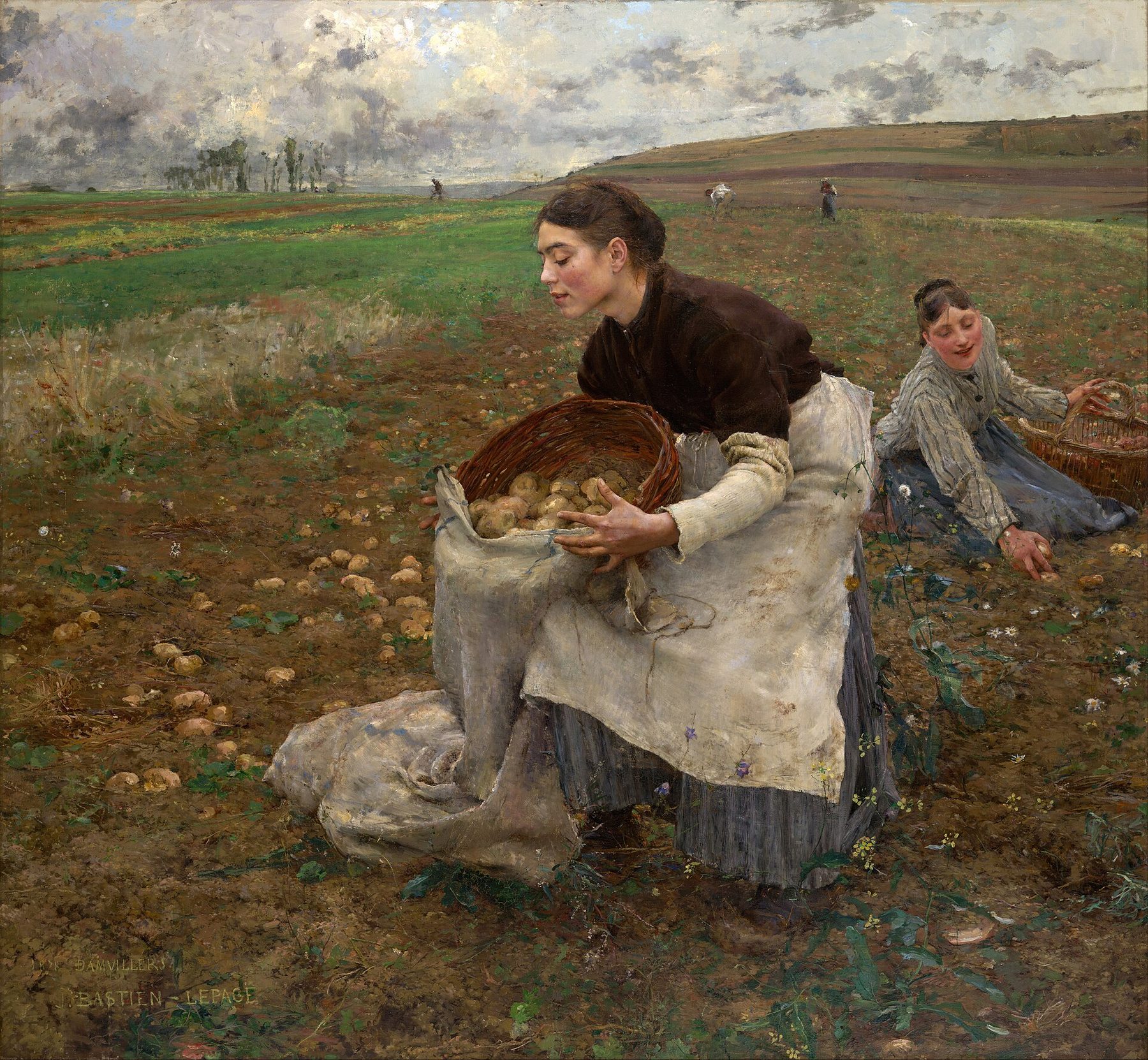
October, also known as The Potato Gatherers, followed in 1878 and appeared at the Salon the next year. It was painted around Damvillers and again puts women into a bleak field. One tips potatoes from a basket; another works farther back. Bastien-Lepage's cousin Marie-Adèle Robert served as the foreground model, one of several major works for which she posed. The leading body is abruptly close, while the field rises toward a remote strip of settlement and sky. The movement seems caught in passing, yet the relationship among basket, bent figure, sacks and furrows is highly organised.[9] [11]
This picture gives rural labour dignity and acknowledges its strain, but it is more consoling than Haymaking. Its affinities with Millet, controlled finish and moral seriousness made it palatable to Salon viewers. Success brought Bastien-Lepage the Legion of Honour. The painting's importance is not reduced by that reception; instead, the reception reveals how a formally unusual picture could renew official rural genre without openly threatening its audience.[9] [11]
The formula was influential because it joined apparent opposites. Naturalists could use clear drawing without returning to classical ideal bodies. They could adopt pale outdoor light without presenting the visibly rapid facture of an Impressionist exhibition. They could crop figures and compress depth while retaining a coherent narrative. High horizons, close foreground bodies, subdued local colour and selective finish became recognisable devices across Europe. They did not guarantee truth, but they made the experience of looking newly urgent.[11] [27]
Bastien-Lepage's rapid fame depended on circulation. Paintings travelled to exhibitions in Paris and London; critics and artists discussed them in Glasgow and Scandinavia; engravings and art magazines reached viewers who never saw the originals. His death in 1884 at thirty-six froze a short career into a compelling model of unrealised promise. Followers appeared quickly, but the best adapted his methods to different climates, labour systems and cultural arguments rather than merely repeating Lorraine peasants.[7] [11]
Naturalist artists to know
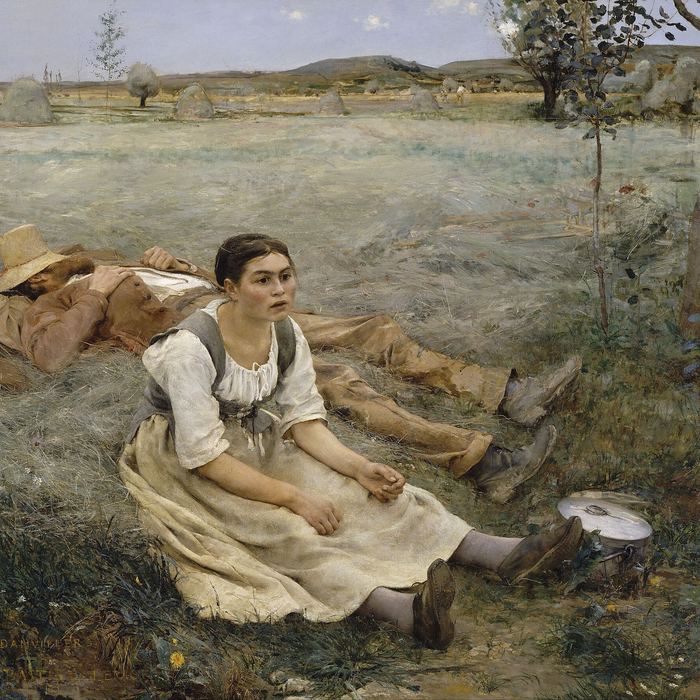
Jules Bastien-Lepage
Bastien-Lepage fused Salon-scale ambition, outdoor observation and exact local detail into the movement's most influential synthesis.
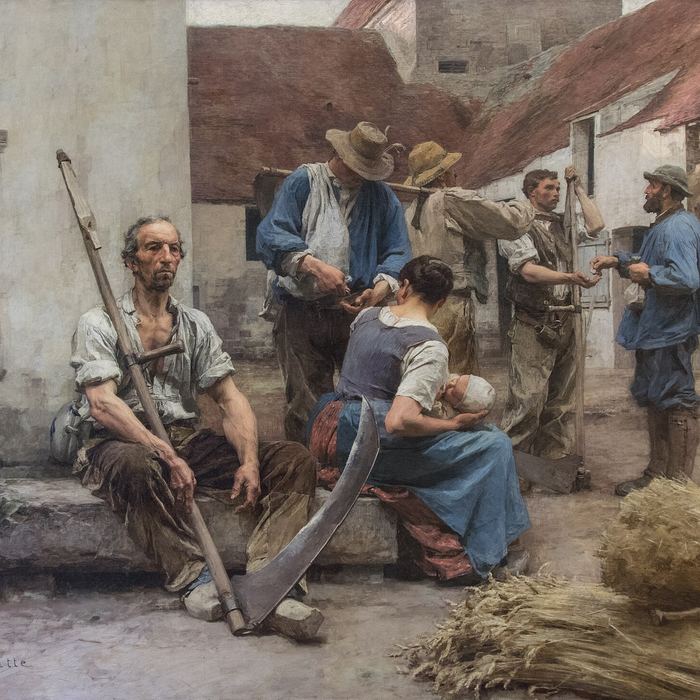
Léon Lhermitte
Lhermitte gave agricultural work and village exchange the gravity of large public painting while retaining close social observation.
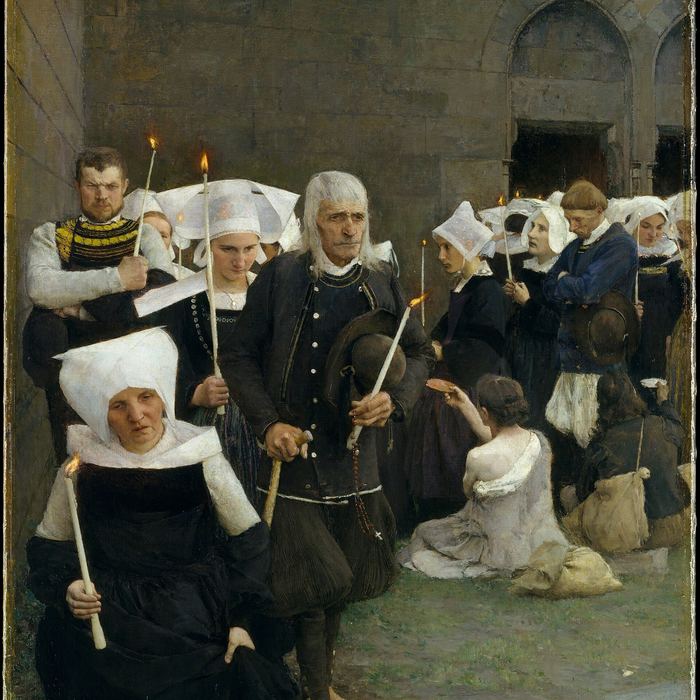
Pascal Dagnan-Bouveret
Dagnan-Bouveret built convincing scenes from travel, studies, photographs and studio rehearsal rather than simple spontaneous transcription.
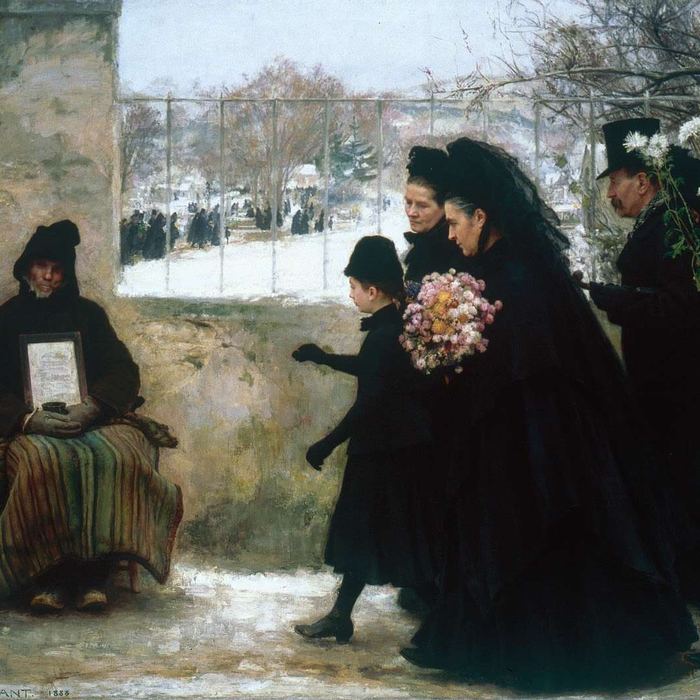
Émile Friant
Friant combined immaculate surfaces with cropped spaces, held gestures and unsettling encounters drawn from contemporary life.
Marie Bashkirtseff
Bashkirtseff made ambitious public pictures of Parisian streets while her diary records the institutional barriers facing women artists.
Joaquín Sorolla
Sorolla's early social paintings unite Naturalist seriousness with the vigorous handling and brilliant light that later defined his art.
Joan of Arc: when vision enters the garden
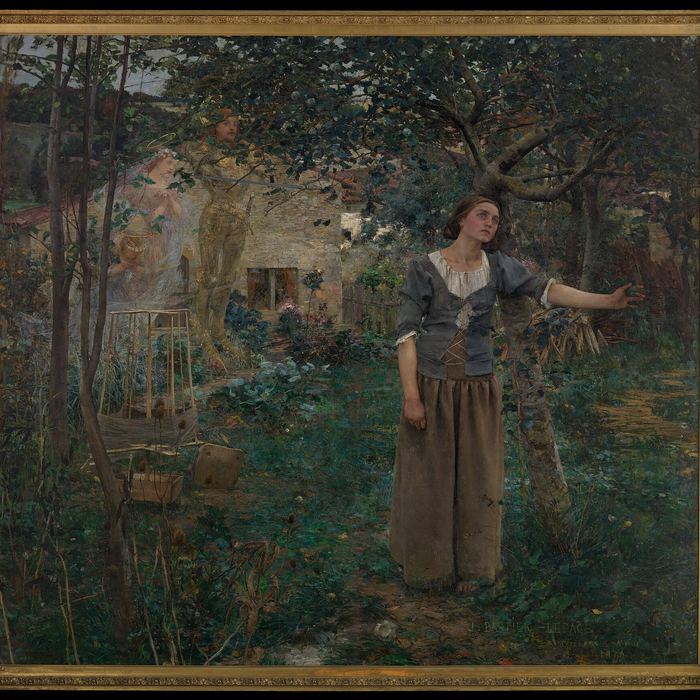
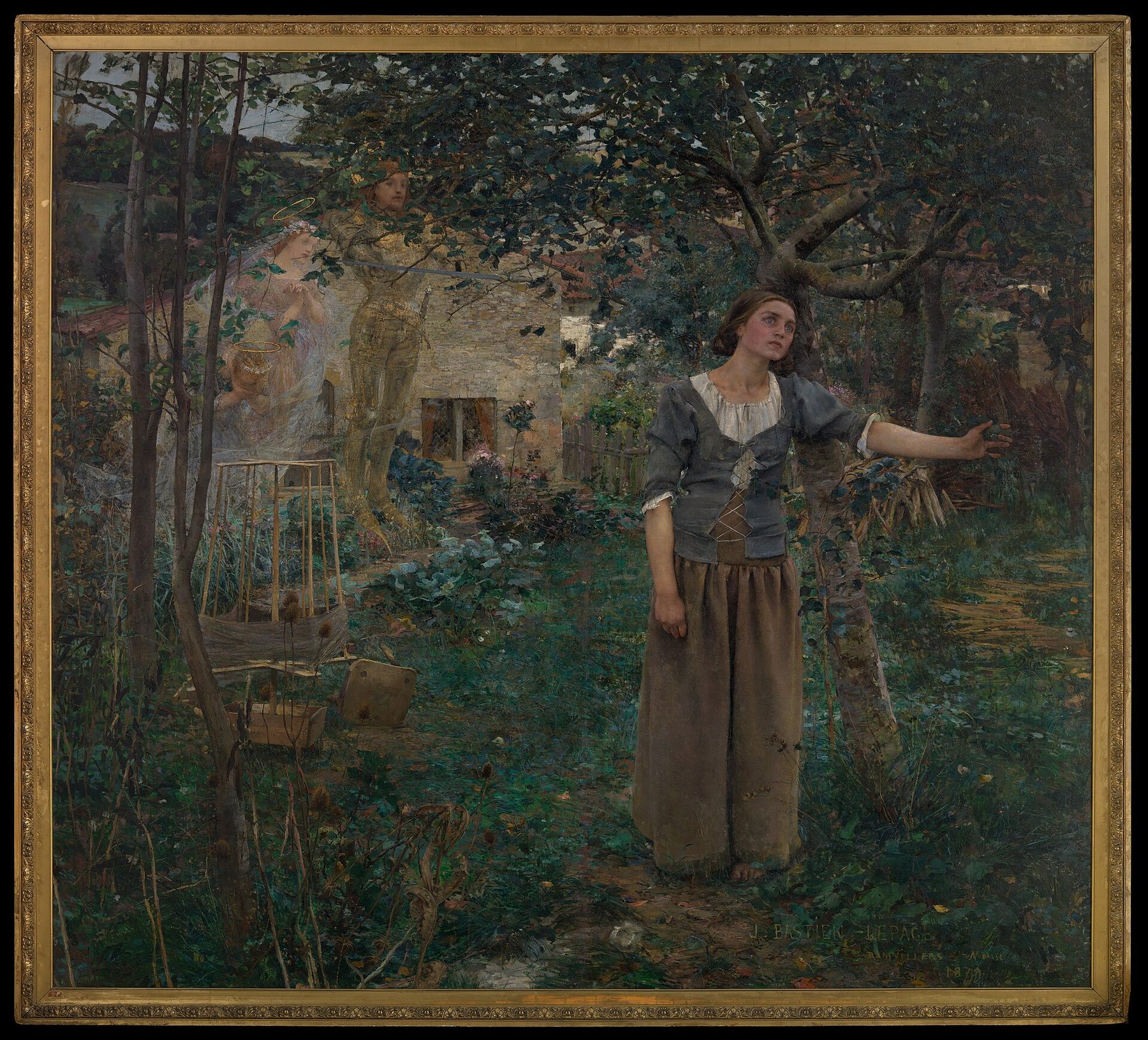
Joan of Arc of 1879 tests the movement's boundaries. Bastien-Lepage represented the moment the young Joan receives her supernatural call. The setting is not an invented medieval stage but the densely observed garden of his family home. Leaves, branches, stool, wall and household objects accumulate with almost oppressive specificity. Joan stretches forward at the right, her body taut and eyes fixed on something beyond ordinary sight. Saints appear as pale, partly transparent presences among the foliage.[10]
Critics objected that supernatural figures contradicted the painting's Naturalism. The friction is more revealing than a seamless solution would have been. Exact environment does not cancel vision; it makes Joan's departure from shared reality more disturbing. A familiar place becomes psychologically unstable. The picture also had contemporary national force. After the Franco-Prussian War and France's loss of Alsace-Lorraine, the heroine born in that region became an urgent symbol, and Bastien-Lepage's own Lorraine identity intensified the association.[10]
The painting shows why Naturalism cannot be limited to secular documentary subjects. Its claim might concern the credibility of a body, garden or mental event rather than the literal existence of everything represented. The spectral saints expose the very convention other pictures hide: every painted reality combines different kinds of evidence.
Follow Naturalism through four stages
–1860s
Realist foundations and the claim of ordinary life
Courbet, Millet and Bonheur establish the dignity of contemporary labour, landscape and animal life while critics debate truth to nature and social fact.
A new Salon-scale synthesis
Bastien-Lepage joins exact rural observation, high horizons, outdoor light and Academic finish in works that rapidly become international reference points.
Naturalism travels through Europe
Lhermitte, Dagnan-Bouveret, Friant, Bashkirtseff, Edelfelt and Krohg adapt the method to harvest, ritual, city streets, sickness and local national subjects.
–1900s
Social painting, brighter light and regional afterlives
The Naturalist project continues in Spanish social painting, northern schools and artists' colonies even as Impressionism, Symbolism and modernist narratives reshape its reputation.
Rural truth after Bastien-Lepage
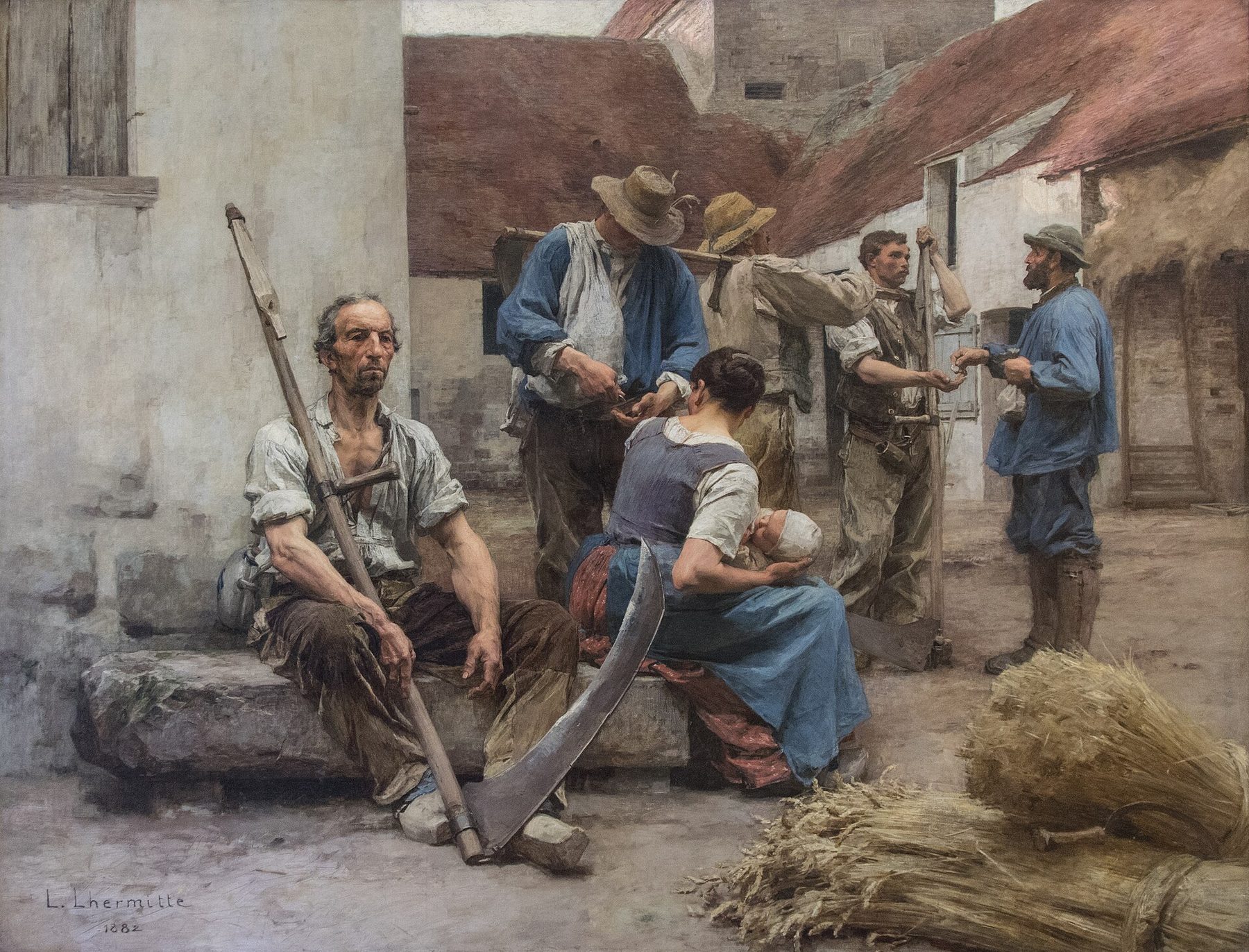
Léon Lhermitte's The Pay of the Harvesters of 1882 shifts attention from exertion to exchange. Workers gather as a landowner or paymaster distributes money. Resting bodies, tools and counted wages make the economic structure of harvesting visible. The composition gives each figure weight and lets fatigue accumulate across the group. Yet the Musée d'Orsay cautions against reading the picture as a manifesto against agricultural exploitation. Lhermitte records a relation of dependence while preserving order, dignity and pictorial harmony.[12] [13]
That ambiguity is typical. Naturalist art made labour visible to an audience often protected from it. A harvester's cracked hand or bent back could create recognition; monumental scale could confer seriousness. The same beauty could make hardship consumable, reassuring viewers that honest work produced stable character. National Galleries of Scotland research on children in art describes a “censored” realism in which noble rural workers were safer than factories, mines or revolt. The politics reside in what a painting shows, how it stages conflict and what it leaves beyond the frame.[50]
Alfred Roll's Manda Lamétrie, fermière of 1887 offers another approach. Its title retains the model's name and occupation rather than converting her into “Peasant Girl.” Roll placed the young Norman farm worker on a monumental scale and represented her within everyday surroundings. Naming does not erase the unequal relation between professional artist and labouring sitter, but it resists complete typification. The individual enters the record beside her work.[22]
Jules Breton belongs to an earlier, more idealising rural tradition. His gleaners and religious processions gave ordinary villagers solemn rhythm and won state purchases. The figures are observed but harmonised with landscape and communal ritual; their world is rarely fractured by open conflict. Breton's work matters to Naturalism because later painters could inherit its successful scale and dignity while claiming greater accident, exhaustion or specificity.[12] [49]
Dagnan-Bouveret and the work behind authenticity
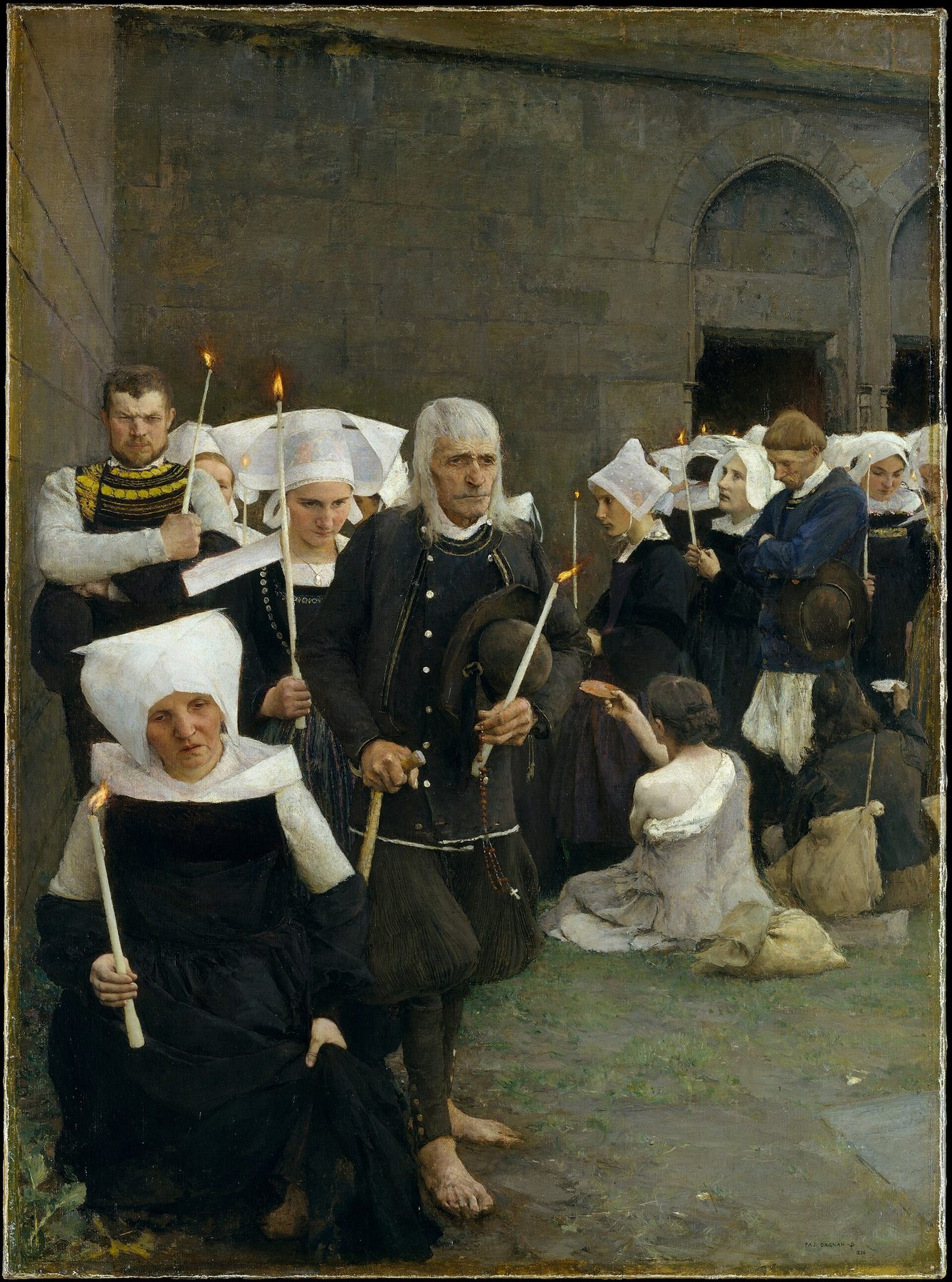
Pascal Dagnan-Bouveret demonstrates how much labour could be required to make an image appear directly observed. The Pardon in Brittany, shown at the 1887 Salon and the 1889 Paris Exposition, depicts a regional Catholic procession. Faces, costumes, varied light and an apparently unforced grouping promise ethnographic immediacy. The cropped arrangement resists the centred symmetry of traditional academic ceremony, while meticulous finish makes every participant seem individually encountered.[16]
The surviving preparation dismantles any fantasy that Dagnan-Bouveret simply set up an easel before a passing event. He used drawings, oil studies and photographs. At least some figures were posed by people outside the Breton community represented, and research indicates that neither the painting nor all its studies were made in Brittany. Costumes, bodies and observations from separate times and places were assembled into a compelling whole.[17] [18]
This does not make the result fraudulent. It identifies Naturalism's method. Photography could preserve a gesture, but the artist selected the model, arranged the costume, altered scale and integrated fragments. Painted exactitude was an effect of synthesis. The work's regional authority came partly from details that viewers were prepared to accept as evidence. Its construction asks a wider question: when does respect for local specificity become an external, metropolitan staging of “authentic” people?
Dagnan-Bouveret continued beyond this rural ritual. Works such as Dans la forêt occupied later Salon culture and demonstrate a career whose subjects and spiritual interests changed. A movement page should not imprison any artist at the moment when one painting best fits its definition.[19]
Friant, observation and modern intimacy
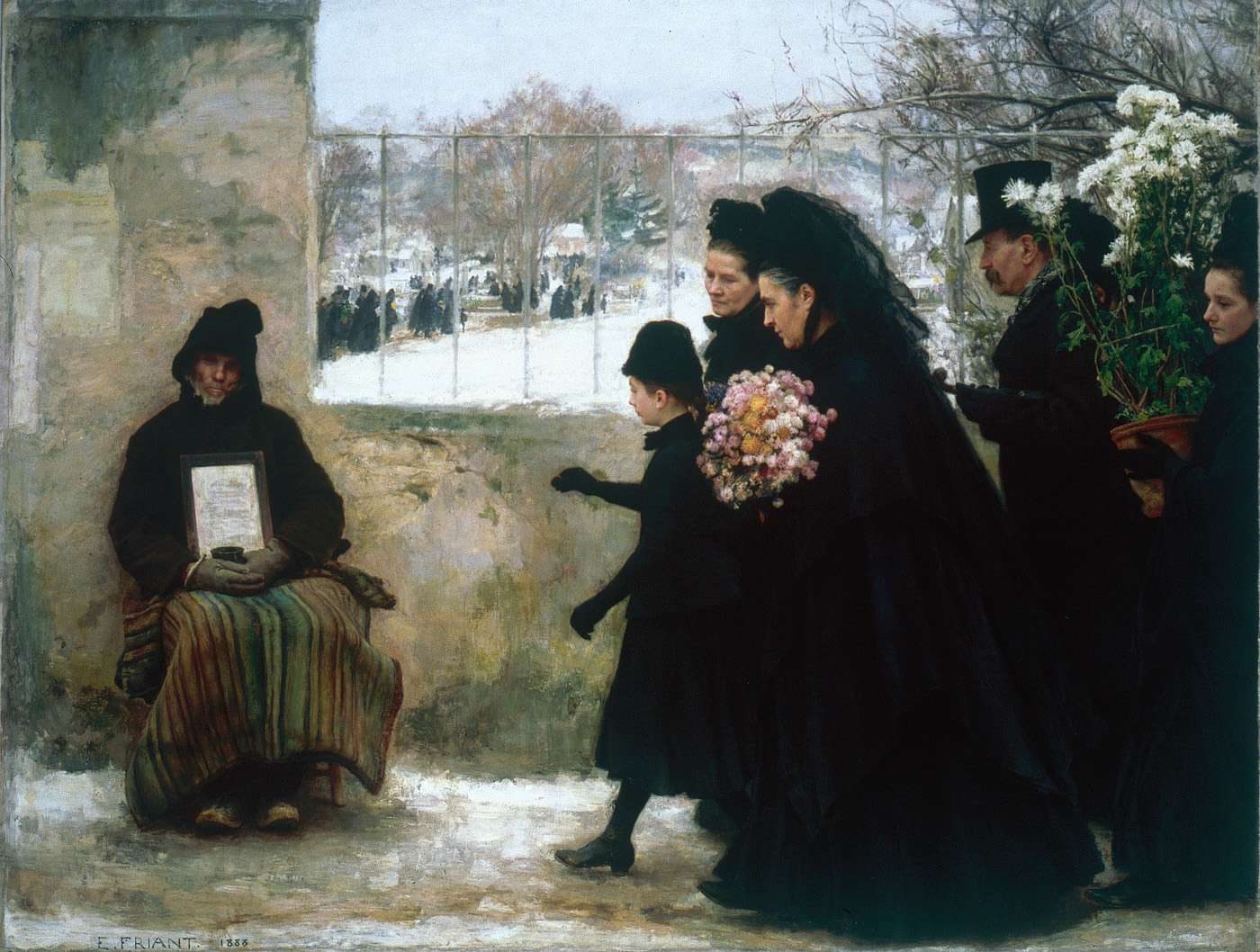
Émile Friant, another artist rooted in Lorraine, absorbed Bastien-Lepage's example but developed a distinctive precision. His figures often have near-photographic clarity, strong contours and persuasive bodily presence, while backgrounds open into freer air and light. This combination appears in urban encounters, portraits and scenes of mourning as well as rural life. The Lovers isolates an intimate exchange above a river; All Saints' Day organises public grief and family movement around a cemetery.[20] [21]
Friant's long official career complicates the story that Naturalism simply ended when modern art began. He won medals, taught and entered the Académie des Beaux-Arts, yet his observational intensity does not fit comfortably into the dismissive category of “pompier” painting. A Nancy retrospective posed the question “the last Naturalist?” rather than answering it, acknowledging both continuity and the inadequacy of a single label for work that extended into the twentieth century.[20]
Fernand Cormon reveals a different expansion. In prehistoric subjects he consulted the contemporary sciences, Darwinian discussion and archaeological evidence in an attempt to make remote human life objectively plausible. The method resembled Zola's claim that modern art should investigate conditions and causes, even though the scene could not be directly witnessed. A Naturalist ambition could therefore animate reconstruction as well as record.[45]
Marie Bashkirtseff and the street
Naturalist training and recognition were shaped by gender. Women could exhibit at the Salon and build professional careers, but the École des Beaux-Arts excluded them during most of this period. Private academies offered alternatives at additional cost and with unequal access to life study. Marie Bashkirtseff enrolled in the women's studio of the Académie Julian and committed herself to the current associated with Bastien-Lepage. Her experience shows both the opportunities of the Paris system and the barriers it normalised.[24] [25]
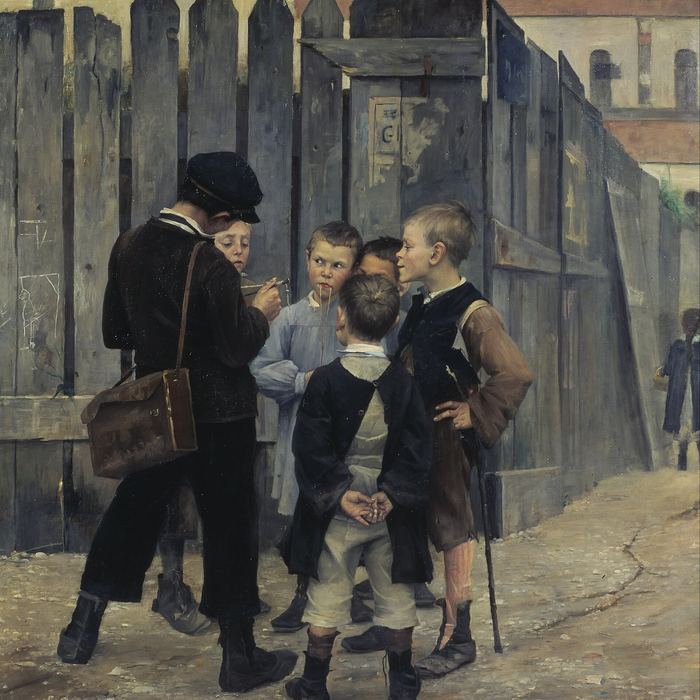
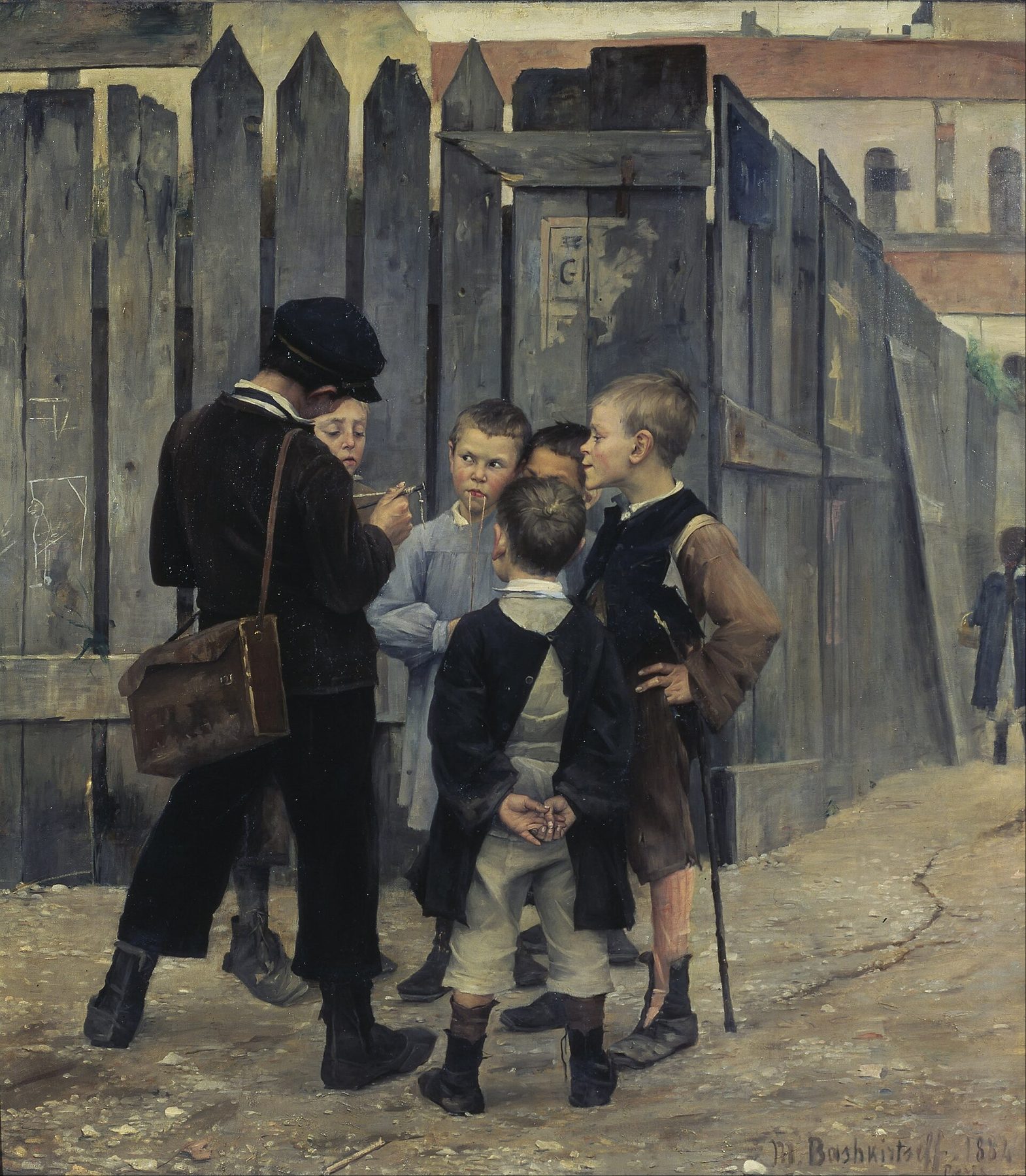
Bashkirtseff's Un meeting of 1884 moves the Naturalist figure group into a working-class Paris street. Six boys cluster around a toy beside a battered fence marked by graffiti and torn paper. Their worn clothes, varied ages and concentrated gestures are observed without turning them into a comic swarm. The artist lowers the implied viewpoint toward the children and grants their discussion the scale of public life.[23]
The title calls the gathering a political meeting, humorously enlarging childhood debate while recognising that these pupils are learning the behaviours of adult citizenship. Their school smocks connect the image to the Ferry laws establishing secular, free and compulsory education. At the right, a small girl faces away and leaves the male circle. Her exclusion can be read beside Bashkirtseff's own feminist commitments and professional frustration, though the painting should not be reduced to a single allegory.[23]
Born in a town in present-day Ukraine, then within the Russian Empire, Bashkirtseff travelled widely before settling in France. That geography matters: older labels often make her simply “Russian,” while her education, career and artistic network were Parisian. The work itself turns a French Naturalist language toward subjects its privileged maker did not share socially. Observation does not abolish distance between painter and model; it can make that distance available for scrutiny.
Naturalism travels north and east
Naturalism was one of the most mobile currents of the 1880s. Foreign artists filled Paris studios, Salons and rural colonies, then carried methods home through paintings, letters, teaching and reproductions. The Musée d'Orsay's transnational display places Bashkirtseff, Albert Edelfelt, Fanny Brate, Akseli Gallen-Kallela, Angelo Morbelli and Joaquín Sorolla within an interconnected European field rather than a French centre surrounded by derivative margins.[26]
Nationalmuseum in Stockholm describes Bastien-Lepage as the leading model for Nordic artists during the 1880s because he seemed to connect tradition and new art. His example did not dictate a uniform Nordic appearance. It offered a way to combine exact figure work, outdoor light, contemporary local subject and public exhibition. Northern painters adapted that structure to long summer evenings, cold interiors, coastlines, provincial economies and their own debates about national culture.[27]
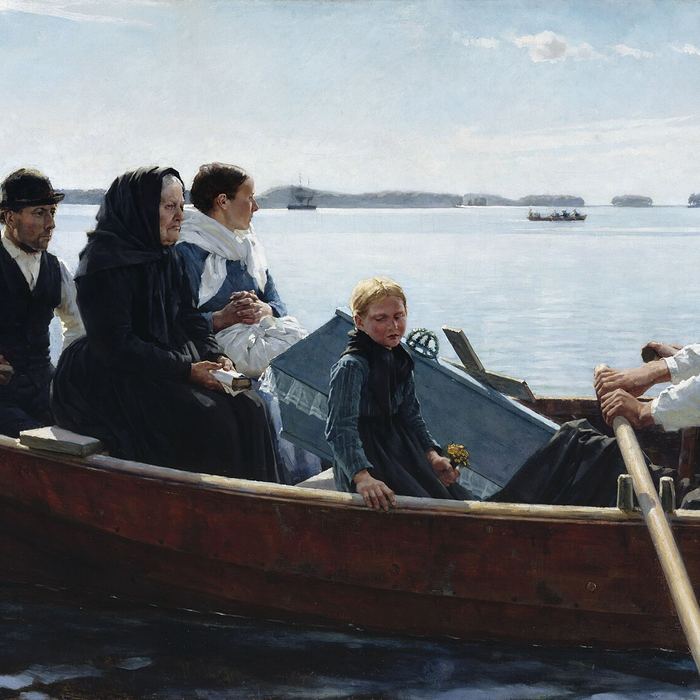
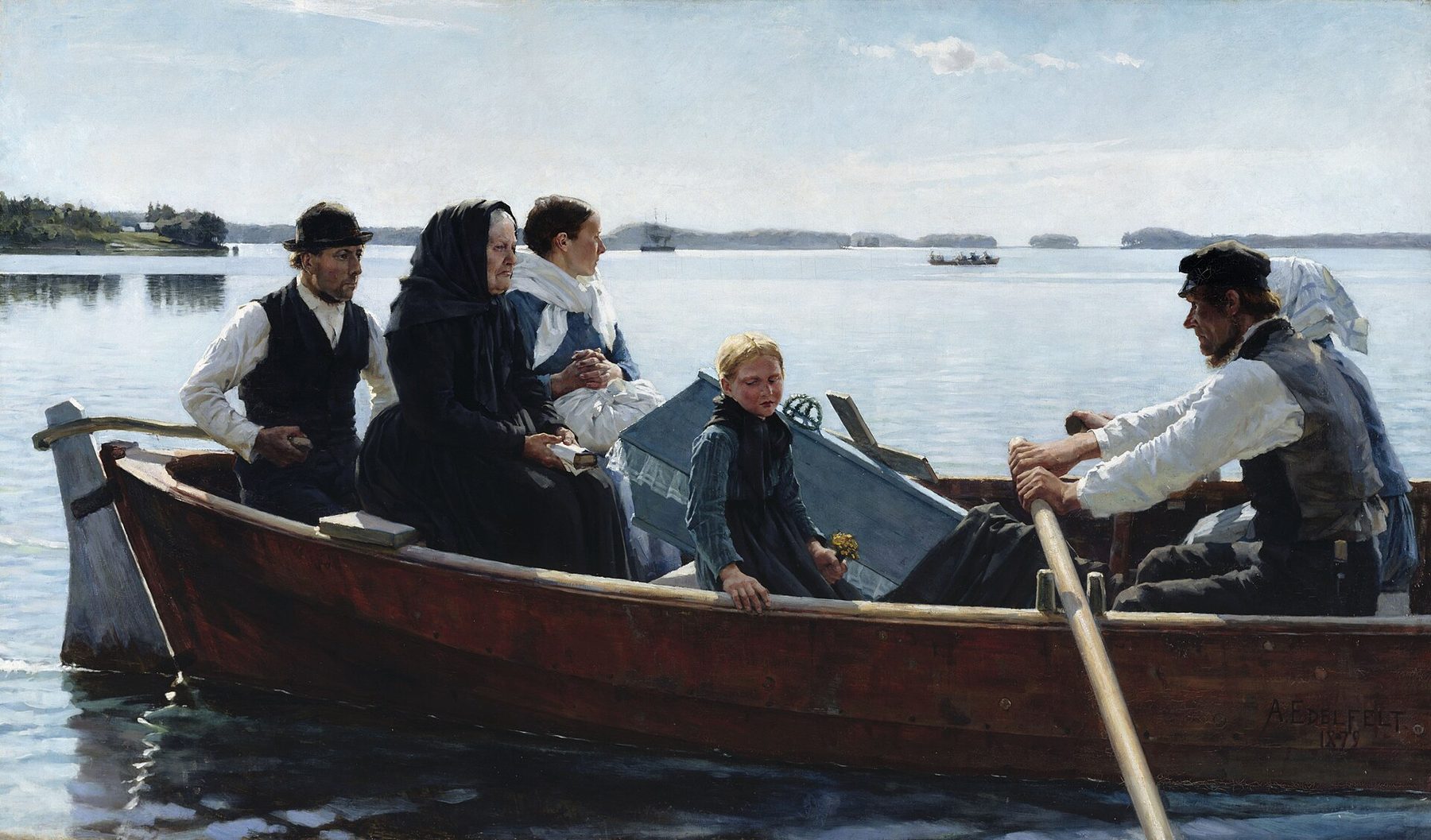
Albert Edelfelt met Bastien-Lepage in 1875 after training in Antwerp and Paris. His Finnish work joined academic command to clearer northern light and direct study. A Child's Funeral Procession brought a recognisably local journey onto the international Salon stage, while portraits such as Louis Pasteur demonstrated a different form of exact contemporaneity. Edelfelt's success shows that Naturalism could help an artist be at once Finnish, Parisian and internationally official.[28]
Christian Krohg approached local life with sharper social urgency. In Skagen, where many visiting artists pursued landscape and light, he concentrated on fishing families mending nets, cutting bread, sleeping and caring for the ill. In Kristiania he painted seamstresses and developed the story of Albertine, a woman forced into prostitution, across literature and image. Krohg's practice linked Naturalist observation to journalism and arguments about censorship, poverty and sexual double standards.[30]
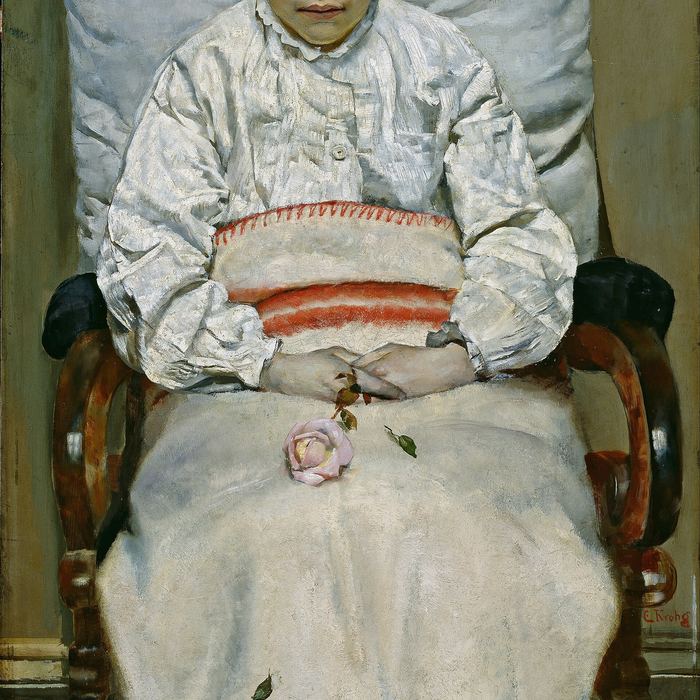
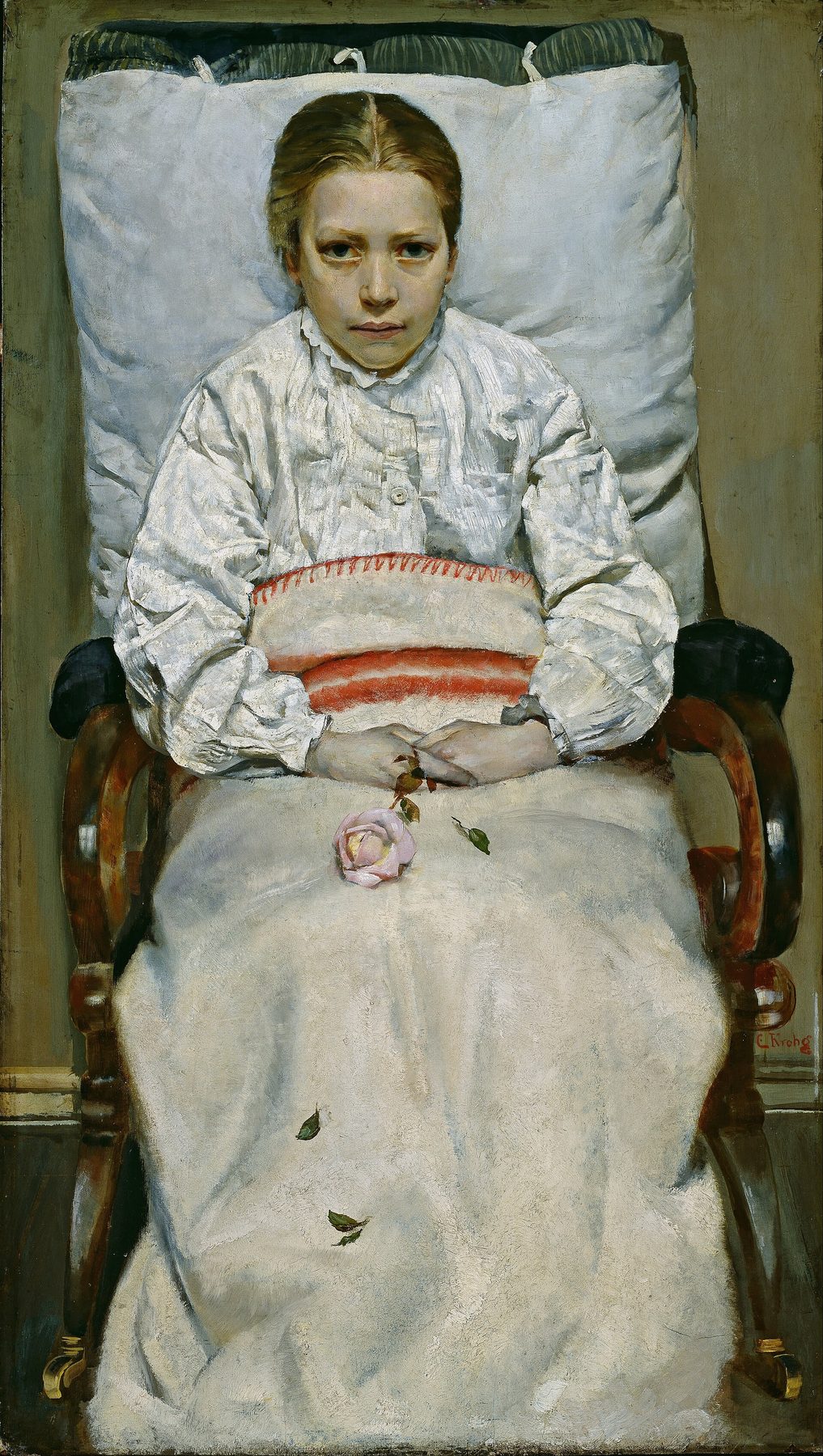
Sick Girl brings a young patient almost against the picture surface. Muted whites, browns and greys describe wood, linen, cushion and wool with exact differences of texture. A withered rose and the girl's fixed gaze make tuberculosis present without a crowded narrative. Contemporary critics found the subject morbid and badly chosen. That discomfort was a measure of its Naturalism: an interior associated with private care became a public encounter with vulnerability.[31]
L. A. Ring's Danish rural world is harsher and stranger than a simple celebration of country continuity. Roads, thresholds, labourers and villages register the passage between old patterns and modern life. Ring could work with Realist detail while allowing death, isolation and symbolic expectation into the scene. The National Gallery of Denmark now presents him as both Realist and Symbolist, a reminder that Naturalism often became the ground from which inward or metaphysical meanings developed.[29] [42]
Polish painting offers a comparable refusal of fixed categories. Józef Chełmoński chronicled village life, horses, weather and landscapes in Poland and Ukraine, exhibited in Paris and developed an observational realism freed from ideal patriotic formulas. In his later work, panoramic earth and sky, dawn, dusk and animal life become increasingly synthetic and contemplative. Precise description gives way selectively to tonal atmosphere without severing the artist's attachment to experienced nature.[43] [44]
These adaptations belong to a wider “Modern Breakthrough” in northern European culture. Literature, painting and public debate turned toward contemporary work, gender, belief, provincial life and the limits of inherited authority. Naturalism, Impressionism and Symbolism were not a neat sequence. They supplied different tools that could operate inside one career or even one image.[42]
Ilya Repin provides a useful comparison rather than another member to add automatically. Russian Realism and the Peredvizhniki developed through their own institutions, political arguments and exhibition networks. Repin's intensely observed figures and social subjects share concerns with Naturalism, but treating every later European Realist as a follower of Bastien-Lepage would erase those independent histories.
Portraits, animals and landscapes
The prominence of tired harvesters can make Naturalism appear synonymous with social-problem painting. Its commitment to observed presence was much wider. Bastien-Lepage built a substantial reputation as a portraitist. Friant's sitters occupy carefully differentiated interiors and outdoor settings. Edelfelt's Louis Pasteur is credible because scientific equipment, posture, concentration and the working room form a single environment, not because every surface has been given equal sharpness.[7] [20] [28]
Portrait Naturalism posed a different ethical problem from rural genre. A named, paying sitter arrived with social identity and some authority over public appearance, whereas a worker might be hired to represent a class. Exact likeness could affirm bourgeois professionalism, artistic celebrity or scientific achievement as readily as it could record poverty. This breadth helps explain the current's success: its language of unidealised specificity served very different patrons.
Animal painting and landscape likewise expanded observation beyond human narrative. Bonheur's knowledge of anatomy and work placed animals inside economies of farming, transport and trade. Chełmoński watched horses, birds, marshes and changing weather until human activity appeared as one rhythm among others. His later simplification demonstrates that fidelity does not require an inventory of every detail; a broad sky and a few tonal intervals can convey a place's physical pressure more effectively than literal enumeration.[14] [44]
Landscape also unsettles the boundary with Impressionism. Naturalists sought regional topography and atmosphere, while Impressionists made perception and changing light increasingly autonomous subjects. Many artists crossed the line repeatedly. Anders Zorn, for example, belongs to the international Nordic world of outdoor painting and virtuoso observation but cannot be confined to a stable Naturalist identity. His fluid handling and brilliant water effects show how direct study could lead away from the controlled figure-landscape synthesis associated with Bastien-Lepage.
Religious and symbolic meanings did not disappear either. Breton's processions, Dagnan-Bouveret's pardons and Ring's thresholds attach belief, ritual or mortality to exact environments. Naturalism opposed inherited ideal formulas more consistently than it opposed imagination. Its artists asked whether the unseen, remembered or feared could be made credible within a world of recognisable bodies and things.[19] [29] [49]
Scotland, Cornwall and the international colony
In Scotland, the Glasgow Boys formed no official Naturalist society. They were a loose generation disillusioned with academic history painting and attracted to contemporary rural subjects, outdoor work and French and Dutch Realism. Paintings moved through Glasgow dealers and exhibitions; artists studied in Paris or worked in colonies at Grez-sur-Loing and elsewhere. Bastien-Lepage's high horizons, close figures and unsentimental settings offered a decisive example.[32]
James Guthrie's A Hind's Daughter makes an ordinary rural child and field command attention without a historical anecdote. John Lavery, Edward Arthur Walton, William York Macgregor and colleagues developed different responses, and by the late 1880s the common ground was already shifting toward stronger colour, Japanese design, Whistlerian harmony and Impressionist handling. Naturalism helped Scottish painting become modern, but did not define its endpoint.[32]
Women participated in this transfer despite the masculine group name. Flora Macdonald Reid travelled independently in France and Belgium and made contemporary labour a major subject. Fieldworkers gives a sun-browned worker unusual scale against a high horizon. Light models his back, neck and hands, while the painting's location complicates national readings: male potato harvesters were more typical in northern France, whereas comparable itinerant work in Scotland was frequently done by women. Reid's picture is both an image of labour and evidence about how labour subjects travelled.[33]
Farther south, Newlyn became a British centre for rural and fishing Naturalism. Artists found working models, changing coastal light and a community imagined as distant from industrial modernity. Fred Hall's Newlyn pictures absorbed Bastien-Lepage's social themes and square touch. The colony enabled sustained observation, but its urban-trained visitors also selected which parts of village life would signify authenticity to metropolitan exhibitions.[34]
Naturalism's route to Australia demonstrates the power of exhibitions and reproduction. Tom Roberts saw Bastien-Lepage at the Royal Academy while studying in London and carried lessons of tonal realism and rural subject into his outdoor work after returning to Melbourne. Arthur Streeton knew the French example through illustrated art magazines; the detailed foreground of Golden Summer, Eaglemont coexists with far freer paint and an Australian light that cannot be derived from Lorraine.[35] [36]
These artists are usually discussed within Australian Impressionism because their practice changed in a different environment. That is precisely why influence should be understood as adaptation. A high horizon or tonal field could migrate, while colonial land use, climate and local ideas of national identity gave it new implications.
Spain: social painting and light
Spanish Naturalism became especially visible through the great social canvases of the 1890s. As history painting lost authority, artists treated factories, agriculture, illness, poverty, prostitution, accidents and labour conflict on the scale once given to national legend. The Prado describes this as a turn toward objectivity and often criticism. Photography and, after 1895, cinema addressed many of the same subjects with competing claims to truth.[37] [38]
This social painting flourished inside official culture. Works won medals at national and universal exhibitions and entered state collections. Luis Jiménez Aranda and Sorolla received high international awards. Large format and precise description helped new subjects assume public seriousness, but institutional triumph again raises the Naturalist question: did a picture expose inequality, dignify endurance or convert crisis into an impressive state-owned spectacle?[38]
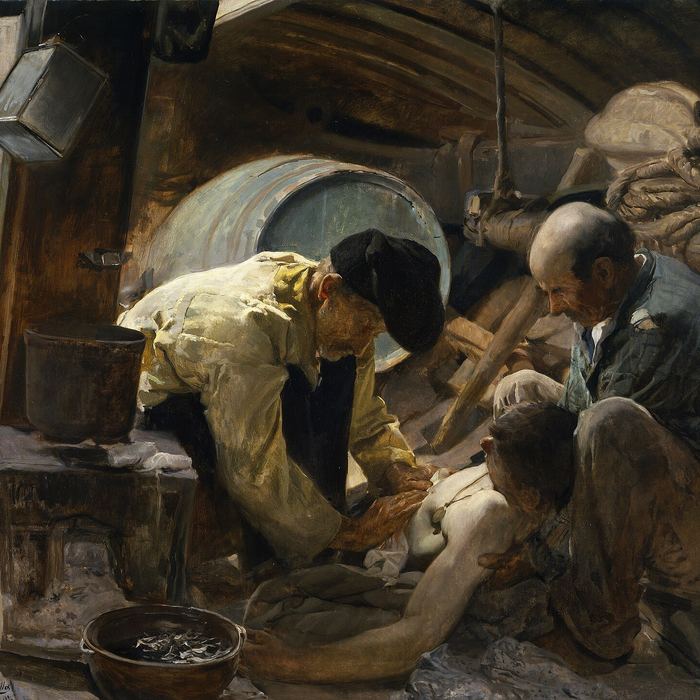
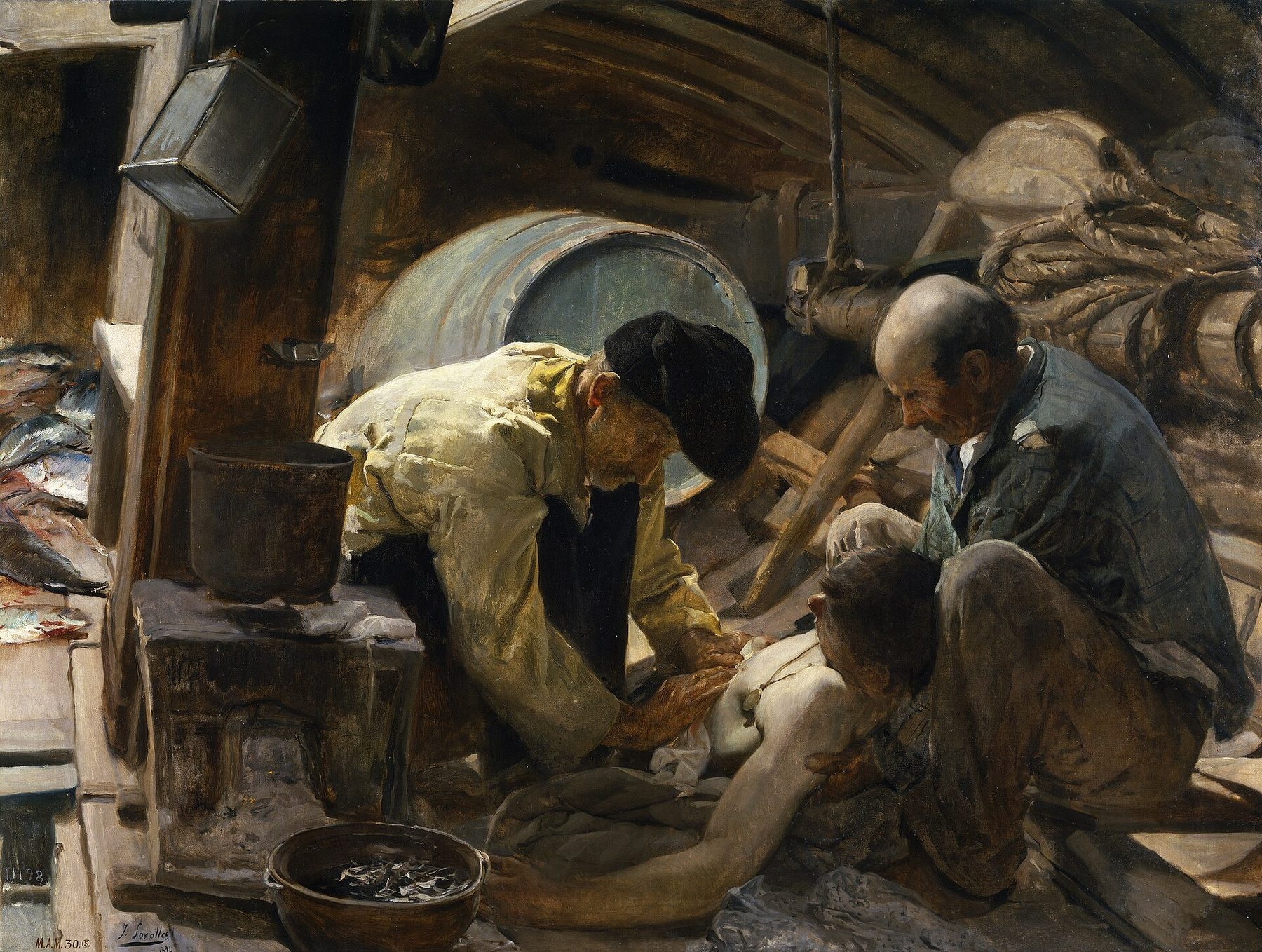
Joaquín Sorolla shows how rapidly one career could pass through the field. His early social paintings connect directly to French Naturalism. And They Still Say Fish Is Expensive! represents two older fishermen tending an injured youth inside a boat. Nets, timber, wet surfaces, utensils and the boy's vulnerable body are described with firm precision. The triangular group carries the gravity of a secular pietà, translating dangerous labour into a form associated with sacred compassion.[40]
The picture is carefully composed, not an incident copied without mediation. Its compressed interior brings assistance and bodily risk close, while a glimpse of the catch makes the economic cause of danger visible. Sorolla's later handling became faster and more open as beaches, moving water, landscape and portraiture occupied him. He retained a Naturalist concern with atmosphere and direct looking while turning light itself into an active subject.[39] [40]
Antoni Fabrés developed another socially critical Naturalism. After an internationally successful career that moved through Rome, Barcelona, Paris and Mexico City, he addressed poverty and madness with acidic precision. His mobility resists any assumption that national schools developed in isolation. It also shows how an artist could make conservative Orientalist pictures for one market and confront contemporary deprivation elsewhere in the same body of work.[41]
Spanish collections further complicate the centre-periphery model. Naturalist social painting appeared beside work by artists born in the Philippines, then under Spanish colonial rule, whose landscapes and “types” were displayed in Madrid. Observation of local difference could support cultural recognition, imperial classification or both. A responsible history asks who had power to name a population as a type.[37]
How Naturalist truth was made
Naturalism often looks transparent because its labour has been hidden. Several recurring processes help recover it.
The word “objective” should therefore be used with care. These painters did not possess a view from nowhere, and their pictures were never equivalent to scientific measurements. What they offered was a culturally persuasive discipline of attention: bodies should obey weight, places should retain local difference and contemporary evidence should resist ideal correction. Viewers could dispute the selection while recognising the seriousness of the look. Naturalist truth was a relationship among observed fact, pictorial judgement and public belief.
Direct observation supplied local weather, tools, clothes, bodily habits and specific environments. Bastien-Lepage's Damvillers, Krohg's Skagen and Sorolla's coast are not interchangeable scenery. Yet looking always involved selection. Artists chose the moment, the person and the evidence that would stand for a community.
Outdoor study registered light and colour, but a large canvas was rarely completed as quickly as its apparent instant suggests. The long European tradition of plein-air oil sketching had already taught artists to collect atmospheric information. Naturalists made that information compatible with a more finished public picture.[47] [48]
Posing and preparation stabilised bodies. Marie-Adèle Robert's recurring presence in Bastien-Lepage's work and Dagnan-Bouveret's photographed models show that a painting's rural truth could depend on repeated professional or family collaboration. The model's labour was essential even when the title reduced the person to a type.[11] [17]
Photography provided exact reference, arrested movement and unfamiliar crops. Dagnan-Bouveret assembled painted and photographed studies; American painter Thomas Eakins used the camera to extend anatomical and motion research. Photographs were themselves staged and framed. The camera altered the materials of invention without abolishing invention.[16] [17] [46]
Mixed handling reconciled precision with atmosphere. A face or hand could be tightly drawn while sky and foliage dissolved into lighter touches. This was not necessarily inconsistency. It directed attention and let durable form coexist with the sensation of open air. Bastien-Lepage and Friant used the contrast differently, and later followers loosened it further.[11] [20]
Scale, horizon and cropping transformed genre. A worker near life size could confront a viewer accustomed to meeting rulers or saints on a large canvas. High horizons reduced reassuring depth and made ground press forward. Cropped tools or bodies implied a world continuing beyond the frame, even when every edge had been planned.
Exhibition and reproduction completed the claim. Salon placement, catalogue title, medal, state purchase, press review and engraved copy determined which reality became publicly authoritative. Naturalism was not only a way of applying paint; it was a system for making selected observations circulate as social truth.[16] [18]
What Naturalism revealed—and concealed
Naturalist painters widened the visible world of serious art. Fatigue could replace heroic action. A cemetery visit, child's debate, sickroom or wage payment could sustain the attention once demanded by myth. Particular clothes, tools and places preserve evidence that ideal painting suppressed. Named models such as Manda Lamétrie disturb the anonymity of “the peasant.”
Yet visibility is not justice. Many artists were educated outsiders to the labour they represented; paintings circulated among people with the money and leisure to contemplate work. Rural hardship was especially susceptible to nostalgia. It could appear timeless just as mechanisation, migration, land ownership and market relations were changing village life. Naturalism sometimes showed the body shaped by labour while withholding the conflict that organised it.[22] [47] [50]
The same caution applies to regional costume and national identity. A Breton pardon, Finnish funeral or Polish field could resist Parisian sameness and articulate local culture. It could also turn a living community into an authentic “type” for outsiders. Dagnan-Bouveret's composite preparation is not an embarrassing exception; it helps readers see how authority was manufactured across the movement.[17]
Naturalism declined as a dominant label partly because its solutions dispersed. Impressionist colour and touch, Symbolist inwardness, Post-Impressionist structure and newer social Realisms redirected its subjects. Modernist histories then treated finish, Salon medals and state patronage as signs of compromise. That judgement obscured how Naturalists connected academic skill to modern cropping, photography, outdoor light and neglected lives.
The current's legacy is not simply detailed painting. It survives in the expectation that serious art may investigate ordinary conditions, that style carries an argument about evidence, and that a convincing reality should prompt questions about its construction. Naturalism remains valuable when viewers look beyond resemblance to the social relationships that made resemblance persuasive.
How to recognise Naturalist painting
No checklist can identify every work, but several features often combine:
- Contemporary workers, families, children, patients or regional communities replace elevated historical subjects.
- Figures have bodily weight and individual physiognomy rather than idealised types.
- Clothing, tools, plants, interiors and weather establish a materially specific environment.
- Large scale grants genre or labour subjects the authority of public painting.
- High horizons, close cropping or compressed depth make people and ground unusually immediate.
- Precise drawing of figures coexists with freer, lighter handling in landscape or atmosphere.
- Poses seem caught in passing but may reveal the influence of photography or extended study.
- A title, named model or visible economic exchange gives observation a social direction.
These traits also occur in Realism, Academic art and Impressionism. Context decides: who made the picture, when and where it was shown, how it was prepared and what contemporary viewers understood by its claim to nature.
Essential Naturalist works
Haymaking
Jules Bastien-Lepage · 1877 · A monumental rural labour scene in which fatigue, heat and the dense field are observed without pastoral idealisation.
October (The Potato Gatherers)
Jules Bastien-Lepage · 1878 · Bastien-Lepage's high horizon and sharply studied foreground became a model for ambitious modern peasant painting.
Joan of Arc
Jules Bastien-Lepage · 1879 · Everyday Lorraine detail meets visionary experience, testing how Naturalist observation could carry history and belief.
The Pay of the Harvesters
Léon Lhermitte · 1882 · Lhermitte makes the distribution of wages a serious social event, balancing exact gesture with an ordered monumental frieze.
The Pardon in Brittany
Pascal Dagnan-Bouveret · 1886 · Dagnan-Bouveret joins documentary specificity, devotional ritual and carefully orchestrated studio preparation.
Un meeting
Marie Bashkirtseff · 1884 · Bashkirtseff brings the Naturalist eye into a working-class Paris street where children's bodies form a tense civic gathering.
Sick Girl
Christian Krohg · 1881 · Krohg transforms close observation of illness into an intimate image whose restraint intensifies its emotional pressure.
And They Still Say Fish Is Expensive!
Joaquín Sorolla · 1894 · Sorolla uses cramped space, bodily strain and brilliant coastal light to expose the danger behind the market price of fish.
All Saints' Day
Émile Friant · 1888 · Friant's precision and abrupt spatial cut turn a cemetery encounter into a psychologically charged modern ritual.
Conveying a Child's Coffin
Albert Edelfelt · 1879 · Edelfelt places a small funeral boat within an expansive Finnish landscape, joining social fact to northern light.
Where to see Naturalism
The Musée d'Orsay in Paris offers the broadest concentrated view, from Realist foundations through Bastien-Lepage, Lhermitte, Roll, Bashkirtseff and international artists. Displays rotate, but its collection and French-language research make it the movement's primary starting point.
The National Gallery of Victoria in Melbourne holds Bastien-Lepage's October and The Annunciation to the Shepherds, an exceptional pair for studying his passage from academic ambition to mature Naturalism. The Metropolitan Museum of Art in New York displays Joan of Arc and holds Dagnan-Bouveret's Pardon in Brittany, allowing two very different constructions of observed truth to be compared.
The Musée des Beaux-Arts de Nancy is essential for Lorraine Naturalism, especially Friant and Bastien-Lepage. The Museo Nacional del Prado in Madrid places Sorolla and Spanish social painting inside the transformation of late-century official art. The Ateneum in Helsinki gives Edelfelt and Finnish adaptations their national setting.
The National Galleries of Scotland connect Bastien-Lepage to the Glasgow Boys and to Flora Macdonald Reid, while the Nasjonalmuseet in Oslo provides the strongest route into Krohg's socially engaged Norwegian practice. Individual works may travel or remain in storage, so current display information should be checked before visiting.
Where to see Naturalism
Displays rotate and some works travel or remain in storage. Check the current collection display before travelling.
- 01
Musée d'Orsay
Paris, France
Its nineteenth-century collections place French Naturalism beside Realism, Academic painting and Impressionism, including major works by Bastien-Lepage and Lhermitte.
French Naturalism in contextVisit collection website - 02
Musée des Beaux-Arts de Nancy
Nancy, France
Nancy is essential for Émile Friant and the regional culture from which several major French Naturalists emerged.
Émile Friant and LorraineVisit collection website - 03
Musée Jules Bastien-Lepage
Montmédy, France
The local museum brings Bastien-Lepage's career back to the Meuse landscape and rural culture that shaped his art.
Bastien-Lepage and the MeuseVisit collection website - 04
The Metropolitan Museum of Art
New York, USA
Joan of Arc and The Pardon in Brittany anchor a strong account of Naturalism's dialogue with history, religion and Academic practice.
Bastien-Lepage and Dagnan-BouveretVisit collection website - 05
Nationalmuseum
Stockholm, Sweden
The collection connects French training with Scandinavian Naturalism through Edelfelt, Zorn and their Nordic contemporaries.
Nordic NaturalismVisit collection website - 06
Nasjonalmuseet
Oslo, Norway
Works by Christian Krohg and other Norwegian artists reveal how Naturalist observation addressed illness, labour and modern social life.
Norwegian NaturalismVisit collection website - 07
Museo Sorolla
Madrid, Spain
Sorolla's home and studio illuminate the passage from Spanish social Naturalism to the artist's brighter mature language.
Spanish social paintingVisit collection website - 08
Ateneum Art Museum
Helsinki, Finland
Finnish paintings by Edelfelt and Gallen-Kallela show how Parisian Naturalism was translated into local landscape and identity.
Finnish NaturalismVisit collection website
Suggested books
Gabriel P. Weisberg, Beyond Impressionism: The Naturalist Impulse. The most useful broad account of Naturalism as an international force rather than a minor alternative to Impressionism. It follows shared methods while preserving national and individual differences.
Gabriel P. Weisberg, ed., The European Realist Tradition. A wider collection for understanding the long relationship among Realism, Naturalism, social subject matter and institutional display across Europe.
Marnin Young, Realism in the Age of Impressionism: Painting and the Politics of Time. A major study of how Realist and Naturalist painters structured duration, labour and modernity. It is especially valuable for moving beyond simple judgements based on finish.
Richard Thomson, Art of the Actual: Naturalism and Style in Early Third Republic France, 1880–1900. A close examination of Naturalist style, politics and public culture in the period when the French Republic made the current institutionally significant.
Jane R. Becker, ed., Rural Genre Painting in France: From Millet to Gauguin. A focused route through the rural image, showing how peasants and landscape could support Realist, Naturalist, religious, commercial and modernist meanings.
Major Naturalist artists directory
| Name | Nationality | Key Works |
|---|---|---|
| Akseli Gallen-Kallela | Finnish | Boy with a Crow · Old Woman and a Cat |
| Albert Edelfelt | Finnish | Conveying a Child's Coffin · The Luxembourg Gardens |
| Alfred Roll | French | The Miners' Strike · Work |
| Angelo Morbelli | Italian | For Eighty Cents · The Christmas of the Left Behind |
| Antoni Fabrés | Spanish | The Slave · A Thief |
| Arthur Streeton | Australian | Fire's On · Golden Summer, Eaglemont |
| Christian Krohg | Norwegian | Sick Girl · Albertine in the Police Doctor's Waiting Room |
| Fanny Brate | Swedish | A Day of Celebration · Sleeping Baby |
| Fernand Cormon | French | Cain · Return from a Bear Hunt |
| Flora Macdonald Reid | Scottish | Field Workers · The Harvesters |
| Fred Hall | British | The Drinking Pool · Homeward |
| George Clausen | British | The Stone Pickers · The Girl at the Gate |
| Gustave Courbet | French | The Stone Breakers · A Burial at Ornans |
| Ilya Repin | Russian | Barge Haulers on the Volga · Religious Procession in Kursk Province |
| James Guthrie | Scottish | A Hind's Daughter · Schoolmates |
| Jean-François Millet | French | The Gleaners · The Angelus |
| Joaquín Sorolla | Spanish | And They Still Say Fish Is Expensive! · Sad Inheritance! |
| John Lavery | Irish | The Tennis Party · The Bridge at Grez |
| Jules Bastien-Lepage | French | Haymaking · Joan of Arc |
| Jules Breton | French | The Gleaners · The Song of the Lark |
| Józef Chełmoński | Polish | Four-in-Hand · Storks |
| L. A. Ring | Danish | The Railroad Guard · At Breakfast |
| Luis Jiménez Aranda | Spanish | A Hospital Ward during the Visit of the Chief Doctor |
| Léon Lhermitte | French | The Pay of the Harvesters · The Gleaners |
| Marie Bashkirtseff | Ukrainian-French | Un meeting · In the Studio |
| Pascal Dagnan-Bouveret | French | The Pardon in Brittany · At the Watering Place |
| Rosa Bonheur | French | The Horse Fair · Ploughing in the Nivernais |
| Tom Roberts | Australian | Shearing the Rams · A Break Away! |
| William York Macgregor | Scottish | The Vegetable Stall · French Landscape |
| Émile Friant | French | All Saints' Day · The Political Discussion |
Frequently Asked Questions
Naturalism was a transnational later nineteenth-century current that pursued observed, materially credible representations of contemporary people and environments. It was strongest from the 1870s through the 1890s and included rural labour, urban life, illness, portraiture, regional custom and social subjects. It was not a formal society with one manifesto.[1] [2]
Realism arose earlier and challenged ideal subjects and academic hierarchy most forcefully in mid-century France. Naturalism inherited that commitment but often combined it with academic training, outdoor light, photography, precise finish and the later Salon system. The terms overlap, and museums or national traditions sometimes use them differently.[3] [14]
No. Zola's literary programme emphasised observation, experiment, heredity and environment. Those ideas influenced the language around painting, but they did not prescribe one visual style. Painters could be called Naturalists without applying a novelistic method, and Zola did not approve equally of everyone placed under the label.[4] [5]
Jules Bastien-Lepage was the most influential model during the current's international expansion. Haymaking, October and Joan of Arc joined academic figure drawing, modern cropping, outdoor light and close local observation. Naturalism nevertheless had many centres and cannot be reduced to his followers.[7] [27]
They often observed and studied outdoors, and some completed substantial passages before the motif. Large Salon pictures commonly required further studio work, posed models and multiple studies. Outdoor oil sketching had existed for generations before Naturalism and was one tool rather than a definition.[47] [48]
Yes, some used photography extensively. Dagnan-Bouveret employed photographs alongside drawings and painted studies; photographic crops and arrested poses affected the wider visual culture. A photograph remained selected and staged, and painters altered its evidence while constructing the finished work.[17] [46]
It could operate within academic institutions without simply preserving academic tradition. Many practitioners studied under established masters, exhibited at the Salon, won medals and received state purchases. They redirected those skills and systems toward contemporary subjects, irregular compositions and outdoor effects.[16] [18]
Not necessarily. It made labour, poverty and illness newly visible, and some artists pursued explicit reform. Other pictures dignified workers while containing conflict or idealising rural endurance for wealthy viewers. Politics must be read through composition, title, model, patronage and reception rather than subject alone.[22] [50]
Yes. Marie Bashkirtseff and Flora Macdonald Reid are major examples, and many other women worked within related European currents. They faced unequal training and professional access. Their paintings of urban childhood and labour reveal that Naturalism was not exclusively a male or rural history.[23] [25] [33]
Artists studied in Paris, visited Salons, worked in rural colonies and encountered paintings through London, Glasgow and other exhibition markets. Reproductions and art magazines carried compositions much farther. Local painters then adapted the methods to their own climates, social structures and national debates.[26] [32] [36]
Both labels illuminate parts of his career, but neither covers all of it. His early Spanish social pictures use strict Naturalist drawing and moral gravity. Later landscapes, beach scenes and portraits use freer handling and brilliant moving light often described as Luminism or Impressionist in character.[39] [40]
Its methods dispersed into national Realisms, social art, photography-influenced painting and modern exhibition practice. Impressionism, Symbolism and Post-Impressionism offered more visibly radical alternatives, while later histories distrusted Salon finish and official success. Renewed scholarship now treats Naturalism as a central negotiation between tradition and modernity.[20] [26]
Discussion
Which Naturalist picture seems most truthful to you, and what creates that effect: bodily fatigue, exact surroundings, outdoor light, a photographic crop or knowledge of the sitter? Does discovering how carefully the scene was staged weaken its claim—or make its argument about reality more interesting?
Reader Insights
Notice how a high horizon can press figures into the foreground and replace picturesque distance with the material density of field, street or shore.
Compare carefully described faces and hands with looser passages of weather, ground and light: Naturalist truth often depends on that controlled mixture.
Social detail can dignify labour while still turning rural poverty or urban hardship into a Salon spectacle for another class.
Join the Conversation
Which Naturalist picture most convincingly balances close observation with large-scale artistic construction—and where does that balance become uncomfortable?
References
- Réalisme et naturalisme. Musée d'Orsay (French; consulted in French). View Source
- Figures du naturalisme. Institut national d'histoire de l'art (French; consulted in French). View Source
- Realism and Naturalism. National Gallery of Art. View Source
- Zola and the Painters. Musée d'Orsay (French; consulted in French). View Source
- Le Roman expérimental. Émile Zola / Bibliothèque nationale de France (French; consulted in French). View Source
- Les Classiques de la littérature: le Naturalisme. Bibliothèque nationale de France (French; consulted in French). View Source
- Jules Bastien-Lepage 1848–1884. Musée d'Orsay (French; consulted in French). View Source
- Les Foins. Musée d'Orsay (French; consulted in French). View Source
- October. National Gallery of Victoria. View Source
- Joan of Arc. Metropolitan Museum of Art (French; consulted in French). View Source
- Jules Bastien-Lepage: a New Perspective. National Gallery of Victoria. View Source
- Le Monde rural. Musée d'Orsay (French; consulted in French). View Source
- La Paye des moissonneurs. Musée d'Orsay. View Source
- Millet Courbet et le naturalisme français. Musée d'Orsay (French; consulted in French). View Source
- Dessins de Jean-François Millet. Musée d'Orsay (French; consulted in French). View Source
- The Salon and the Royal Academy in the Nineteenth Century. Metropolitan Museum of Art. View Source
- Some Notes on Pardon in Brittany by Dagnan-Bouveret. Metropolitan Museum of Art. View Source
- Pascal-Adolphe-Jean Dagnan-Bouveret. National Gallery of Art. View Source
- Dans la forêt. Musée d'Orsay (French; consulted in French). View Source
- Émile Friant le dernier naturaliste?. Musée des Beaux-Arts de Nancy (French; consulted in French). View Source
- Peinture des XIXe et XXe siècles. Musée des Beaux-Arts de Nancy (French; consulted in French). View Source
- One Hundred Works That Tell the Story of Labour. Musée d'Orsay (French; consulted in French). View Source
- Un meeting. Musée d'Orsay (French; consulted in French). View Source
- La Parisienne portrait d'Irma. Petit Palais / Paris Musées (French; consulted in French). View Source
- Women Artists in Nineteenth-Century France. Metropolitan Museum of Art. View Source
- La peinture en Europe autour de 1900. Musée d'Orsay (French; consulted in French). View Source
- Timeline 1870–1910. Nationalmuseum Sweden. View Source
- Wall Texts: Albert Edelfelt. Ateneum Art Museum. View Source
- Laurits Andersen Ring. Statens Museum for Kunst (English and Danish; consulted in English and Danish). View Source
- Christian Krohg. Nasjonalmuseet (Norwegian and English; consulted in Norwegian and English). View Source
- Syk pike. Nasjonalmuseet (Norwegian; consulted in Norwegian). View Source
- Glasgow Boys. National Galleries of Scotland. View Source
- Fieldworkers by Flora Macdonald Reid. National Galleries of Scotland. View Source
- Fred Hall. Penlee House Gallery and Museum. View Source
- Australian Impressionism. National Gallery of Australia. View Source
- Streeton Exhibition Text. Art Gallery of New South Wales. View Source
- Salas del siglo XIX. Museo Nacional del Prado (Spanish; consulted in Spanish). View Source
- Arte y transformaciones sociales en España 1885–1910. Museo Nacional del Prado (Spanish; consulted in Spanish). View Source
- Joaquín Sorolla 1863–1923. Museo Nacional del Prado (Spanish; consulted in Spanish). View Source
- ¡Aún dicen que el pescado es caro!. Museo Nacional del Prado (Spanish; consulted in Spanish). View Source
- Antoni Fabrés. Museu Nacional d'Art de Catalunya (Catalan; consulted in Catalan). View Source
- Przesilenie: Malarstwo Północy 1880–1910. National Museum in Warsaw (Polish; consulted in Polish). View Source
- Józef Chełmoński. National Museum in Warsaw (Polish; consulted in Polish). View Source
- Józef Chełmoński: Pejzaż. National Museum in Warsaw (Polish; consulted in Polish). View Source
- Fernand Cormon and Naturalism. Musée d'Orsay (French; consulted in French). View Source
- Photography Processes Preservation and Conservation. Metropolitan Museum of Art. View Source
- Picturing France 1830–1900. National Gallery of Art. View Source
- True to Nature: Open-Air Painting in Europe 1780–1870. National Gallery of Art. View Source
- La Glaneuse. Jules Breton / Musée d'Orsay (French; consulted in French). View Source
- Children in Art. National Galleries of Scotland. View Source
- Naturalism image records. Wikimedia Commons: Haymaking (Public domain; Jules Bastien-Lepage), October (The Potato Gatherers) (Public domain; Jules Bastien-Lepage), Joan of Arc (CC0; The Metropolitan Museum of Art), The Pay of the Harvesters (Public domain; Léon Lhermitte), The Pardon in Brittany (CC0; The Metropolitan Museum of Art), Un meeting (Public domain; Marie Bashkirtseff), Sick Girl (Public domain; Christian Krohg), And They Still Say Fish Is Expensive! (Public domain; Joaquín Sorolla), All Saints' Day (Public domain; Émile Friant), Conveying a Child's Coffin (Public domain; Albert Edelfelt).