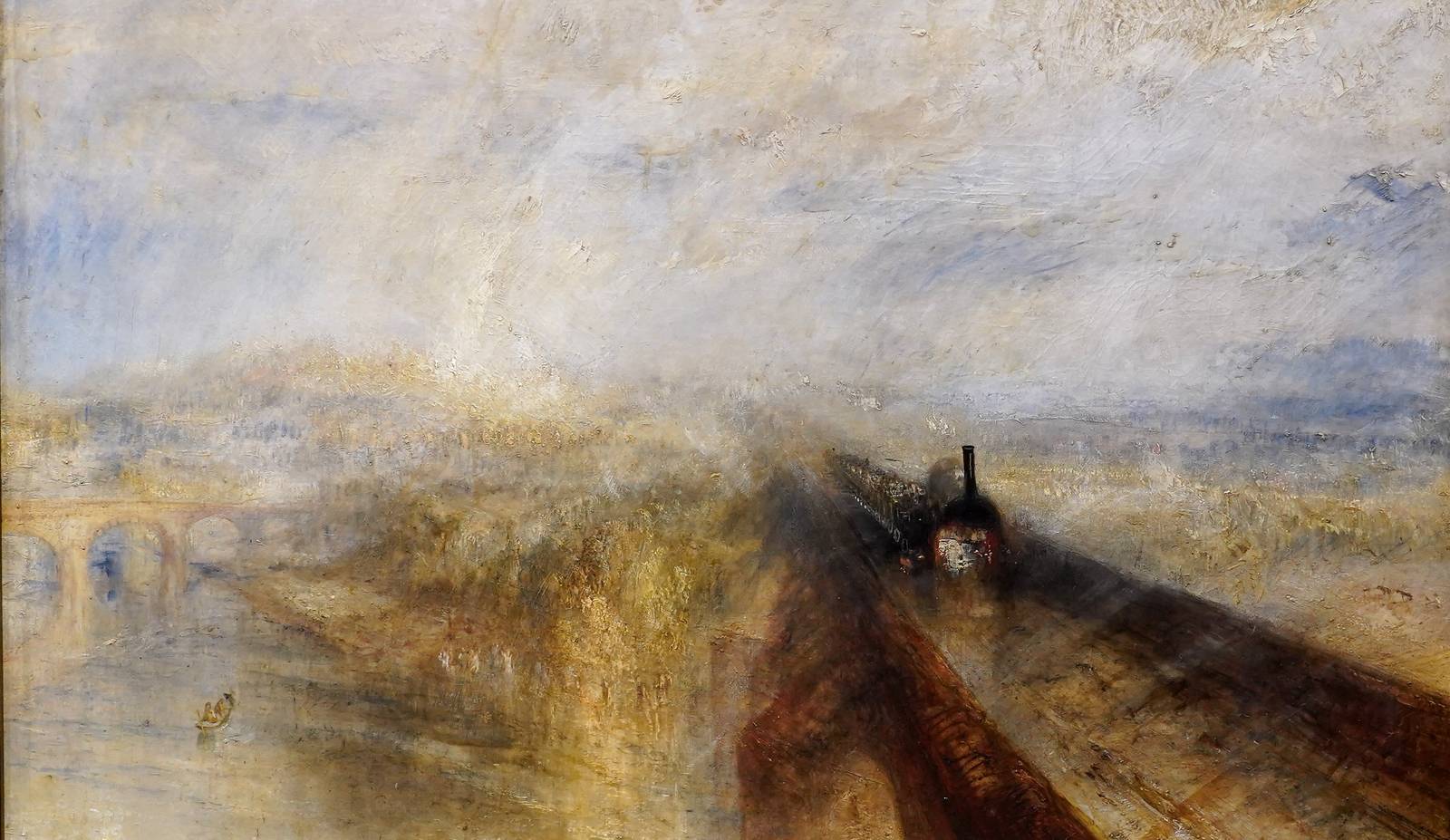
Image reference: William Turner, Rain, Steam and Speed.
At a Glance
- Core period1837–1901, with important continuities before and after the reign
- Principal centresLondon · Edinburgh · Glasgow · Liverpool · Manchester · Birmingham
- Known fornarrative detail · brilliant colour · modern crowds · literary subjects · medievalism · atmosphere · portraiture
- Major mediaoil · watercolour · mural painting · photography · illustration · reproductive print
- Leading namesTurner · Landseer · Millais · Rossetti · Brown · Leighton · Alma-Tadema · Whistler · Butler
- Key contextindustrialisation · urban growth · exhibitions · religion · gender reform · mass media · empire
- Important cautiona reign-based umbrella—not one movement, nationality or style
Contents
- Victorian painting in context
- What Victorian painting means
- A changing art world
- Steam, landscape and the early reign
- Pre-Raphaelite reform
- Painting modern society
- Women making and selling art
- History, antiquity and beauty
- Empire, war and the global frame
- Artists to know
Victorian painting in context
Turner
Principal careerLandseer
Principal careerFord Madox Brown
Principal careerMillais
Principal careerRossetti
Principal careerLeighton
Principal careerWhistler
Principal careerBurne-Jones
Principal careerAlma-Tadema
Principal careerWaterhouse
Principal careerVictorian painting is not one style. The name covers painting made within Britain's art world during the reign of Queen Victoria, from 1837 to 1901: more than six decades in which Romantic landscape, academic history, Pre-Raphaelite experiment, crowded scenes of modern life, archaeological classicism, military subjects, Aesthetic colour and Symbolist reverie coexisted. A highly finished story picture may look characteristically Victorian, but so may the dissolving steam and rain of Turner or the restricted nocturnal harmonies of Whistler. The period is held together less by a shared appearance than by changing institutions, audiences and arguments about what painting was for. The same caution applies to Victorian architecture, which encompasses several contemporary design languages rather than one uniform look.
Those arguments unfolded amid railway expansion, industrial cities, mass exhibitions, widening literacy, illustrated journalism, photography, religious controversy, campaigns over women's education and an empire built through coercion, extraction and settlement. Pictures circulated through annual exhibitions, dealers, reproductive prints, newspapers, royal rooms, civic galleries and domestic interiors. Artists born in Britain worked beside immigrants and expatriates, and British collections drew objects and visual languages from across the world. “Victorian” is therefore most useful as a historical frame, not a badge that every painter recognised or a sealed national tradition.[1] [3] [49] [55]
The reign began after British Romanticism had already transformed landscape, imagination and the status of personal vision. William Turner was sixty-two at Victoria's accession, while John Constable had died only months earlier. Portraiture, animal painting, biblical and literary narrative, academic history painting and the specialist British culture of watercolour were all established. Victorian artists inherited these forms; they did not begin from an empty canvas.
Nor did the end of the reign close them down. John William Waterhouse continued painting myth, poetry and fatal enchantment into the twentieth century. Frank Dicksee became president of the Royal Academy in 1924. Aestheticism, Arts and Crafts, Symbolism, Naturalism, Newlyn painting and the Glasgow Boys crossed the political boundary of 1901 in different ways. The date is firm for government and monarchy, but porous for artistic life.
Several more precise movements sit inside this broad frame. The Pre-Raphaelite Brotherhood was a small organised group founded in 1848, even though “Pre-Raphaelite” soon described a wider and longer tendency. Aestheticism valued formal and sensory experience without requiring a didactic story. William Morris and the Arts and Crafts movement challenged the separation of fine art from the designed environment and criticised industrial production. Late-century painters absorbed French, Belgian, German, Dutch, Italian, Spanish, American and Japanese examples. The period page connects these histories without pretending that their differences disappear.[16] [39] [40]
Geography also requires care. “British” does not mean simply English. Scottish and Irish artists, Welsh patrons, regional academies, watercolour societies and municipal galleries all mattered. London nevertheless concentrated the monarchy, Royal Academy, major dealers, press and many wealthy buyers. Artists such as the Dutch-born Lawrence Alma-Tadema, French-born James Tissot and American-born James Whistler became central through residence, exhibition and commerce. Their presence shows that an art world is made by movement and exchange as much as birthplace.[22] [23] [47]
The British Empire extended that geography while making it unequal. Pictures, pigments, decorative objects, military reports, money and people moved through imperial routes. Settler-colonial visual cultures developed their own institutions and conflicts, including representations made amid the dispossession of Indigenous peoples in Australia. They cannot simply be folded into a metropolitan “British school” as distant branches. Victorian painting in Britain was connected to them, but this page does not claim to contain their histories.[44] [45]
What does “Victorian painting” mean?
Artists did not wait until 1901 to be called Victorian. The word linked culture to a monarch and an era during the reign itself. Yet the category was actively constructed rather than naturally discovered. The Manchester Royal Jubilee Exhibition of 1887 has been identified as the first comprehensive exhibition to present Victorian art explicitly as a national school. Biblical painting and classical antiquity helped organisers turn a diverse recent past into a story of British achievement.[49]
That retrospective act matters. A chronological label can make unlike works look more unified than their makers experienced them. Turner's late surfaces, Millais's precise early naturalism, Alma-Tadema's polished marble worlds and Whistler's tonal veils answered different problems. They sometimes competed for the same viewers, but no formal recipe joins them. The name works best when it prompts questions about shared conditions: who could train, where pictures were shown, how reputations spread, what buyers expected and which structures of class, gender and empire made the culture possible.
Later histories narrowed the field again. Modernist accounts often treated legible narrative, finish, sentiment and popularity as signs that British painting had failed to become properly modern. The art appeared embarrassing beside a French sequence leading from Manet to abstraction. Such judgements made a useful warning against easy moralism into an equally easy dismissal. Scholarship on Victorian sentimentality has shown that feeling is not automatically false because it is tender or accessible; emotion can organise difficult relations between viewer, subject and social value.[50]
International exhibitions have further unsettled the old caricature. Spanish, German, French and Italian museum accounts place the Pre-Raphaelites, Tissot, Alma-Tadema, Leighton and Burne-Jones within European exchanges and experiments in modern image-making. They do not all define modernity in the same way. Their value lies in revealing that a national category has always been viewed, collected and remade from outside Britain.[14] [46] [48]
Victorian painting should therefore neither be celebrated as a confident mirror of national greatness nor rejected as a cupboard of overworked anecdotes. It is a contested visual culture. Its exact surfaces can conceal uncertainty; its fantasies can disclose present anxieties; its reforms can reproduce exclusions; and its most familiar stories can remain genuinely open to interpretation.
A changing art world
The Royal Academy's annual summer exhibition remained the most visible centre of the professional art year. Selection could establish a career, and prominent hanging brought critics, buyers and crowds. Academicians enjoyed status and institutional authority, but the Academy never contained the entire market. Watercolour societies, the British Institution, dealers, private galleries, provincial exhibitions, print publishers and spectacular one-picture displays created alternative paths. A painting could be commissioned, sent to an exhibition, sold, engraved and reviewed, reaching several audiences in different forms.
The monarchy participated directly. Victoria and Prince Albert commissioned living painters, collected Old Masters and contemporary works, drew and etched, exchanged art as family memory and used images in courtly representation. Their collection included British and German artists as well as painters such as Edwin Henry Landseer, whose animals, landscapes and royal subjects connected domestic affection with monarchy and national identity. Royal taste did not dictate all Victorian painting, but it supplied money, visibility and a powerful model of cultivated family life.[1] [2]
Public building offered another ambition. After the old Palace of Westminster burned in 1834, its replacement was designed in a Gothic language that connected the modern constitution to a selected medieval past. The Fine Arts Commission promoted large historical cycles, and painters including William Dyce attempted fresco within the new palace. The project made national history into an architectural environment, although technical difficulties, shifting taste and the British climate complicated the hoped-for revival of monumental painting.[4] [42]
The Great Exhibition of 1851 expanded the scale of public looking. More than 100,000 objects from about 14,000 exhibitors were arranged in the Crystal Palace, and more than six million visits were recorded. The building joined art, machinery, raw material and manufactured design. Its stated internationalism was organised through imperial power: Britain and its empire occupied large portions of the space, and displays from colonised territories were presented through commercial and political hierarchies.[3]
Albert's commitment to design reform helped shape the institutions and collections that became the Victoria and Albert Museum. Painting was increasingly considered beside furniture, textiles, ceramics, architecture and mechanical reproduction. This wider field is essential to Aestheticism and Arts and Crafts, whose artists wanted walls, frames, books and furnishings to work together rather than treating the easel picture as an isolated object.[16] [40]
The market also encouraged scale, novelty and recognisable identity. Successful artists cultivated studios and public personas; collectors opened picture galleries; dealers managed access; critics turned exhibitions into printed debate. Close hanging meant pictures competed above, below and beside one another. A bold colour, conspicuous frame or puzzling title could be a strategy for survival in the crowd. The quiet white space of a modern gallery can therefore give a misleading impression of how many Victorian pictures first demanded attention.
Steam, landscape and the early reign
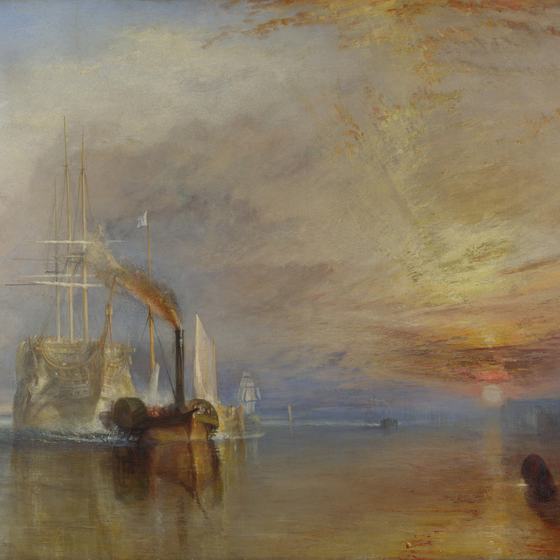
Turner's late work overturns the idea that Victorian painting always described objects with hard precision. In The Fighting Temeraire, shown in 1839, a dark steam tug pulls the pale veteran warship towards its final berth. The sun lowers across a luminous sky while smoke moves in the opposite direction. The old ship had fought at Trafalgar; the tug belongs to a newer industrial system. Turner does not simply illustrate progress defeating tradition. The glorious vessel is already spectral, and the small modern machine is both forceful and visually unheroic. Memory, obsolescence and national pride are carried by an invented, highly controlled atmosphere.[9]
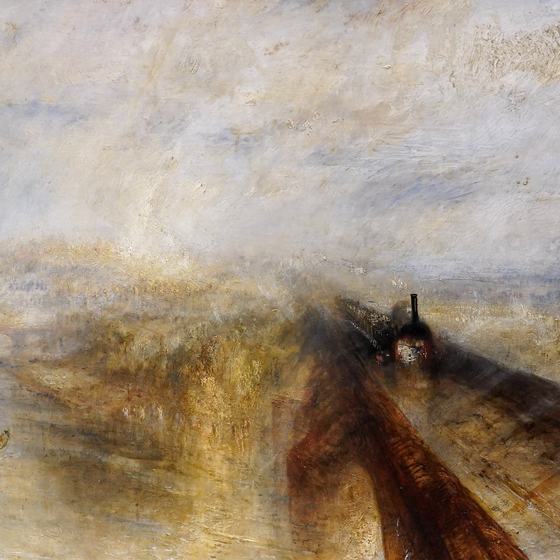
Rain, Steam, and Speed – The Great Western Railway, exhibited in 1844, is still less stable. A locomotive advances over Maidenhead Railway Bridge through bands of rain, cloud and golden light. A tiny hare may race before it. The train is not placed against nature as a solid intruder; weather, motion and machine enter the same painted field. The image can sustain exhilaration and alarm at once. It lets a viewer feel speed without deciding that technology is either salvation or catastrophe.[8]
Turner's method depended on long experience in oil and watercolour, travel, exhibition and repeated reworking. Continental museum research has stressed both the radical handling of his late paintings and the role of John Ruskin in defending them. His vast bequest to the nation later altered how this experimental body could be studied. The seeming instant of weather is the product of memory, material revision and a career negotiating public incomprehension.[10]
Watercolour was not merely a portable sketching aid. British artists and collectors promoted it as a national art, and specialist societies created an exhibition market. Transparent wash, opaque bodycolour, scratching, lifting and layered paper could serve topographical record, intense weather, architectural precision or imaginative colour. South Kensington's collecting helped institutionalise that history. Treating Victorian painting as oil alone would erase one of the period's most distinctive systems of training, commerce and display.[5]
Landscape itself ranged from detailed rural labour to highland tourism, biblical terrain and the changing industrial city. Even when no machine is visible, enclosure, railway access, extraction and ownership may shape the view. The strongest pictures do not merely tell us what Victorians saw outdoors. They show how land became memory, property, national identity, leisure and material resource.
Essential works
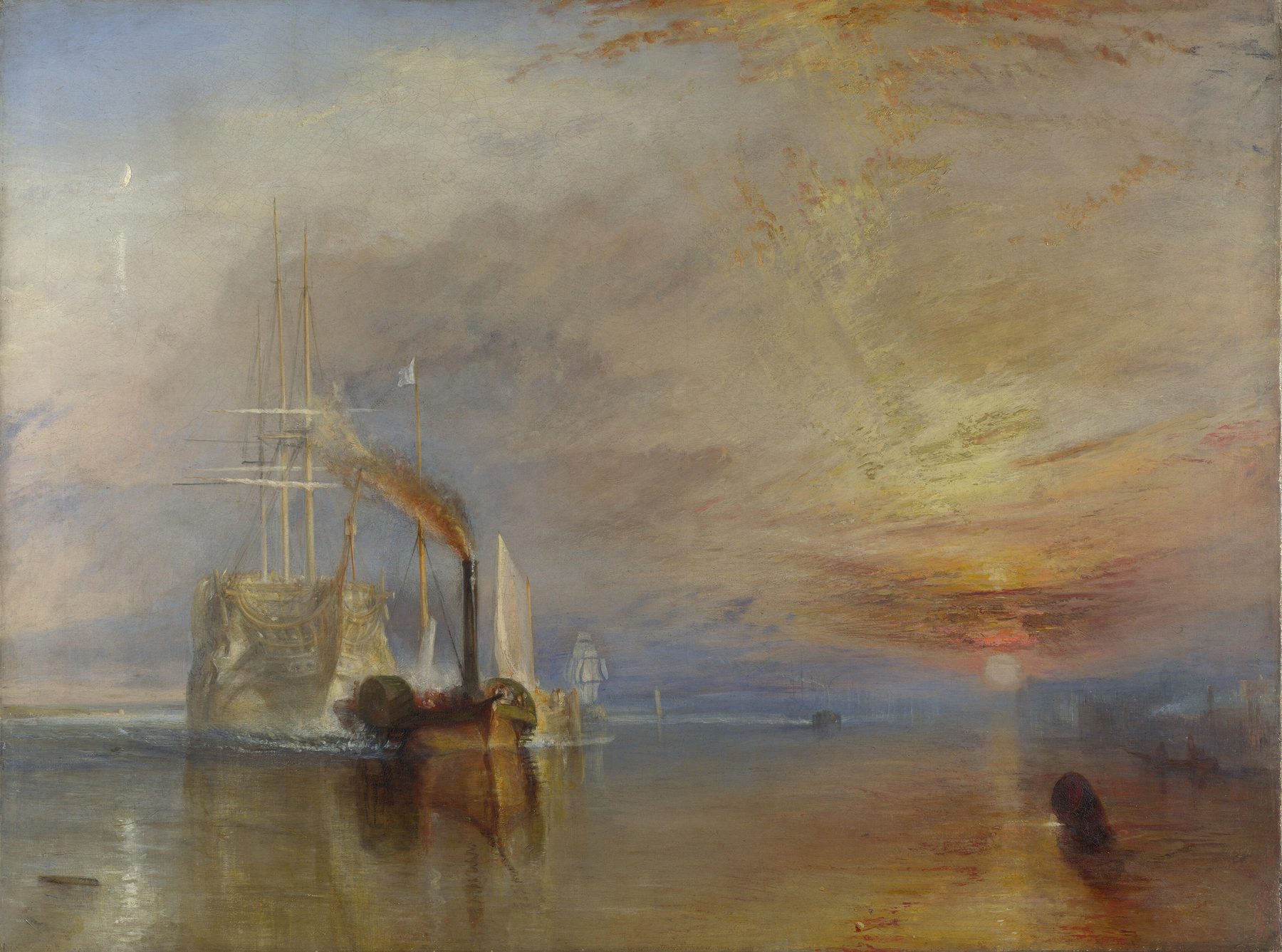
The Fighting Temeraire
William Turner, 1839
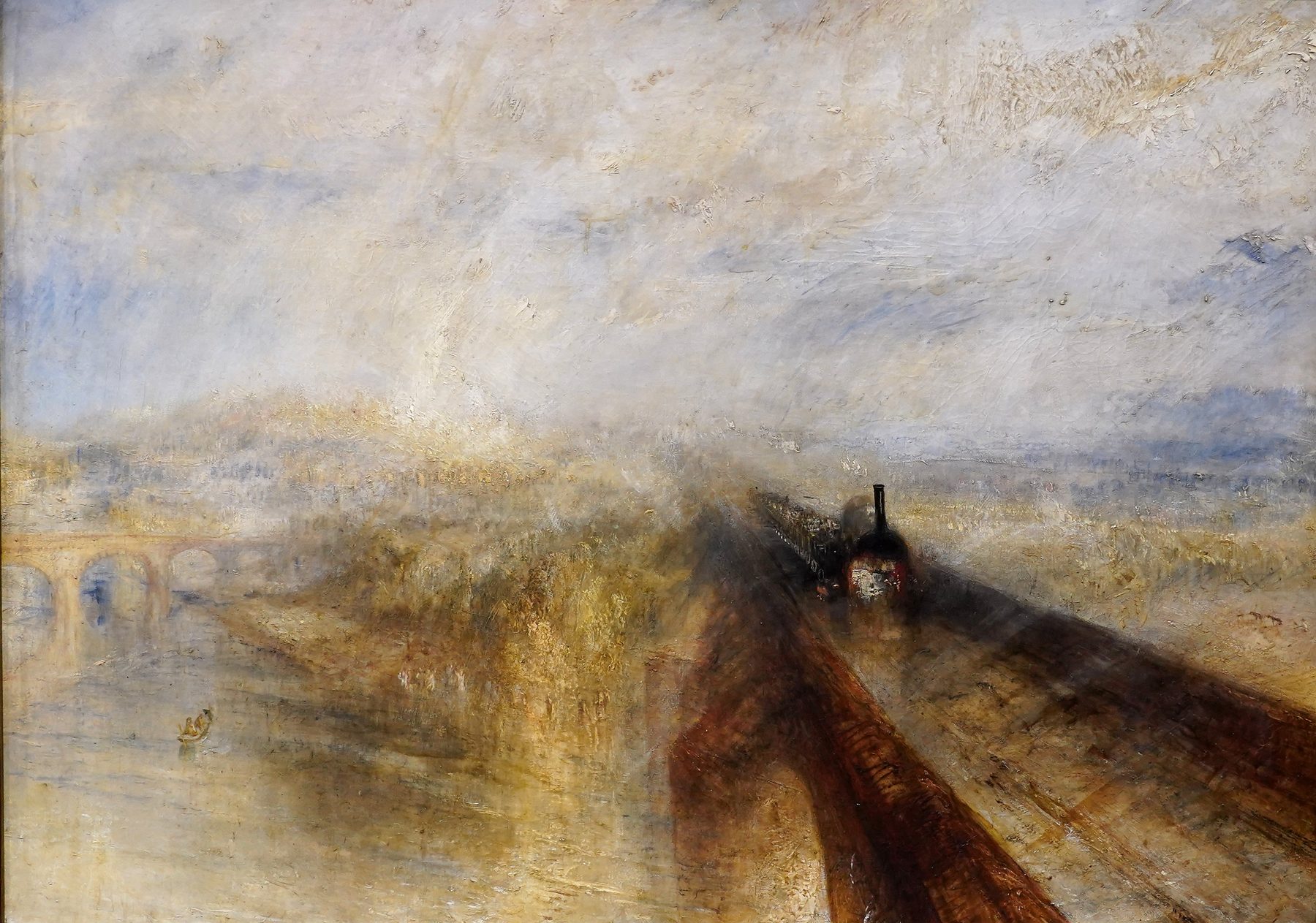
Rain, Steam and Speed
William Turner, 1844
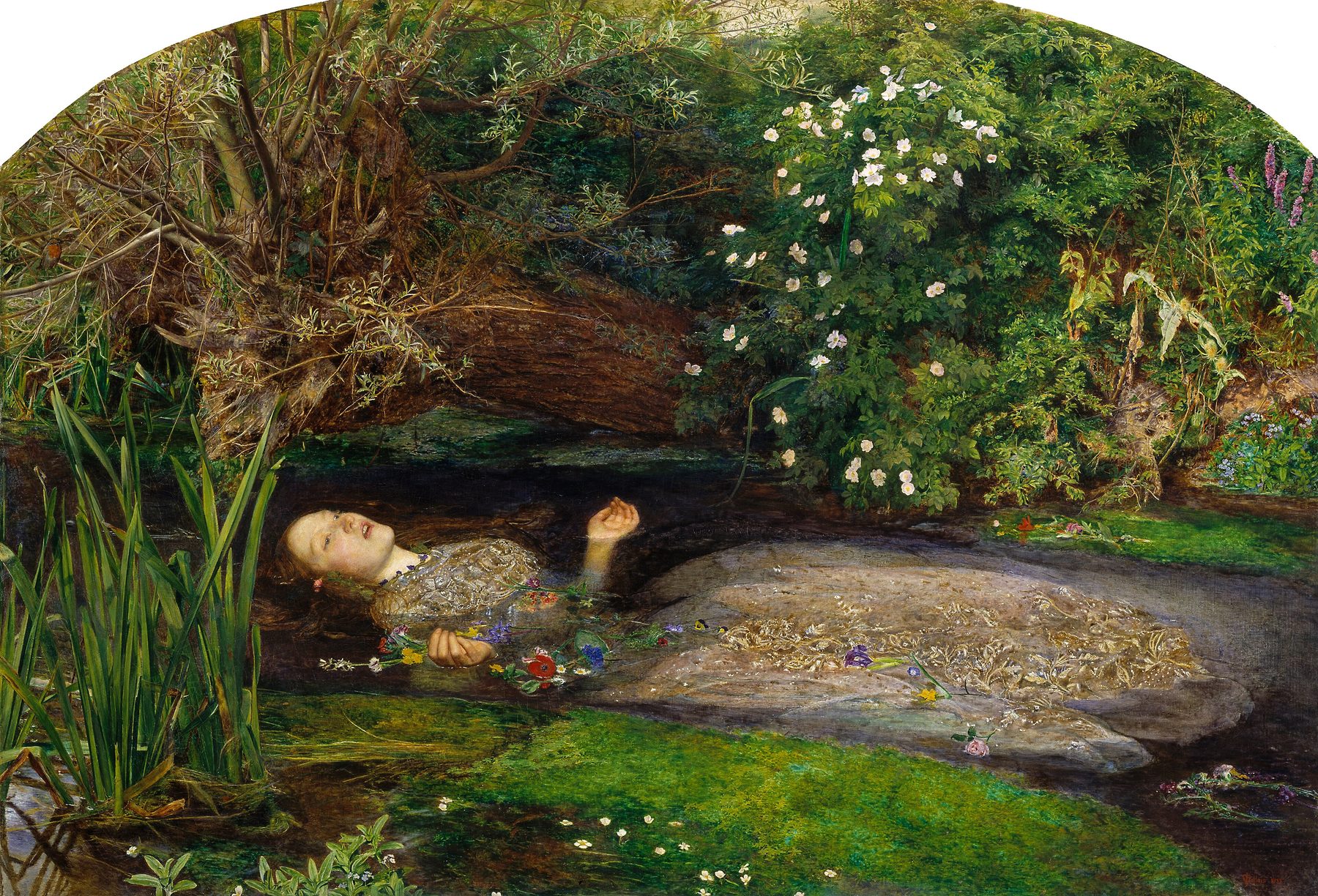
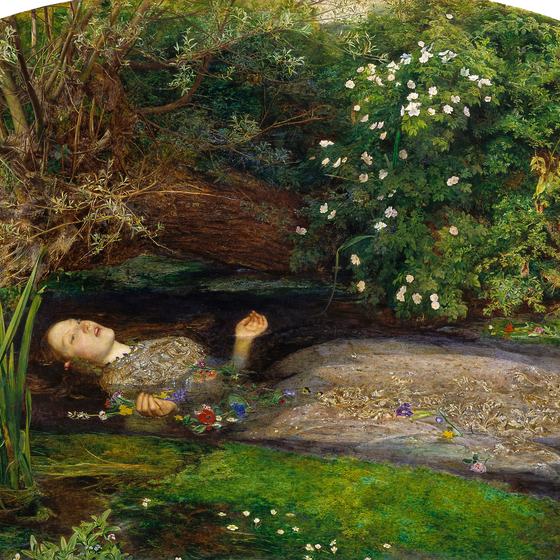
Ophelia
John Everett Millais, 1851–52
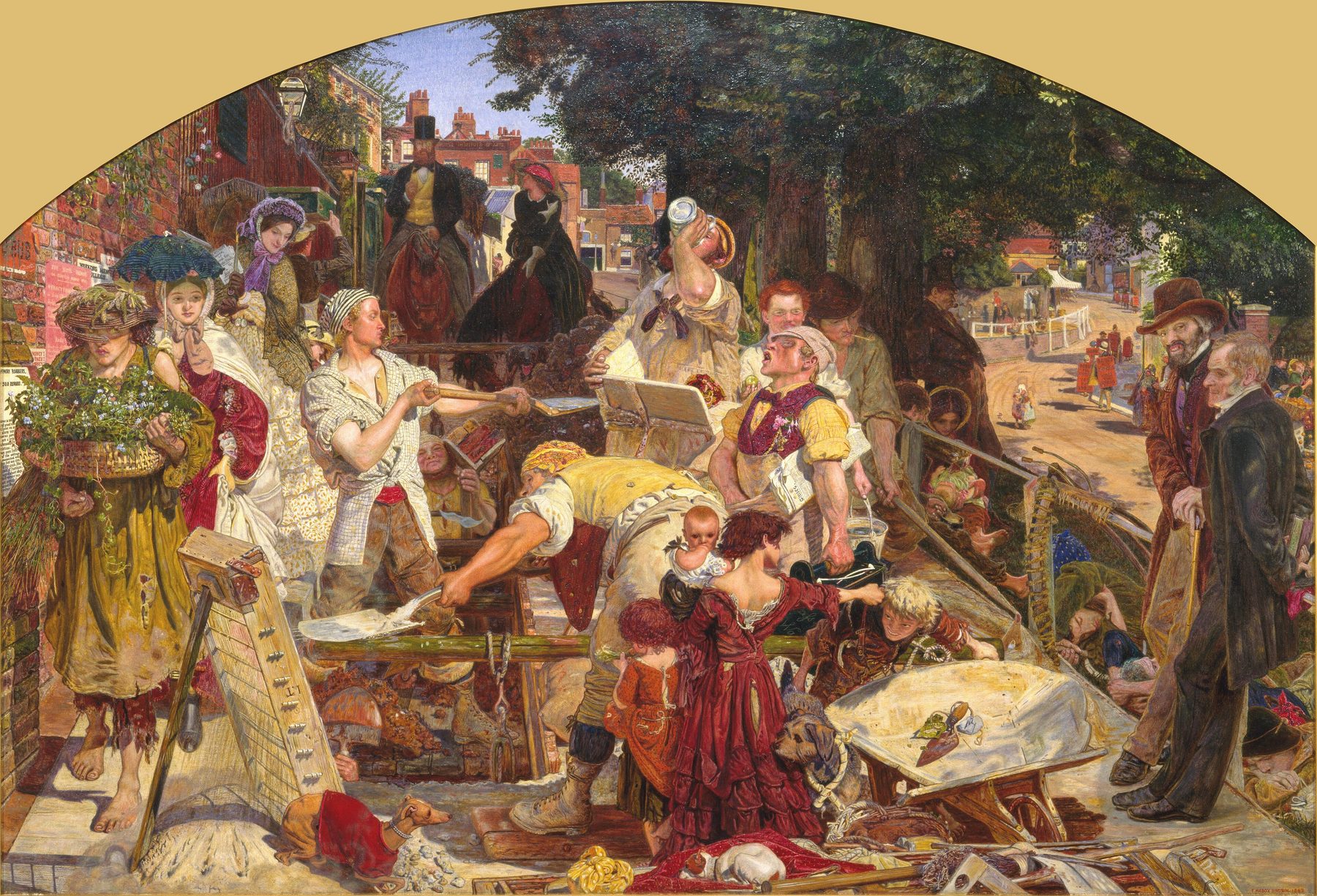
Work
Ford Madox Brown, 1852–65
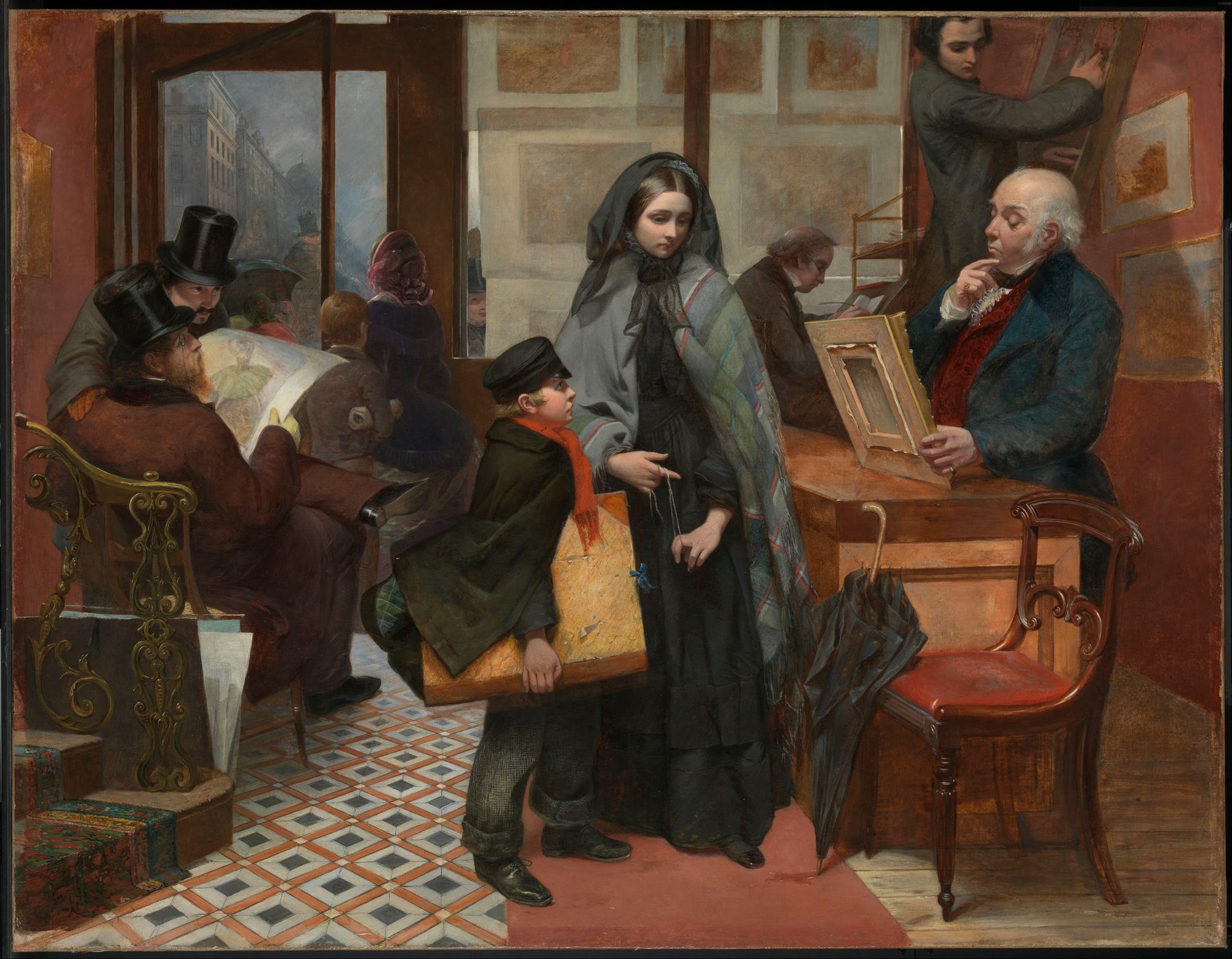
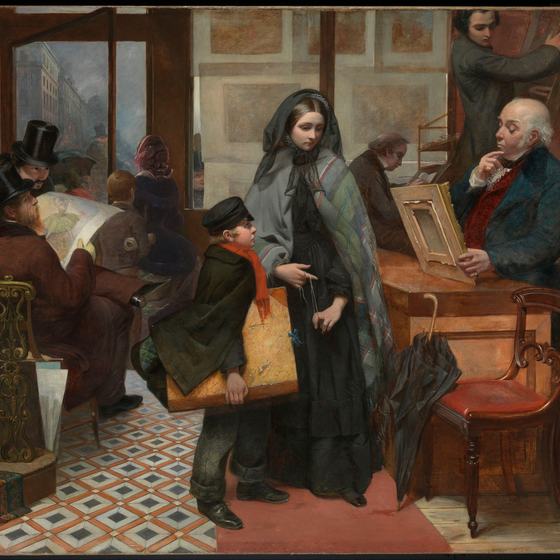
Nameless and Friendless
Emily Mary Osborn, 1857
Pre-Raphaelite reform
In 1848 John Everett Millais, Dante Gabriel Rossetti, William Holman Hunt and four companions formed the Pre-Raphaelite Brotherhood. They opposed what they understood as routine academic formulas derived from Raphael and his followers. Their alternative joined brilliant colour, close observation, early Italian and northern sources, poetry, religious seriousness and subjects taken from modern life. A Spanish-language Prado account of Millais also draws attention to the international Old Masters within this supposedly national revolt.[15]
Millais's Ophelia demonstrates how these commitments could conflict productively. He painted the riverbank outdoors with extraordinary botanical attention, then completed the drowning figure in the studio using Elizabeth Siddal as model. Shakespeare's narrative is familiar, yet the sustained surface delays its climax. Flowers are at once plants, literary symbols and dazzling patches of colour. Ophelia's open hands and singing mouth hover between life, performance and death. Exactness does not make the emotional meaning simple.
The Brotherhood's medievalism was not an escape from the nineteenth century. Early religious art provided a way to question industrial manufacture, academic convention and compromised modern belief. The V&A's research on Perugino's rediscovery shows how old art reached Victorian viewers through collections, prints and large exhibitions such as Manchester's Art Treasures display. “Before Raphael” was already a modern reconstruction mediated by reproduction and connoisseurship.[41]
The original Brotherhood soon loosened, and its members changed. Millais became a successful Academician and society portraitist. Hunt pursued elaborate religious pictures informed by travel. Rossetti shifted towards dense, sensuous images of women, poetry and decorative objects. A second generation including Edward Burne-Jones developed elongated dream worlds, while Morris carried related ideals into design, craft and politics. Birmingham's collections show how Pre-Raphaelite and Arts and Crafts practices flourished beyond London and created opportunities for women at the city's School of Art.[39]
Pre-Raphaelitism is consequently both a specific brotherhood and a much wider Victorian afterlife. Its detailed surfaces could support Protestant sincerity, Catholic revival, erotic reverie, socialist craft or commercial luxury. The phrase should never substitute for looking at which of those purposes a particular work serves.
Painting modern society
Victorian narrative painting often asks viewers to become detectives. Gesture, dress, furniture, newspapers, mirrors, clocks, railway architecture and catalogue titles provide evidence from which a story can be assembled. The process is pleasurable because the picture does not merely deliver a verdict; it distributes clues across time. What has just happened? Who knows it? What will occur when another figure understands?
William Powell Frith's Derby Day and The Railway Station turn modern crowds into panoramic theatre. Their many incidents reward prolonged inspection, and reproductive prints allowed viewers to revisit the details at home. Yet social abundance is not the same as neutrality. Costume, posture and physiognomic type invite the public to sort respectability from deception, wealth from need and legitimate pleasure from danger. The pictures construct society through the very act of looking.
Ford Madox Brown made Work into an even more explicit argument. Navvies dig in a Hampstead street while well-dressed intellectuals, animals, children, vendors and bystanders occupy the edges. Brown's detailed 1865 pamphlet identifies figures and explains the moral hierarchy he intended. It is invaluable evidence, but an artist's explanation cannot settle every relation in the picture. Modern scholarship reads its celebration of bodily labour beside masculinity, class, sanitation, political economy and the value assigned to the artist's own work.[24] [25]
Emily Mary Osborn's Nameless and Friendless shifts attention to the unequal market. A young woman presents a picture to a dealer while men appraise the object and, by implication, its maker. Through the window, another woman works in a form of commercial visibility associated with sexual vulnerability. The canvas has sometimes been treated as a simple autobiography of female struggle. It is more useful as a constructed analysis of how respectable women could enter urban commerce while remaining exposed to judgement.[26]
Florence Claxton's satirical Woman's Work: A Medley makes structural restriction deliberately unruly. Its crowded scenes contrast the professions open to men with the exhausting, trivialised or dependent tasks assigned to women. Humour creates visual overload rather than a single moral lesson. The work was exhibited publicly, proving that critique could enter the same market it mocked.[28]
“Problem pictures” at the end of the century intensified ambiguity. A spouse may discover a letter; a family group may contain an unspoken scandal; a woman at a threshold may be leaving or returning. Titles and press commentary could direct discussion without closing it. Their popularity shows that narrative legibility did not eliminate uncertainty. It made contested social meanings into public entertainment.
Women making and selling art
Women were never absent from Victorian art, but institutions distributed access unequally. The Female School of Art and Design opened in 1842, and women entered the Royal Academy Schools from 1860 after a campaign triggered by Laura Herford's successful submission of drawings under initials. Even then, life study, prizes, membership and major commissions remained restricted. The Royal Academy admitted no new female Academician between the founding members Angelica Kauffman and Mary Moser and Laura Knight's election in 1936.[27]
Professional practice extended beyond that institutional record. Women exhibited, painted portraits, taught, illustrated, travelled, formed societies and managed studios. Ann Mary Newton supported herself as a portrait painter and family breadwinner before her early death. Her self-portrait presents skilled professional identity rather than decorative accomplishment.[29] Louise Jopling built a prominent portrait career, represented artistic and social networks in her writing and founded a painting school for women when access to training remained unequal.[30]
Sophie Anderson offers a cosmopolitan case. Born in Paris to a British mother and French father, she lived in the United States, London, Capri and Cornwall. Public collections acquired her images of women and children, yet later cataloguing and display often made her difficult to locate. Research into her career shows how nationality, gender, mobility and municipal collecting shape who remains visible in a national school.[38]
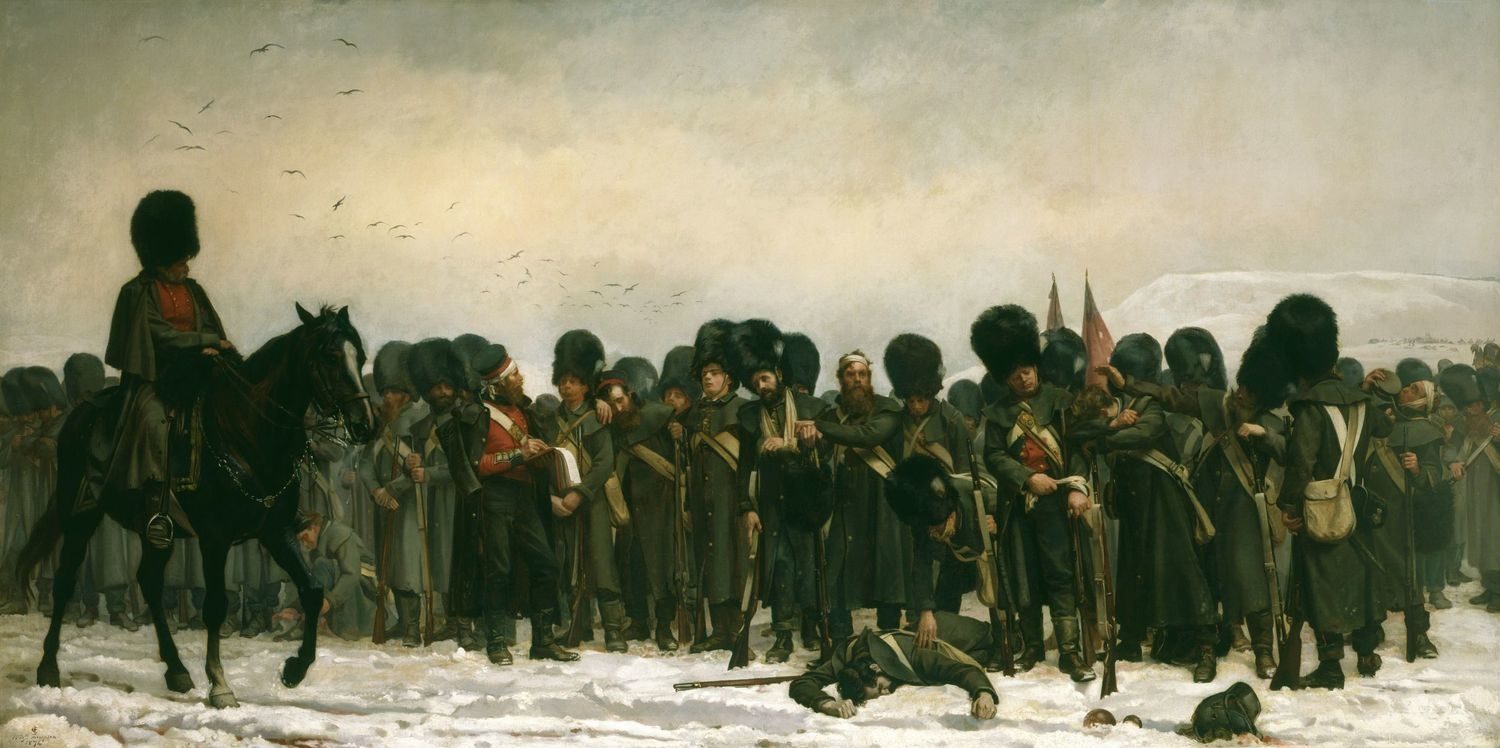
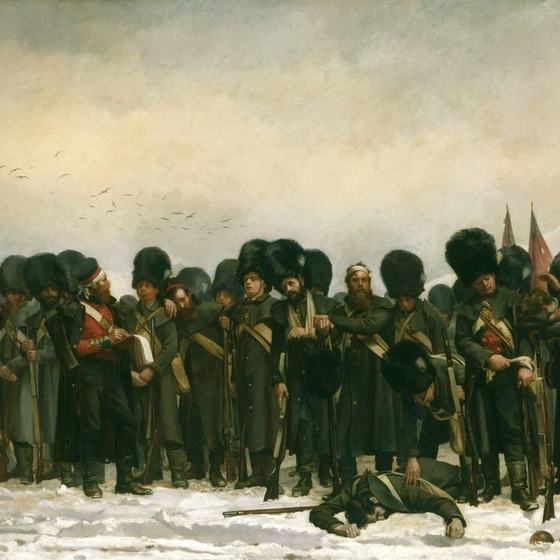
Elizabeth Butler achieved extraordinary fame with battle paintings that foreground ordinary soldiers rather than triumphant commanders. In The Roll Call, exhausted troops stand after combat; in The Dawn of Waterloo, mounted officers and resting men anticipate violence. She studied uniforms, horses, weather and military testimony with great care. The National Army Museum's account emphasises how pathos and preparation distinguished her work, but empathy for British soldiers did not remove the subjects from imperial and national myth.[31] [32]
Butler twice came close to Royal Academy membership and was never elected. Her celebrity and exclusion belonged to the same system. So did the pressure on women to make their professional ambition appear compatible with femininity and family. Feminist histories of Victorian visual culture have moved beyond simply adding neglected names; they examine how viewing, labour, sexuality, modernity and colonial power defined the frame itself.[51]
Women also shaped painting as patrons, models, writers, teachers and viewers. Victoria purchased work by women artists, and Thomas Holloway assembled a picture gallery intended partly for the women of his new college. Such patronage opened real opportunities while preserving class distinctions. A complete account must ask not only whether a woman appears, but whether she controls the image, owns it, models for it, interprets it or is positioned as its moral evidence.[27] [34]
Follow the period through four stages
–1848
Romantic inheritance and a changing public
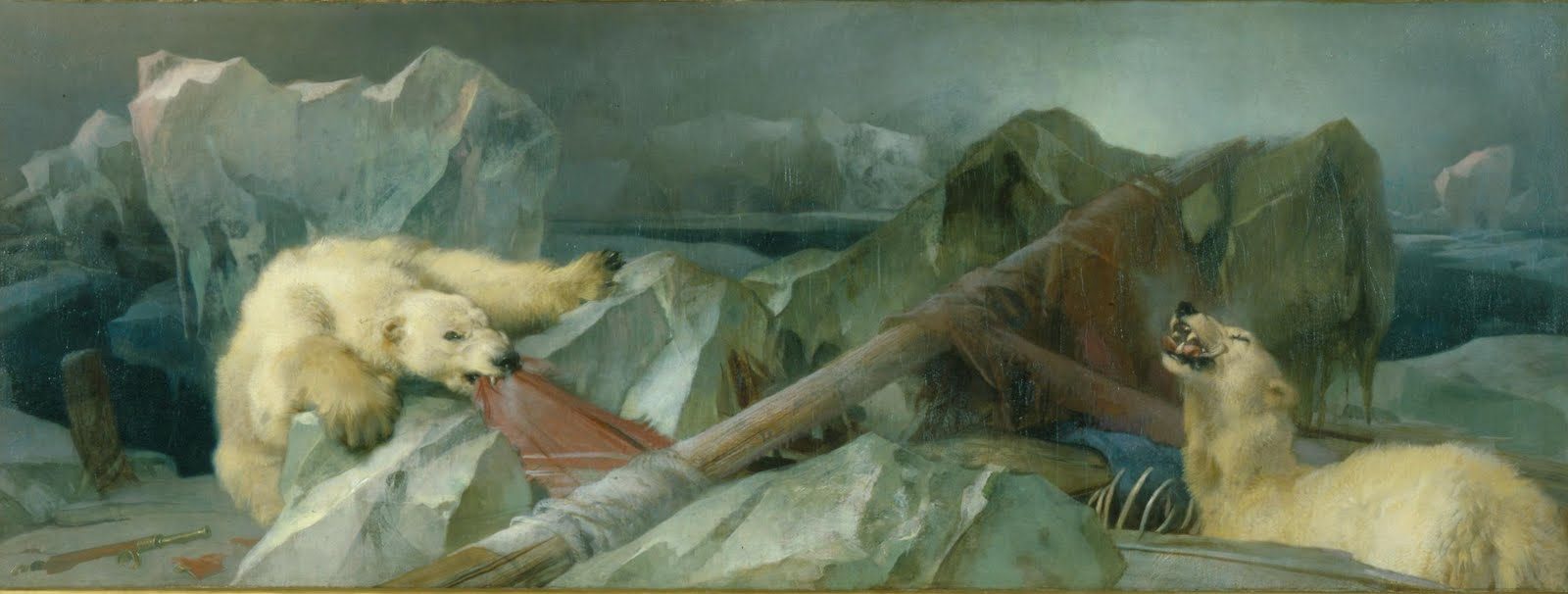
Turner and Landseer carry Romantic landscape, animal painting and public celebrity into the early reign as railways and exhibitions alter British looking.
–1860
Pre-Raphaelite reform and modern society
The Brotherhood’s close observation, brilliant colour and literary intensity develop beside paintings of labour, urban vulnerability and women’s professional lives.
–1877
History, empire and exhibition culture
Academic display, antiquity, military subjects and fashionable modern life command large publics while institutions expand beyond London.
–1901
Aestheticism and late-century plurality
Whistler’s tonal art, Burne-Jones’s dream worlds, Waterhouse’s literary encounters and Dicksee’s romance show the period ending without one dominant style.
History, antiquity and beauty
Victorian history painting did more than illustrate the past. It used selected pasts to make present institutions appear ancient, continuous or morally instructive. The Palace of Westminster's Gothic architecture and mural cycles joined monarchy, parliament, medieval legend and constitutional history. Their authority depended on omission as much as inclusion: complex conflict became a sequence suitable for state space.[4] [42]
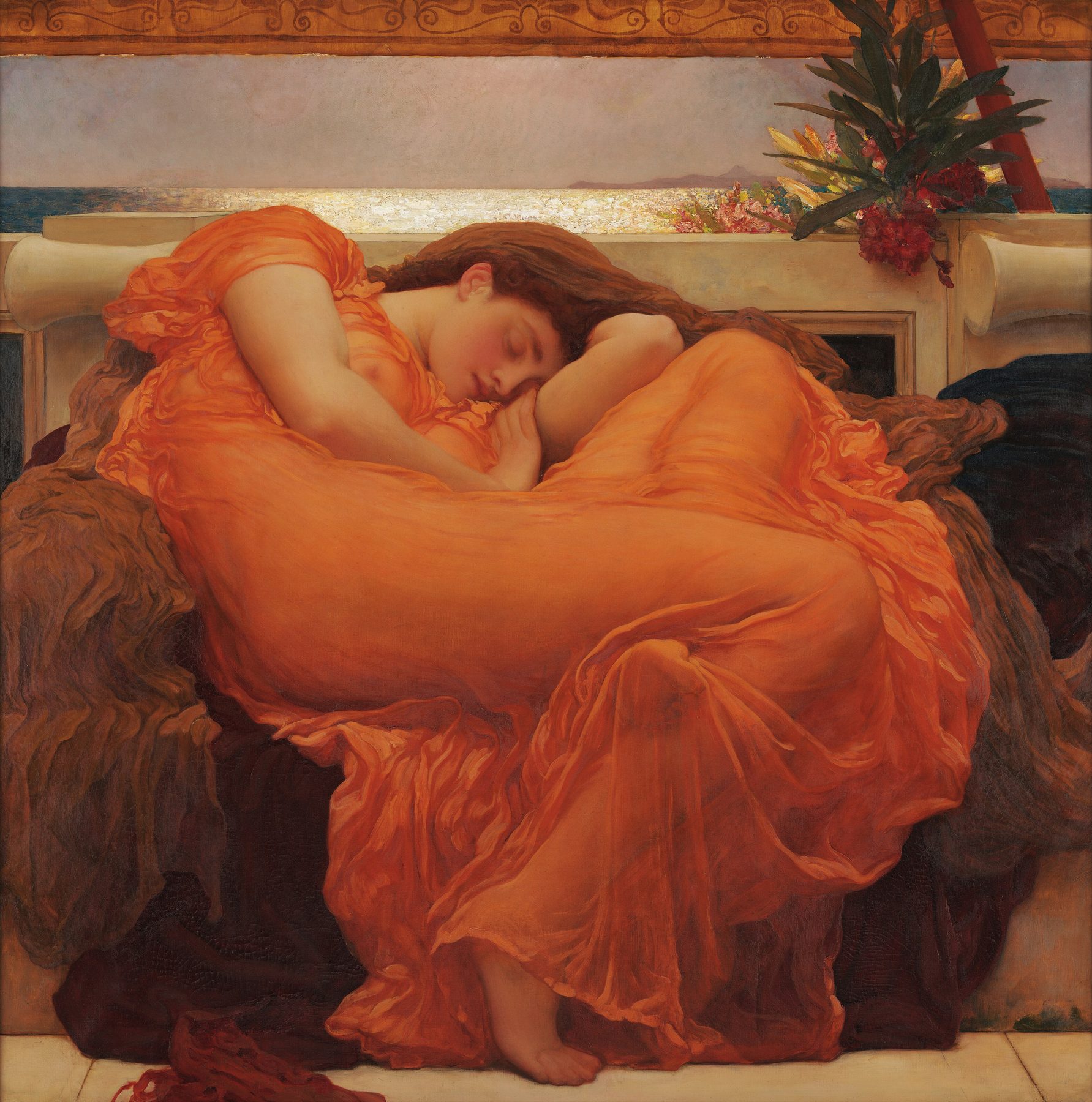
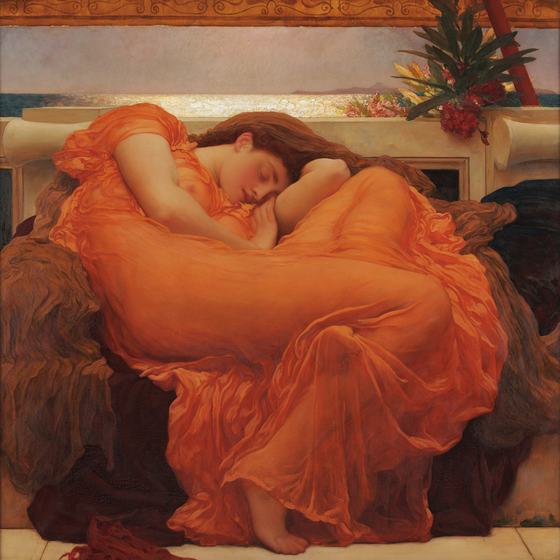
Frederic Leighton moved between historical narrative, portraiture, landscape, mural and the Aesthetic body. His South Kensington frescoes joined Renaissance technique to an institution devoted to design education. Their making shows how a future president of the Royal Academy could work across architecture and public decoration before becoming identified with ideal beauty.[20]
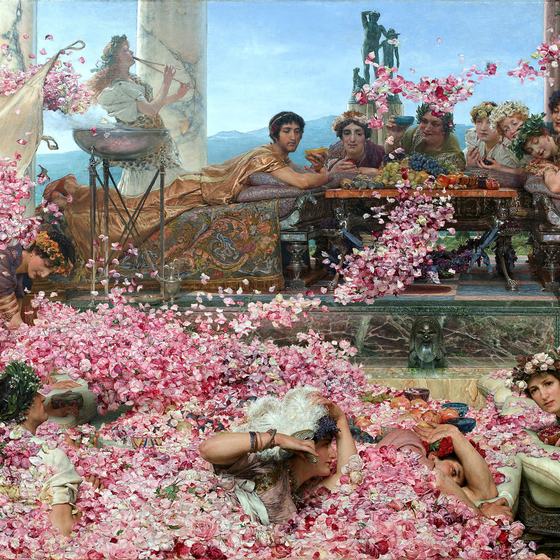
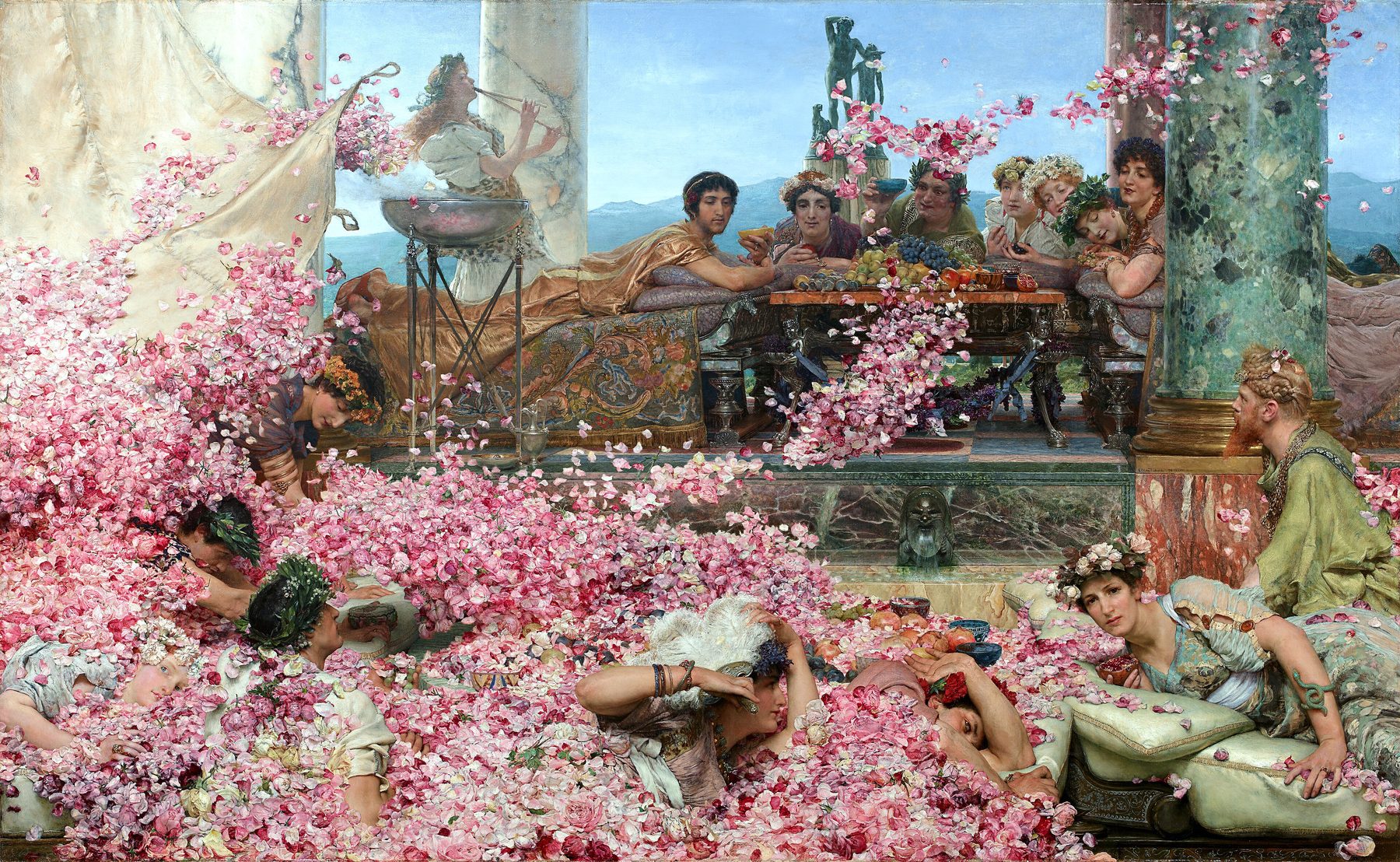
Alma-Tadema reconstructed Greece and Rome through travel, museum study, photographs, books and an acute knowledge of luxury. Marble, bronze, flowers, textiles and distant water offer almost tactile pleasure. His archaeological details were not inert displays of learning. They gave Victorian rituals of courtship, leisure, performance and spectatorship the estranging distance of antiquity. Born in the Netherlands and trained in Antwerp, he adapted his work after settling in London, demonstrating how “Victorian taste” itself was made through migration.[21] [22]
In Autumn (Scene in a Roman Garden), an ancient relief, architectural fragments and costumed figures assemble a world from objects available through collections and reproduction. The Metropolitan Museum's record traces some of those borrowings. The result is neither documentary Rome nor arbitrary fantasy. Archaeological quotation lends credibility to a modern arrangement of bodies and surfaces, inviting viewers to consume the past as cultivated sensation.[54]
Classicism could also naturalise hierarchy. White marble, languid servants, exotic materials and Mediterranean settings made elite consumption appear timeless. At the same moment, archaeological knowledge and museum collections were being enlarged through imperial and commercial networks. Sensory beauty need not be denied, but it should not be mistaken for innocence.
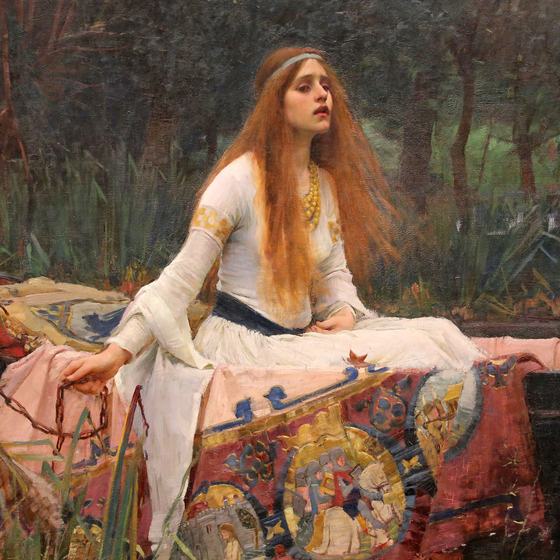
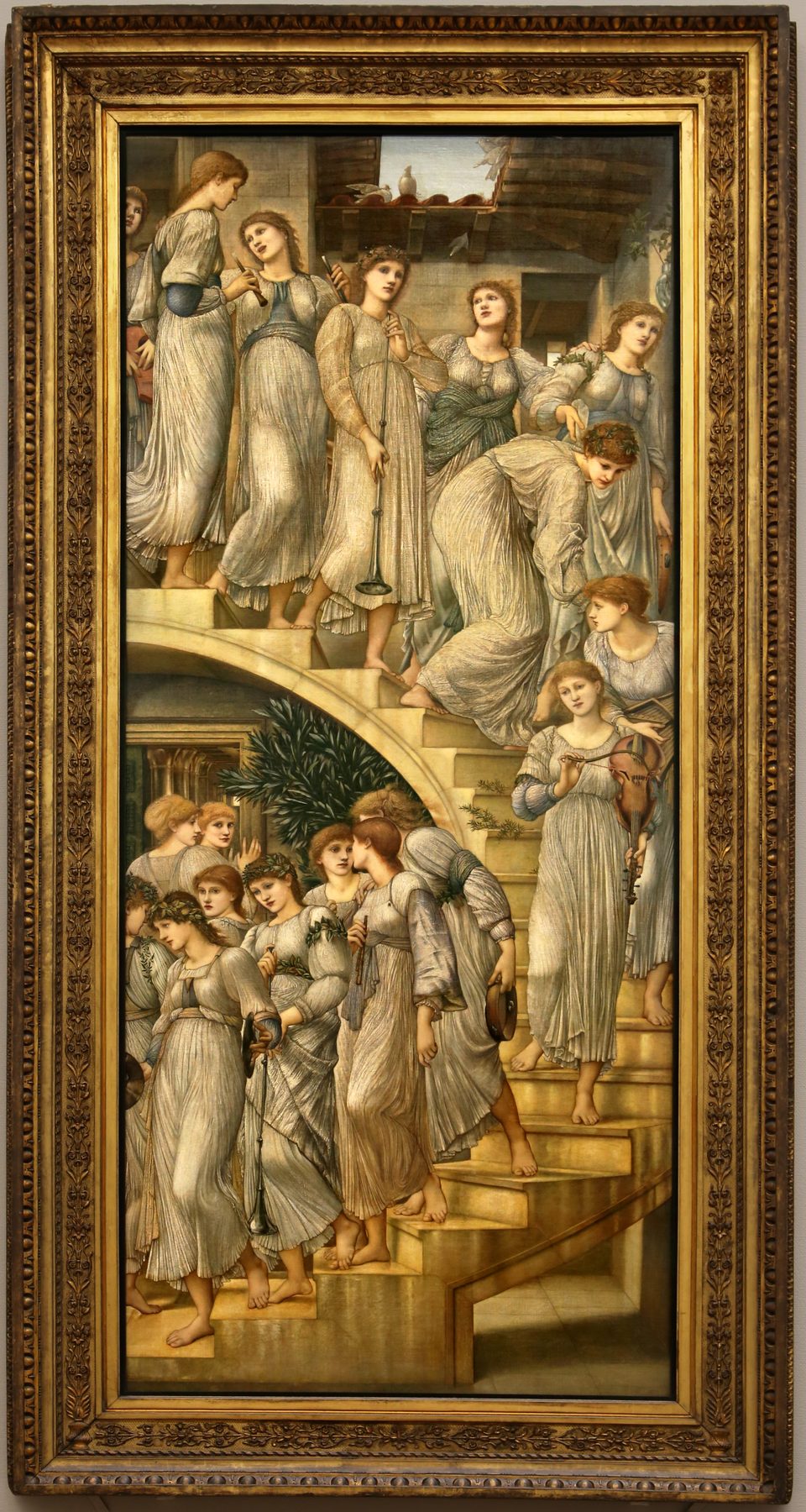
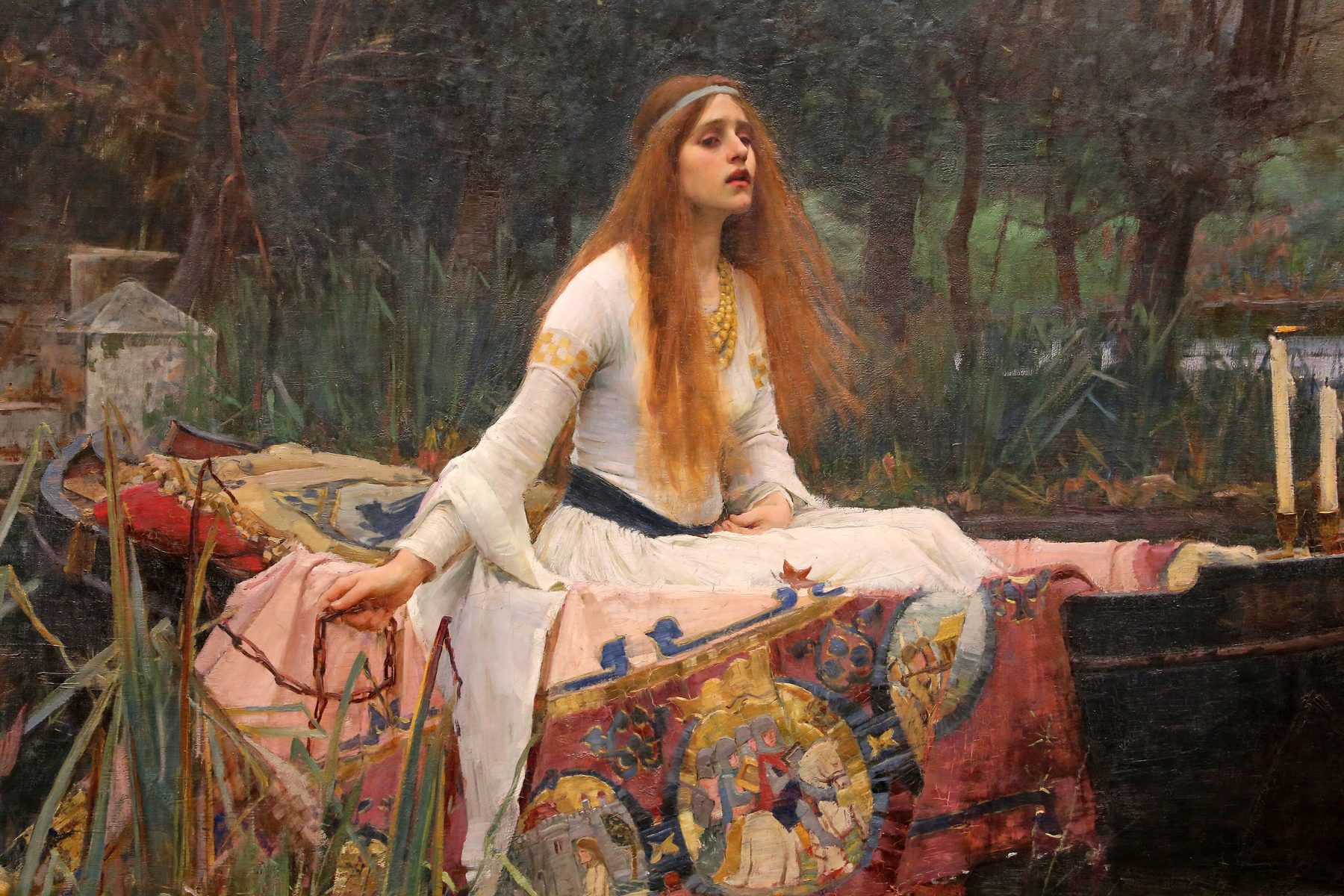
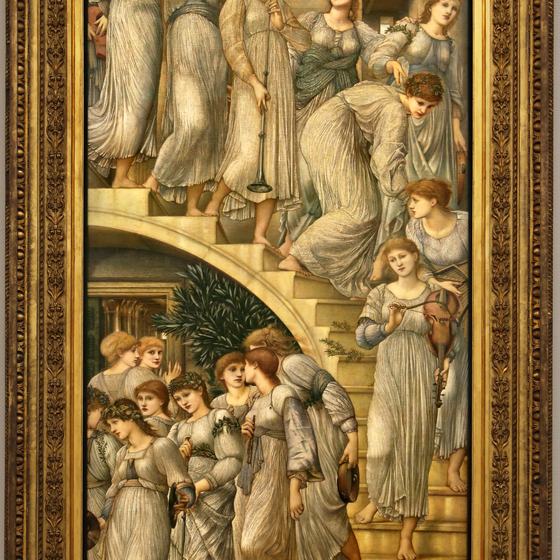
Burne-Jones and Waterhouse drew from other pasts: Arthurian legend, Italian art, classical myth and poetry. Their sleeping, enchanted or endangered women became among the period's most reproducible images. Desire, passivity, danger and agency vary from picture to picture. The recurrent female body is not a universal symbol waiting to be decoded once; it is a site where masculine fantasy, literary memory, modelling, colour and female spectatorship meet.
Aesthetic painting and Whistler's challenge
The Aesthetic movement rejected the demand that every work deliver an improving message. Its advocates pursued “art for art's sake”, placing colour, line, atmosphere, material and carefully arranged interiors at the centre of experience. This was not the absence of meaning. It was an argument that formal relation and cultivated sensation could be meaningful in themselves. Japanese art, Chinese ceramics, Renaissance design and contemporary fashion entered the resulting visual language.[16]
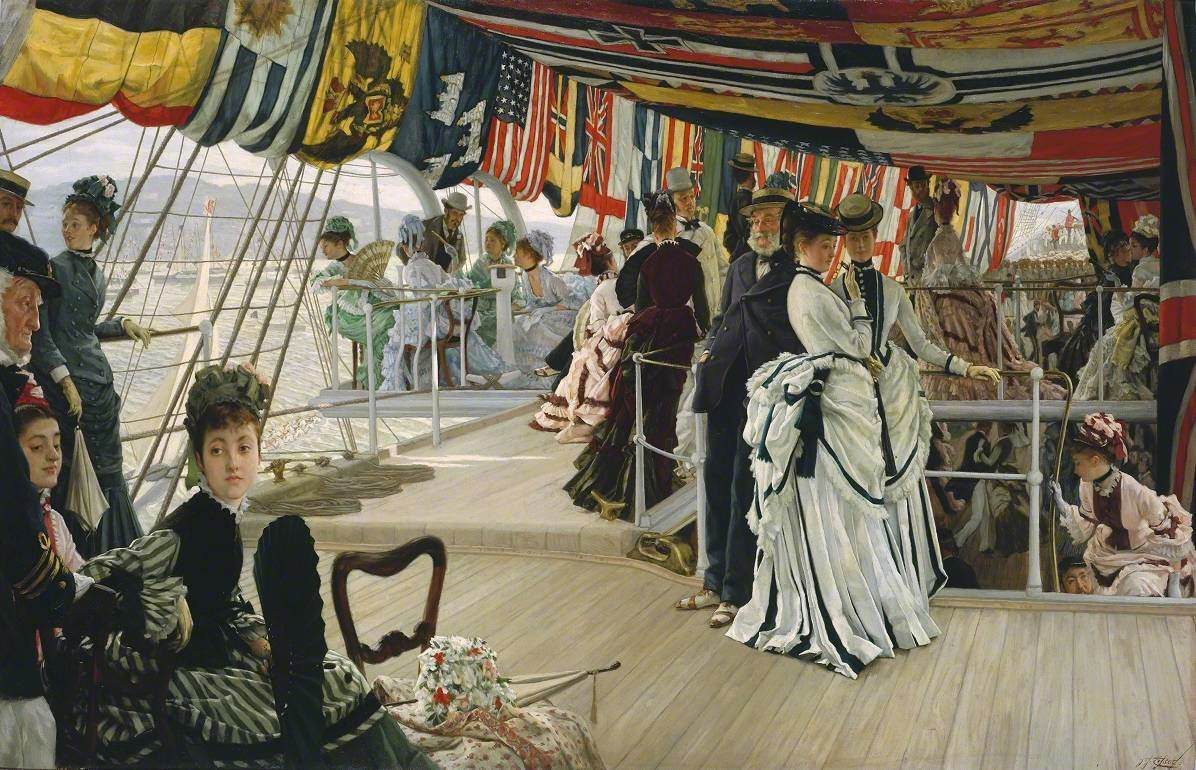
Tissot occupied an ambiguous position between narrative and Aesthetic surface. After leaving Paris for London in 1871, he painted the rituals of fashionable life with minute attention to dress, railings, river views and social distance. French and Italian museum accounts stress both his outsider's perception and his active manufacture of images across borders. His scenes can be seductive and uneasy at the same time: elegance becomes a means of measuring who belongs, who watches and what a social gesture conceals.[23] [47]
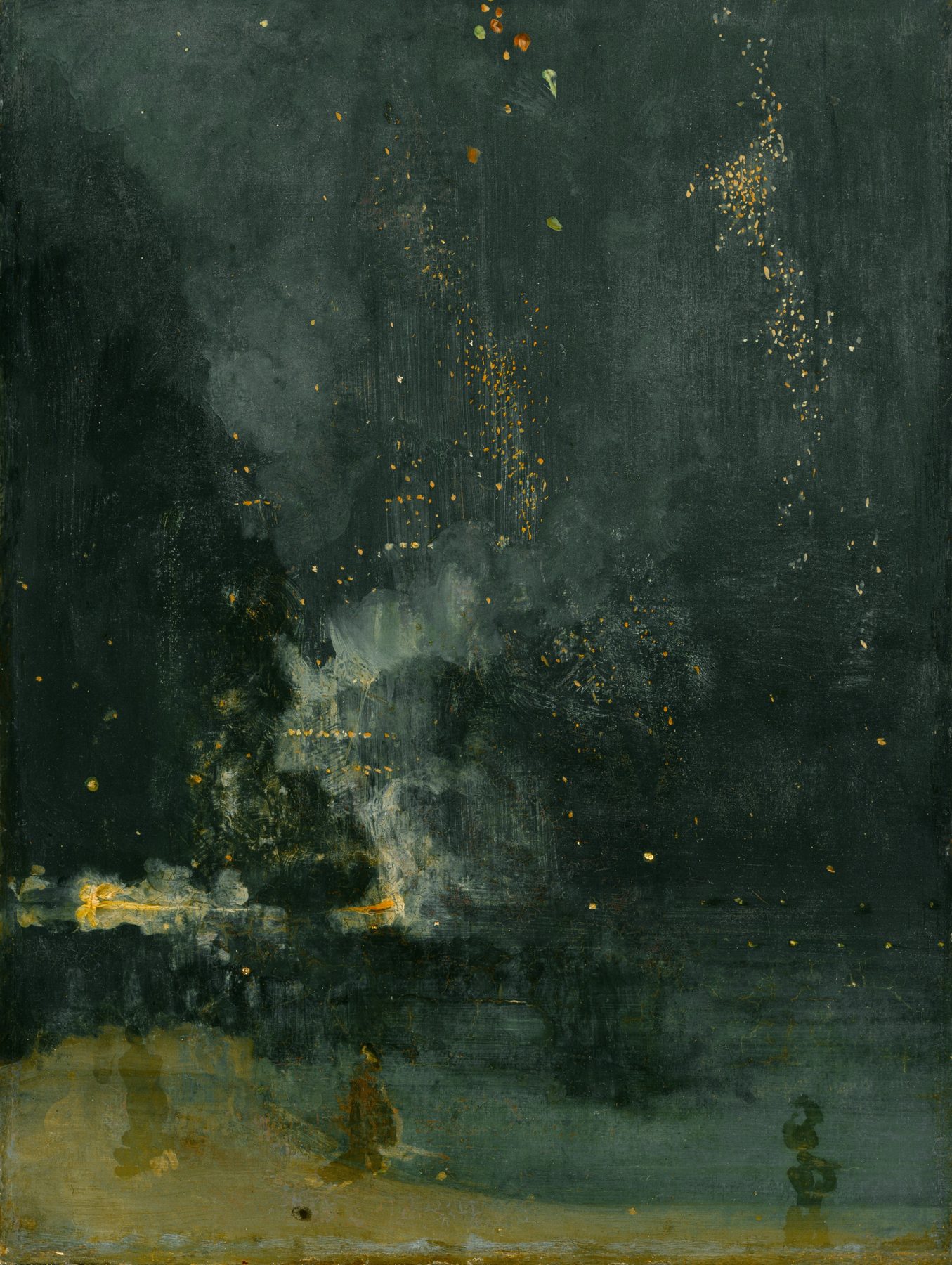
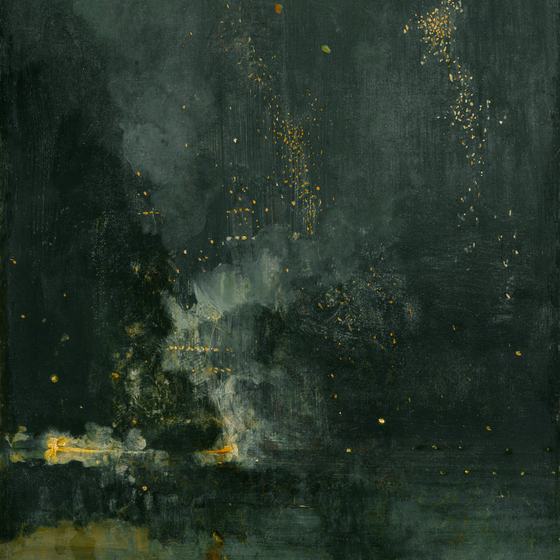
Whistler pushed the challenge further. In nocturnes of the Thames and Cremorne Gardens, restricted colour and thinly organised marks replace explanatory incident. Cremorne Gardens, No. 2 gives modern leisure as scattered illumination, silhouettes and uncertain social space. The picture is not detached from contemporary life; it refuses to explain that life through a single anecdote.[19]
The Grosvenor Gallery opened in 1877 as an alternative exhibition venue and became associated with Aesthetic painting. When Ruskin accused Whistler of impudence in relation to Nocturne in Black and Gold, Whistler sued for libel. At the 1878 trial, the question of price became a question of artistic labour. A picture painted rapidly could still embody knowledge accumulated across twenty years, Whistler argued. The damages awarded were only a farthing, and the action was financially ruinous, but the transcript preserves a revealing conflict between visible finish, moral criticism, market value and professional expertise.[17] [18]
The Peacock Room shows how Aesthetic unity could produce its own struggle. Whistler transformed the dining room designed by Thomas Jeckyll for the shipowner Frederick Leyland, integrating shelves of Chinese porcelain, painted decoration and The Princess from the Land of Porcelain. Patron and artist then quarrelled over authority and cost. The room's beauty cannot be separated from ownership, labour and the global trade that brought ceramics into a London collector's interior.[43] [53]
Chinese blue-and-white porcelain had reached Europe over centuries, but nineteenth-century collectors often detached objects from their original contexts and ranked them within Western systems of taste. Aesthetic “influence” was therefore not a weightless exchange of motifs. It involved shipping, wealth, connoisseurship, imitation and unequal power. The objects changed British colour and interior design while retaining histories that their new settings could obscure.[43] [44]
Empire, war and the global frame
Empire was not a specialist subject confined to battle canvases. It financed collectors, supplied objects and pigments, structured travel, shaped news and entered claims about national progress. The Great Exhibition announced fellowship among nations while organising colonised territories as sources of material, manufacture and spectacle. Civic wealth in industrial cities also depended on cotton, trade and networks connected to slavery and colonial extraction.[3] [36] [37]
Military painting carried distant violence into exhibitions and homes. Artists used reports, uniforms, eyewitness testimony and photography to construct scenes that few viewers had witnessed. Originals might be engraved or reproduced in illustrated papers, multiplying their emotional reach. Sympathy for exhausted soldiers could humanise war while leaving colonised opponents absent, anonymous or stereotyped. The National Army Museum's “Myth and Reality” framing captures this double operation: military art recorded experience and built memory, but it also helped turn conflict into national narrative.[32]
Landseer's Man Proposes, God Disposes approaches imperial exploration through animals. Two polar bears tear at relics of Sir John Franklin's lost Arctic expedition. Painted after revelations and rumours about starvation and cannibalism, the work stages the collapse of confident distinctions between British civilisation and the supposedly savage. The bears can appear as nature's judgement, dramatic predators or instruments through which the human disaster becomes visible without showing a body. Its enduring unease belongs to imperial anxiety, not only animal painting.[33]
Butler's focus on British rank-and-file soldiers similarly complicates triumph without leaving national culture behind. Attention to fatigue, fear and weather may resist heroic simplification, yet the viewer is still asked to identify primarily with imperial troops. Ethical intensity and ideological limitation can occupy the same canvas.
Orientalist interiors and travel pictures converted North Africa, the Middle East and South Asia into colour, architecture, costume and imagined access. Some artists conducted close study; others assembled scenes in metropolitan studios. Accuracy in one object cannot guarantee an equal relation between observer and observed. The category “type” could turn individuals into evidence of racial hierarchy. A critical reading should examine how the picture's authority was produced rather than assuming either complete truth or total fantasy.
Metropolitan Victorian painting also cannot stand for art made throughout the empire. The history of colonial Australia, for example, includes settler institutions, depictions of land as available for possession and Indigenous artistic traditions continuing amid violent dispossession. Museum projects that address this history expose the cost of treating “British influence” as a neutral style travelling outward.[45]
Collection histories now make these connections more visible. The British Museum describes how objects entered through military conquest, colonial government, missionaries, excavation and trade as well as gift and purchase. Manchester and Liverpool have likewise examined the imperial and slave-economy connections behind civic cultural wealth. Acknowledging those foundations does not make public museums worthless. It makes their promise of access historically accountable.[36] [37] [44]
Photography, print and repeated images
Photography did not abruptly replace painting. It altered particular jobs, provided new evidence, created new art and changed expectations of likeness and reproduction. Prince Albert collected photographs as works of art, records of collections, documents of science and instruments of public knowledge. Photography appeared at the Great Exhibition, and royal patronage helped establish the medium's legitimacy.[11]
Julia Margaret Cameron made large, deliberately soft-focused portraits and staged literary or biblical scenes. Her relationship with the South Kensington Museum was unusually close: the institution exhibited and collected her work, and provided rooms that helped her operate professionally during visits to London. Her practice demonstrates that photography could share Victorian painting's literary ambition while challenging its technical definitions of finish.[13]
Painters also used photographs as studies, records and means of circulation. Frederick Hollyer became especially important for reproducing works by Rossetti, Burne-Jones, Leighton and G. F. Watts. His platinum prints translated colour paintings into subtle monochrome objects suitable for albums and domestic walls. Viewers could know a picture intimately without seeing the original; the reproduction developed its own material beauty and helped stabilise reputations.[12]
Illustrated journalism multiplied visual labour. The Illustrated London News, founded in 1842, built a vast audience for engraved current events. The Graphic, founded in 1869, employed major illustrators and pursued high-quality social imagery. Museum records of these publications show that news illustration was a professional field, not a debased echo of easel art. Designs moved through draughtsmen, engravers, blocks, presses and paper before reaching readers.[6] [7]
Repetition changes meaning. A vast exhibition painting becomes a small engraving; colour turns to line; a press caption fixes interpretation; an image enters a scrapbook beside unrelated material. Tissot adapted compositions across painting, print and later biblical illustration. A famous face circulated through photography. Victorian visual culture was not only a collection of unique canvases but a system for turning images into mobile, purchasable and repeatedly interpreted things.
Civic galleries and a national school
The expansion of municipal and public collections changed who could encounter painting. Manchester's institution grew from the Royal Manchester Institution and became publicly owned in 1882, offering free access and using art for civic improvement. Its buildings and collections were also products of industrial wealth. The gallery's current history explicitly connects that wealth to cotton, colonialism and slavery, placing moral education beside material accountability.[36]
Liverpool's Walker Art Gallery opened in 1877. Its important Victorian holdings reflect a city enriched through shipping and commerce whose history is inseparable from the transatlantic slave trade and empire. Annual exhibitions, local patrons and purchases helped provincial artists and audiences participate in a national market without merely copying London.[37]
Birmingham developed a distinctive relationship between municipal culture, Pre-Raphaelitism and Arts and Crafts. Its School of Art trained women and linked design to local manufacture. Such regional histories weaken the idea that Victorian art flowed from a single metropolitan centre; they show cities using culture to educate, compete and fashion their own civic identities.[39]
Private philanthropy created other publics. Thomas Holloway's collection, formed rapidly in the 1880s for his women's college, included paintings of contemporary social concern as well as celebrated academic art. The gallery joined educational access to one collector's market choices.[34] Public acquisition could preserve women artists while cataloguing systems and later taste could also hide them, as Sophie Anderson's uneven institutional visibility demonstrates.[38]
The National Gallery of British Art opened at Millbank in 1897, founded through Henry Tate's gift and administered by the National Gallery. It gave modern British painting a dedicated national institution only four years before Victoria's death. The later name “Tate” can make its origin seem inevitable; archival and government histories instead show a specific late-Victorian act of canon-making.[35] [52]
By then the nation already possessed multiple, competing pictures of its recent art. Manchester's 1887 exhibition had defined a Victorian school through biblical and classical achievement. Civic galleries told local stories. Royal collections joined family memory to state. Dealers and reproductions created popular canons. What now appears to be “the Victorian period” was assembled through all of them.
Artists to know
William Turner
Turner carried Romantic landscape into the railway age. His late paintings turn weather, memory, light and modern technology into unstable experience, demonstrating that Victorian art could be loose, ambiguous and materially experimental.[8] [9] [10]
John Everett Millais
Millais gave early Pre-Raphaelitism its startling conjunction of outdoor exactness, saturated colour, literature and psychological danger. His later success as portraitist and Academician shows how a youthful challenge could become part of the establishment.[15]
Dante Gabriel Rossetti
Rossetti joined poetry, painting, medieval sources and the designed object. His later half-length women helped define an Aesthetic ideal whose beauty is inseparable from repetition, modelling, desire and reproduction.[12] [41]
Frederic Leighton
Leighton combined cosmopolitan training, academic office, public fresco and idealised bodies. His career links the institutional centre of British art to Aesthetic colour and the European movement of artists and models.[20]
James Whistler
Whistler turned modern rivers, gardens and interiors into relations of tone. His arguments over the nocturnes and Peacock Room made artistic expertise, patronal control and the value of visible labour public controversies.[17] [18] [19] [53]
Further artists
Edwin Henry Landseer
Landseer was celebrated for animals that appear to think and feel, but his work also shaped monarchy, class and empire. Man Proposes, God Disposes transforms the Franklin disaster into a disturbing encounter between animal force and failed exploration.[2] [33]
William Holman Hunt
Hunt pursued moral and religious meaning through brilliant colour, symbolic detail and painstaking study. His travels and biblical subjects also require attention to Victorian assumptions about place, faith and cultural authority.
Ford Madox Brown
Brown was never one of the Brotherhood's seven members, but became central to its wider history. Work turns a London street into a debated hierarchy of labour, health, intellect, class and artistic value.[24] [25]
Lawrence Alma-Tadema
Alma-Tadema used archaeological research to make antiquity sensuously present. His marble interiors and festivals translate Victorian habits of viewing, leisure and social display into a meticulously assembled classical world.[21] [22] [54]
James Tissot
Tissot was a French participant-observer in London society. Dress, modern transport, domestic space and guarded interaction make his fashionable scenes both alluring records and ambiguous social fictions.[23] [47]
Edward Burne-Jones
Burne-Jones expanded Pre-Raphaelite sources into dreamlike cycles of myth, romance and suspended action. Reproduction and decorative collaboration carried his figures far beyond their original settings.[12] [39]
John William Waterhouse
Waterhouse brought myth, poetry and the dangerous encounter into the late century and beyond. His smooth, atmospheric storytelling demonstrates how Victorian subjects survived the political end of the reign.
Frank Dicksee
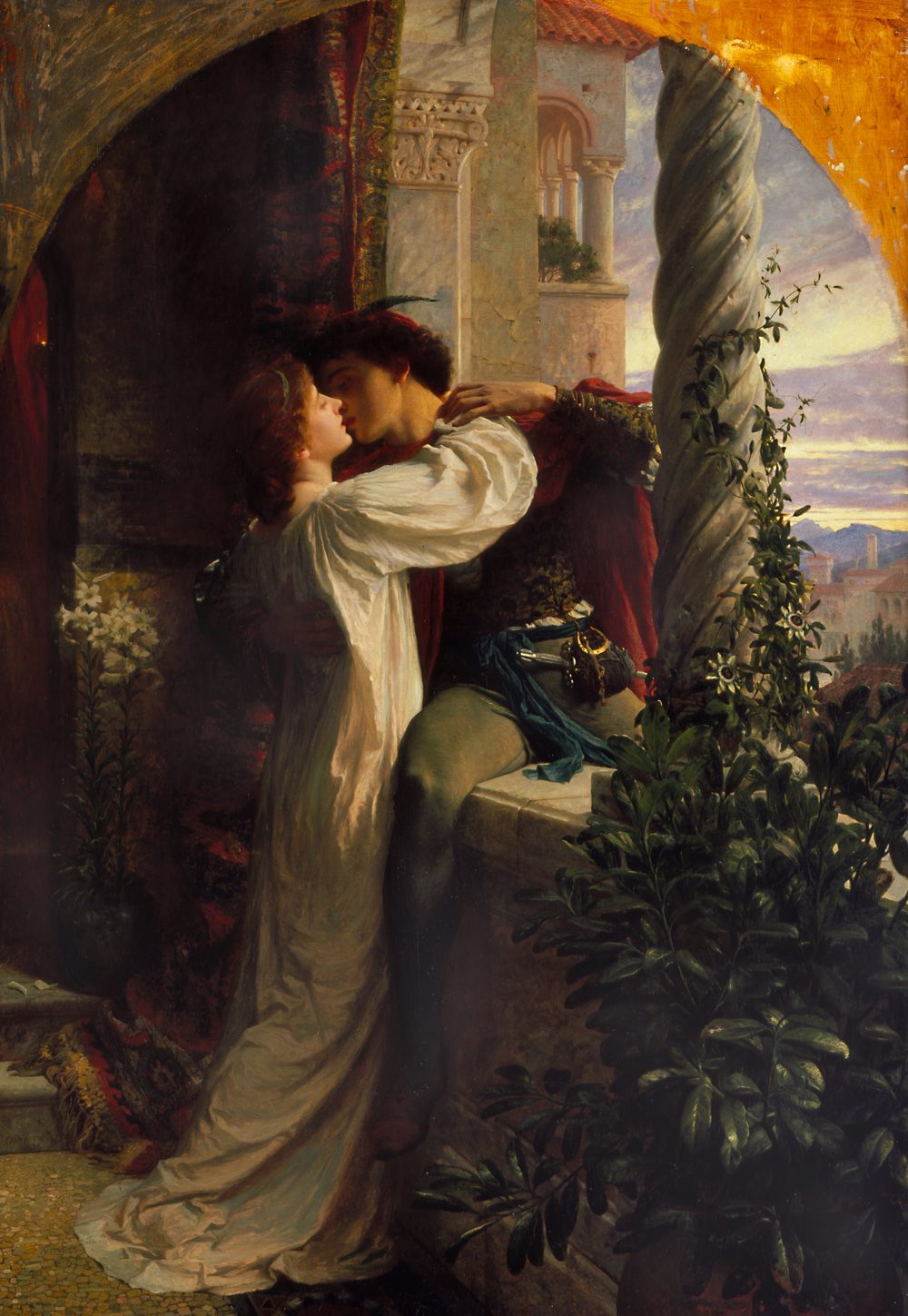
Dicksee combined literary romance, portraiture and academic technique. His long career and later Academy presidency are reminders that Victorian forms continued within twentieth-century institutions.
Major artists directory
| Name | Nationality | Key Works |
|---|---|---|
| Dante Gabriel Rossetti | British | Proserpine |
| Edward Burne-Jones | British | The Golden Stairs |
| Edwin Henry Landseer | British | Man Proposes, God Disposes |
| Elizabeth Butler | British | The Roll Call |
| Ford Madox Brown | British | Work |
| Frank Dicksee | British | Romeo and Juliet |
| Frederic Leighton | British | Flaming June |
| James Tissot | French | The Ball on Shipboard |
| James Whistler | American | Nocturne in Black and Gold |
| John Everett Millais | British | Ophelia |
| John William Waterhouse | British | The Lady of Shalott |
| Lawrence Alma-Tadema | Dutch-British | The Roses of Heliogabalus |
| William Holman Hunt | British | The Light of the World |
| William Turner | British | The Fighting Temeraire, Rain, Steam and Speed |
How to look at Victorian painting
Begin with the display the picture expected. Was it an Academy exhibit competing on a crowded wall, a royal commission, a fresco bound to architecture, a domestic watercolour or an image made famous through print? Scale, frame and venue may explain choices that seem excessive or oddly emphatic in reproduction.
Follow the clues, but do not assume they yield one solution. Titles, inscriptions, literary quotations, clocks, letters and reflected figures can construct a narrative. Ask whether the picture confirms its apparent moral or keeps several futures in play. A catalogue explanation is evidence of intended reception, not a command that ends interpretation.[18] [24]
Look at the surface before naming the subject. Turner's thin veils, Pre-Raphaelite brightness, Alma-Tadema's polished stone and Whistler's restricted tones imply different kinds of labour and attention. Smooth finish may conceal revisions; apparent spontaneity may depend on decades of knowledge. The Victorian argument over workmanship remains visible in the paint.
Notice who gets to look. A crowd scene distributes spectators within the picture as well as outside it. Dealers inspect Osborn's woman artist; fashionable figures watch and avoid one another in Tissot; Aesthetic women are repeatedly offered to viewers as beautiful surfaces. Identify who meets the gaze, who is observed without consent and whose presence is turned into a social “type”.
Test historical detail against present purpose. Classical architecture, medieval costume or military uniform can be carefully researched while serving a contemporary story about gender, nation or authority. Accuracy is a method, not a guarantee of neutrality.[31] [41] [54]
Trace absent labour and movement. Who ground colour, carved the frame, engraved the reproduction, cleaned the gallery or transported the porcelain? Where did a material or object come from? The canvas may seem self-contained while its production and ownership connect it to factories, shipping, colonial collection and domestic service.[43] [44]
Finally, preserve contradiction. A work may be beautiful and politically troubling, popular and formally inventive, compassionate towards one group and silent about another. Victorian painting becomes more interesting when close attention replaces the choice between admiration and dismissal.
Endings and legacy
Queen Victoria's death in 1901 closed a reign, not a visual language. Burne-Jones had died in 1898 and Leighton in 1896, but Waterhouse, Dicksee, Whistler, Tissot and many others crossed the century. Arts and Crafts ideals shaped modern design; Pre-Raphaelite colour and symbol entered international Art Nouveau and Symbolism; Victorian narrative practices continued in illustration, cinema and popular imagery.
Reputation changed more sharply than practice. Twentieth-century modernism often made Victorian popularity, finish and emotion into negative values. Museums stored works that had once drawn crowds. At the same time, Turner's late painting and Whistler's nocturnes were extracted as forward-looking exceptions, as though they mattered chiefly because they anticipated later art. This selective rescue distorted the period as much as indiscriminate praise.
Renewed research has restored women artists, labour, sentiment, regional institutions, reproductive media and empire to the account. It has also changed display. Birmingham's work on Victorian collections, for example, treats objects and artists as mobile within global histories rather than illustrations of an isolated national genius.[55] Such approaches do not demand that every painting receive equal esteem. They make evaluation better informed.
The period's strongest legacy may be its argument about public value. Should art teach, console, beautify, disturb, document, advertise national identity or defend its independence? Who pays for it, who enters the gallery, and whose history becomes visible? Victorian painters never reached one answer. Their disagreement is exactly why the category remains useful.
Frequently Asked Questions
No. It is a broad historical category based on Queen Victoria's reign, 1837–1901. It contains organised movements such as the Pre-Raphaelite Brotherhood and wider tendencies such as Aestheticism, but it has no single doctrine or style.
There is no universal appearance. Dense narrative detail, literary subjects and high finish are common, but atmospheric landscape, tonal nocturnes, watercolour, murals and decorative painting also belong. Venue, audience and historical context are often more reliable guides than surface alone.
No. Alma-Tadema was born in the Netherlands, Tissot in France and Whistler in the United States. They became important to Britain's art world through residence, exhibition, patronage and debate. British identity itself included distinct nations and regional centres.
It was the most prominent exhibition and professional institution, and its annual show could transform a reputation. But dealers, watercolour societies, provincial exhibitions, private galleries, royal patronage, illustrated papers and reproductive prints meant it never monopolised artistic life.
Empire shaped military subjects, travel, collecting, imported objects, exhibition displays and the wealth behind patrons and civic galleries. It also structured whose bodies and cultures were represented as rulers, soldiers, possessions or types. Its influence extends beyond pictures with obviously colonial subjects.[3] [32] [36] [37] [44] [45]
Modernist taste often distrusted narrative clarity, sentiment, polish and mass popularity. That reaction exposed some conventions but hardened into a stereotype. Recent study has recovered the period's formal variety, gendered institutions, affect, media networks and global entanglements.[49] [50] [51] [55]
Discussion
Which Victorian painting most changes your idea of the period: a narrative crowded with clues, a Pre-Raphaelite study of nature, a classical fantasy, a military scene, or an image built from little more than weather and colour? What does its surface reveal that its subject initially hides?
Reader Insights
Notice where finish, visible brushwork, saturated colour or tonal restraint asks to be treated as an argument.
Ask whether a picture settles its narrative clues or leaves class, gender and morality unresolved.
Imagine the Academy wall, civic gallery, illustrated press or private room through which the work first reached viewers.
Join the Conversation
Which work most changes your idea of what Victorian painting could be? Share your view below.
References
- Royal Collection Trust, “The patronage and collecting of Queen Victoria and Prince Albert”, rct.uk. View Source
- Royal Collection Trust, “Paintings”, rct.uk. View Source
- Victoria and Albert Museum, “The foundation of the V&A's Collections: the Great Exhibition of 1851”, vam.ac.uk. View Source
- UK Parliament, “Works of art in the Palace”, parliament.uk. View Source
- Victoria and Albert Museum, “What is watercolour?”, vam.ac.uk. View Source
- British Museum, “The Illustrated London News”, britishmuseum.org. View Source
- British Museum, “The Graphic, January–June 1871”, britishmuseum.org. View Source
- National Gallery, “Rain, Steam, and Speed – The Great Western Railway”, nationalgallery.org.uk. View Source
- National Gallery, “The Fighting Temeraire”, nationalgallery.org.uk. View Source
- Metropolitan Museum of Art, “Joseph Mallord William Turner (1775–1851)”, metmuseum.org. View Source
- Royal Collection Trust, “Prince Albert's photographic collection”, rct.uk. View Source
- Victoria and Albert Museum, “Frederick Hollyer – Life and Work”, vam.ac.uk. View Source
- Victoria and Albert Museum, “Julia Margaret Cameron and the V&A”, vam.ac.uk. View Source
- Museo Nacional del Prado, “La bella durmiente: Pintura victoriana del Museo de Arte de Ponce”, museodelprado.es. View Source
- Museo Nacional del Prado, “Millais, John Everett”, museodelprado.es. View Source
- Victoria and Albert Museum, “An introduction to the Aesthetic Movement”, vam.ac.uk. View Source
- Victoria and Albert Museum, “The wonderful world of Whistler”, vam.ac.uk. View Source
- University of Glasgow, Whistler Correspondence, trial transcript of 25 November 1878, whistler.arts.gla.ac.uk. View Source
- Metropolitan Museum of Art, “Cremorne Gardens, No. 2”, metmuseum.org. View Source
- Victoria and Albert Museum, “The South Court and Leighton Frescos”, vam.ac.uk. View Source
- J. Paul Getty Museum, Lawrence Alma-Tadema: Spring, getty.edu. View Source
- Museo Nacional del Prado, “Alma Tadema, Lawrence”, museodelprado.es. View Source
- Musée d'Orsay, “James Tissot (1836–1902), l'ambigu moderne”, musee-orsay.fr. View Source
- Ford Madox Brown, A Description of the Celebrated Picture ‘Work’, reproduced by Manchester Art Gallery, manchesterartgallery.org. View Source
- Tim Barringer, Men at Work: Art and Labour in Victorian Britain, yalebooks.co.uk. View Source
- Smarthistory, “Emily Mary Osborn, Nameless and Friendless”, smarthistory.org. View Source
- Royal Collection Trust, “The Victorian Era: Women Artists”, rct.uk. View Source
- Manchester Art Gallery, “Woman's Work: A Medley”, manchesterartgallery.org. View Source
- National Portrait Gallery, “Ann Mary Newton”, npg.org.uk. View Source
- Tate, “Louise Jopling: Through the Looking-Glass”, shop.tate.org.uk. View Source
- National Army Museum, “Dawn of Waterloo”, nam.ac.uk. View Source
- National Army Museum, “Myth and Reality: Military Art in the Age of Queen Victoria”, nam.ac.uk. View Source
- Royal Holloway University of London, “Man Proposes, God Disposes”, weddings.royalholloway.ac.uk. View Source
- Royal Holloway University of London, “History of the University and Picture Gallery”, royalholloway.ac.uk. View Source
- Tate Archive, “Tate Gallery administrative history”, archive.tate.org.uk. View Source
- Manchester Art Gallery, “History of the Gallery”, manchesterartgallery.org. View Source
- National Museums Liverpool, Walker Art Gallery Guide, shop.liverpoolmuseums.org.uk. View Source
- Art UK, “Victorian women artists in public collections: the case of Sophie Anderson”, artuk.org. View Source
- Birmingham Museums Trust, “Victorian Radicals”, birminghammuseums.org.uk. View Source
- Victoria and Albert Museum, “Arts and Crafts: an introduction”, vam.ac.uk. View Source
- Victoria and Albert Museum, “Perugino and his rediscovery by the Pre-Raphaelites”, vam.ac.uk. View Source
- UK Parliament, “A new Gothic vision”, parliament.uk. View Source
- Victoria and Albert Museum, “Chinese blue-and-white ceramics”, vam.ac.uk. View Source
- British Museum, “Collecting and Empire”, britishmuseum.org. View Source
- National Gallery of Victoria, “Colony: Australia 1770–1861”, ngv.vic.gov.au. View Source
- Belvedere Museum, “Schlafende Schönheit: Meisterwerke viktorianischer Malerei”, belvedere.at. View Source
- Musée d'Orsay, “James Tissot: l'ambiguità moderna”, musee-orsay.fr. View Source
- Museo Thyssen-Bornemisza, “Alma-Tadema y la pintura victoriana en la Colección Pérez Simón”, static.museothyssen.org. View Source
- Kate Nichols, “The Bible, Classical Antiquity, and the Invention of Victorian Art at the 1887 Manchester Jubilee Exhibition”, research.birmingham.ac.uk. View Source
- Nicola Bown, “Tender Beauty: Victorian Painting and the Problem of Sentimentality”, academic.oup.com. View Source
- Deborah Cherry, Beyond the Frame: Feminism and Visual Culture, Britain 1850–1900, routledge.com. View Source
- Tate Gallery Annual Report and Accounts 2017–18, assets.publishing.service.gov.uk. View Source
- Victoria and Albert Museum, “About the Filthy Lucre installation”, vam.ac.uk. View Source
- Metropolitan Museum of Art, “Autumn (Scene in a Roman Garden)”, metmuseum.org. View Source
- University of Birmingham, “Reimagining how we display Victorian art”, birmingham.ac.uk. View Source
- Image references 56–69: open-access reproductions and institutional collection records.
View 14 image sources
01 · commons.wikimedia.org02 · commons.wikimedia.org03 · commons.wikimedia.org04 · commons.wikimedia.org05 · commons.wikimedia.org06 · commons.wikimedia.org07 · commons.wikimedia.org08 · commons.wikimedia.org09 · commons.wikimedia.org10 · commons.wikimedia.org11 · commons.wikimedia.org12 · commons.wikimedia.org13 · commons.wikimedia.org14 · commons.wikimedia.org