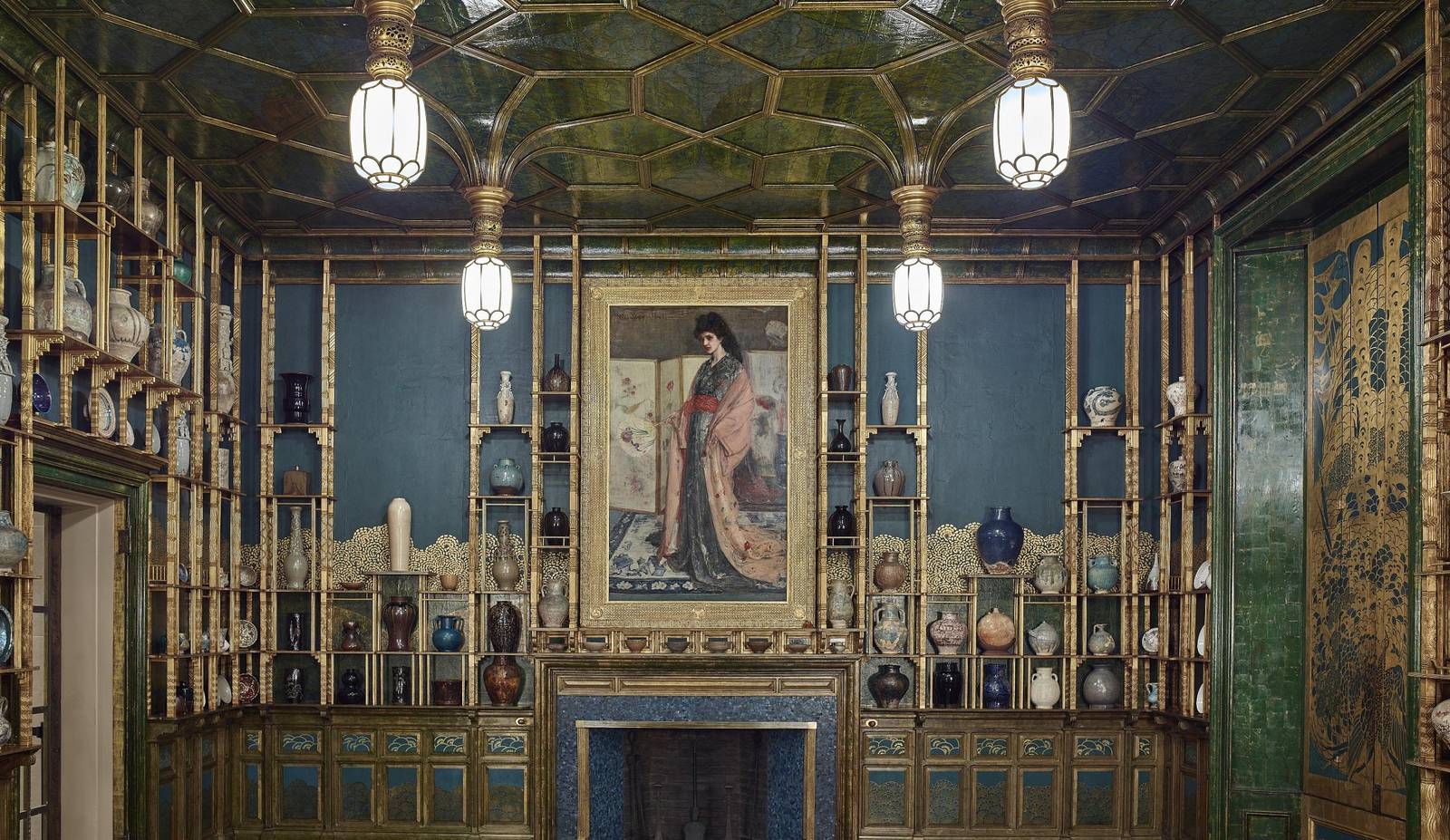
Image reference: James McNeill Whistler and Thomas Jeckyll, Harmony in Blue and Gold: The Peacock Room.
At a Glance
- Core periodc. 1860–1895 in Britain, within a wider c. 1860–1900 history
- Principal centresLondon · Paris · Venice · Philadelphia · New York
- Known forart for art’s sake · tonal harmonies · dreamlike figures · Japonisme · artistic interiors · peacocks · sunflowers
- Key artists and writersWhistler · Burne-Jones · Rossetti · Albert Moore · Walter Pater · Oscar Wilde
- Key designersE. W. Godwin · Christopher Dresser · Thomas Jeckyll · William Morris · William De Morgan
- Important venuesGrosvenor Gallery · New Gallery · studio-houses · internationally exhibited interiors
- Best understood asa network of arguments and tastes across art, literature, design and everyday life
Contents
- Where the movement fits
- What “art for art’s sake” meant
- From Pre-Raphaelitism to Aestheticism
- Whistler and painting as harmony
- Burne-Jones, Moore and the beautiful figure
- The house beautiful
- The Peacock Room
- Japonisme and Chinese collecting
- Women, making and artistic dress
- Artists and designers to know
Where the Aesthetic Movement fits
Whistler
Principal careerBurne-Jones
Principal careerRossetti
Principal careerAlbert Moore
Principal careerLeighton
Principal careerWilliam Morris
Principal careerE. W. Godwin
Principal careerChristopher Dresser
Principal careerMarie Spartali Stillman
Principal careerOscar Wilde
Principal careerAubrey Beardsley
Principal careerThe Aesthetic Movement made beauty a provocation. In Britain from the 1860s to the 1890s, painters, writers and designers challenged the expectation that art should teach a moral lesson, improve public behaviour or justify itself through usefulness. They argued that colour, line, rhythm, texture and intensity could be sufficient reasons for making and experiencing art. The phrase most closely associated with them—“art for art's sake”—was simple enough for a slogan and disruptive enough to change how a painting, poem, chair or room could be understood.[1] [2]
There was no membership card, manifesto or agreed style. James McNeill Whistler gave paintings musical titles and defended the artist's freedom from narrative demands. Edward Burne-Jones turned medieval and mythological stories into suspended dreams. Walter Pater made the quality of individual experience central to criticism. Oscar Wilde carried aesthetic argument into fiction, lectures, dress and celebrity. E. W. Godwin and Christopher Dresser brought Japanese-derived structure and new thinking about objects into modern manufacture. William Morris shared the desire to unite art and life, but insisted that beauty could not be separated from materials, useful work and society.[3]
This diversity is the movement's strength. Aestheticism could reject philistine commerce while selling a fashionable lifestyle; praise individual freedom while relying on patrons and factories; admire Japanese and Islamic art while converting it into European fantasy; and celebrate beautiful women while limiting women's professional identities. It taught people to look more closely, but it also made taste into social distinction. Its history is not a retreat from the world. It is an argument about what beauty does within it.
Aestheticism developed between the reforming ambitions of the Pre-Raphaelites and the sharper experiments of the fin de siècle. Its British roots lie partly in the 1850s, when Dante Gabriel Rossetti, Morris and their circle widened Pre-Raphaelite art beyond the Brotherhood's original commitment to close natural observation and morally serious subject matter. Rich colour, medieval reverie, poetic ambiguity and the cultivated domestic interior became increasingly important. By the 1860s, Whistler and Albert Moore were finding other routes to visual autonomy through Japanese art, classical figures and musical analogy.[1] [25]
The movement's practical core begins around 1860. Whistler's Symphony in White, No. 1: The White Girl was rejected in London, then appeared at the Paris Salon des Refusés in 1863. Rossetti's private patrons encountered rooms filled with blue-and-white porcelain, old furniture, textiles and paintings. Burne-Jones withdrew from regular public exhibition before returning spectacularly at the new Grosvenor Gallery in 1877. Pater's Studies in the History of the Renaissance had appeared in 1873, giving readers a language for cultivated sensation and the fleeting intensity of experience.[25] [26] [40]
The year 1877 forms a useful midpoint. The Grosvenor Gallery opened as a prestigious alternative exhibition space; Burne-Jones emerged as its star; Whistler showed Nocturne in Black and Gold: The Falling Rocket; and the Peacock Room was completed after a bitter dispute with its patron. Painting, exhibition, interior and controversy met in one season.[6] [38] [39]
By the early 1880s, Aestheticism was publicly recognisable enough to parody. A drooping figure with long hair, knee breeches, a lily or sunflower and an obscure enthusiasm for blue-and-white china could be understood as a type. Gilbert and Sullivan's Patience opened in 1881. Wilde toured the United States in 1882, lecturing on decorative art while newspapers circulated Napoleon Sarony's photographs of him in carefully arranged costume. Fashion and satire helped the movement reach people who never entered the Grosvenor Gallery.[34] [35]
The endpoint is less tidy. In the 1890s, Aubrey Beardsley's black-and-white designs, Wilde's writings and the culture of Decadence intensified Aestheticism's erotic, artificial and transgressive associations. Wilde's conviction in 1895 devastated his life and encouraged moralists to treat the aesthete as a dangerous social type. Yet furniture, graphic design, interiors and the Arts and Crafts movement continued. Art Nouveau transformed Aesthetic line and Japonisme rather than waiting for a clean ending.[7] [8]
Several neighbouring movements must therefore remain distinct. The Pre-Raphaelite Brotherhood began in 1848 and carried a reforming programme that Aestheticism did not inherit whole. Arts and Crafts made labour, materials and social purpose more explicit than “art for art's sake”. Symbolism often sought spiritual or psychological meanings behind visible form. Decadence embraced artifice, extremity and decline as themes. Art Nouveau developed a new international design language in the 1890s. Aestheticism overlaps all four without being identical to any of them.
What “art for art's sake” meant
The slogan began in French. Théophile Gautier's provocative preface to Mademoiselle de Maupin in 1835 rejected the demand that literature be useful or morally improving. The Parnassian poets later made l'art pour l'art a principle of formal discipline and impersonal beauty. Baudelaire's criticism and poetry complicated the inheritance by finding modern beauty in artificial, unsettling and urban experience. British Aestheticism did not merely translate a phrase; it adapted a French dispute about art's independence to Victorian arguments about morality, industry, religion and taste.[25] [27] [28]
“Art for art's sake” did not mean that art contained no thought. It denied that a picture's value depended on a lesson that could be extracted from it. A painting might organise colours beautifully without illustrating a virtuous deed. A poem might intensify sensation without telling the reader how to behave. The work remained capable of emotional, social and even ethical effects, but those effects were not a compulsory external test.
Pater's Studies in the History of the Renaissance offered one of the period's most influential formulations. In its Conclusion, he presents experience as a flow of impressions and asks the cultivated person to sharpen perception before life passes. Art matters because it supplies some of the richest moments of consciousness. This is more demanding than simple pleasure-seeking: the viewer must discriminate among sensations, remain alert to form and resist inherited formulas.[40]
Whistler's theory was related but different. In his Ten O'Clock lecture, delivered in 1885 and later published, he defended the artist as a selective maker rather than a reporter who copies nature or serves public morality. Nature supplies materials, but art depends on arrangement. His musical titles insist on this distinction. A nocturne is not valuable because it describes a bridge accurately; it succeeds through the relation of darkness, light, interval and tone.[41]
Wilde turned the argument into paradox. His criticism repeatedly reverses the assumption that art should imitate life, while his public persona suggests that clothing, speech and rooms can themselves become authored performances. Yet Wilde's Aestheticism is not reducible to a vase and a velvet coat. His fiction tests the danger of confusing beautiful surfaces, ethical responsibility and the desire to make life imitate art.
The slogan was powerful precisely because it remained unstable. Whistler used autonomy to defend pictorial experiment. Pater valued the intensity of reception. Wilde explored artifice and self-creation. Morris could admire beauty everywhere while refusing to sever it from work and collective life. Aestheticism is best approached as a sustained disagreement about art's freedom, not a rule that every participant obeyed.
From Pre-Raphaelitism to Aestheticism
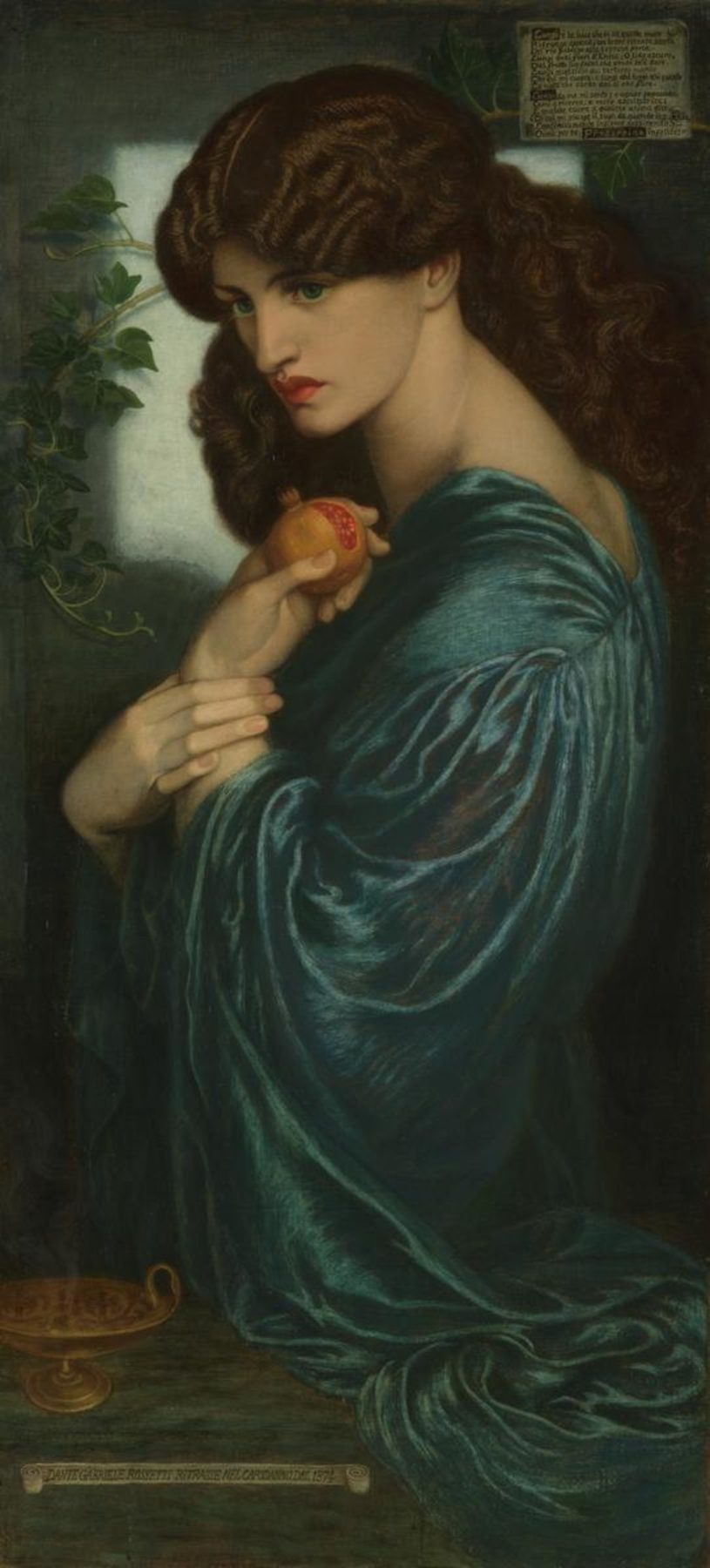
The Pre-Raphaelite Brotherhood had sought truth to nature, brilliant colour and moral or poetic seriousness. By the late 1850s, Rossetti's work shifted toward half-length women, musical instruments, flowers, luxurious fabrics and literary moods whose stories are deliberately elusive. Beauty no longer simply carried a legible moral. The face, colour and surrounding objects became the event.
This later Pre-Raphaelite world supplied Aestheticism with patrons, models, makers and domestic settings. Rossetti collected Chinese blue-and-white porcelain and arranged rooms that visitors remembered as extensions of his art. Morris and Burne-Jones collaborated across stained glass, furniture, embroidery, tapestry and book design. Jane Morris appeared as a model but also made embroidery and contributed to the material culture around the circle. Images and objects moved through friendships, businesses and households rather than along one formal line.[5] [42]
Burne-Jones retained medieval and mythological subjects throughout his career. That matters because Aestheticism did not require the abolition of narrative. In his mature work, however, action slows. Figures seem absorbed in music, sleep, enchantment or waiting. Repeated bodies and carefully tuned colour can become more important than a dramatic climax. A story remains present while painting suspends it.
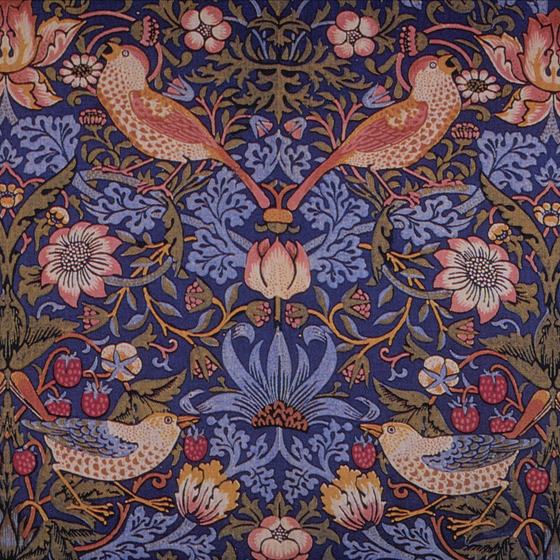
Morris exposes a productive fault line. He co-founded Morris, Marshall, Faulkner & Co. in 1861 and developed wallpapers, textiles, furniture and stained glass intended to reunite the arts. This ambition strongly overlaps the “house beautiful”. But Morris increasingly argued that good design required pleasure in labour, respect for materials and a transformed social order. Beauty for a wealthy client could not compensate for degraded work elsewhere. Arts and Crafts grew from this ethical and economic critique, even while Morris & Co. sold costly goods to an elite market.[42] [48]
The relationship is therefore neither identity nor opposition. Aestheticism helped elevate the decorative arts and assert that daily surroundings matter. Morris shared that revolution. He differed in asking who made the beautiful thing, under what conditions and for whom. The question remains one of the movement's most important unresolved inheritances.
Essential works
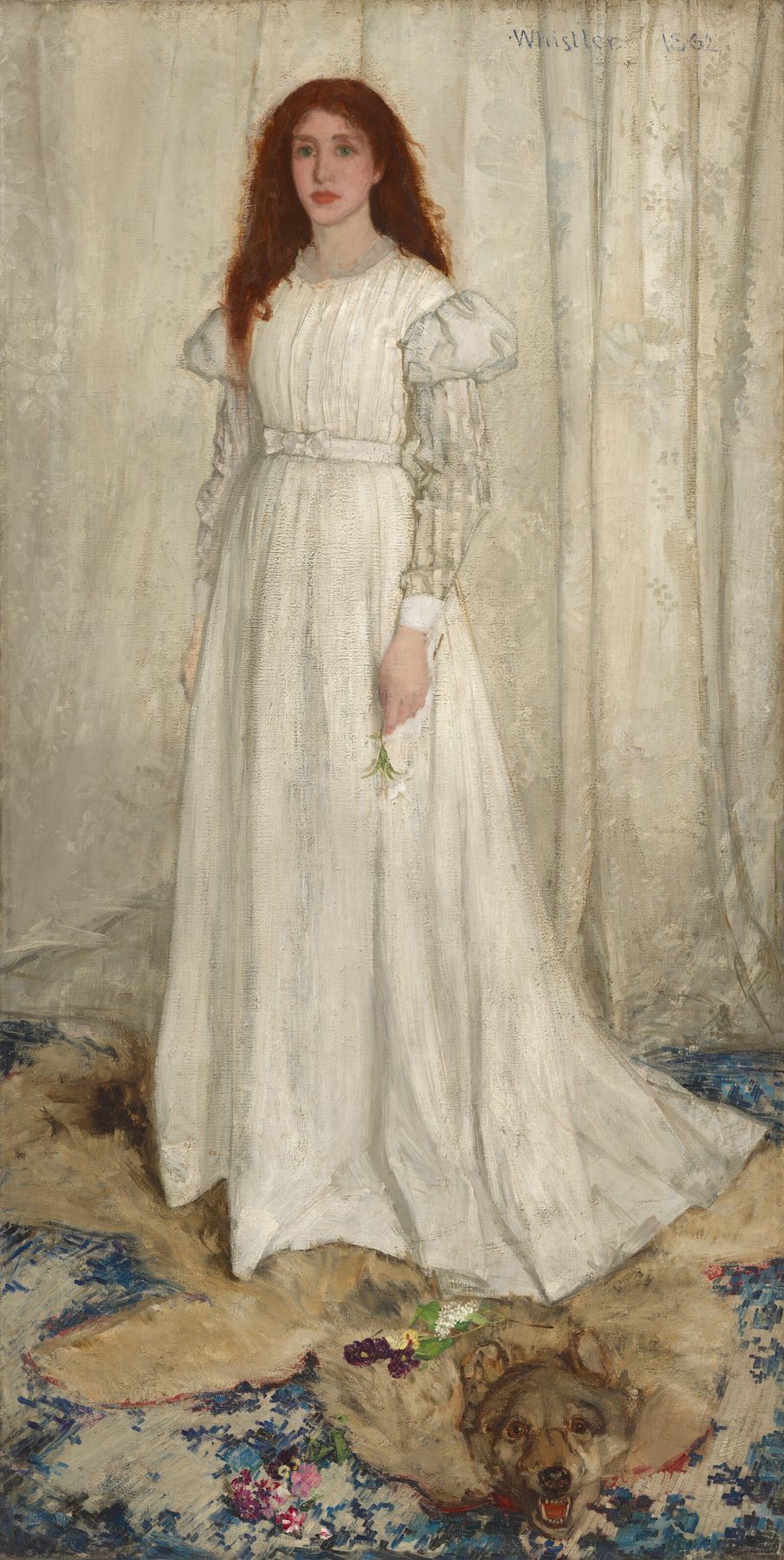
Symphony in White, No. 1: The White Girl
James McNeill Whistler, 1861–62
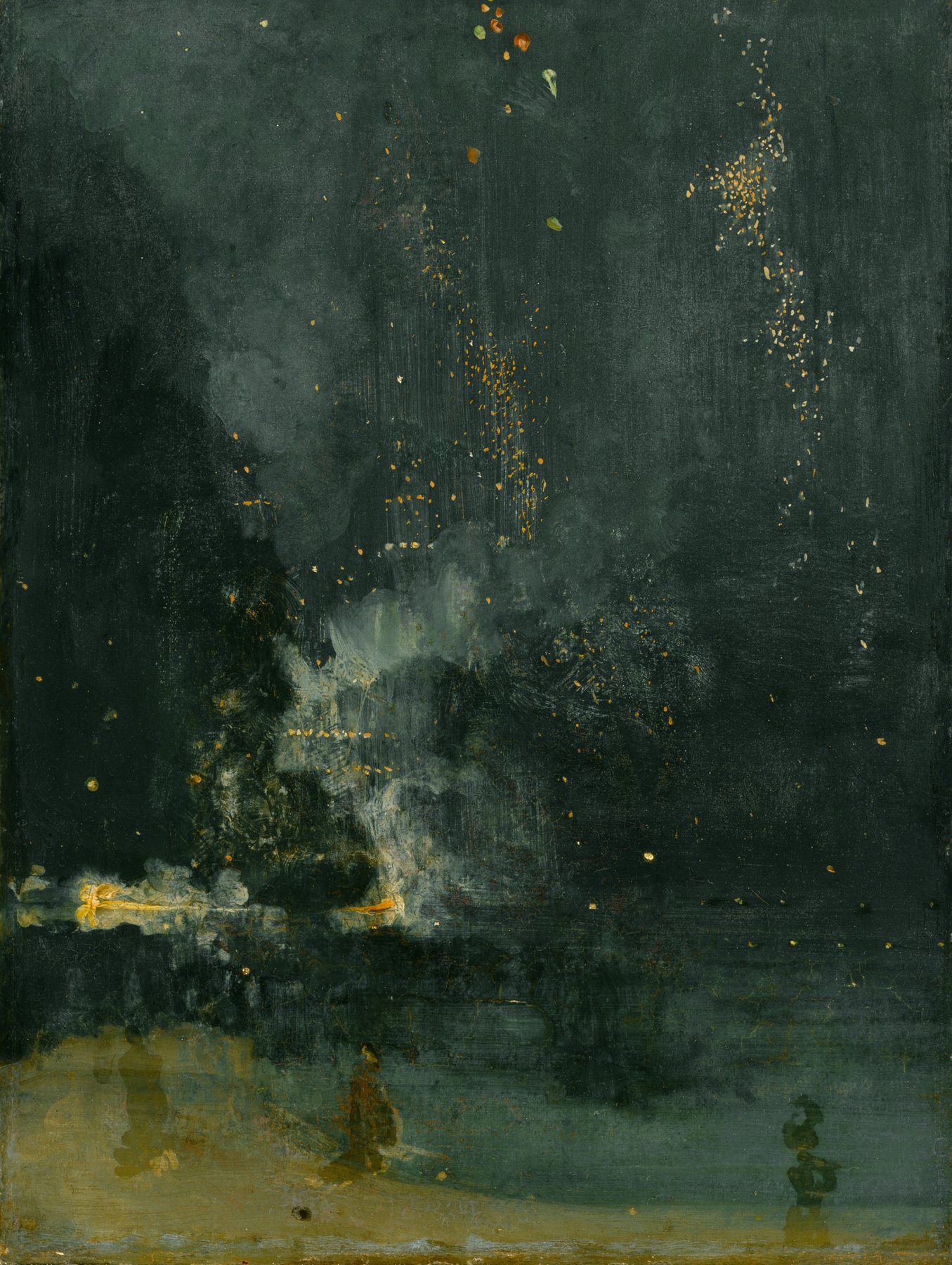
Nocturne in Black and Gold: The Falling Rocket
James McNeill Whistler, c. 1875
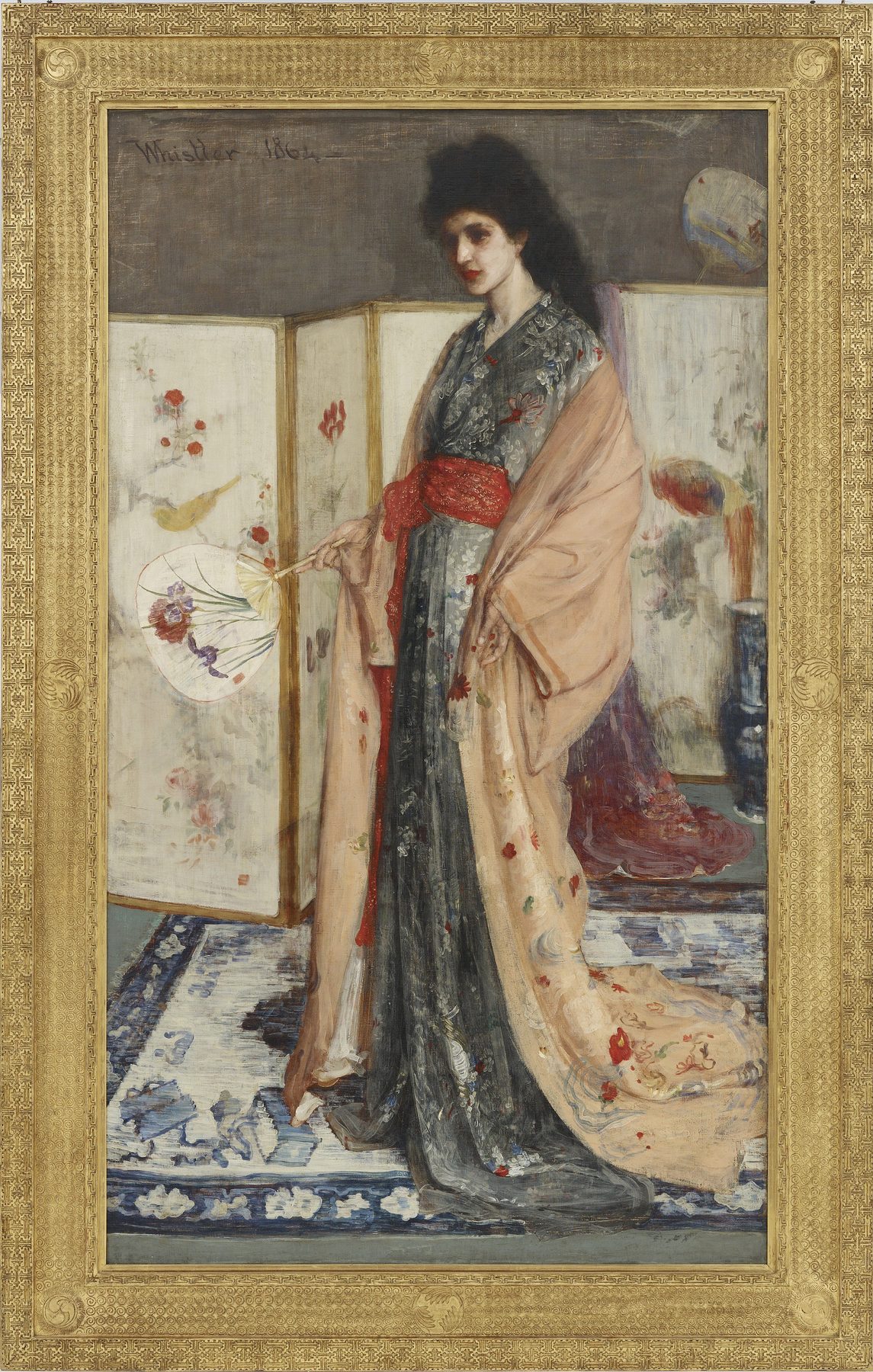
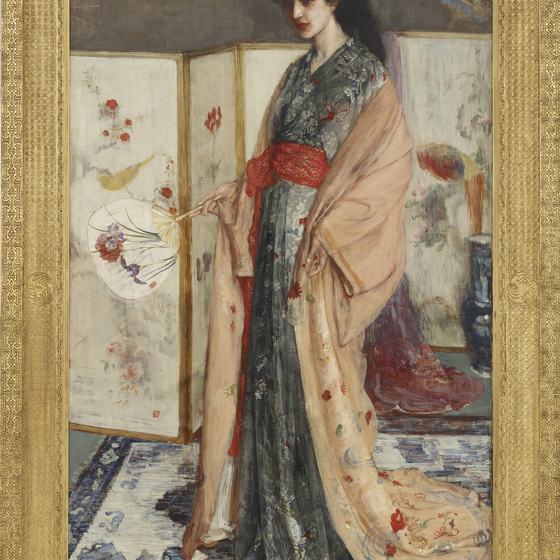
The Princess from the Land of Porcelain
James McNeill Whistler, 1863–65
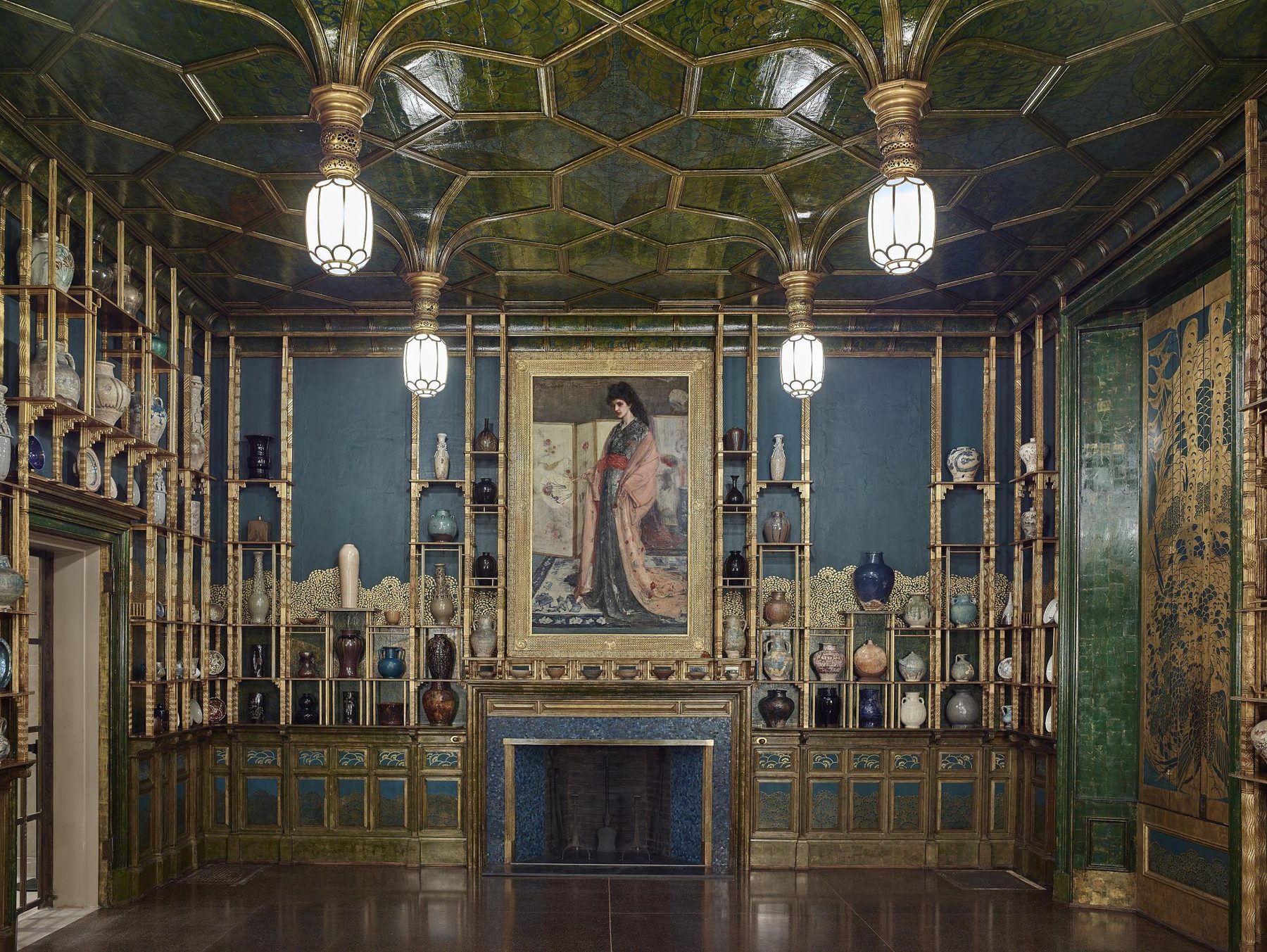
Harmony in Blue and Gold: The Peacock Room
James McNeill Whistler and Thomas Jeckyll, 1876–77
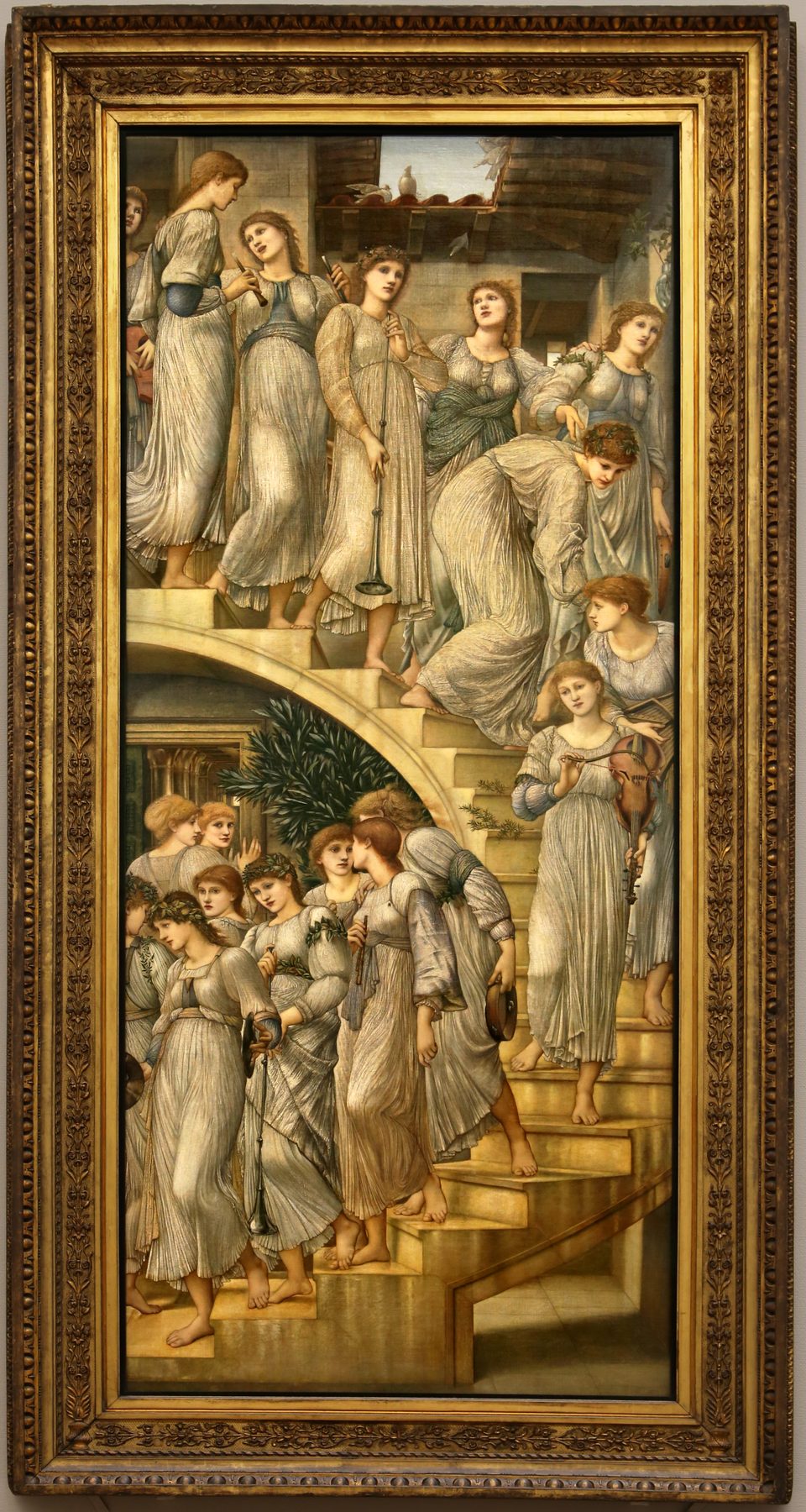
The Golden Stairs
Edward Burne-Jones, 1880
Whistler and painting as harmony
Whistler's titles tell the viewer how to begin. Symphony in White, Arrangement in Grey and Black, Harmony in Grey and Green and the Nocturnes borrow language from music. The titles do not make subject disappear: a woman still stands before a curtain, a mother sits in profile, the Thames remains a recognisable place. They change the order of attention. Before asking who the sitter is or what event has occurred, the viewer is invited to notice how white differs from white, how a vertical interrupts an empty field or how small lights hold together a dark expanse.[6] [14]
His Japonisme changed in the same way. Early paintings and prints visibly include a fan, folding screen, robe or blue-and-white pot. These objects announce contemporary collecting. As his art developed, lessons from Japanese prints moved into structure: high horizons, abrupt cropping, asymmetrical placement, compressed depth, large quiet areas and lines that describe without modelling every volume. Museum research in German and Spanish emphasises this shift from imported prop to compositional intelligence.[13] [14]
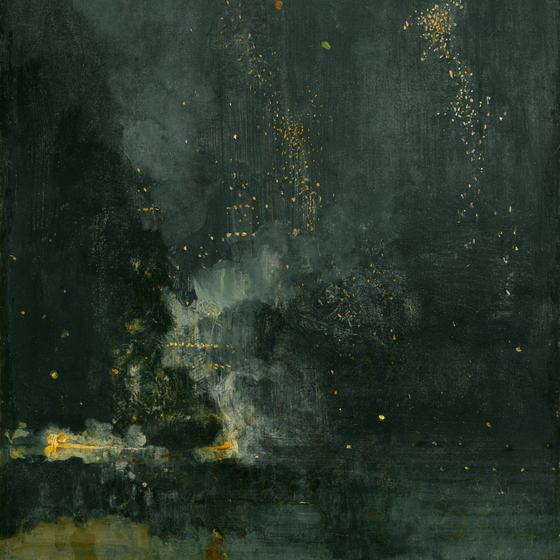
The Nocturnes are the clearest test. Whistler thinned paint and worked from memory to evoke the Thames at dusk, mist around Battersea Bridge or fireworks at Cremorne Gardens. In Nocturne in Black and Gold: The Falling Rocket, sparks descend through a dark green-black atmosphere. Small marks of orange and pale yellow appear to float at uncertain distances. The crowd is scarcely more substantial than the smoke. The picture does not reproduce a firework display; it makes vision itself intermittent.[26] [47]
When the picture appeared at the Grosvenor Gallery in 1877, John Ruskin attacked Whistler for demanding a large price after seemingly throwing paint at the public. Whistler sued for libel. The trial turned an aesthetic dispute into a question about labour: how long should a painting take, what constitutes finish, and whether price measures hours or accumulated expertise. Whistler won, but received nominal damages of one farthing. Legal costs contributed to his bankruptcy.[6] [47]
The dispute is often narrated as modern genius defeating conservative incomprehension. That is too simple. Ruskin also believed profoundly in art and perception, but expected form to answer to truth, labour and moral life. Whistler asserted the artist's authority to decide when arrangement was complete. Their clash made visible two different ways of linking art to the world.
Whistler carefully designed frames, signatures, catalogues and exhibition spaces, so autonomy did not mean indifference to presentation. His Yellow Room of 1883 coordinated yellow walls, Japanese objects and paintings in a temporary display associated with Maud Franklin. He used interiors to control the conditions under which individual works were seen.[19]
His influence reached beyond Aestheticism. Tonal painters in Britain and the United States learned from his restricted palettes and atmospheric intervals. Later abstract artists could recognise the proposition that relations within a picture need not be subordinate to story. Whistler did not invent abstraction, and his views remain tied to river, figure, print and decorative setting. He helped make formal relation a public subject.[26]
Burne-Jones, Albert Moore and the beautiful figure
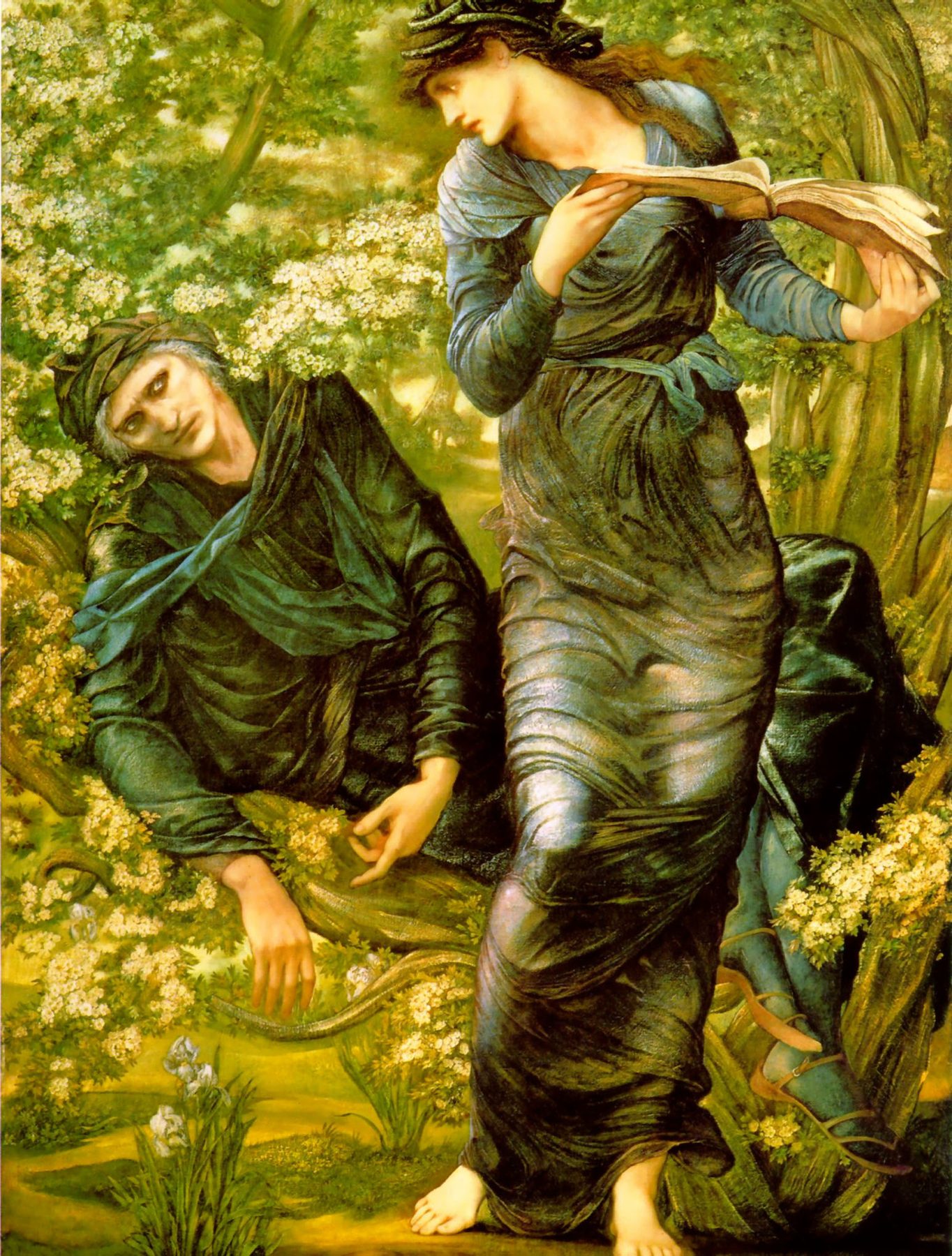
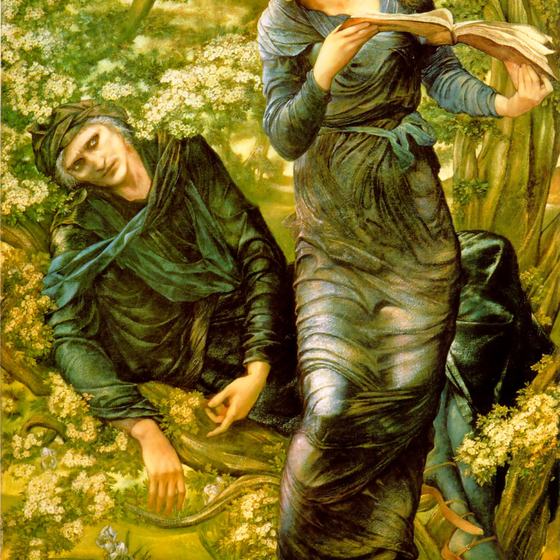
Burne-Jones returned to public exhibition at the Grosvenor Gallery in 1877 after years of working mainly for private patrons. Eight paintings, including The Beguiling of Merlin and the Days of Creation, established him as a central figure for a new audience. His reputation rested on an art that looked backward and forward at once: medieval legend, early Renaissance painting and classical bodies were reorganised into a modern dream of repetition, stillness and desire.[38] [39]
The Golden Stairs, shown in 1880, offers no agreed story. A long procession of young women descends a turning staircase, carrying musical instruments. Their pale dresses repeat with small variations; their bodies form a measured cadence; the architecture cuts a strong curve through a shallow, patterned space. Music is represented but not heard. The painting behaves like the performance it withholds, allowing intervals of colour and gesture to structure time.
The figures resemble one another enough to create unity, yet individual faces differ. Several were drawn from people in Burne-Jones's circle. The tension between type and person is central to Aesthetic painting. Repetition can turn the body into ornament, but a glance or tilt of the head resists complete absorption into pattern.
Albert Moore took the suppression of incident further. He painted classically draped figures reclining, standing or arranging themselves among textiles and architecture. Titles often name a colour, flower or object rather than a myth. Bodies become elements in a harmony of intervals, folds and repeated curves. Where Burne-Jones keeps the pressure of legend, Moore approaches an ideal of pictorial music.
Frederic Leighton occupies a more institutional position as a successful Royal Academician and later its president. His paintings and sculpture demonstrate exceptional academic training, but works organised around music, dance or languor also participate in Aesthetic attention to formal harmony. The early 1880s friezes for his house's Arab Hall use rhythm and gesture rather than narrative climax, placing his art within the movement's broader sensory world.[33]
Lawrence Alma-Tadema likewise belongs near the movement rather than inside a narrow definition. His archaeologically detailed marble interiors, flowers, fabrics and bodies offered Victorian audiences a classical antiquity experienced through luxury and atmosphere. John William Godward later extended that classicising dream after Aestheticism's avant-garde moment had passed. Both are valuable connections, but neither should be mistaken for a theorist of art's autonomy.
The Grosvenor Gallery and the public of taste
Sir Coutts Lindsay and his wife, Blanche, opened the Grosvenor Gallery in New Bond Street in 1877. Blanche's Rothschild wealth helped finance a richly decorated building that offered artists an alternative to the Royal Academy's crowded annual exhibition. Pictures were more widely spaced and could be grouped by artist, encouraging visitors to experience a coherent style rather than scan a dense wall for isolated subjects.[39]
The gallery did not represent one faction. Burne-Jones, Whistler, Albert Moore and Walter Crane appeared alongside Leighton, G. F. Watts and other Academicians. That mixture mattered. Aestheticism emerged through juxtaposition and fashionable sociability rather than institutional secession. The gallery could challenge Academy habits while borrowing the prestige of established artists.
Its rooms were themselves part of the spectacle. Musée d'Orsay research notes the memorable progression from rich crimson toward the “artistic” greens associated with later Aesthetic interiors. Electric lighting, decoration, dress and the ritual of the private view made looking a social performance. To attend was to display one's capacity for advanced taste.[25]
The Grosvenor also exposed art to satire and conflict. Ruskin's review of the 1877 exhibition produced the Whistler case. Burne-Jones's elongated figures invited admiration and parody. Newspapers and Punch translated specialist disputes into comic types. The gallery created a public for aesthetic autonomy by making that autonomy news.
After disagreements within its management, many artists moved to the New Gallery, which opened in 1888. This transition confirms that Aestheticism was not contained by one building. The Grosvenor's lasting achievement was to demonstrate how hanging, colour, architecture and social occasion could shape the meaning of art.
Follow the Aesthetic Movement through four stages
–1873
Beauty becomes an argument
Later Pre-Raphaelite colour, Whistler’s musical titles and Pater’s writing shift attention from moral narrative toward form, sensation and artistic autonomy.
–1881
A public of taste takes shape
The Grosvenor Gallery, the Peacock Room and new artistic interiors turn Aesthetic experiment into a visible culture of exhibitions, collecting and controversy.
–1890
The house beautiful and the fashionable aesthete
Furniture, metalwork, textiles, dress and Wilde’s celebrity spread Aesthetic ideas through manufacture, shopping, satire and transatlantic lecture culture.
–1900
Decadence and transformation
Beardsley intensifies line, artifice and black-and-white design as Aestheticism flows into Decadence, Symbolism and Art Nouveau.
The house beautiful
Aestheticism asked what would happen if art left the frame. The answer appeared in houses where walls, furniture, ceramics, metalwork, textiles, clothing and behaviour were coordinated. The home became both a lived environment and an argument that daily perception could be educated.[1] [4]
Artist houses made the argument visible. Morris and Philip Webb's Red House joined architecture, furniture and collaborative decoration. Rossetti's interiors converted collecting into personal mythology. Leighton's studio-house gave professional identity a ceremonial setting. Alma-Tadema designed rooms that echoed the marble, metal and antique objects in his paintings. Whistler's White House, designed with E. W. Godwin, pursued a sparer modern geometry.
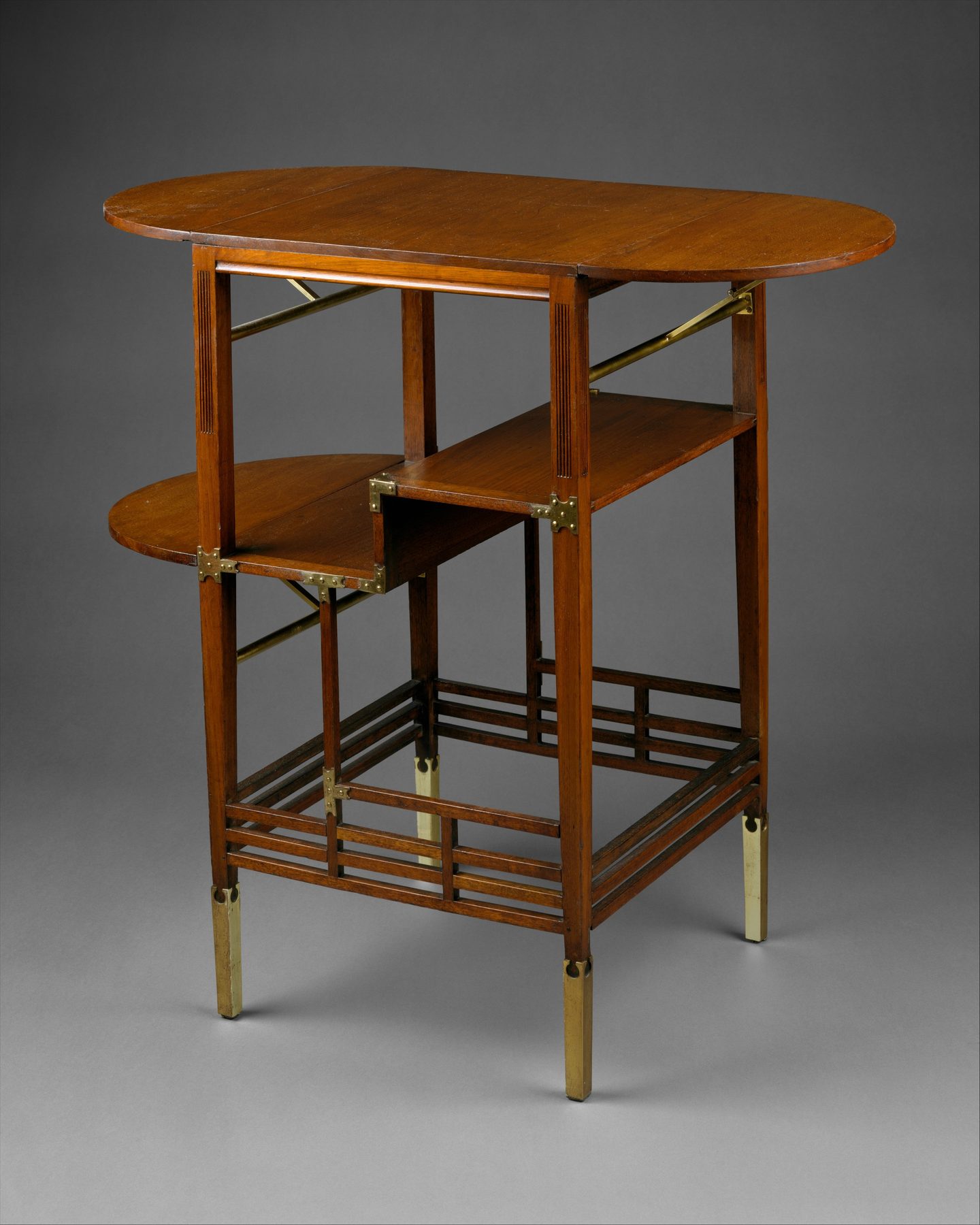
Godwin's furniture reveals how many sources could meet in one object. A side table of about 1872 uses attenuated posts, asymmetrical stretchers and exposed metal braces. Its linearity relates to Japanese furniture and architecture, but also to restrained Georgian forms. Godwin's interest in theatre and hygienic rooms mattered too. He wanted furniture that could be moved and cleaned rather than covered with dust-catching upholstery and carving.[10] [11]
Christopher Dresser offers another route. Trained in botany, he studied plant structure and developed designs that abstracted natural growth without merely copying flowers. Unlike most British designers of his generation, he travelled to Japan in 1876–1877. He worked extensively with manufacturers of ceramics, glass, metal and textiles, designing forms suited to industrial processes.[12]
The contrast with Morris is instructive. Dresser could regard the factory as a means of distributing intelligent form. Morris feared that industrial division of labour destroyed the maker's pleasure and the object's integrity. Both opposed dishonest ornament and wanted design to respect material; their remedies differed.[48]
The “house beautiful” could also become a shopping list. Advice literature encouraged consumers to avoid crowded, conventionally respectable interiors and choose harmonious colours, simpler furniture, peacock feathers, sunflowers, lilies, Japanese fans and blue-and-white ceramics. A commissioned artist's house was beyond most budgets, but a patterned paper or pot allowed the middle class to buy a fragment of aesthetic identity.[4]
This was an achievement and a contradiction. Aestheticism expanded the claim that ordinary surroundings deserved attention. At the same time, “taste” separated those who knew the correct shade of green or arrangement of china from those labelled philistine. Beauty became a democratic aspiration and a competitive social language.
The Peacock Room
The Peacock Room is the movement's most concentrated interior and its most revealing quarrel. In 1876, the Liverpool shipping magnate Frederick Leyland asked architect Thomas Jeckyll to redesign the dining room of his London house at 49 Prince's Gate. Leyland wanted to display an important collection of Chinese blue-and-white porcelain. Whistler's painting The Princess from the Land of Porcelain occupied a place of honour over the mantel.[20] [21]
Jeckyll created shelving, a lattice-like ceiling and architectural woodwork sympathetic to the porcelain. When he became ill, Whistler was asked to make limited colour adjustments so his painting would sit more comfortably in the room. During Leyland's absence, Whistler expanded the commission. He covered leather wall panels, shutters and ceiling with a blue-green ground and metallic gold, turning the room into what he called a harmony in blue and gold.[6] [20]
The result coordinates enclosure and display. Gold feathers spread across blue surfaces; shelving divides the wall into changing rectangles; circular plates and bulbous pots punctuate the grid. The room neither imitates a Chinese interior nor hides its British architecture. It stages a European Aesthetic fantasy around Chinese objects.
On the shutters, two peacocks confront one another. The bird identified with Whistler appears alert and combative; the patronal peacock is burdened by coins. Silver shillings are scattered like plumage. The image turns a dispute about payment and permission into decoration. Whistler had transformed more than Leyland authorised, then expected compensation for the artistic whole. Leyland objected to both the cost and the loss of control.[21] [22]
The conflict complicates “art for art's sake”. Whistler claimed the right to complete a harmony according to artistic judgement. But the room belonged to a patron, contained his collection and depended on his money. Artistic autonomy was asserted within a private commission, not outside economics. The fighting peacocks preserve both the brilliance and aggression of that claim.
Calling the room a three-dimensional painting captures its visual unity but can erase collaborators and use. Jeckyll designed the architectural framework; craftspeople made the fittings; Chinese potters had produced the ceramics; servants and diners moved through the space. It was an artwork, collection display and dining room at once.
Its later history adds another layer. American industrialist and collector Charles Lang Freer bought the room in 1904 and installed it in his Detroit home. Instead of reconstructing Leyland's exact porcelain display, Freer arranged ceramics from Syria, Iran, Japan, China and Korea according to colour and form. The room moved from one collector's Chinese display to another collector's comparative vision of Asian art.[23] [24]
Freer's installation eventually became part of the Smithsonian's museum in Washington. The move preserved the room but changed its public. A private dining room built from disputed authority became a museum environment through which millions of visitors encounter Whistler and Asian ceramics. Current interpretation increasingly asks how global trade, collecting and unequal cultural power sit inside its beauty.[22]
The Peacock Room is therefore not a decorative footnote. It is a test of the entire movement: autonomy against patronage, integrated design against individual authorship, admiration against appropriation, and beauty against the money that makes it possible.
Japonisme and Chinese collecting
European Aestheticism encountered East Asian art through trade, international exhibitions, dealers and collections. Japan's opening to treaty trade in the 1850s increased the movement of objects, and the London International Exhibition of 1862 gave many British viewers a concentrated encounter with Japanese design. Prints circulated in Paris and London, sometimes used as wrapping before collectors and artists assigned them new status.[16] [18]
Ukiyo-e prints were not spontaneous sheets by a solitary master. They were commercial collaborative works involving a designer, block carvers, printers and publishers. Their subjects included actors, courtesans, landscapes and urban life. European artists selected particular qualities—flat colour, silhouette, cropping, asymmetry and unfamiliar viewpoints—while often ignoring the social and publishing systems that produced them.[17]
Whistler's prints and paintings show sustained formal learning. A bridge may cut a view abruptly; a figure stands at the edge rather than centre; a large empty interval becomes active; a vertical format compresses river and shore. These are not copies of a particular Japanese print. They are European transformations of compositional ideas encountered through Japanese work.[13] [15]
Designers responded differently. Godwin translated perceived Japanese linearity into furniture. Dresser studied Japanese objects and manufacturing directly, then designed for British firms. Liberty & Co. helped turn Japanese and Japanese-derived goods into a fashionable market. Japonisme could deepen visual understanding and become a commercial label at the same time.[12] [16]
Chinese blue-and-white porcelain belongs to a related but distinct history. Rossetti and Whistler collected antique Chinese ceramics in the 1850s and 1860s, helping make them signs of advanced taste. Their whiteness and cobalt pattern suited rooms organised around controlled colour. In the Peacock Room, the pots are not minor accessories: their shapes and circular displays structure the wall.[5]
Victorian language often grouped Japanese, Chinese, Islamic and other Asian arts as “Oriental”. That historical term describes a European habit of compression, not a coherent source culture. A responsible account names the object: a Japanese woodblock print, Chinese porcelain vessel, Syrian tile or British imitation lacquer. It also asks what was lost when different histories were rearranged as one beautiful elsewhere.
Leighton House and the Orientalist interior
Leighton House makes this question architectural. Leighton began his London studio-house in the 1860s and expanded it over decades. Its most extraordinary addition, the Arab Hall, was built from 1877 to 1881 by architect George Aitchison. Leighton had collected historic tiles during travel in Turkey, Egypt and Syria; most are associated with Damascus, with others from Turkey and Iran.[29] [30]
The hall combines those displaced ceramics with Victorian work. William De Morgan supplied tiles, Walter Crane designed a mosaic frieze, Salviati contributed mosaic, and London makers produced elements such as the chandelier and fountain. A golden dome, dark marble, patterned walls and central water create an atmosphere assembled from Islamic, Mediterranean and European sources.[29] [31]
The room demonstrates sustained admiration and serious knowledge. It also turns fragments of buildings and cultural histories into the private spectacle of a wealthy British artist. Current projects at Leighton House explicitly use contemporary artistic responses to ask where love of another culture becomes appropriation, and what displacement means for the tiles themselves.[32]
Both truths matter. Calling the Arab Hall only exploitation ignores craft, study and the room's capacity to move viewers. Calling it universal beauty hides empire, wealth and the asymmetry that allowed architectural surfaces to be removed and owned in London. Aestheticism makes that tension visible because it placed the foreign object so prominently at the centre of artistic identity.
Objects, industry and commerce
Aestheticism's public image suggests rare objects selected by sensitive individuals. Its actual success depended on manufacture. Furniture, wallpaper, pottery, metalwork, jewellery and printed matter allowed the style to enter many homes. Firms and retailers translated advanced taste into repeatable products.[4]
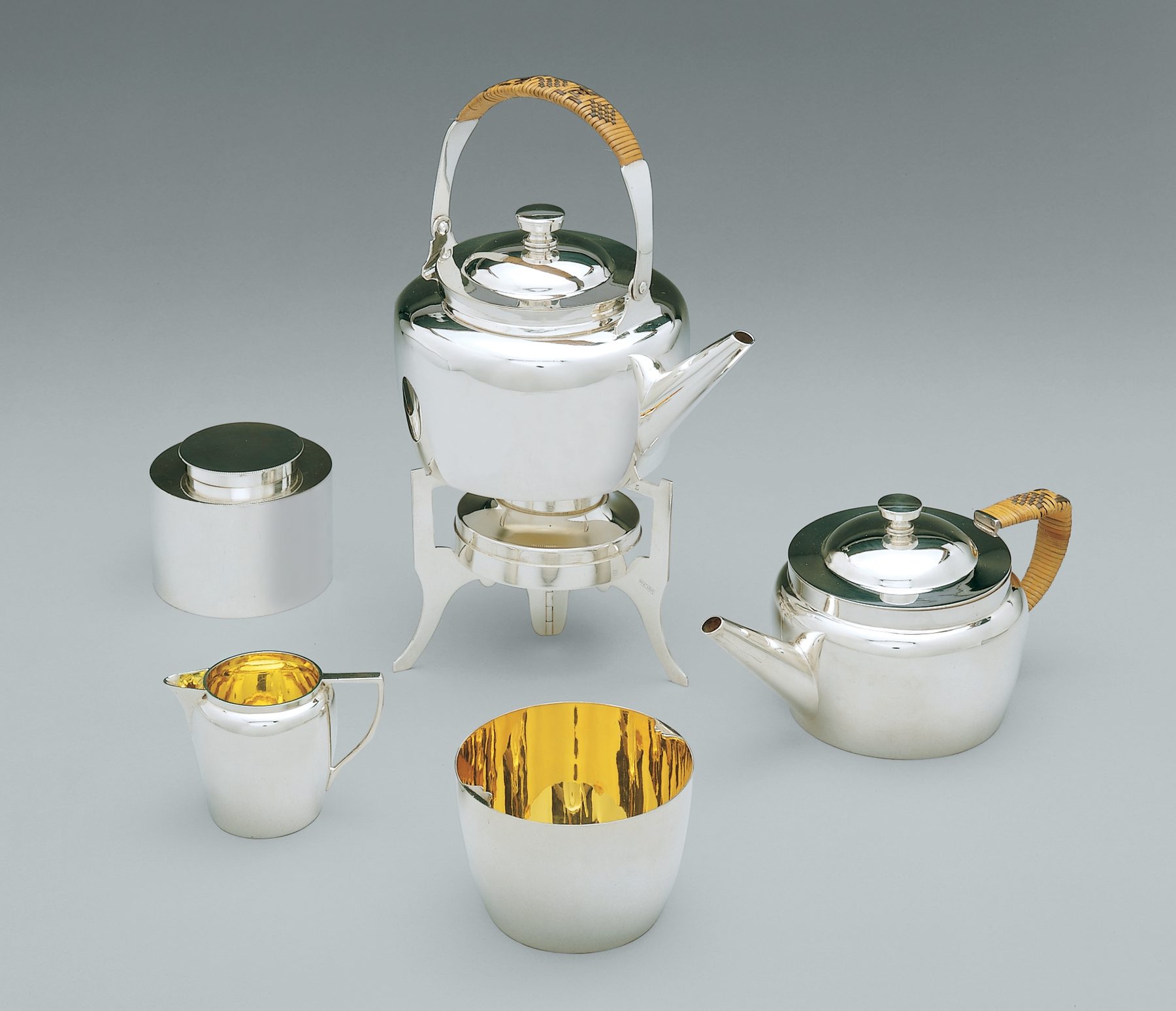
Dresser was unusually direct about this relationship. He worked with Wedgwood, Minton, Linthorpe, Elkington and other manufacturers. A metal teapot might be geometrically spare, its handle separated from the hot body by material intelligence. A vase could abstract a plant, insect or Japanese ceramic profile into a form suited to mould or kiln. Industrial production was not an embarrassment added to the design; it was part of the problem he solved.[12] [48]
Godwin's furniture could be produced in versions for different makers and markets. Morris & Co. also operated as a business, despite Morris's critique of industrial capitalism. William De Morgan designed ceramics, Walter Crane supplied images across media, and Liberty connected buyers with imported and British-made goods. Attribution to a famous designer can obscure potters, decorators, metalworkers, embroiderers and salespeople who turned a drawing into an object.[4]
Commerce did not simply betray Aestheticism. It spread the idea that a chair or teapot could embody intellectual choices. It gave manufacturers reasons to employ designers and consumers a language for comparing form. Yet its prices distributed beauty unevenly. The ideal of an art-filled life could become another pressure to buy.
The movement therefore contains two consumer positions. One is the connoisseur who rejects mass taste through a rare pot or perfectly judged empty wall. The other is the shopper taught to acquire the correct symbols of cultivated simplicity. Both depend on markets. The aesthete's disdain for materialism was itself highly marketable.[10]
Women, making and artistic dress
Women shaped Aestheticism as artists, makers, models, managers, patrons, writers and consumers, though histories often leave them inside male biographies. Jane Morris's face became one of the era's defining images through Rossetti's work, but she was also an expert embroiderer who participated in the production and maintenance of the Morris circle's interiors. Her daughter May Morris directed the embroidery department of Morris & Co. from 1885 and developed an independent career as designer, maker, teacher and advocate.[42]
Marie Spartali Stillman moved from the role of celebrated model into a long professional career. She trained with Ford Madox Brown, exhibited at the Dudley and Grosvenor galleries and sold paintings inspired by Dante, Boccaccio, landscape and portraiture. Her household moved between Britain, Italy and the United States, making her work part of Aestheticism's transnational network.[43]
An embroidered tunic and shoes attributed to Spartali Stillman extend her practice into dress. Floral needlework, a loose silhouette and possible echoes of kimono construction connect bodily freedom, women's traditional skills and Japonisme. The Japanese association should remain a visual possibility rather than a proven source, but the garments demonstrate how clothing could become an authored artistic environment.[44]
Women also worked in commercial ceramics and decorative production, frequently without the status granted to named male designers. The V&A's research on the Aesthetic home recovers figures such as ceramic painter Florence Lewis and shows how industrial workshops opened some professional routes while maintaining gendered divisions of labour.[4]
The Aesthetic woman in painting is often absorbed, languid or remote. Her dress and surroundings turn her into an emblem of beauty. Such images can be formally complex without being socially neutral. Who modelled, who owned the work and whether the represented woman could claim artistic authorship are separate questions.
Wilde's editorship of Woman's World from 1887 complicates his decorative celebrity. He invited women to write on literature, education, politics and professional life and wanted the magazine to address the modern woman rather than provide fashion alone. The project remained within a commercial publishing world, but it shows Aesthetic dress connected to intellectual and social debate.[36]
Recovering these histories changes the movement's scale. The house beautiful was not only designed by an architect and admired by a patron. It was stitched, painted, cleaned, arranged, written about and inhabited. Aestheticism's promise to join art and life cannot be assessed until that labour becomes visible.
Wilde, satire and aesthetic masculinity
By the 1880s, an “aesthete” had become recognisable before he spoke. Long hair, velvet clothes, knee breeches, languid posture, a lily or sunflower and exaggerated sensitivity provided cartoonists with a visual vocabulary. The caricature treated aesthetic masculinity as effeminate, foreign, unhealthy and unproductive—everything a supposedly robust imperial Britain was not.[1] [25]
Gilbert and Sullivan's Patience, first performed in 1881, turned this type into musical comedy. Its poet Bunthorne was a composite drawing on public impressions of Whistler, Walter Crane and Wilde rather than a portrait of Wilde alone. George Grossmith's performance fixed the false poet's postures in popular memory while the opera teased both aesthetes and the society women eager to follow fashion.[34]
Wilde understood that mockery could be converted into publicity. On his 1882 American tour, Sarony's photographs presented him in carefully arranged costume. The tour helped promote Patience while Wilde lectured on decorative arts and the beautiful home. Audiences could attend out of curiosity, amusement or serious interest; the persona made all three possible.[35]
His self-fashioning widened the space in which masculinity might be performed, but it also drew hostile scrutiny. Aestheticism's rejection of utility could be translated into accusations that the aesthete did not work, reproduce or serve the nation correctly. Flowers, colour and refined speech became coded evidence of gender nonconformity.
The legal history must be precise. The Labouchère Amendment of 1885 broadened criminal offences between men by introducing “gross indecency”. After the Marquess of Queensberry left an accusatory calling card in 1895, Wilde unsuccessfully prosecuted him for libel. Evidence gathered for that case led to Wilde's arrest, trials, conviction and maximum sentence of two years' hard labour.[37]
Homosexuality did not suddenly become illegal in 1895, and Wilde was not convicted for an artistic style. Yet the trials allowed hostile commentators to connect his sexual relationships, writings, dress and aesthetic persona. The scandal damaged the public meaning of “aesthete” and reinforced a culture in which deviation in taste could be treated as evidence of sexual danger.
To say that Wilde “ended” the movement gives persecution too much explanatory power. His imprisonment was a catastrophe for him and an important cultural turning point. Furniture, painting and graphic design did not cease. The aesthetic critique of conventional identity survived partly because Wilde had shown how fully a public self could be made—and how violently society could police it.
Aestheticism in America
The Centennial International Exhibition in Philadelphia in 1876 was a catalyst for American Aestheticism. Displays brought British design reform, Japanese objects and new manufactured goods into a vast international setting. Through the late 1880s, especially in New York, Aesthetic ideas entered furniture, ceramics, stained glass, metalwork, jewellery, painting and fully coordinated domestic rooms.[9]
American makers did not merely copy Britain. They translated its sources through local woods, industrial methods, Gilded Age wealth and new institutions. Art furniture could combine East Asian ornament with emphatic construction. Ceramics made the painted vessel a site of individual art. Tiffany's glass and interiors joined colour, light and luxury in forms that would contribute to Art Nouveau.[46]
Magazines, clubs and collecting societies helped turn taste into civic culture. The period coincided with the creation and growth of major museums, including the Metropolitan Museum of Art, founded in 1870. Aesthetic collecting served private distinction, but it also fed public institutions.[9] [46]
Wilde's lecture tour supplied a human emblem, while Whistler's patrons and collectors built transatlantic careers for his work. Freer's acquisition of the Peacock Room is the most spectacular example. American Aestheticism was simultaneously domestic, industrial, institutional and international.
Decadence, scandal and transformation
During the 1890s, Aestheticism acquired a harder edge. Decadent writers and artists embraced artifice, forbidden desire, morbidity and the self-conscious exhaustion of culture. Symbolism pursued dream, myth and psychic meaning. The boundaries remained porous, but the sunflower of 1881 no longer captured the whole atmosphere.
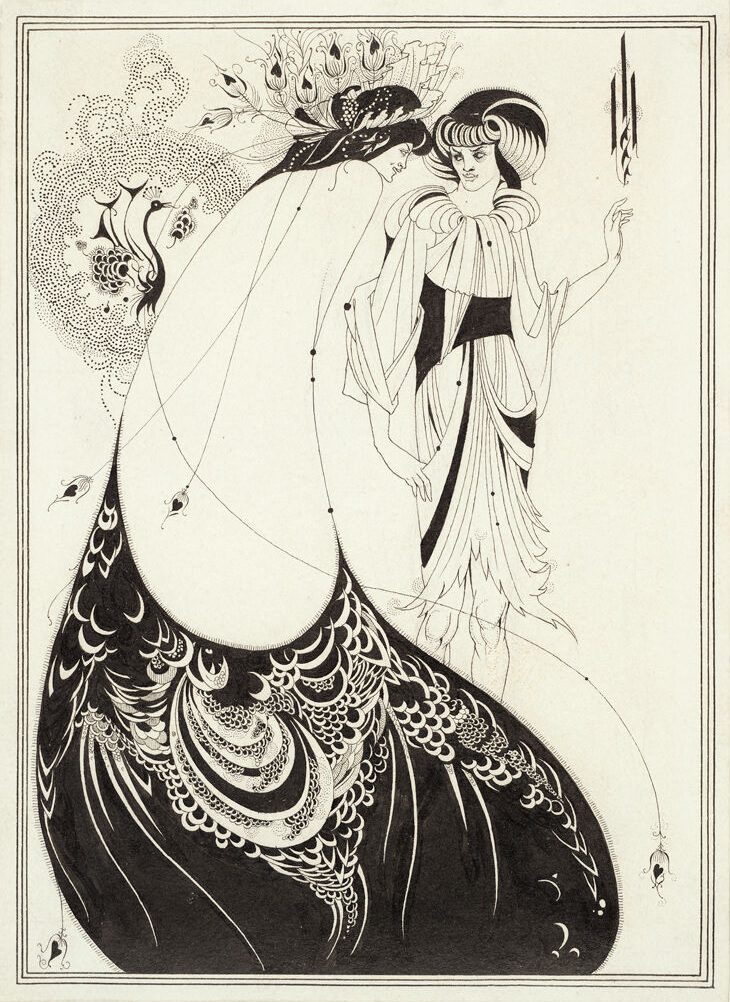
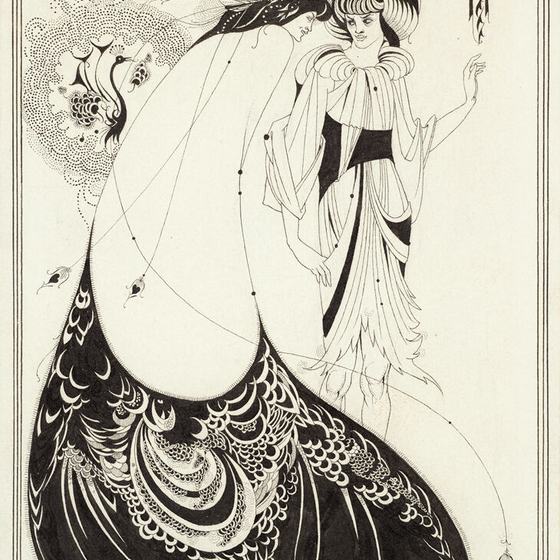
Aubrey Beardsley made black and white newly aggressive. His designs combine the elegant contour of Burne-Jones and Whistler's decorative economy with Japanese print culture, including erotic shunga. Vast white spaces, dense black silhouettes and razor-thin lines turn the printed page into a charged field. Beauty and grotesque comedy can occupy the same curve.[7]
Beardsley's illustrations for Wilde's Salomé do not simply decorate the text. They create an independent visual world of masks, flowers, exposed bodies and impossible interiors. His work travelled easily through magazines and books, showing how cheap reproduction could carry an elite language into mass circulation.
The Yellow Book, with Beardsley as its first art editor, became a symbol of Decadence even though Wilde did not contribute to it. After Wilde's arrest, hostile associations were strong enough that a yellow-covered book carried by him was mistakenly linked with the periodical. The episode demonstrates how public symbols can outrun facts.
Art Nouveau drew on Aestheticism and Arts and Crafts while developing its own international structures. It inherited the integrated interior, Japanese lessons in line and asymmetry, the elevation of applied art and Beardsley's graphic force. Designers in different countries combined these with local craft, new materials and organic growth.[8] [45]
Aestheticism therefore did not die so much as lose its earlier name and coalition. Its paintings entered museums; its interiors shaped histories of design; its social arguments moved into Arts and Crafts, Decadence, queer cultural memory and modernism. The movement's enduring proposition is that form changes life. Its enduring question is who has the freedom, labour and money to make that proposition real.
Artists and designers to know
James McNeill Whistler
Whistler made tonal arrangement and artistic autonomy public issues. His musical titles, Japanese-derived structures, controlled exhibitions and Peacock Room challenged the demand that art explain itself through story. His combative persona was part of the work's reception, but the paintings reward slow attention beyond the controversies.
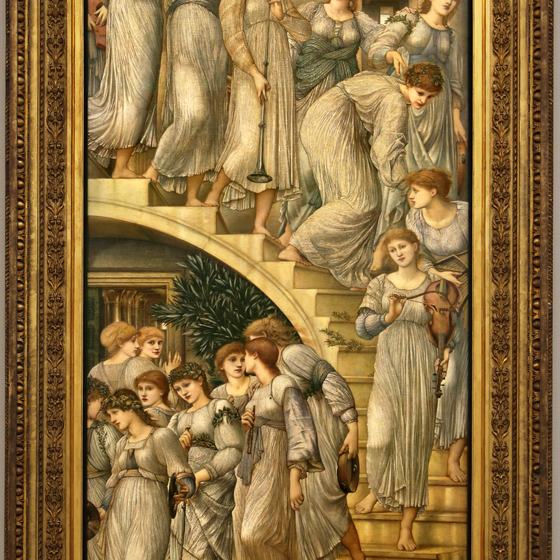
Edward Burne-Jones
Burne-Jones transformed medieval legend, Renaissance sources and repeated bodies into dreamlike pictorial sequences. His 1877 Grosvenor exhibition made him a central Aesthetic figure, while his designs for stained glass, tapestry, jewellery and mosaic kept painting connected to craft.[38]
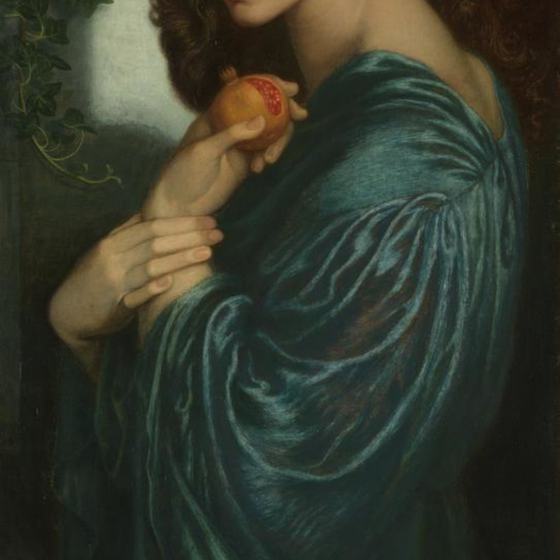
Dante Gabriel Rossetti
Rossetti provided a bridge from Pre-Raphaelitism through his saturated colour, poetic women, musical subjects, collecting and interiors. His influence was social and material as well as stylistic.
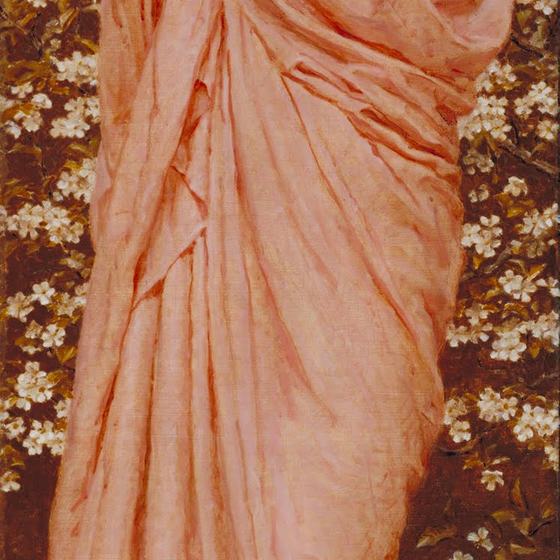
Albert Moore
Moore reduced narrative pressure through classically draped figures arranged as colour and rhythm. He is among the clearest painters of Aesthetic form for its own visual life.
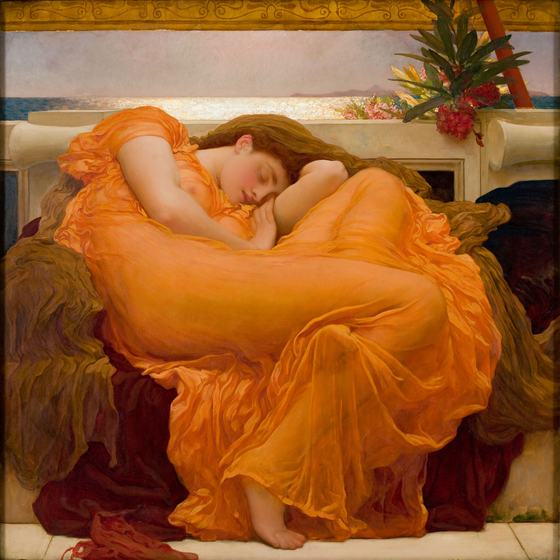
Frederic Leighton
Leighton joined academic skill, classical subject and formal harmony. His studio-house and Arab Hall made collecting and self-presentation part of an artistic career, while also exposing the Orientalist conditions of Victorian cultural possession.
Aubrey Beardsley
Beardsley converted Aesthetic line into a late Decadent graphic language. His designs helped carry the movement toward Art Nouveau and modern illustration.
Further artists and designers
Oscar Wilde
Wilde made Aestheticism mobile across criticism, fiction, theatre, journalism, lecture and dress. His wit sharpened the movement's contradictions rather than offering a single doctrine.
E. W. Godwin
Godwin brought Japanese-derived line, asymmetry, Georgian restraint, theatre and hygiene into furniture and architecture. His designs show that simplicity can be as historically mixed as ornament.[11]
Christopher Dresser
Dresser used botanical knowledge, direct engagement with Japanese design and collaboration with manufacturers to create modern objects. He is essential for understanding why industry belongs inside Aesthetic history.[12]
William Morris
Morris united pattern, craft, literature and the interior, but pushed beyond Aesthetic autonomy toward a social theory of pleasurable work. He is both a central overlap and the movement's most powerful internal critic.
Marie Spartali Stillman
Spartali Stillman's paintings, exhibitions, embroidery and transatlantic career recover women as professional producers of Aesthetic culture rather than only its faces.[43] [44]
Major artists directory
| Name | Nationality | Key Works |
|---|---|---|
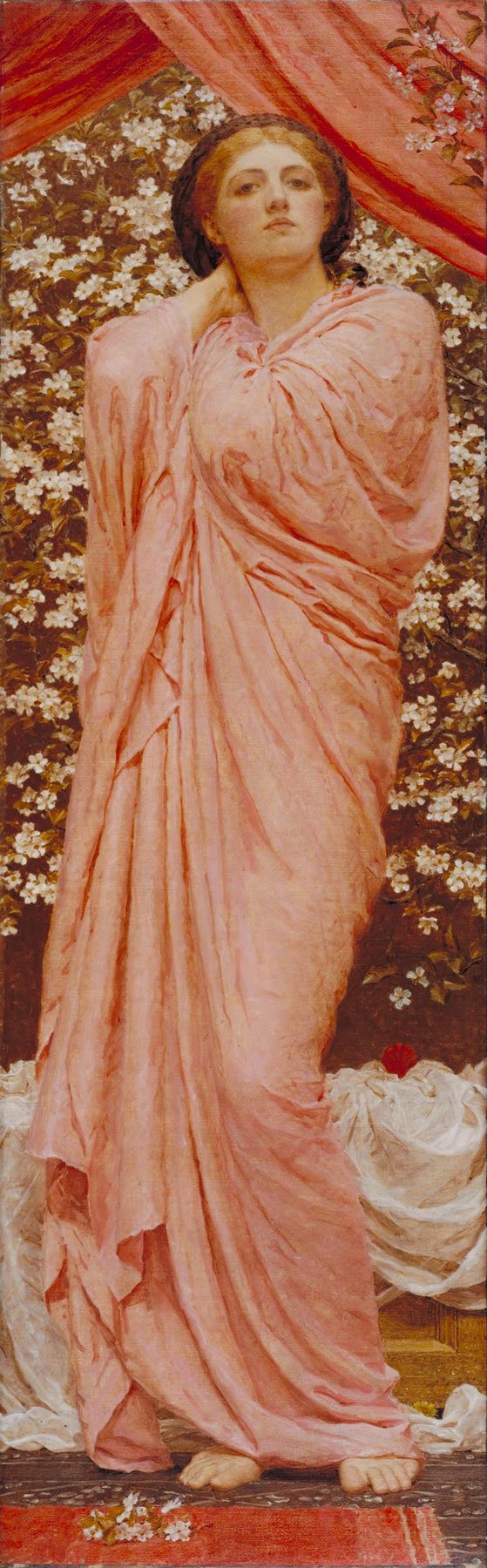
| Albert Moore | British | Blossoms |
| Aubrey Beardsley | British | The Peacock Skirt |
| Christopher Dresser | British | Travelling Tea Set |
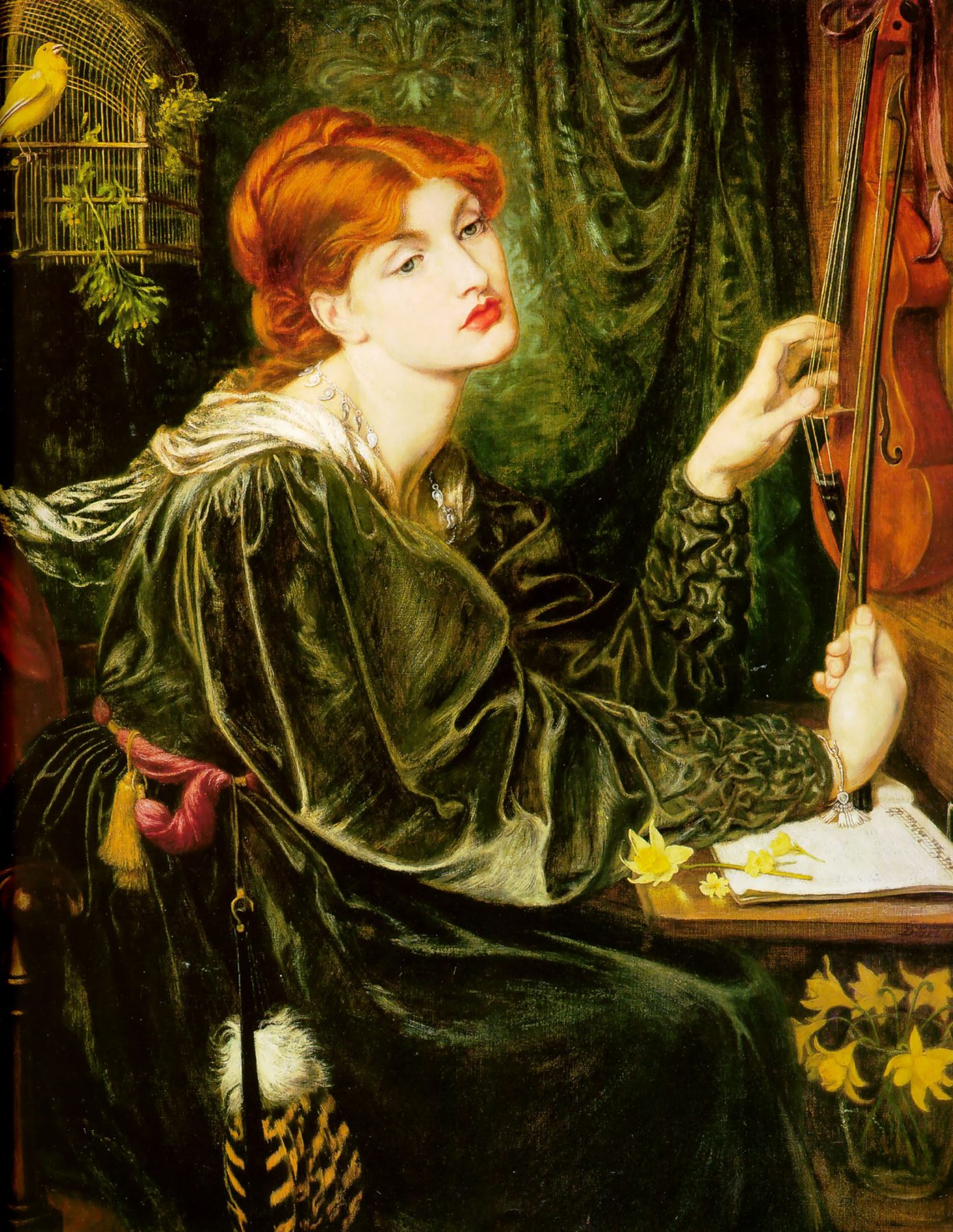
| Dante Gabriel Rossetti | British | Proserpine, Veronica Veronese |
| E. W. Godwin | British | Side Table |
| Edward Burne-Jones | British | The Golden Stairs, The Beguiling of Merlin |
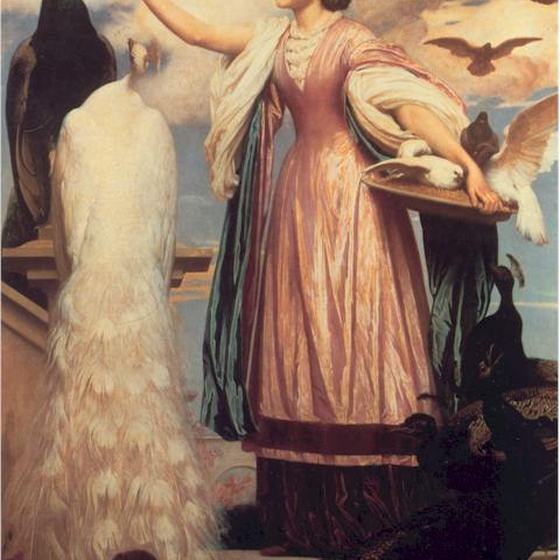
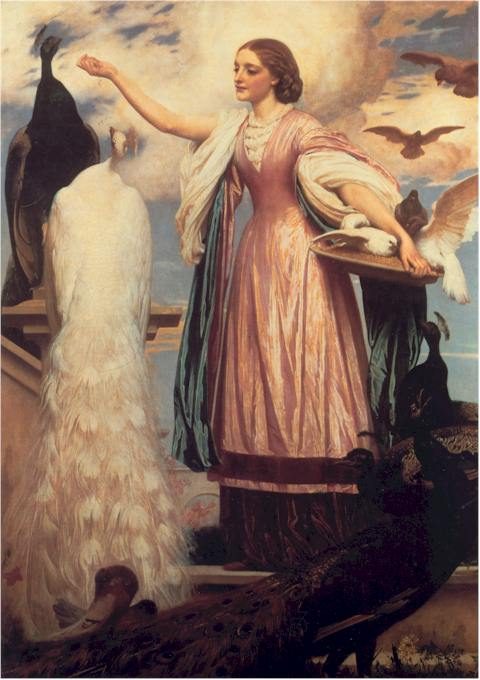
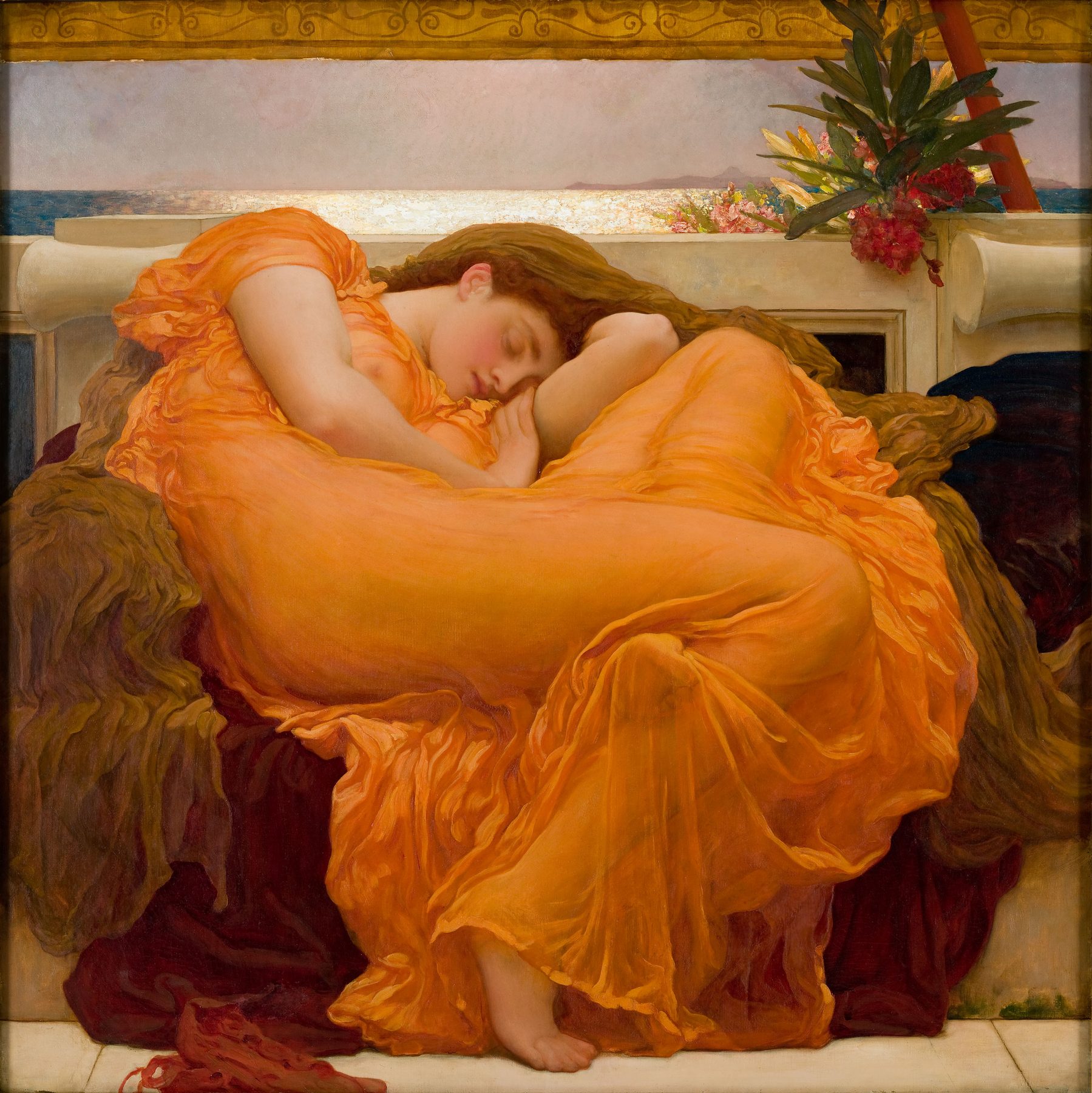
| Frederic Leighton | British | Flaming June, A Girl Feeding Peacocks |
| James McNeill Whistler | American | Symphony in White, No. 1: The White Girl, Nocturne in Black and Gold: The Falling Rocket, The Princess from the Land of Porcelain, Harmony in Blue and Gold: The Peacock Room |
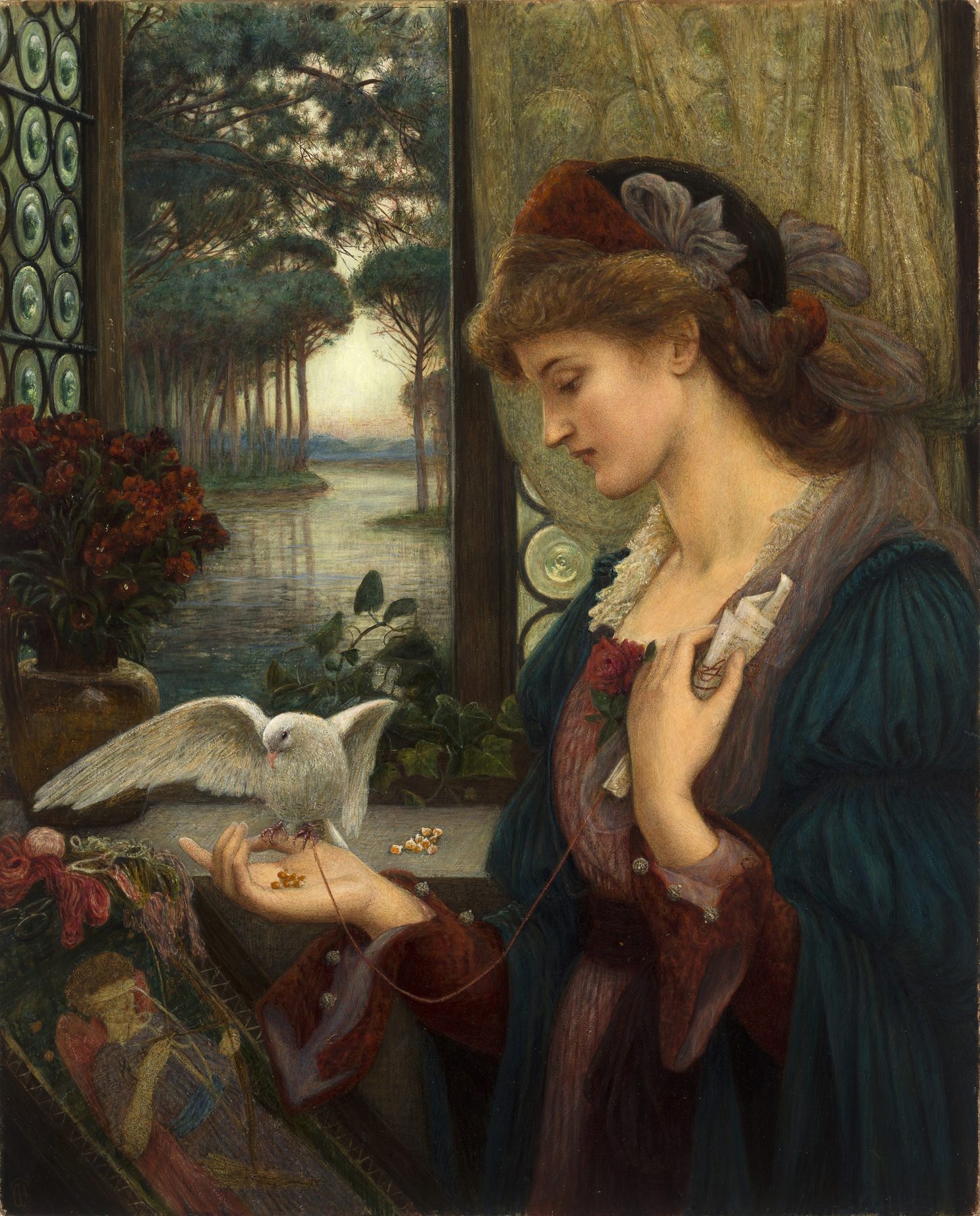
| Marie Spartali Stillman | British | Love's Messenger |
| Oscar Wilde | Irish | |
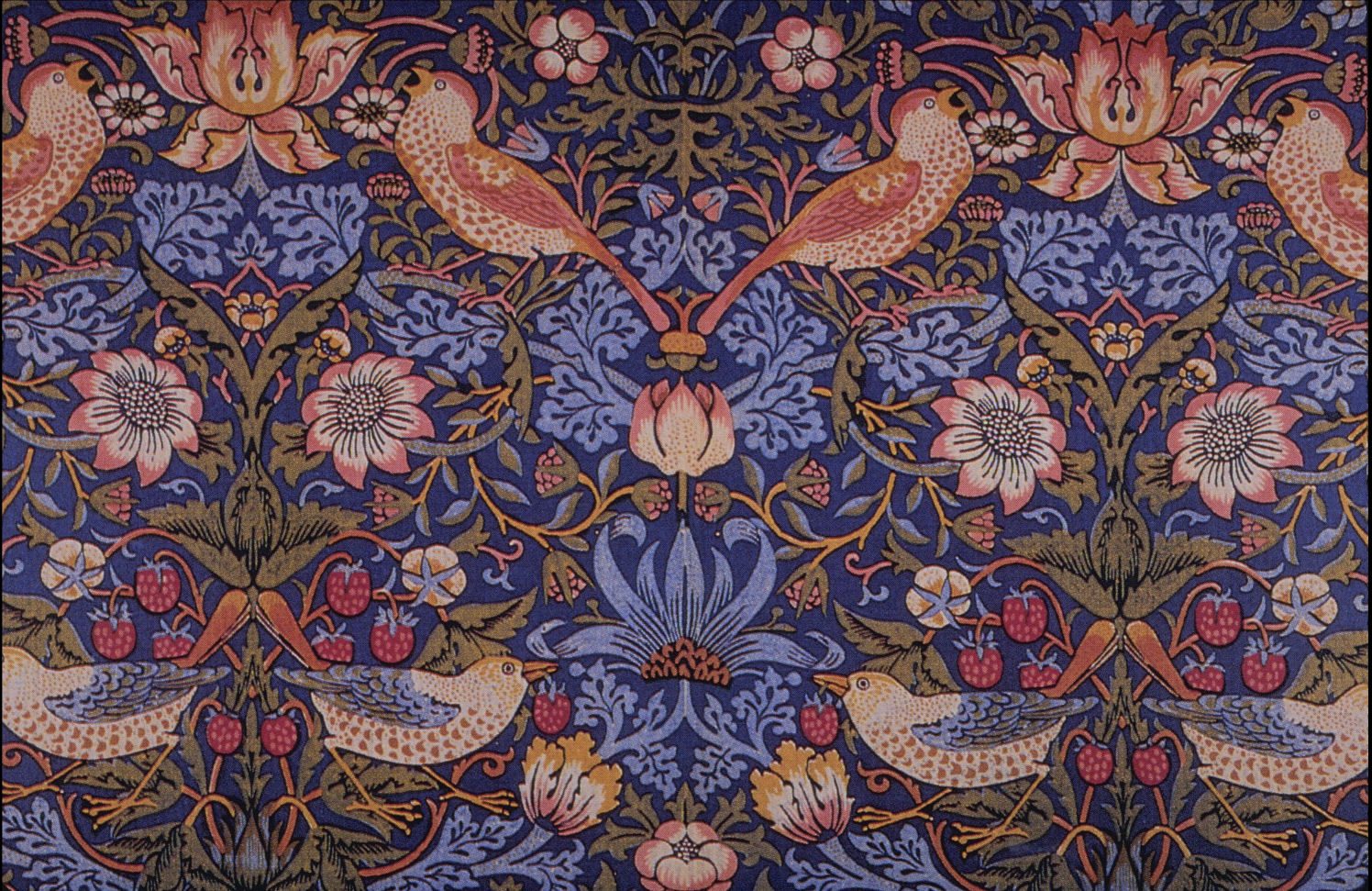
| William Morris | British | Strawberry Thief |
How to look at Aesthetic art
Begin by postponing the story. Ask what your eye notices first: a colour interval, repeated contour, empty field, fabric, gleam of glaze or turn of a body. If the title is musical, test what that invitation changes. Whistler's “nocturne” does not abolish the bridge; it asks you to experience the bridge as a relation of dark masses and small lights before treating it as information.
Then look for suspension. Burne-Jones and Moore often reduce action so that pose, sequence and mood can expand. What has just happened, and what may never happen? Does repetition make figures anonymous, or do small differences restore individuality?
In an interior or object, follow the line across media. A peacock feather moves from wall to shutter; a ceramic plate completes a geometric bay; a metal brace strengthens a table and supplies its ornament. Ask where design solves a practical problem and where it creates atmosphere.
Identify sources precisely. Is an object Chinese porcelain or a British imitation? Does a composition respond to Japanese woodblock structure, or merely include a fan? Are historic Syrian tiles being viewed in their original setting or inside a Victorian reconstruction? Precision protects other cultures from becoming a generalized decorative resource.
Finally, reconstruct the social scene. Who commissioned the room, made the object, cleaned it, sat for the figure, visited the exhibition or bought the magazine? What did the thing cost, and what identity did it advertise? Aestheticism insisted that beauty deserved attention. Looking historically means giving the same attention to the conditions that beauty can conceal.
Frequently Asked Questions
It was a loose cultural formation centred in Britain from the 1860s to the 1890s. Artists, writers and designers argued that beauty, form and intensity could be valuable independently of a moral lesson or practical message. It included painting, literature, furniture, ceramics, metalwork, clothing, exhibition design and interiors rather than one visual style.
It means that art does not need an external moral, religious or utilitarian purpose in order to justify itself. The phrase does not mean that art is empty or socially irrelevant. Pater, Whistler and Wilde used related ideas differently: for intense experience, pictorial arrangement and the creative force of artifice.
A practical British range is c. 1860–1895, though museums often use c. 1860–1900. Its French intellectual roots are earlier, and its influence continued through Arts and Crafts, Decadence and Art Nouveau. The dates describe a changing network, not formal founding and dissolution.
No. Later Pre-Raphaelite art supplied important people, patrons, colours, poetic moods and decorative practices. But the original Brotherhood of 1848 had a more defined reforming programme. Whistler, Moore, Godwin and Dresser brought sources and aims that cannot be explained through Pre-Raphaelitism alone.
Both elevated the decorative arts and wanted beauty to enter everyday life. Arts and Crafts, especially through Morris, more explicitly connected beauty to materials, skilled labour and social reform. Commercial Aesthetic design was often more comfortable with manufacturers, fashionable consumption and the cultivation of individual taste. In practice the people and objects frequently overlap.
Japanese woodblock prints and objects offered European artists alternatives to central perspective and heavy modelling: asymmetry, cropping, flat pattern, silhouette and active empty space. Designers and consumers also turned “Japanese” into a fashion, sometimes flattening distinct histories. The influence should therefore be understood as both serious formal learning and unequal cultural translation.[15] [17]
Their strong silhouettes and decorative structures suited Aesthetic design, and repeated use made them recognisable emblems. The Peacock Room gave the peacock an especially famous role. Satire then amplified the motifs, so a sunflower or lily could identify an aesthete instantly. They are useful clues, not a definition of the movement.
No. Its painters, designers and theories were established before Wilde became its best-known public figure. His lectures, writing, dress and wit made Aestheticism visible to a much larger audience. Patience and newspaper caricature helped create that celebrity, while also producing stereotypes that were not accurate portraits of every aesthete.
It helped establish that painting could prioritise formal relation, that interiors could be designed as coherent experiences and that everyday objects deserved artistic thought. It also anticipated modern lifestyle culture, in which identity is built through chosen surroundings. Its contradictions—between beauty and commerce, cultural admiration and appropriation, freedom and privilege—remain current.
Discussion
If you could preserve only one Aesthetic principle for the present, would it be art's freedom from moral instruction, the beautiful design of daily life, or the demand for more attentive looking? What would your choice leave unresolved?
Reader Insights
Notice how colour, line, interval and repeated motifs organise attention before narrative takes over.
Place the picture or object back among its frames, furniture, ceramics, textiles, lighting and cultivated spectators.
Ask who designed, manufactured, sold, arranged and maintained the beautiful surface—and which global exchanges supplied it.
Join the Conversation
Which Aesthetic work most changes when you consider its setting, materials, labour and cultural sources? Share your view below.
References
- Victoria and Albert Museum, “An introduction to the Aesthetic Movement”, vam.ac.uk. View Source
- Victoria and Albert Museum, “Aestheticism”, vam.ac.uk. View Source
- Victoria and Albert Museum, The Cult of Beauty: The Aesthetic Movement 1860–1900, media.vam.ac.uk. View Source
- Victoria and Albert Museum, “Furnishing the aesthetic home”, vam.ac.uk. View Source
- Victoria and Albert Museum, “Chinese blue-and-white ceramics”, vam.ac.uk. View Source
- Victoria and Albert Museum, “The wonderful world of Whistler”, vam.ac.uk. View Source
- Victoria and Albert Museum, “Aubrey Beardsley – decadence & desire”, vam.ac.uk. View Source
- Victoria and Albert Museum, “Art Nouveau – an international style”, vam.ac.uk. View Source
- Metropolitan Museum of Art, “The Aesthetic Movement in America”, metmuseum.org. View Source
- Metropolitan Museum of Art, “Design Reform”, metmuseum.org. View Source
- Metropolitan Museum of Art, “Side table by Edward William Godwin”, metmuseum.org. View Source
- Metropolitan Museum of Art, “Christopher Dresser (1834–1904)”, metmuseum.org. View Source
- Metropolitan Museum of Art, “James McNeill Whistler as Etcher”, metmuseum.org. View Source
- Metropolitan Museum of Art, “James McNeill Whistler (1834–1903)”, metmuseum.org. View Source
- Metropolitan Museum of Art, “Japonisme”, metmuseum.org. View Source
- Metropolitan Museum of Art, “Exoticism in the Decorative Arts”, metmuseum.org. View Source
- Metropolitan Museum of Art, “Early Collectors of Japanese Prints and The Met”, resources.metmuseum.org. View Source
- Metropolitan Museum of Art, The Great Wave: The Influence of Japanese Woodcuts on French Prints, resources.metmuseum.org. View Source
- Metropolitan Museum of Art, “The Yellow Room”, metmuseum.org. View Source
- Metropolitan Museum of Art, “The Peacock Room at 49 Prince's Gate”, metmuseum.org. View Source
- Smithsonian Institution, “Harmony in Blue and Gold: The Peacock Room”, si.edu. View Source
- Smithsonian Institution, “Ruffled Feathers: Creating Whistler's Peacock Room”, si.edu. View Source
- Smithsonian Institution, “The Peacock Room Comes to America”, si.edu. View Source
- Smithsonian National Museum of Asian Art, “About the Freer Gallery of Art”, asia-archive.si.edu. View Source
- Musée d'Orsay, “Beauté, morale et volupté dans l'Angleterre d'Oscar Wilde”, musee-orsay.fr. View Source
- Musée d'Orsay, “Whistler 1834–1903”, musee-orsay.fr. View Source
- Bibliothèque nationale de France, “Le Parnasse”, gallica.bnf.fr. View Source
- Bibliothèque nationale de France, “Art pour l'art”, catalogue.bnf.fr. View Source
- Leighton House, “Q&A: The Arab Hall”, rbkc.gov.uk. View Source
- Leighton House, “History of Leighton House”, rbkc.gov.uk. View Source
- Leighton House, “The Arab Hall: Past and Present”, rbkc.gov.uk. View Source
- Leighton House, “When the Tiles Spoke: Soudade Kaadan”, rbkc.gov.uk. View Source
- Leighton House, “Leighton's Music and Dance Friezes”, rbkc.gov.uk. View Source
- National Portrait Gallery, “George Grossmith: Iconography”, npg.org.uk. View Source
- National Portrait Gallery, Oscar Wilde large-print guide, npg.org.uk. View Source
- British Library, “Fashioning the feminine: Wilde's editorial vision and the New Woman”, bl.uk. View Source
- The National Archives, “The life and court trials of Oscar Wilde”, nationalarchives.gov.uk. View Source
- Tate Archive, “Album of letters written by Edward Burne-Jones to Agnes Graham”, archive.tate.org.uk. View Source
- George P. Landow, “The Grosvenor Gallery and the Aesthetic Movement”, victorianweb.org. View Source
- Walter Pater, Studies in the History of the Renaissance, en.wikisource.org. View Source
- James McNeill Whistler, Mr. Whistler's Ten O'Clock, library.si.edu. View Source
- William Morris Society in the United States, “Design”, morrissociety.org. View Source
- Delaware Art Museum, “Marie Spartali Stillman”, emuseum.delart.org. View Source
- Delaware Art Museum, “Looking Closely at Marie Spartali Stillman's Embroidered Garments”, delart.org. View Source
- Metropolitan Museum of Art, “Art Nouveau”, metmuseum.org. View Source
- Metropolitan Museum of Art, “Aesthetic Splendors”, metmuseum.org. View Source
- National Gallery of Art, American Paintings of the Nineteenth Century, Part II, nga.gov. View Source
- Metropolitan Museum of Art, The New British Galleries, resources.metmuseum.org. View Source
- Image references 49–64: open-access reproductions and institutional collection records.
View 14 image sources
02 · commons.wikimedia.org04 · asia-archive.si.edu05 · commons.wikimedia.org06 · commons.wikimedia.org07 · commons.wikimedia.org08 · commons.wikimedia.org09 · commons.wikimedia.org10 · commons.wikimedia.org11 · commons.wikimedia.org12 · metmuseum.org13 · metmuseum.org14 · commons.wikimedia.org15 · commons.wikimedia.org16 · commons.wikimedia.org
More ART Movements
Decadent Movement