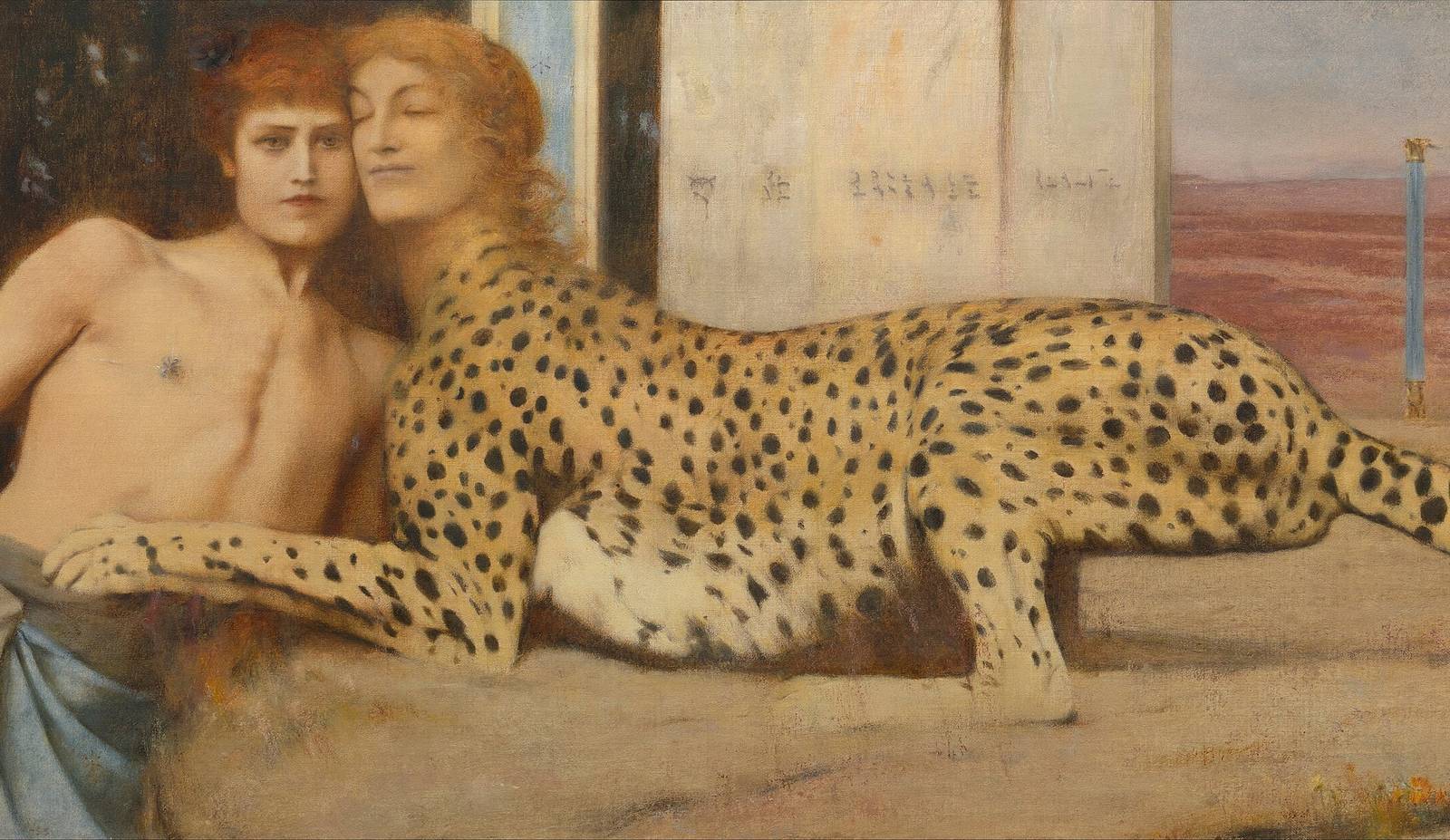
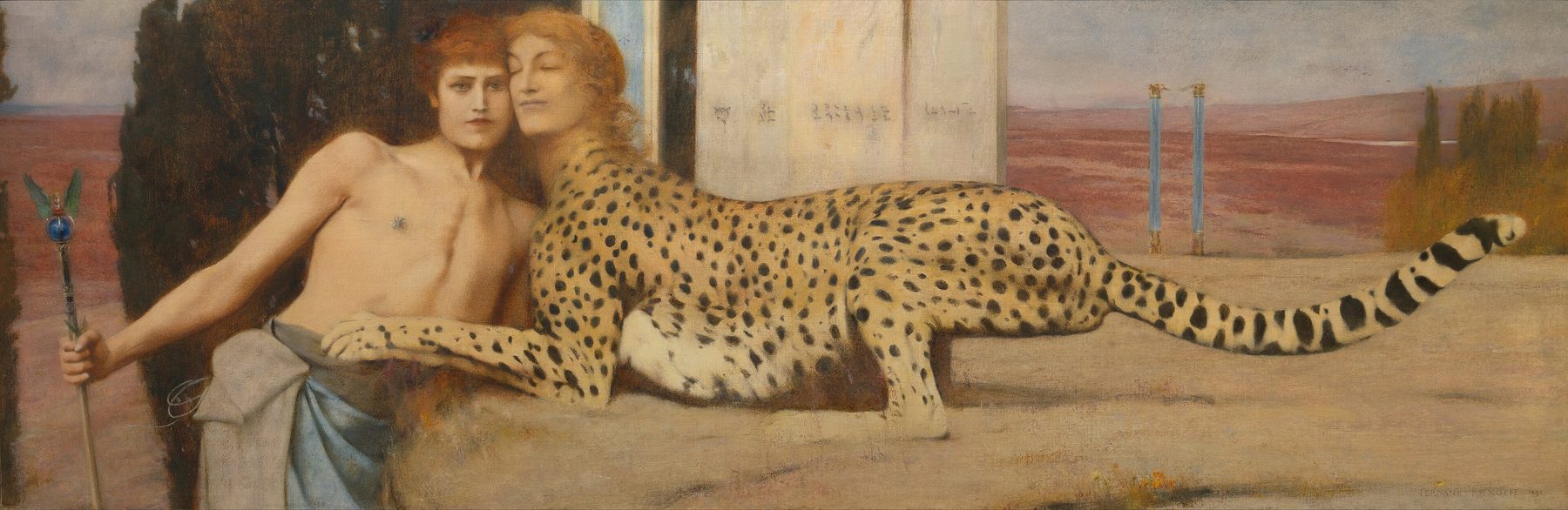
Image reference: Fernand Khnopff, Caresses.
At a Glance
- Core periodc. 1870s–1910s
- Strongest shared identitymid-1880s–early 1900s
- Major centresParis · Brussels · London · Vienna · Oslo · Munich · Helsinki · Moscow · St Petersburg
- Known fordreams · myths · inner states · suggestion · expressive colour · recurring motifs
- Key contexta transnational response to Naturalism, materialism and modern life—not one uniform style
Contents
- Symbolism in context
- What Symbolism means
- Before the name
- France after 1886
- Brussels and the international network
- Northern and eastern transformations
- Vienna and the total work of art
- Britain, books and Decadence
- Gender, spirituality and modern life
- Artists to know
Symbolism in context
Gustave Moreau
Principal careerOdilon Redon
Principal careerPaul Gauguin
Principal careerFernand Khnopff
Principal careerEdvard Munch
Principal careerGustav Klimt
Principal careerAubrey Beardsley
Principal careerSymbolism gave artists a way to paint, draw, print and design what could not be observed directly: a memory, a fear, a spiritual longing, an erotic obsession, a myth that felt newly urgent, or the sense that visible reality concealed another order. It was not one style. The crowded splendour of Gustave Moreau, the shadowy hybrids of Odilon Redon, the flat colour of Paul Gauguin, the charged silence of Fernand Khnopff and the ornamental brilliance of Gustav Klimt can look dramatically different. What connects them is a refusal to treat art as the passive recording of appearances.
Symbolism belongs to the late nineteenth century, but its boundaries are deliberately porous. Its artists inherited Romantic ideas about imagination and subjective experience. They also drew on the Pre-Raphaelites, medieval art, Renaissance masters, academic history painting, folk traditions and the art of Japan. At the same time, they worked beside Impressionism, Post-Impressionism, Synthetism, the Nabis, Aestheticism, Decadence, Art Nouveau and the Secession movements. Those labels overlap without being interchangeable.
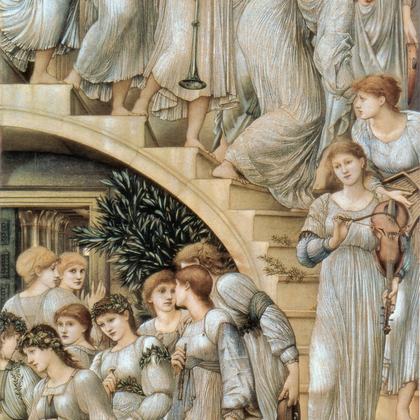
A useful working span runs from the 1870s, when Moreau, Pierre Puvis de Chavannes, Redon, Arnold Böcklin and Edward Burne-Jones had already created much of the movement’s visual groundwork, through the international flowering of the 1890s and early 1900s. The Metropolitan Museum describes these older artists as independent figures whose dream worlds, myths and simplified forms prepared the way for the more self-conscious Symbolist generation.[1] The movement does not end on a single date. Its imagery and methods flow into Expressionism, abstraction, Surrealism and modern design.
Nor did artists move through these categories in orderly succession. Redon exhibited in the last Impressionist exhibition of 1886, although his mysterious charcoal drawings had little in common with the group’s better-known interest in contemporary light and life. Gauguin emerged from the Impressionist circle before rejecting its reliance on observed sensation. Klimt could be discussed as a Symbolist, a member of the Vienna Secession and a central artist of Viennese Art Nouveau. Munch’s imagery belongs to Symbolism while his forceful colour and distortion also helped later Expressionists. The overlapping labels are not a problem to solve. They describe different aspects of the same crowded historical field.
Follow Symbolism through four stages
–1886
Visual groundwork before the name
Moreau, Redon, Böcklin and Burne-Jones turn history, landscape, print and legend toward inward experience.
–1891
Literary name and Synthetist breakthrough
A literary label coincides with new arguments for suggestion, simplified form, memory and emotionally independent colour.
–1900
International networks and private myth
Brussels, Paris, Oslo and London connect enigmatic portraiture, anxiety, colonial myth and radical print design.
–1914
Secessions, total environments and modern legacies
Klimt and other artists join allegory to architecture, ornament and modern design as Symbolism opens toward new movements.
What Symbolism means
The name began in literature. On 18 September 1886 the Greek-born poet Jean Moréas published “Le Symbolisme” in the Paris newspaper Le Figaro. He defended a new poetry against plain description, declamation and the certainties of Naturalism.[2] The manifesto announced a literary position, not a society of painters. It did not recruit Moreau, Redon, Gauguin or Khnopff, and it cannot be used as a rulebook for everything later placed beneath the Symbolist label. Its importance lies in giving a name to a wider desire for indirect expression.
French and Belgian writers had already been testing such ideas. Charles Baudelaire’s poetry proposed “correspondences” between the senses and between the material and spiritual worlds. Stéphane Mallarmé valued suggestion over naming; Paul Verlaine pursued musicality; Arthur Rimbaud transformed colour, sound and language; Edgar Allan Poe, read through Baudelaire’s translations, supplied images of obsession, beauty and death. The Bibliothèque nationale de France characterises literary Symbolism as a reaction against Naturalism and Parnassian impersonality, seeking a spiritual conception through analogy and music.[3] Painters did not simply illustrate these writers. They pursued comparable effects through line, colour, surface and visual rhythm.
This helps explain why a Symbolist symbol is rarely a rebus with one correct answer. An emblem traditionally joins a recognisable image to an agreed meaning: scales signify justice, for example. A Symbolist motif can carry familiar associations yet remain unstable. A flower may suggest erotic awakening, fragility, artificial beauty, a remembered scent or a private event. An eye may promise vision while also suggesting blindness, surveillance or a mind detached from the body. Nineteenth-century debates distinguished the symbol’s interpretive power from the emblem’s fixed identity.[4] The richest works keep several meanings in play.
Albert Aurier offered the period’s most influential visual definition in an 1891 essay on Gauguin. He argued that art should be ideist, symbolist, synthetic, subjective and decorative. Those five terms join content and form: an idea is expressed through signs; visible elements are simplified; the artist’s perception shapes the scene; and the picture asserts itself as an arranged surface.[5] Yet Aurier was not a neutral historian. He was making a case for Gauguin as the leading painter of a new art. His definition clarifies a powerful tendency without enclosing the whole movement.
Symbolism is therefore best understood as an ambition. Its artists wanted form to do more than describe an object. Flat colour could make a vision feel separate from ordinary space. A repeated curve could link a body, a wave and a cloud into one emotional rhythm. An unfinished narrative could move responsibility from painter to viewer. A mural could make architecture feel like a mental landscape. A book page could bind words and images so tightly that neither remained secondary. No single technique was compulsory, but every formal choice was expected to carry imaginative weight.
Music offered an especially attractive comparison because it could move listeners without representing a defined object. Richard Wagner’s operas also proposed a union of poetry, music, drama, costume and setting. Museum of Modern Art research places this search for correspondences—among word, colour and sound—at the centre of the Symbolist aesthetic.[6] The movement’s history consequently extends beyond easel painting to charcoal, lithography, illustrated books, posters, theatre, sculpture, interiors and exhibition design.
Before the name
Gustave Moreau showed how an inherited genre could become a vehicle for inward vision. He called himself a history painter, but he rejected the idea that history painting had to reconstruct the past as a coherent public scene. His biblical and classical subjects accumulate jewels, architecture, plants, weapons and fragments from distant cultures until place and time become uncertain. The Musée Gustave Moreau stresses his conviction that imagination and intuition could renew a genre weakened by convention.[7]
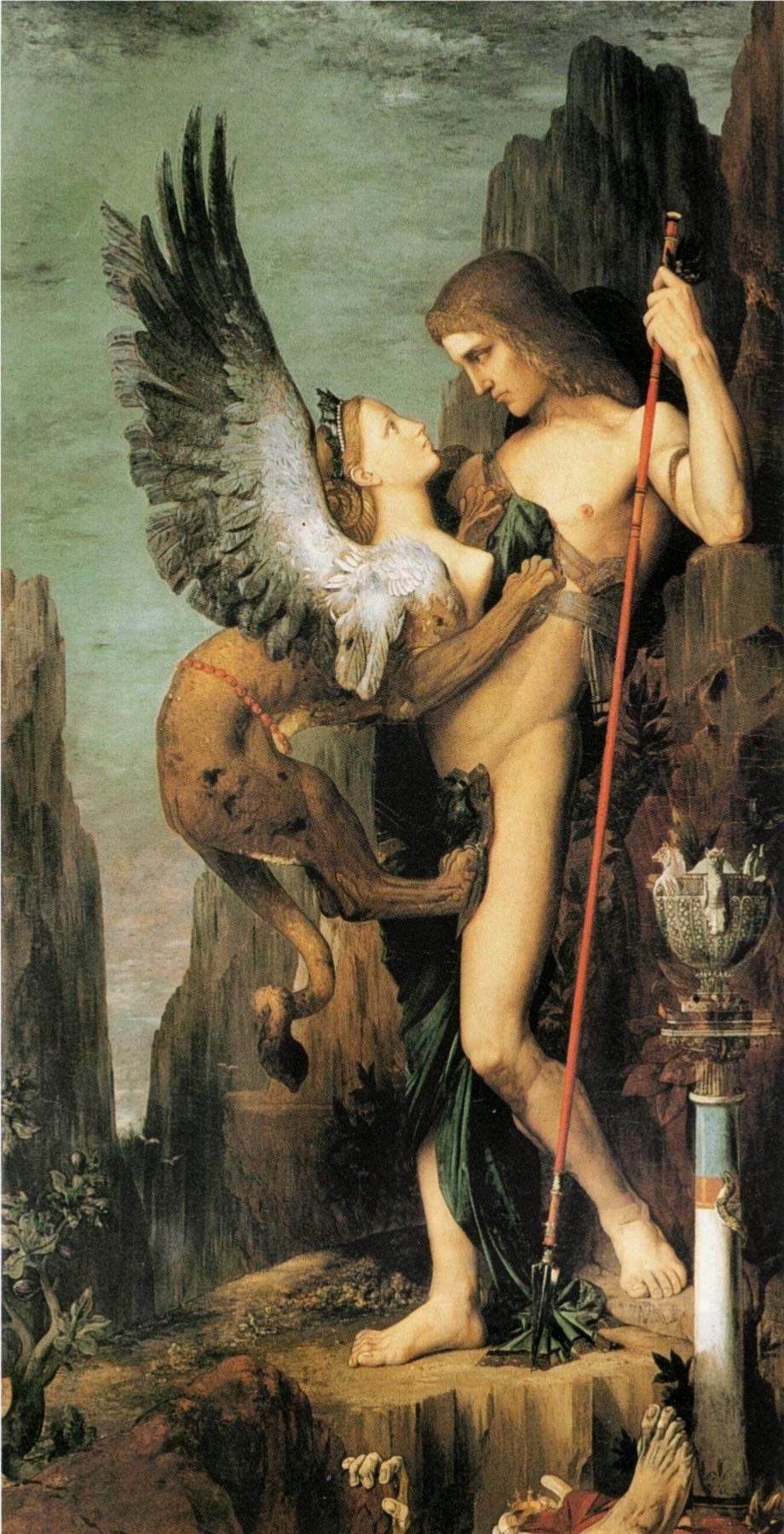
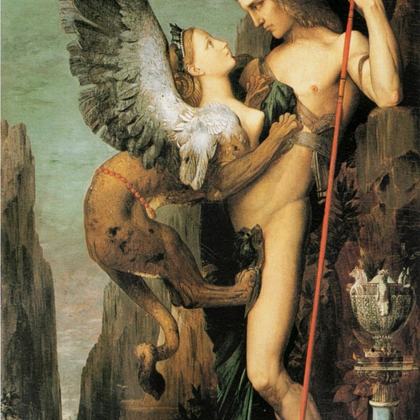
Oedipus and the Sphinx made his reputation at the Salon of 1864. The monster clings to Oedipus’s body and stares directly into his eyes. Instead of presenting the encounter as distant archaeological drama, Moreau compresses it into an intense contest of seeing, knowledge, sexuality and death. Contemporary responses ranged from admiration to caricature, evidence that its attempt at an “epic art” outside academic routine was immediately legible as a challenge.[8]
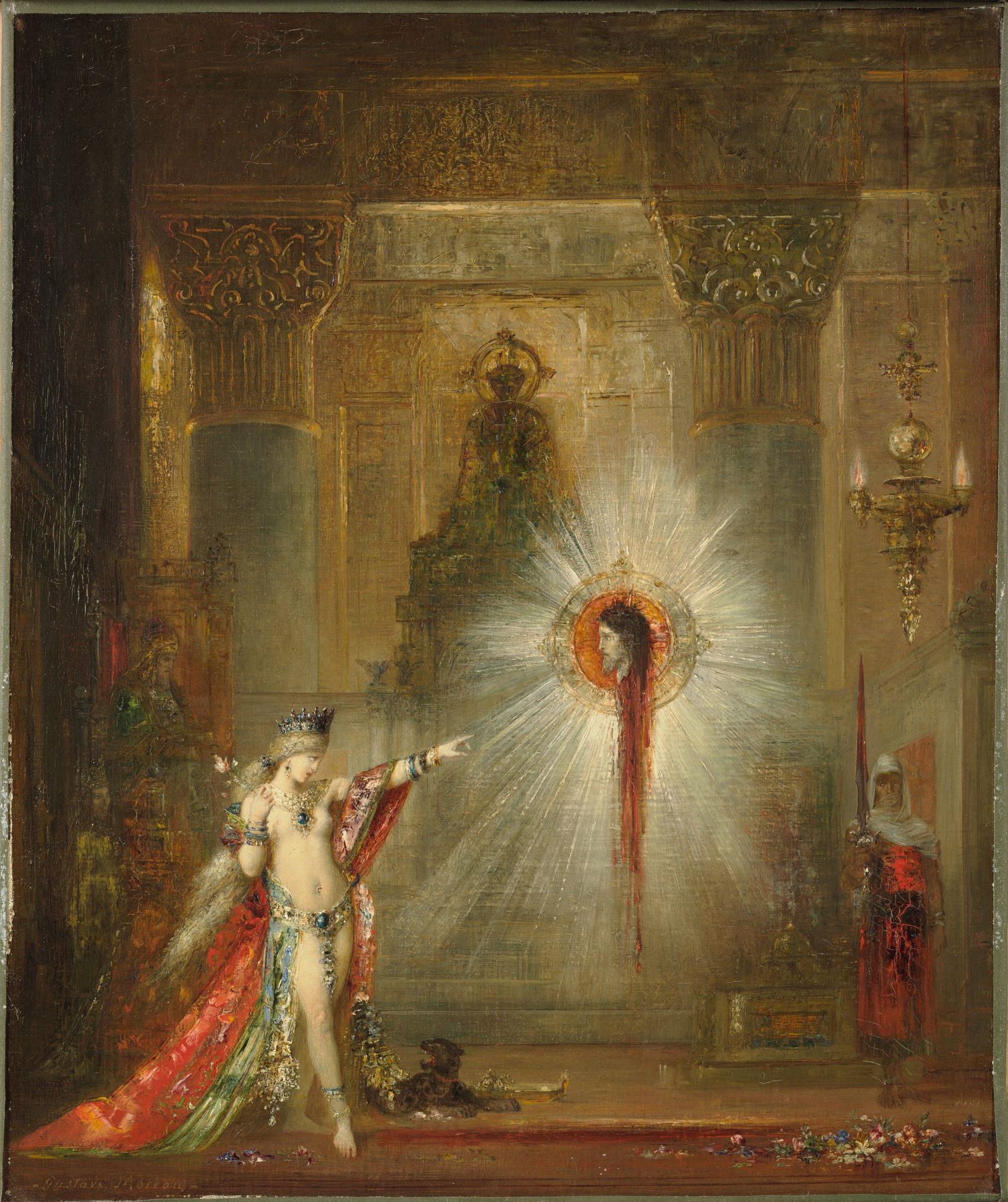
Moreau returned repeatedly to Salome, especially in the paintings and watercolours surrounding the Salon of 1876. In The Apparition, the severed head of John the Baptist hovers in radiance before the dancer while architecture dissolves into a dark web of ornament. The scene looks ancient, medieval, Oriental and theatrical at once. The museum describes Moreau’s Salome as central to a nineteenth-century transformation of a minor biblical figure into the dangerous seductress later called the femme fatale.[9] That image would become one of Symbolism’s most persistent—and most troubling—constructions of woman.
Pierre Puvis de Chavannes represents another path. His pale colour, broad silhouettes and shallow spaces were shaped by mural commissions and the demands of public architecture. Where Moreau makes history painting dense and feverish, Puvis makes it sparse and suspended. His simplified figures seem to belong to a timeless communal world. Younger artists learned that simplification could express an abstract idea rather than merely omit detail. His example mattered to Gauguin, the Nabis and the young Picasso, showing that Symbolist intensity did not always require monsters or violent drama.[10]
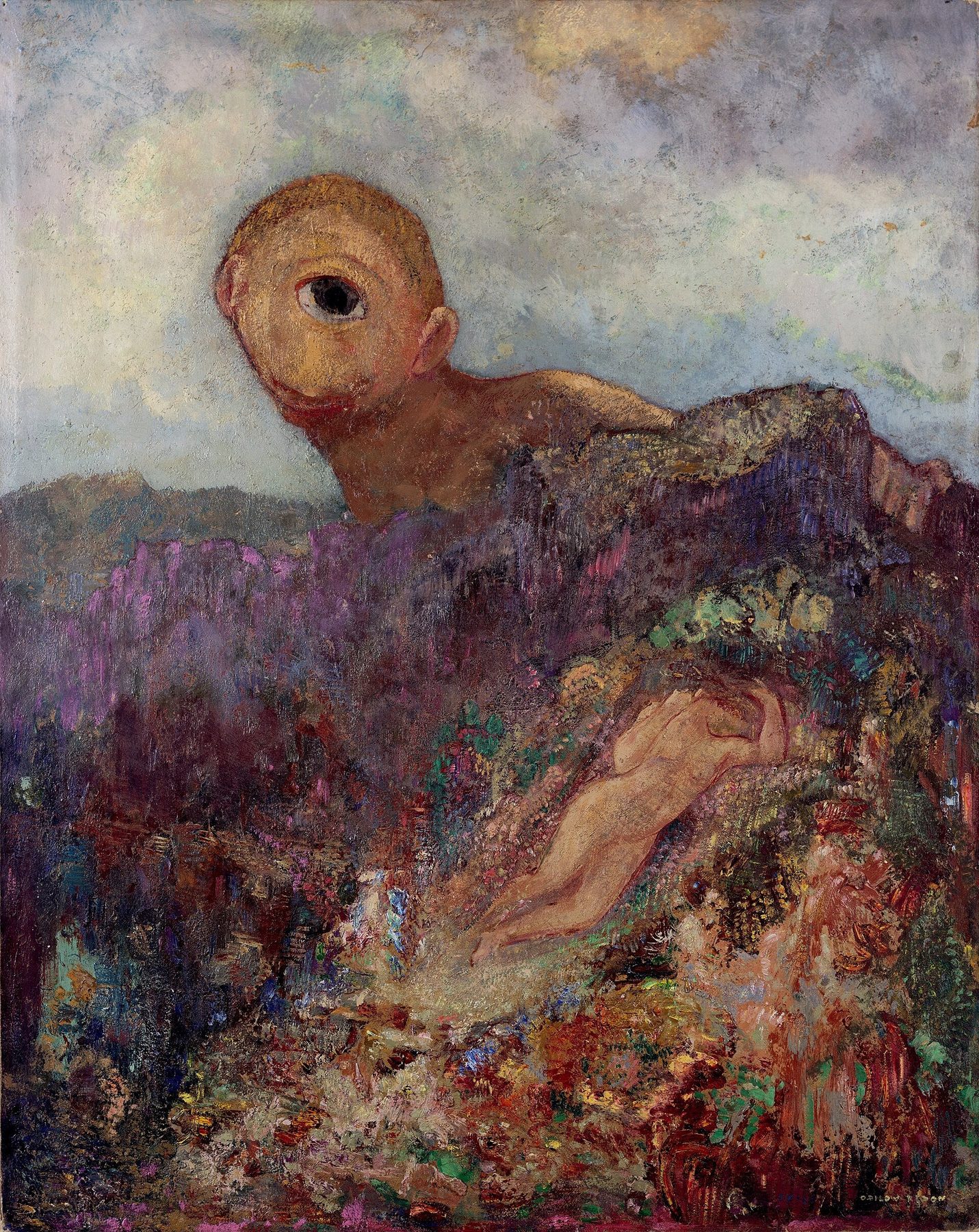
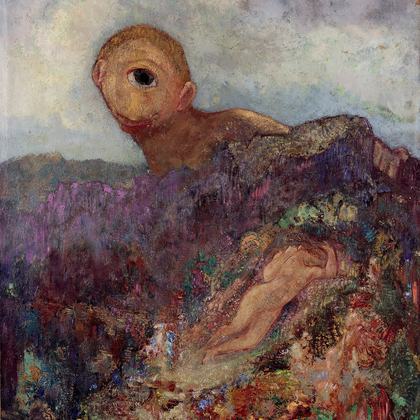
Odilon Redon made the invisible emerge from blackness. During the 1870s and 1880s he concentrated on charcoal drawings and lithographs he called his noirs. Floating eyes, severed heads, spiders with human faces, winged beings and cells poised between plant and animal seem to have been discovered in darkness rather than fully invented. Charcoal’s powdery depth allowed forms to appear and recede. Redon valued the material precisely because it resisted charm and demanded emotional seriousness.[11]
Literature mattered deeply to him. He dedicated print sequences to Poe, responded to Baudelaire and knew Shakespeare, but he resisted the claim that his works were straightforward illustrations. A title can orient the viewer and then make the picture stranger. The National Gallery of Art’s Pandora presents an imagined figure suspended before the consequences associated with her myth; the scene evokes a reality that is felt rather than witnessed.[12] Redon also rejected easy classifications of him as a spiritualist or recorder of supernatural events. His creatures belong to art’s imaginative logic, not to a report from another realm.
Around 1890 colour entered his work with growing force. Pastels and paintings bloom with luminous flowers, shells, chariots, profiles and visionary landscapes. This was not a conversion from despair to uncomplicated happiness. The transition was gradual, and charcoal often remained beneath or beside pastel. The matte, light-absorbing qualities of both materials gave continuity to the change.[13] Redon’s late bouquets can be as psychologically charged as his monsters: flowers expand beyond botanical description into fragile, radiant presences.
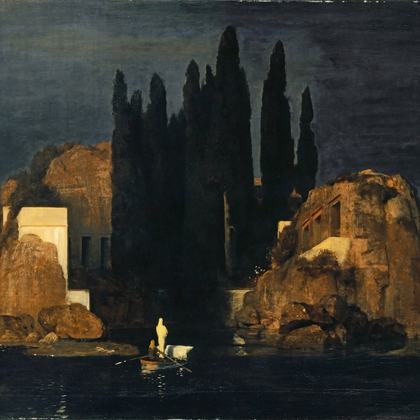
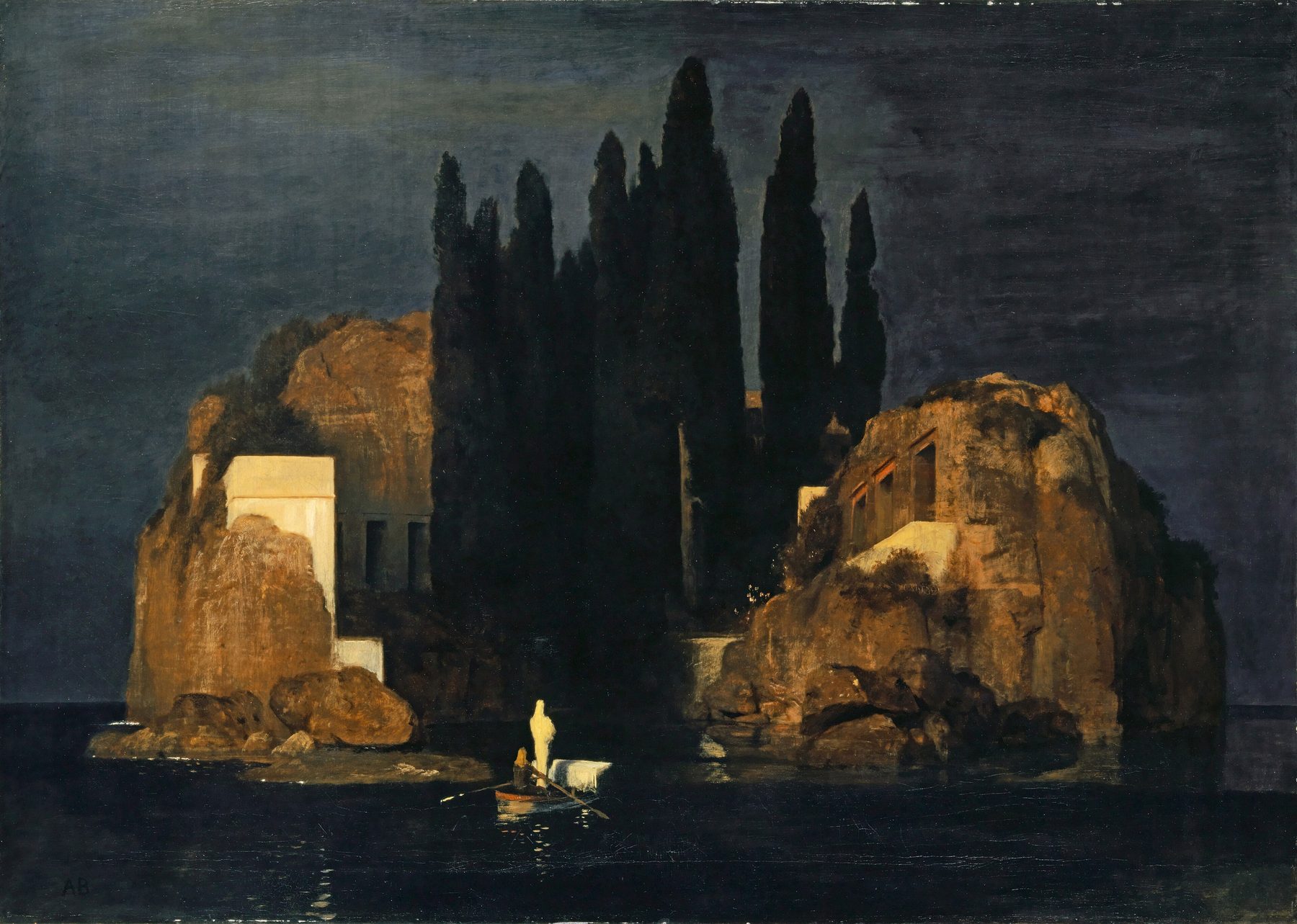
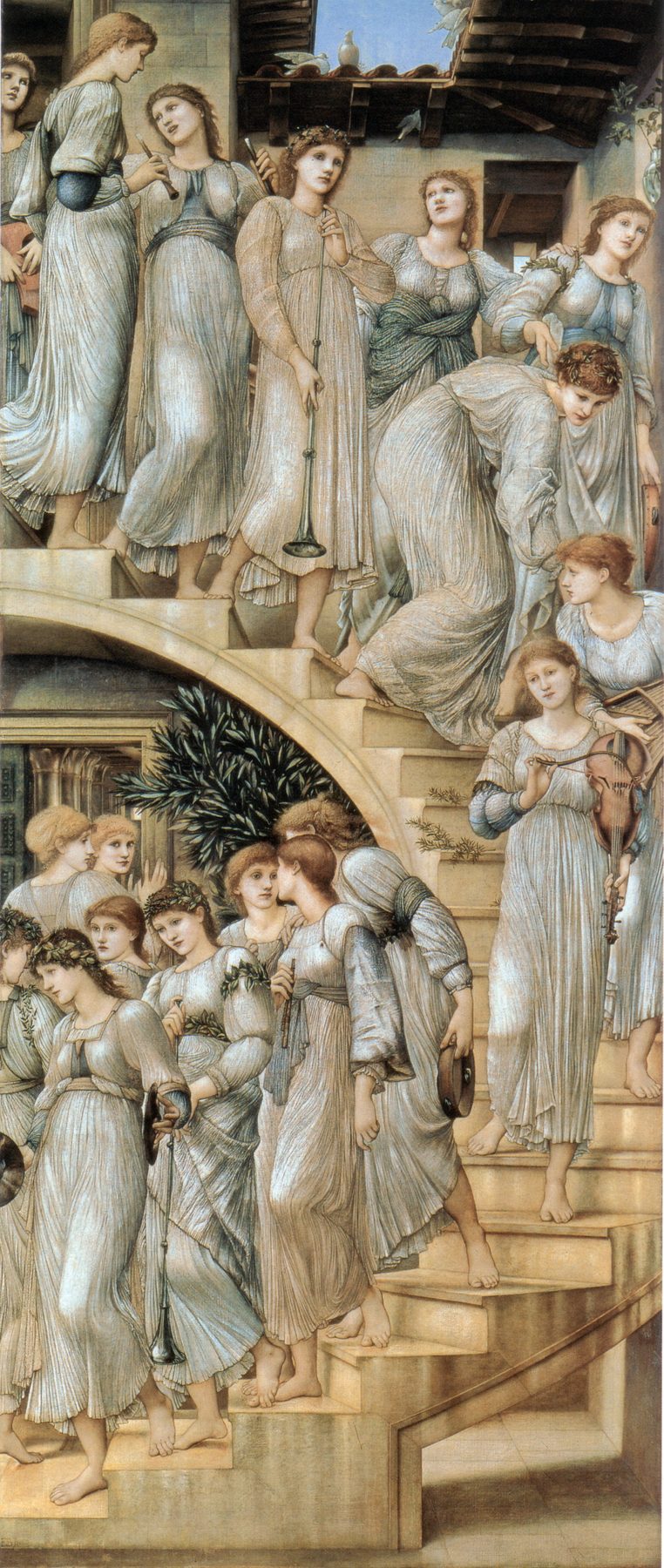
Arnold Böcklin and Edward Burne-Jones broadened this foundation beyond France. Böcklin’s repeated versions of Isle of the Dead place a white-shrouded figure and coffin in a boat approaching an enclosed island of cliffs and dark cypresses. The scene suggests funeral journey, memory and silence without defining a narrative. Its still water and sealed architecture turn landscape into a psychic space.[14] Burne-Jones’s elongated figures and dreamlike medieval subjects connected Pre-Raphaelitism to the Aesthetic and Symbolist worlds. His paintings, tapestries and designs made legend feel remote from ordinary time, yet physically present through pattern and craft.
These artists were not waiting for a manifesto. Their differences established the central fact of visual Symbolism: inward meaning could be pursued through excessive detail or radical simplicity, blackness or colour, public mural or private print, Christian story or invented myth.
Essential works
Oedipus and the Sphinx
Gustave Moreau, 1864
The Apparition
Gustave Moreau, c. 1876
The Cyclops
Odilon Redon, c. 1914
Vision after the Sermon
Paul Gauguin, 1888
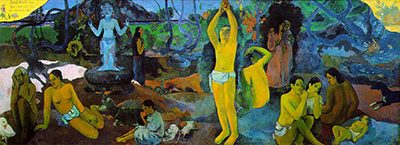
Where Do We Come From? What Are We? Where Are We Going?
Paul Gauguin, 1897–98
France after 1886
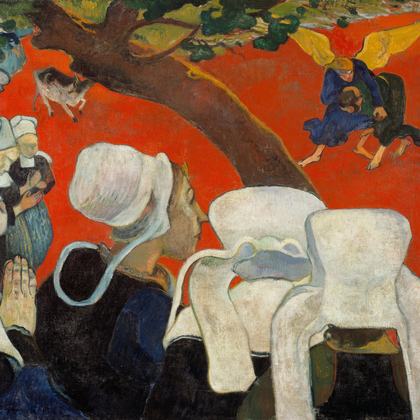
Paul Gauguin gave Symbolism one of its most consequential formal languages. Working with Émile Bernard in Brittany in 1888, he moved away from modelling forms through naturalistic light. Large areas of colour, emphatic outlines and compressed space made the picture less like a window and more like an arrangement of emotionally charged signs. This approach became known as Synthetism because it joined an external subject, the artist’s feeling and the independent qualities of line and colour.[15]
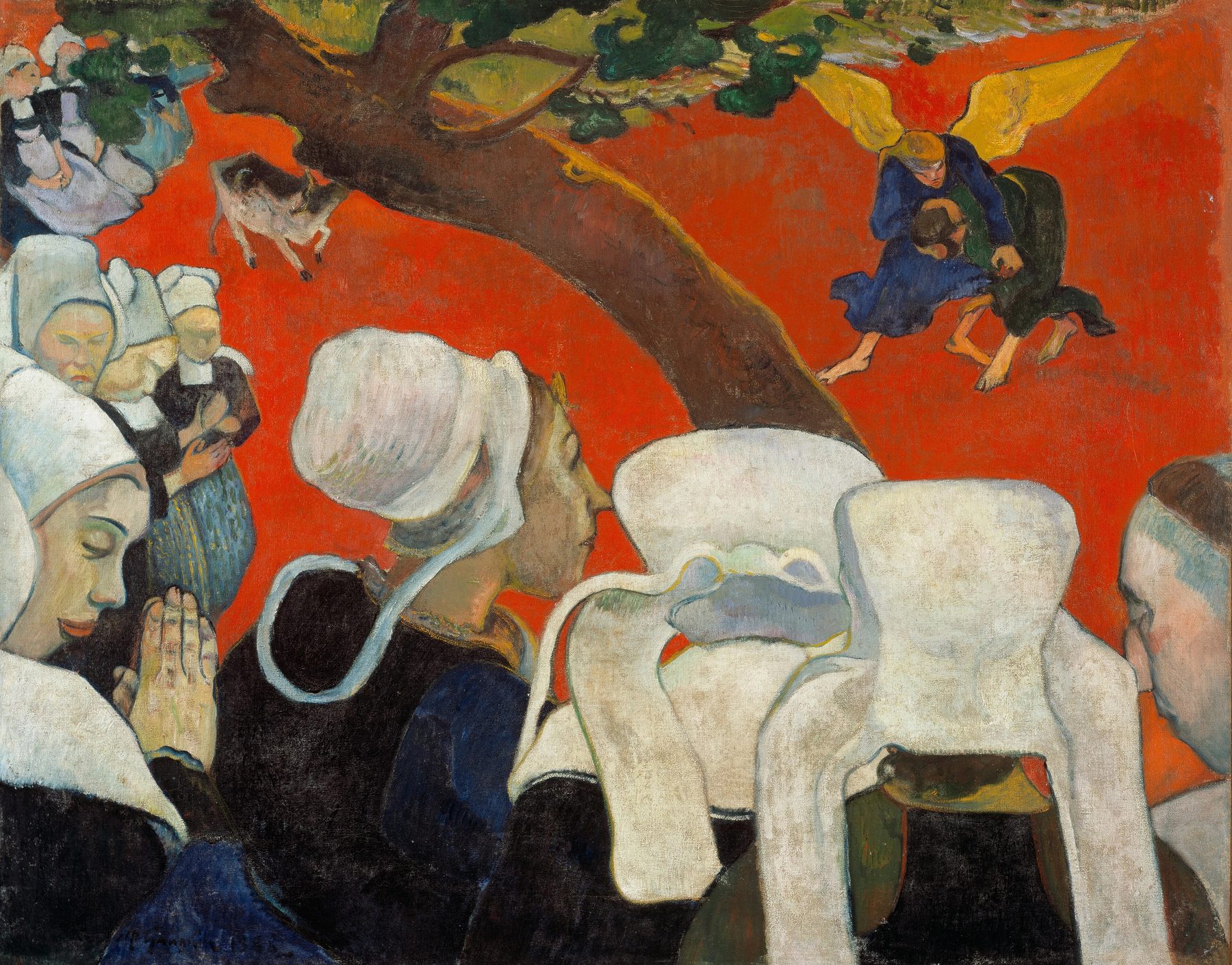
In Vision after the Sermon, Breton women in white caps occupy the foreground while Jacob wrestles with an angel across a field of startling red. A diagonal tree separates ordinary worshippers from the vision they share or imagine. Scale and colour do not follow optical probability. They organise belief. Gauguin insisted on painting from memory and imagination, while Bernard’s experiments with simplified, enclosed forms were equally important to the new direction. Later arguments over priority warn against turning collaboration into the story of one solitary inventor.[16]
The picture also reveals the period’s search for cultures imagined to be outside modern Paris. Brittany was treated as ancient, devout and “primitive”, although it was part of contemporary France and already shaped by tourism. Gauguin’s attraction to such places became central to his artistic persona. He styled himself as both a rebellious “savage” and a martyr to art, a posture that rejected bourgeois respectability while helping him compete for leadership of the Paris avant-garde.[17]
That self-invention intensified after he sailed to Tahiti in 1891. The islands were under French colonial rule and had already been transformed by missionisation, disease, trade and administration. Gauguin arrived expecting the unspoiled paradise described by European travel literature and colonial displays. When reality did not match the fantasy, he assembled a Tahiti of his own from observed people and landscapes, Polynesian names and objects, photographs, Christian imagery, classical poses and texts written by earlier Europeans. The National Gallery of Art describes his art as myth-making across Brittany, Martinique and Polynesia rather than transparent ethnography.[18]
Parau na te Varua ino demonstrates the resulting mixture. Its standing nude derives partly from European conventions of Eve and Venus, while a serpent and masked figure enter an invented Tahitian setting. Even the title remains uncertain. Viewers in Paris could not have decoded the supposed local legend; obscurity was part of the work’s exotic appeal.[19] Gauguin’s symbols shift from picture to picture because they serve a personal mythology as much as any inherited belief.
Formally, these paintings transformed modern art. Their non-natural colour and simplified shapes showed that a picture could construct emotional and spiritual space without conventional perspective. Ethically, they cannot be separated from the colonial inequality that made Gauguin’s life and imagery possible. His representations of Polynesian girls and women emerged from a relationship between a mobile adult European man and colonised communities with far less institutional power. The Samoan artist and writer Dan Taulapapa McMullin has directly identified the Western patriarchal gaze embedded in this museum history.[20] Acknowledging that harm does not make the formal inventions disappear. It changes what responsible looking requires.
The artists called the Nabis adopted lessons from Gauguin, Bernard and Japanese prints. Paul Sérusier, Maurice Denis, Pierre Bonnard and Édouard Vuillard treated the canvas as a flat surface organised by colour before it was a view into depth. They extended painting into screens, interiors, books and theatre. Their name, derived from a Hebrew word for prophet, suited a youthful belief in art’s transformative role. Yet the Nabis were a particular network, not another name for all Symbolists. Their domestic scenes and decorative ensembles also connect them to Post-Impressionism and Art Nouveau.[21]
French Symbolism was therefore never a march from manifesto to agreed style. Moreau maintained a private, learned history painting; Redon moved between darkness and colour; Gauguin pursued Synthetist flatness and colonial myth; the Nabis brought painting into daily surroundings. Poetry and criticism gave these practices a vocabulary, but images kept exceeding the theories written for them.
Brussels and the international network
Brussels was not an outpost of Paris. It was a major meeting place where Belgian and international art circulated through exhibitions, journals, theatres, collectors and design. The exhibiting society Les XX and its successor La Libre Esthétique brought ambitious new work before a cosmopolitan public. Belgian Symbolism developed beside literary figures such as Maurice Maeterlinck and Émile Verhaeren, the graphic ferocity of Félicien Rops, the masks and crowds of James Ensor, and the idealist ambitions of Jean Delville.
The Royal Museums of Fine Arts of Belgium describe fin-de-siècle Brussels as a crossroads in which Symbolism, Idealism and Art Nouveau converged without losing their differences. The Wagnerian total work of art encouraged painters, architects, composers and designers to cross disciplinary boundaries.[22] Modern exhibition societies made inward-looking art public and international.
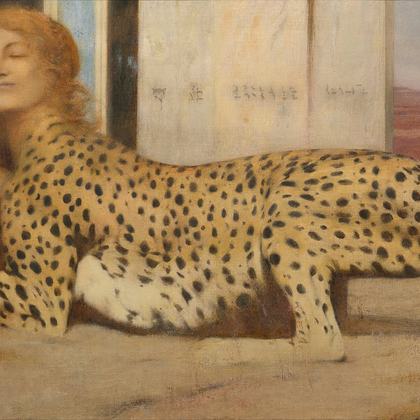
Fernand Khnopff embodies this contradiction. He painted, drew, sculpted, designed costumes and sets, illustrated books, used photography and planned his own house as a controlled artistic environment. His figures often seem inaccessible: eyes averted or closed, bodies mirrored, faces doubled, rooms emptied of ordinary action. His sister Marguerite became a recurring model, but biography alone cannot unlock these images. Repetition converts an individual face into an instrument of distance, memory and self-scrutiny.[23]
In Caresses, also known as The Sphinx, an androgynous Oedipus leans close to a creature with a woman’s head and a cheetah’s body. The pair appear intimate and adversarial at once. The sphinx belongs to the wider fin-de-siècle fascination with the femme fatale: woman imagined as beautiful, irrational, predatory and dangerous to male identity. The setting also draws on a Western fantasy of an exotic Orient.[24] The work’s force lies partly in refusing to say whether Oedipus has mastered the riddle or surrendered to it.
Rops and Ensor demonstrate how far Belgian practice could depart from Khnopff’s polished stillness. Rops joined erotic fantasy to anticlerical satire; Ensor filled streets and rooms with masks, skeletons and unstable crowds. The grotesque was not the opposite of Symbolist seriousness. It exposed the social roles and hidden appetites beneath respectable surfaces. Belgian art made the inner world theatrical, comic and public as well as silent and private.
Northern and eastern transformations
Edvard Munch turned personal experience into images that could circulate beyond biography. Illness and death in his family, relationships, anxiety and urban alienation mattered to his art, but his pictures are not diary entries enlarged onto canvas. He simplified bodies and landscapes until they became carriers of states shared by many viewers. In Paris in 1889, writings later called the Saint-Cloud Manifesto show him imagining an art about the most sacred and decisive moments of human life. Those ideas developed into the long-running Frieze of Life.[25]
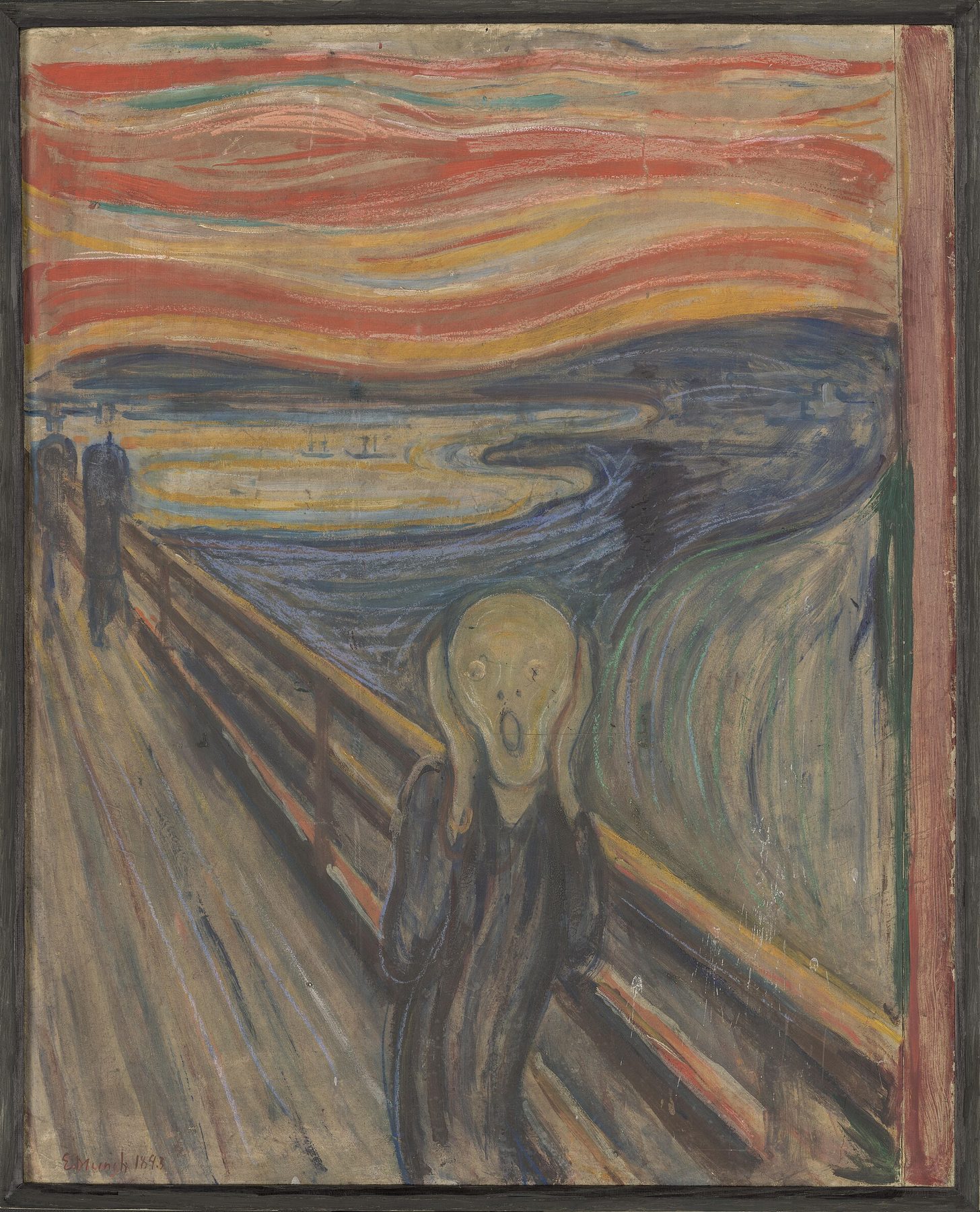
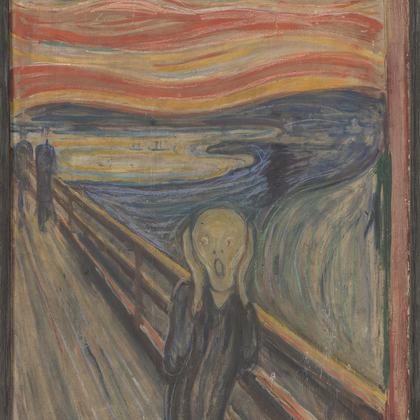
The frieze gathered motifs of attraction, jealousy, separation, anxiety, sickness and death. Munch repeated and altered them across painting and print, which prevented the cycle from becoming one final sequence. A shoreline, a moonlit column, a bridge or a face can return in a new emotional key. Repetition makes the motif more universal while preserving the pressure of an individual hand.
The Scream began in both language and image. Munch wrote of walking with friends, stopping as the sky changed and sensing a scream through nature. He made painted, pastel, drawn and printed versions. The central figure may be screaming or may be covering its ears against the scream; it may be a person, an apparition or a visual sign of sensation. MUNCH’s curatorial account calls the work a riddle and stresses that no single reading settles it.[26] Straight road, receding companions, turbulent sky and undulating body divide the scene between ordinary movement and overwhelming perception.
Finnish Symbolism shows how international forms could carry national and regional histories. Akseli Gallen-Kallela, Magnus Enckell, Hugo Simberg and Ellen Thesleff explored dream, death, landscape and spirituality. The Ateneum presents Symbolism as an attempt to bridge the visible world and a realm of ideas rather than a single style.[27] Finnish artists also turned to the Kalevala, the collection of oral poetry elevated as a national epic. Gallen-Kallela’s Lemminkäinen’s Mother combines grief, resurrection and a stark northern landscape; myth becomes a language for family feeling and national culture.
These works were not isolated from European centres. Gallen-Kallela exhibited with Secession groups in German cities and in Vienna. His Kalevala subjects paralleled the wider Symbolist search for ancient legend while remaining locally specific.[28] National mythology could assert cultural identity under political pressure, but it could also idealise a unified people and obscure internal differences. Symbolism’s turn to origins was never politically innocent.
In Russia, Mikhail Vrubel joined folklore, literature, opera, architecture and decorative art. His fractured, jewel-like surfaces make bodies seem to crystallise from their surroundings. Panels such as Morning transform vegetation into women and fabulous creatures without fixing their identities. The Russian Museum links his monumental ambitions to a national form and to the multiple meanings of myth.[29] His demons, prophets and fairy-tale figures show that Russian Symbolism was not a delayed copy of French art. It emerged through its own theatre, music, literature, religious imagery and debates about national modernity.
Across Norway, Finland and Russia, Symbolism could make landscape psychological, myth contemporary and national tradition experimental. International exhibitions and journals connected these artists, but connection did not erase place.
Vienna and the total work of art
The Vienna Secession, founded in 1897, challenged conservative exhibition institutions and treated painting, sculpture, architecture and applied design as equal partners. Symbolist ideas arrived through artists including Khnopff, Böcklin, Max Klinger and Jan Toorop, while Austrian artists transformed them. The Belvedere’s survey of Austrian Symbolism emphasises its range: idyllic retreat, cosmic vision, dream, eroticism and modern unease.[30]
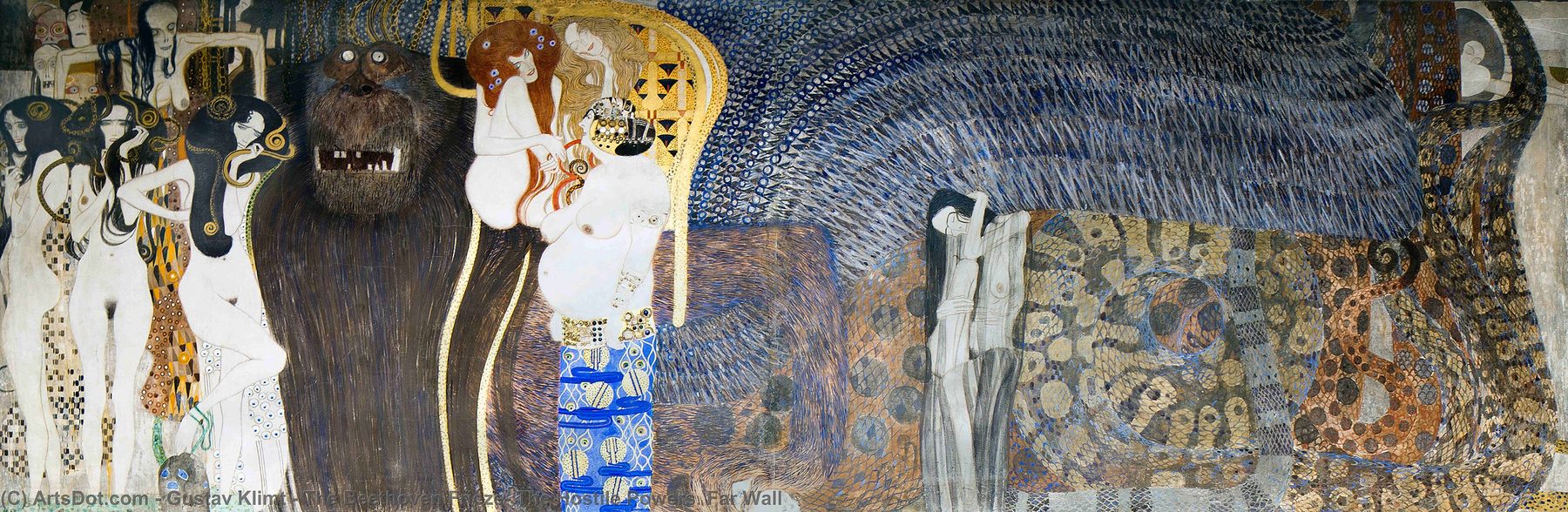
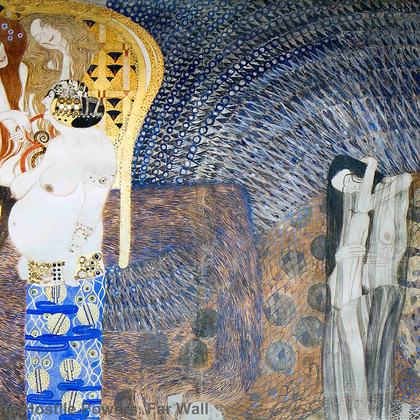
Gustav Klimt’s Beethoven Frieze of 1902 made these ambitions architectural. It was created for the Secession’s fourteenth exhibition, a collaborative tribute to Beethoven designed under Josef Hoffmann. Twenty-one artists arranged painting, sculpture and interior space around Max Klinger’s statue of the composer. The stated aim was to reunite the arts so that the exhibition itself became one encompassing work.[31]
Klimt based his three-wall allegory on Wagner’s interpretation of Beethoven’s Ninth Symphony. Suffering humanity seeks happiness, encounters sickness, madness, lust and other hostile forces, then finds fulfilment through poetry and the arts. Gold, plaster, glass and other materials interrupt ordinary painting. Flat ornament sits beside modelled bodies; isolated figures alternate with dense pattern. The final embrace before a chorus of angels turns Schiller’s “kiss for the whole world” into an image of aesthetic and erotic completion.[32]
The frieze was meant to be temporary. Its survival should not disguise the importance of its original setting, where viewers moved through a carefully arranged space toward sculpture and music. Klimt’s later golden paintings retain this tension between object and environment. Ornament is not an added luxury. It contests the idea that painting’s highest purpose is to imitate depth. The Belvedere connects the Secession’s equal treatment of fine and applied arts to the ideal of the Gesamtkunstwerk, or total work of art.[33]
Symbolism, the Vienna Secession and Art Nouveau overlap here, but each term answers a different question. Symbolism describes the work’s pursuit of ideas through allegory and suggestive form. Secession names an institutional network. Art Nouveau identifies a wider reform of line, ornament, objects and spaces. Klimt can belong to all three histories without proving that they are synonyms.
Britain, books and Decadence
Britain had its own route into Symbolism. Pre-Raphaelite intensity, medieval revival and the Aesthetic Movement’s defence of beauty prepared a culture in which art could turn away from moral illustration and industrial ugliness. Edward Burne-Jones created languid figures, enchanted narratives and decorative surfaces across painting, stained glass and tapestry. His art connected Botticelli and chivalric legend to modern design, influencing continental Symbolists even though his career began before the movement received its name.
By the 1890s French poetry and Decadent literature gave British Aestheticism a more disturbing edge. The Victoria and Albert Museum notes that writers such as Verlaine, Mallarmé, Rimbaud and Joris-Karl Huysmans brought ideas of self-conscious artifice, transgression and decline into the British debate.[34] Symbolism and Decadence shared subjects and moods, but Decadence placed particular emphasis on cultivated artificiality, exhausted civilisation and the pleasure of violating moral convention.
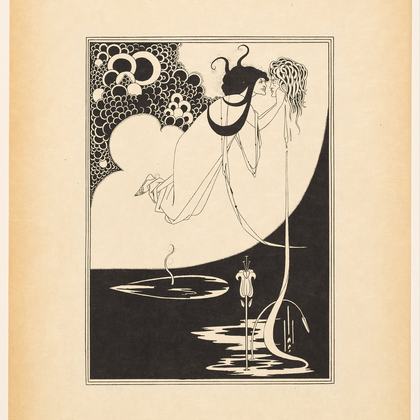
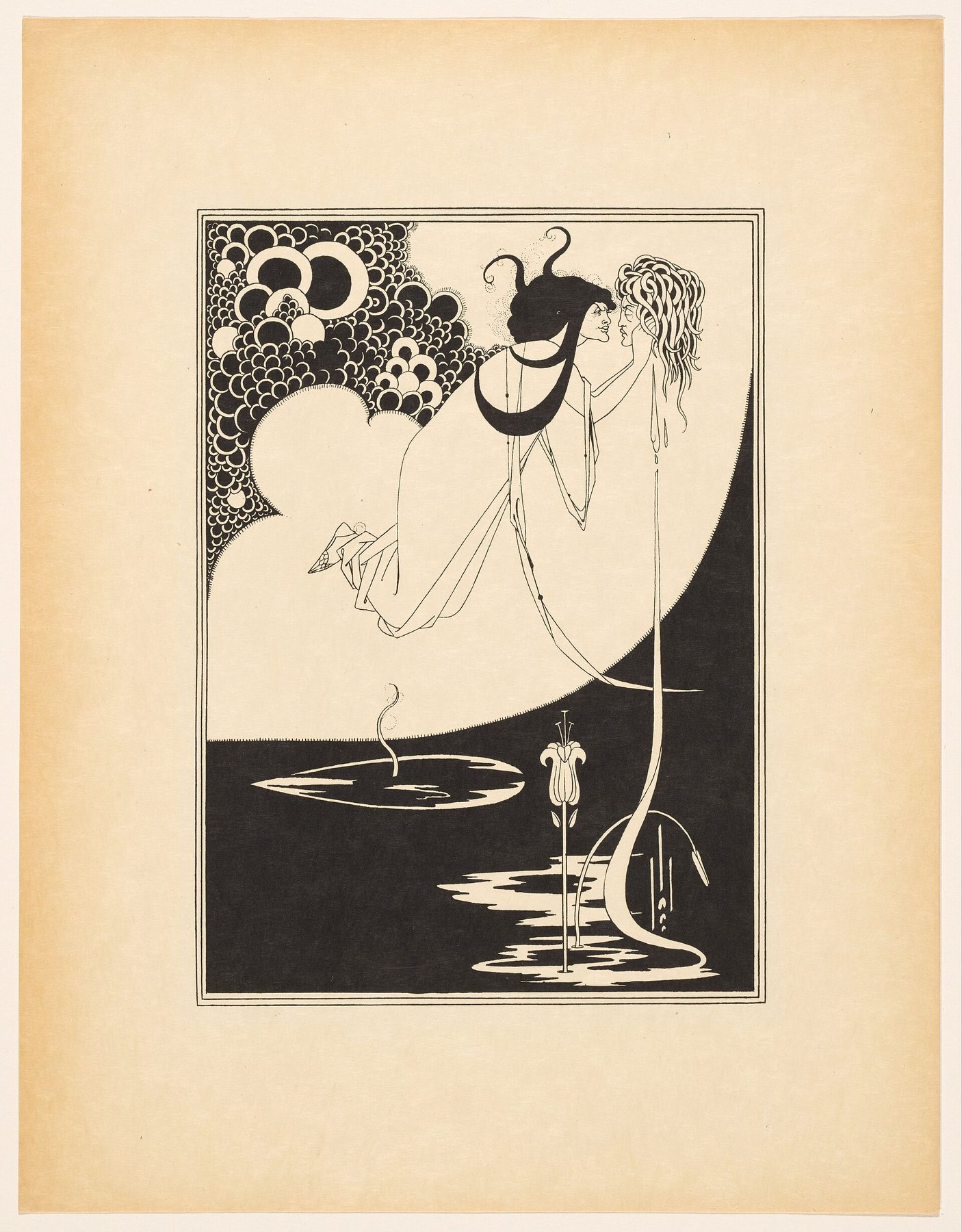
Aubrey Beardsley made the printed page one of the period’s most radical spaces. His drawings for Oscar Wilde’s Salome of 1894 do not merely visualise scenes from the play. Black fields, white paper, sinuous contours and floating figures create a parallel performance. Japanese prints, Whistler, fashion and erotic caricature meet in compositions that feel exquisitely controlled and unstable. The V&A shows how modern line-block printing enabled his extreme contrasts to circulate through books and magazines.[35]
Beardsley’s Salome is performer, designer, threat and object of desire. The drawings exaggerate bodies, gender signs and decorative excess until identity itself seems theatrical. His brief career also exposes the modern machinery behind the movement’s cult of private vision: publishers, illustrated periodicals, new printing methods, publicity and scandal. Symbolism’s escape from ordinary life was circulated through thoroughly modern media.
Gender, spirituality and modern life
Woman became one of Symbolism’s most overworked signs. Images repeatedly divide femininity between the distant virgin and the destructive seductress. Salome, Judith, Medusa, Eve, the sphinx and the siren fuse attraction with fear. In many works, the supposedly universal drama is specifically a male anxiety about desire, intellectual autonomy and changing gender roles. Museum research on the nineteenth-century femme fatale describes a figure imagined as combining sexual allure with powers that threaten men and lead toward sterility or death.[36]
This does not make every such image identical. Moreau’s Salome, Khnopff’s sphinx, Munch’s women and Klimt’s Judiths stage different relationships among agency, gaze and ornament. Nor were female viewers required to accept the roles offered to them. The same Salome who embodied danger for male writers and artists could become a vehicle for bold female performance. Interpretation should ask who is allowed interiority and who becomes a sign for somebody else’s feelings.
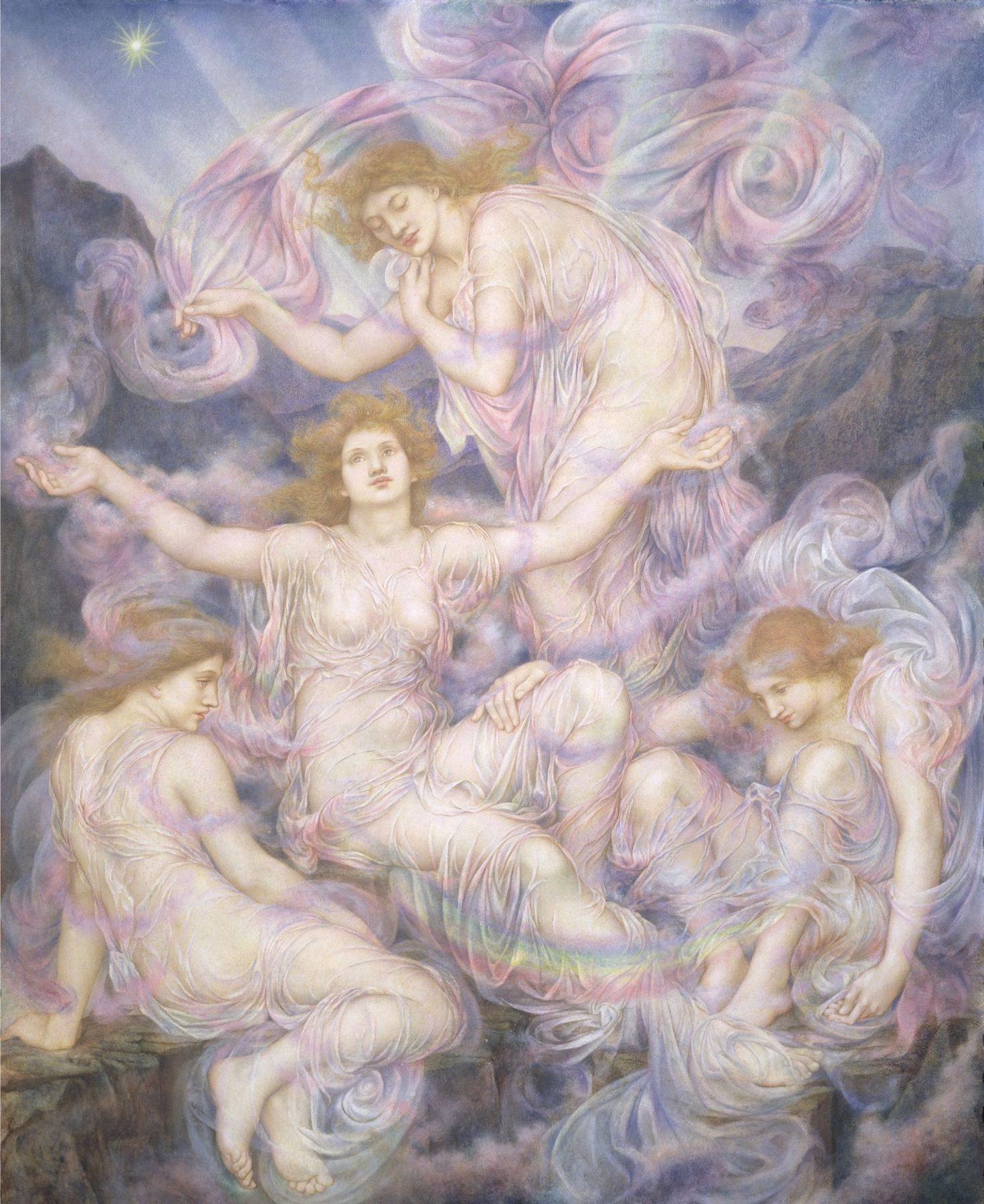
Women were also makers, despite unequal access to academies, life classes, commissions and critical attention. Evelyn De Morgan trained seriously in figure painting and used classical myth, Christian story, allegory and Spiritualist belief to build a distinctive art. Her women can personify the soul or suffering, yet they often occupy the moral centre rather than serving as temptations on a male hero’s path. In Daughters of the Mist, made around 1910, rainbow colour and four barely interacting figures replace a clear narrative with an invitation to feel spiritual transformation.[37]
De Morgan’s example also complicates the movement’s chronology. Her work became more explicitly Symbolist after 1900, when the first Paris generation was dispersing. Her anti-materialist and spiritual concerns intersected with women’s rights and social reform. One artist cannot stand for every woman excluded from standard histories, but her presence changes the questions asked of the movement.
Spirituality itself must remain plural. Some artists returned to Catholic ritual; others investigated Spiritualism, Theosophy, Rosicrucianism, esoteric philosophy, Buddhism or an undefined ideal realm. Finnish artists drew on Neoplatonic ideas; De Morgan believed in the soul’s continued existence; Gauguin constructed hybrid religious myths. Redon, by contrast, objected when critics treated his imagined beings as evidence that he was a spiritualist.[38] The word “spiritual” often meant only that art should possess value beyond material description.
Landscape could carry that search without depicting a god. Puvis and Alphonse Osbert created “landscapes of the soul”; Redon made trees and colour feel dreamlike; Gallen-Kallela joined forest, water and myth. Musée d’Orsay research shows that the sacred landscape varied with each artist’s religious background, national culture and intellectual network.[39] The movement’s nature is therefore no untouched opposite of the city. It is a mental and cultural construction.
Symbolism is often described as an escape from modernity, and many artists did oppose materialism, industrial standardisation, positivist confidence and the Naturalist claim to explain people through environment and heredity. Fin-de-siècle culture also carried fears of social decline, political violence, disease, sexuality and the anonymous metropolis. Munch’s bridge, Ensor’s masked crowd and Khnopff’s sealed room give modern estrangement visual form.
Yet Symbolism was also made by modernity. International rail travel brought artists to exhibitions. Journals moved poetry, criticism and images across borders. Lithography and line-block printing expanded the audience for Redon and Beardsley. New exhibition societies in Brussels, Paris, Munich and Vienna challenged official institutions. Dealers and collectors created markets for art that claimed inward purity. Art Nouveau moved Symbolist imagery into furniture, glass, jewellery, posters and domestic interiors.[40] The movement’s private dream depended on public systems.
Artists to know
Gustave Moreau
renewed history painting by making biblical and classical subjects deliberately enigmatic. His importance lies not only in recurring figures such as Oedipus and Salome but in the conviction that colour, ornament and accumulated sources could preserve mystery.
Odilon Redon
moved from charcoal and lithographic noirs to radiant pastel and painting. Across both phases, suggestion mattered more than explanation. His influence reached the Nabis, Fauves and later artists interested in dream and metamorphosis.
Paul Gauguin
helped develop Synthetism and demonstrated the expressive independence of colour and contour. His achievement must be read together with his deliberate self-mythology and the colonial, racial and sexual inequalities within his Polynesian work.
Fernand Khnopff
made distance itself into a subject. Portraits, doubled faces, sphinxes, photographs and controlled interiors turn memory and identity into polished but unresolved surfaces.
Edvard Munch
built a vocabulary of repeated figures, shorelines, bridges and skies for love, anxiety, jealousy and death. His images move between Symbolist suggestion and the expressive force that later artists developed.
Gustav Klimt
joined allegory, portraiture, erotic drawing, gold and applied design. His Secession work shows how a Symbolist idea could occupy an entire architectural setting.
Further artists
Arnold Böcklin
transformed myth and landscape into psychological theatre. Isle of the Dead became one of the period’s most widely recognised images without surrendering its narrative silence.
Akseli Gallen-Kallela
brought Finnish landscape and Kalevala myth into an international modern language. His career demonstrates exchange between national culture and the Secession networks of Central Europe.
Mikhail Vrubel
fused Russian folklore, opera, literature, mosaic-like surface and monumental decoration. His figures appear to emerge from matter, making ornament psychologically active.
Edward Burne-Jones
linked Pre-Raphaelite medievalism to Aesthetic and Symbolist dream worlds. His work across media made pattern, craft and narrative inseparable.
Aubrey Beardsley
transformed book illustration through black-and-white line, erotic grotesque and the tension between text and image. His designs prove that Symbolism belonged as fully to print culture as to oil painting.
Evelyn De Morgan
used allegory and symbolic colour to address love, death, materialism, the soul and female suffering. Her work makes women’s authorship central to any adequate account of British Symbolism.
Major artists directory
| Name | Nationality | Key Works |
|---|---|---|
| Akseli Gallen-Kallela | Finnish | The Defence of the Sampo |
| Arnold Böcklin | Swiss | Isle of the Dead |
| Aubrey Beardsley | British | The Climax, The Peacock Skirt |
| Edvard Munch | Norwegian | The Scream, The Frieze of Life |
| Edward Burne-Jones | British | The Golden Stairs, The Beguiling of Merlin |
| Evelyn De Morgan | British | Daughters of the Mist, The Gilded Cage |
| Fernand Khnopff | Belgian | Caresses, I Lock My Door upon Myself |
| Gustav Klimt | Austrian | Beethoven Frieze, The Kiss |
| Gustave Moreau | French | Oedipus and the Sphinx, The Apparition |
| Mikhail Vrubel | Russian | Demon Seated, The Swan Princess |
| Odilon Redon | French | The Cyclops, Pandora |
| Paul Gauguin | French | Vision after the Sermon, Where Do We Come From? |
How to look at Symbolist art
Begin by delaying the hunt for a solution. Ask what the work withholds. Are the figures performing a recognisable story, or has the artist removed the event that would explain them? Does a title clarify the image or make it stranger? Ambiguity is often an intended structure, not missing information.
Then examine how form carries feeling. In a Gauguin, flat red may separate visionary space from ordinary sight. In a Redon, charcoal darkness may allow a being to hover between presence and disappearance. In a Munch, repeated curves may bind body, landscape and sound. In a Klimt, pattern may press a figure toward the picture surface while gold suggests preciousness, ritual and abstraction. Formal distortion is not decoration applied after meaning; it is how meaning happens.
Look for repetition within an artist’s career. Munch’s shorelines, Redon’s eyes, Khnopff’s faces and Moreau’s Salomes change through recurrence. A motif does not carry the same message every time. Its history accumulates, and differences among versions matter.
Consider the medium. Charcoal can absorb light; lithography can make a private vision widely available; a mural belongs to a room; an illustrated page stages a conversation with words; a decorative object enters touch and daily use. Symbolism challenged the hierarchy that placed monumental painting above design. The close relationship between the movement and Art Nouveau grew from this expanded understanding of art.
Ask whose inner life is represented. When a woman appears as sphinx, virgin or seductress, is she a character with agency or a sign of male desire and fear? When Gauguin presents a Polynesian subject as timeless and exotic, what colonial conditions have been excluded from the scene? Ethical context does not replace visual attention. It makes the visual choices more legible.
Finally, notice the work’s relation to its own present. A medieval legend, classical myth or empty landscape can appear to reject modern life. But its style, exhibition history and circulation may depend on modern institutions and technology. Symbolist art frequently occupies both positions at once: protesting the modern world while inventing a distinctly modern image.
The legacy of Symbolism
Symbolism widened what an artwork could claim as its subject. By allowing colour, line and rhythm to express states rather than copy objects, it helped make Fauvism, Expressionism and abstraction imaginable. Gauguin’s flat colour affected Matisse and the German avant-garde; Munch’s emotional distortion resonated with Expressionists; the mystical landscape provided one route toward Kandinsky’s spiritual abstraction.[41]
Its dream images, hybrids and open narratives also mattered to Surrealism. André Breton admired Moreau, while Redon’s floating beings seemed newly contemporary in an age interested in the unconscious. But calling these artists precursors can flatten their actual aims. Moreau was renewing history painting, not waiting for Surrealism; Redon distrusted literal accounts of the supernatural; Khnopff’s control differs from later automatism.
In design, Symbolist correspondences encouraged the integration of page, object, room and performance. Beardsley changed illustration; the Nabis treated interiors as artistic ensembles; the Vienna Secession joined building, display and decoration. Modern graphic culture inherited the conviction that a line or field of colour could establish a complete atmosphere.
The movement’s most durable lesson is interpretive. An image does not need to choose between private experience and public meaning. It can remain open without becoming empty. The viewer’s uncertainty is not a failure to understand; it is often the space in which the work acts.
Frequently Asked Questions
Not in the manner of a society with one membership list and style. Writers, critics, artists and exhibition groups formed overlapping networks. Some painters accepted the label; others were classified later. Shared interests in suggestion, inner states and the expressive work of form are more reliable than a roster.[1]
The literary name dates from 1886, but visual precedents were active much earlier. A broad visual span of the 1870s to the 1910s is useful, with the most concentrated international activity from the mid-1880s through the first decade of the twentieth century. Different national fields follow different chronologies.
There is no single appearance. Look for an image that turns away from straightforward observation toward dream, myth, memory, emotion or spiritual questioning. Flat colour, unnatural light, simplified forms, dense ornament and enigmatic narrative are common, but none is required on its own.
The contrast is useful but incomplete. Symbolist critics rejected what they saw as Impressionism’s concern with optical surface, while Gauguin pursued memory and invention. Yet artists and exhibitions overlapped, and both movements challenged academic convention. Redon even appeared in the final Impressionist exhibition.
No. Symbolism is primarily an approach to ideas and suggestion; Art Nouveau is a wider reform of line, ornament, architecture and applied design. They intersect in Khnopff, Klimt, Beardsley and the Nabis, and both questioned the separation of fine and decorative arts.[40]
No. Spiritualism, Theosophy, Catholic revival, esotericism and idealist philosophy mattered to different artists, while others developed private mythologies or rejected doctrinal labels. Redon specifically resisted being called a spiritualist.[38]
The femme fatale condensed fin-de-siècle anxieties about sexuality, changing gender roles and male control. Salome, Judith, Medusa and the sphinx made desire appear inseparable from danger. The pattern should be analysed as a gendered construction, not accepted as a timeless truth.[36]
It strengthened the independence of colour and line, encouraged open-ended images, connected fine and applied arts, and treated inner experience as a legitimate subject. Those achievements fed Expressionism, Fauvism, abstraction, Surrealism and modern graphic design without making every Symbolist merely a forerunner.[41]
Discussion
Does the openness of a Symbolist image give viewers greater freedom, or does it allow the artist to guide emotion more powerfully by withholding a clear explanation?
Reader Insights
Notice whether the title or narrative resolves the image, or deliberately keeps several meanings in play.
Follow the expressive work done by colour, line, pattern, blackness, repetition and the chosen medium.
Ask who receives interiority and who is turned into a sign of desire, fear, myth or colonial fantasy.
Join the Conversation
Have a thought or observation about Symbolism? Share it below. Thoughtful responses may be added to this section.
References
- “Symbolism”, Metropolitan Museum of Art. View Source
- Jean Moréas, View Source; Metropolitan Museum of Art, View Source.
- “Le symbolisme”, Bibliothèque nationale de France. View Source
- “Le symbole au XIXe siècle”, Bibliothèque nationale de France. View Source
- “Gauguin and symbols”, Grand Palais. View Source
- The Symbolist Aesthetic, Museum of Modern Art. View Source
- “The Art of Gustave Moreau”, Musée Gustave Moreau. View Source
- “Œdipus and the Sphinx”, Musée Gustave Moreau. View Source
- “Artworks on the move: Salomé”, Musée Gustave Moreau. View Source
- Bibliothèque nationale de France, View Source; Metropolitan Museum of Art, View Source.
- “Drawings by Odilon Redon”, Musée d’Orsay. View Source
- “Pandora’s Box: Odilon Redon”, National Gallery of Art. View Source
- “Redon 1840–1916”, Musée d’Orsay. View Source
- “Die Toteninsel”, Staatliche Museen zu Berlin. View Source
- “Après l’impressionnisme, du néo-impressionnisme au fauvisme”, Musée d’Orsay. View Source
- Picturing France 1830–1900, National Gallery of Art. View Source
- “Paul Gauguin (1848–1903)”, Metropolitan Museum of Art. View Source
- “Gauguin: Maker of Myth”, National Gallery of Art. View Source
- “Parau na te Varua ino”, National Gallery of Art. View Source
- “Lo Tatou Seiana: Our Flowering, Our Time”, Dan Taulapapa McMullin, Metropolitan Museum of Art. View Source
- “Art Nouveau”, Metropolitan Museum of Art. View Source
- “Symbolism, Idealism and Art Nouveau at the Fin-de-Siècle Museum”, Royal Museums of Fine Arts of Belgium. View Source
- “Space Series 1: Symbolism”, Royal Museums of Fine Arts of Belgium. View Source
- Félicien Rops & Fernand Khnopff, Royal Museums of Fine Arts of Belgium. View Source
- “Edvard Munch in Paris”, MUNCH. View Source
- “5 things you should know about The Scream”, MUNCH. View Source
- “Gallery 15: Symbolism”, Ateneum Art Museum. View Source
- “Gallen-Kallela, Klimt & Wien”, Ateneum Art Museum. View Source
- “Mikhail Vrubel: Morning”, Virtual Russian Museum. View Source
- “Decadence: Aspects of Austrian Symbolism”, Belvedere Museum Vienna. View Source
- “Beethoven Frieze”, Vienna Secession. View Source
- “Iconographic Program and Symbolism”, Vienna Secession. View Source
- “Who Was Gustav Klimt?”, Belvedere Museum Vienna. View Source
- “An introduction to the Aesthetic Movement”, Victoria and Albert Museum. View Source
- “Aubrey Beardsley: decadence & desire”, Victoria and Albert Museum. View Source
- Dangerous Beauty: The Nineteenth-Century Femme Fatale, Metropolitan Museum of Art. View Source
- “Evelyn De Morgan”, De Morgan Foundation. View Source
- Musée d’Orsay, View Source; Ateneum Art Museum, View Source; De Morgan Foundation, View Source.
- “Beyond the Stars: The Mystical Landscape”, Musée d’Orsay. View Source
- Art Nouveau 1890–1914, National Gallery of Art. View Source
- Musée d’Orsay, View Source; Metropolitan Museum of Art, View Source.
- Symbolist Art in Context, Michelle Facos. View Source
- The Symbolist Roots of Modern Art, Michelle Facos and Thor J. Mednick, eds. View Source
- The Symbolists, Philippe Jullian. View Source
- Image references 45–56: open-access reproductions and institutional collection records.
View 12 image sources
01 · commons.wikimedia.org02 · commons.wikimedia.org03 · commons.wikimedia.org04 · commons.wikimedia.org05 · commons.wikimedia.org06 · commons.wikimedia.org07 · commons.wikimedia.org08 · commons.wikimedia.org09 · commons.wikimedia.org10 · commons.wikimedia.org11 · demorgan.org.uk12 · commons.wikimedia.org