 by Tom Gurney
Tom Gurney BSc (Hons) is an art history expert with over 20 years experience
Published on August 14, 2026 / Updated on August 14, 2026
Email: tomgurney1@gmail.com / Phone: +44 7429 011000
Where Do We Come From? What Are We? Where Are We Going?: Introduction
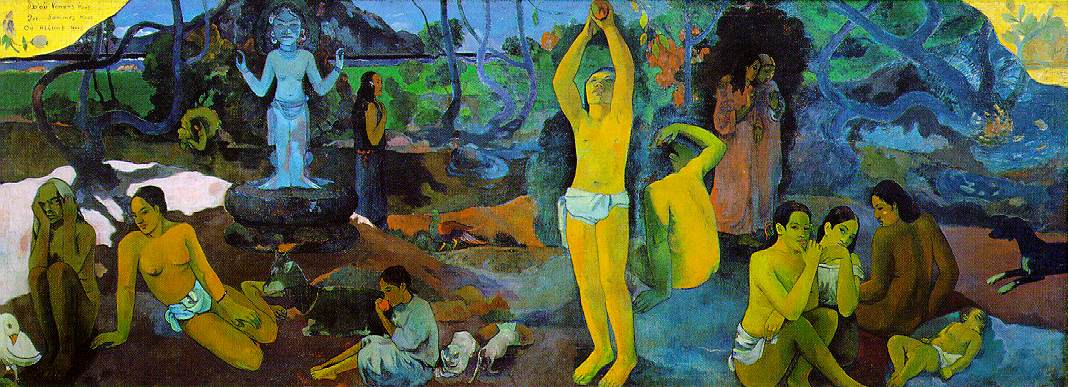
Paul Gauguin's largest painting does not offer a comfortable viewing distance. At almost 3.75 metres wide, it extends beyond a single glance. Yellow shapes at the upper corners act like fragments of a frame: the French title is painted into the left one, while P. Gauguin / 1897 occupies the right. Between them, bodies appear in clusters across a blue-green landscape, close enough to suggest one gathering but too discontinuous to form an ordinary episode. [1] [2]
At a Glance
- ArtistPaul Gauguin [1]
- TitleWhere Do We Come From? What Are We? Where Are We Going? [1]
- Date1897 [1]
- Mediumoil on canvas [1]
- Dimensions / object size139.1 by 374.6 centimetres [1]
- Object recordcomplete title; Paul Gauguin; 1897-98; MFA Boston [1]
- FocusPaul Gauguin's largest painting does not offer a comfortable viewing distance.
Contents
- Where Do We Come From? What Are We? Where Are We Going?: Introduction
- How the panorama asks to be read
- A painting made to resemble a wall
- The story Gauguin told about making it
- A Tahitian scene directed towards Paris
- Whose world carries the questions?
The Museum of Fine Arts, Boston, dates the panorama to 1897–98. This oil on canvas measures 139.1 by 374.6 centimetres and is numbered 36.270, Tompkins Collection—Arthur Gordon Tompkins Fund. The upper-left inscription reads D'où Venons Nous / Que Sommes Nous / Où Allons Nous: three questions without painted question marks. The current English title supplies the punctuation, but the composition declines to supply three matching answers. [1] [2]
How the panorama asks to be read
At the far right, a baby sleeps beside seated figures. Two people crouch together farther in, while another turns away from the viewer. Above them, a pair in long purplish garments stands against a dark tree. These bodies overlap, yet their glances and gestures do not join into one continuous action. Two small dark animals at the edge add a flicker of ordinary observation to a scene already carrying monumental ambitions.
The central figure interrupts every horizontal rhythm. Standing almost frontally, the person reaches both arms towards a red fruit held above the head. A pale cloth catches the strongest light; the yellow-orange body advances against the cooler ground. Immediately behind, a second body turns and bends, its raised arm echoing the fruit picker's arc without repeating its purpose. The two forms make the centre feel active, but not like a clean division between one stage of life and the next.
The left half becomes stranger. A seated child holds fruit near a goat and other small animals. A pale-blue figure stands frontally on a dark platform with both arms lifted. At the extreme left, a folded, hooded person sits near a pale bird; beside them, a larger nude figure stretches diagonally across the ground. Scale changes abruptly. Some bodies press forward, others seem embedded in the landscape, and the supposed sequence repeatedly doubles back on itself.
Gauguin did propose a route. The MFA's account of his letters says he described the picture from right to left, beginning with the infant, moving past the central fruit picker and ending with an old woman nearing death. He said that the raised-arm blue figure “indicates the Beyond” and assigned the white bird a meaning connected with the futility of words. [1] Those propositions sharpen the irony of a painting titled with language: at the end of the artist's own visual journey, a bird represents words failing.
This is a useful path, not a master key. The groups do not separate neatly into infancy, maturity and death. Children, adults and animals recur between the imagined endpoints; the central picker may recall a story of forbidden fruit, but neither gender nor a fixed biblical role follows from the visible body. The blue figure is Gauguin's sacred-looking invention in this composition, not authenticated evidence for a traditional Tahitian deity. His explanation belongs beside the canvas, not over it.
A painting made to resemble a wall
The upper corners change the status of the image. Rather than hiding the rectangular support, Gauguin painted signs of an aged border onto it. The MFA says he wanted the yellow areas to make the work resemble a damaged fresco attached to a golden wall, and that he requested a simple white frame for exhibition. [1] The device gives a newly made, transportable canvas the imagined authority of an old mural.
Material choices reinforce that fiction. Although the formal medium is oil on canvas, the MFA describes a coarse, heavy burlap support and relatively smooth paint. In his February 1898 letter to Daniel de Monfreid, Gauguin called it a knotty, irregular sackcloth whose texture made the result look extremely rough. The low relief of the paint allows that weave to remain active rather than burying it beneath thick impasto. [1] [4]
Carol Christensen's technical study places these choices within a much longer practice. Coarse fabrics, absorbent grounds and thin paint were not techniques suddenly forced upon Gauguin by island poverty; he had developed them in Brittany and Arles and used them partly for their visual effect. For this painting, the study identifies a lead or lead-zinc white ground bound with glue. The surface could evoke worn plaster while remaining an oil painting designed to be rolled, shipped and displayed in Europe. [5]
That distinction matters. Calling the support merely an emergency sack turns material evidence into another story of heroic deprivation. Ignoring shortages would be equally misleading. Gauguin did have difficulty obtaining supplies in the South Seas, but Christensen's comparison of his work and correspondence shows that necessity, preference and self-presentation cannot be pulled apart by repeating the artist's account alone. [5]
The story Gauguin told about making it
The Louvre preserves the autograph letter in which Gauguin connected the canvas with a period of debt, distress and what he described as a failed suicide attempt. That is primary evidence that he made the report in February 1898; it is not independent verification of the attempt, a diagnosis of his condition or proof that one crisis explains every figure. [4]
In the same letter, he contrasted his method with an academic progression from studies after nature to a preparatory cartoon. He insisted that everything had been fait de chic au bout de la brosse—worked from invention or memory at the brush tip. The phrase promotes immediacy. It also sits within a letter shaped for a trusted correspondent and for the reputation Gauguin was constructing around his work. [4] [6]
The surviving object refuses a literal no-preparation story. The first sheet of the letter itself bears a pen-and-wash project sketch. The Louvre identifies it and another drawing as studies for the Boston painting. Christensen reproduces a related 1898 study on tracing paper that was squared in graphite for transfer, and notes additional figure studies. Her conclusion is direct: the panorama was carefully planned, whatever freedom or urgency governed its final execution. [4] [5]
The date makes the legend still less tidy. Gauguin signed the painting 1897; the MFA and WPI date it 1897–98. Christensen reports Richard Brettell's argument that the artist continued working on it during 1898 while retaining the earlier painted date. There is no need to choose between cold calculation and a single volcanic outburst. Long preparation, rapid passages of paint, personal crisis and later self-dramatisation can coexist. [2] [5]
A Tahitian scene directed towards Paris
The picture's remote setting did not mean withdrawal from a European audience. WPI records Gauguin sending the work towards Monfreid in 1898; it was with him by September, passed to Georges-Alfred Chaudet in November and then to Ambroise Vollard. Vollard displayed it in Paris from 17 November to 10 December with recent related paintings. [3]
The first reviews did not agree that the questions solved the image. Thadée Natanson treated it as a mysterious decorative panel that gathered the surrounding motifs and invited meditation on human destiny. André Fontainas thought the figures and idol would not reveal an allegory without the words painted above them. Henri Ghéon admired individual groupings but found attention dispersed across the large panel. Their disagreement is revealing: obscurity was present at the work's first public showing, not invented by later viewers. [3]
The exhibition also exposes the double direction of the painting. Its people and landscape were made in colonised Tahiti, but its title is French, its mural effect was calibrated for framing, and its passage to Vollard was actively managed. Gauguin's distance from Paris became part of the work's appeal while Paris remained essential to its visibility, sales and reputation.
WPI traces the canvas from Vollard to the Bordeaux collector Gabriel Frizeau around 1901, then through Galerie Barbazanges, Jørgen Breder Stang, Alfred Gold and the Marie Harriman Gallery. The MFA acquired it on 16 April 1936. [3] That journey helped turn a canvas posing questions into a canonical object, but canonical status does not make its imagined Tahiti transparent.
Whose world carries the questions?
Gauguin painted within a French colony, drawing on observed bodies while assembling symbols, remembered motifs and European expectations of a supposedly untouched Pacific world. The National Gallery of Art describes his art as constructing the paradise he failed to find, blending fact with fiction in images that also promoted the persona of an instinctive outsider. [6] The blue figure, compressed landscape and procession of bodies belong to that authored dreamworld. They cannot be treated as an ethnographic diagram of Tahitian religion or social life.
Current Pacific-facing scholarship also requires attention to who had the power to make and circulate such images. The National Gallery of Australia states plainly that present-day standards reject Gauguin's conduct and relationships in Polynesia. [7] This history does not cancel the painting's formal intelligence. It changes the terms of admiration: Tahitian people are not timeless material for a French artist's universal philosophy, and the work's ambition cannot be separated from the colonial conditions that enabled his claim to speak through them.
A 2020 response by Yuki Kihara, Fonofono o le Nuanua: Patches of the Rainbow (after Gauguin), offers a precise answer to that imbalance. Made as a chromogenic photographic panorama, it measures 139 by 375 centimetres—almost exactly the Boston painting's scale—and features members of the Aleipata Fa'afafine Association. Kihara, an artist of Japanese and Sāmoan descent living in Sāmoa, calls her use of Gauguin's composition repurposing and upcycling: a way to reclaim representation for an Indigenous, third-gender Pacific community. [8]
The response is specifically Sāmoan, not a substitute for Tahitian testimony or a universal Indigenous verdict. Its title comes from a poem by Sāmoa-based Reverend Ruperake Petaia and invokes vā fealoa'i, the nurturing of relational space between people and between people and nature. Kihara turns a composition once organised by an outsider's questions into a field occupied by named community, gender politics and environmental responsibility. [8]
The three questions endure because no single sequence can contain them. In Gauguin's panorama, infancy, desire, age, animals, invented divinity and landscape share a surface without becoming one doctrine. In Kihara's reworking, the same scale becomes a means of taking authorship back. Looking across both works makes the title less like a timeless riddle delivered from nowhere and more like an ethical demand: who is permitted to ask, who is made to carry the answer, and who controls the image that survives?
Related Pages
Frequently Asked Questions
Paul Gauguin's largest painting does not offer a comfortable viewing distance.
In the same letter, he contrasted his method with an academic progression from studies after nature to a preparatory cartoon.
The three questions endure because no single sequence can contain them.
Discussion
Paul Gauguin's largest painting does not offer a comfortable viewing distance.
Reader Insights
Paul Gauguin's largest painting does not offer a comfortable viewing distance.
The Louvre preserves the autograph letter in which Gauguin connected the canvas with a period of debt, distress and what he described as a failed suicide attempt.
In Kihara's reworking, the same scale becomes a means of taking authorship back.
Join the Conversation
Share the visible detail or source that most changed your reading.
References
- Museum of Fine Arts, Boston, Where Do We Come From? What Are We? Where Are We Going?, collection object 36.270 and current approved reproduction/curatorial page. and View source
- Wildenstein-Plattner Institute, D'où venons-nous ? Que sommes-nous ? Où allons-nous ?, W561, current object record and public API. and View source
- Wildenstein-Plattner Institute, W561 cataloguing record: provenance, exhibitions, contemporary reviews and publications View source
- Musée du Louvre / Musée d'Orsay, Paul Gauguin, February 1898 letter from Tahiti to Daniel de Monfreid, RF 41648 and RF 41648.BIS. and View source
- Carol Christensen, The Painting Materials and Technique of Paul Gauguin, Studies in the History of Art 41, National Gallery of Art, 1993, pp. 62–103 View source
- National Gallery of Art, Gauguin: Maker of Myth, scholarly exhibition publication View source
- National Gallery of Australia, Gauguin's World: Tōna Iho, Tōna Ao, current exhibition and contemporary-context overview View source
- National Gallery of Australia, Yuki Kihara, learning resource and artist-event record on Fonofono o le Nuanua: Patches of the Rainbow (after Gauguin). and View source
 Paul Gauguin.jpg)