 by Tom Gurney
Tom Gurney BSc (Hons) is an art history expert with over 20 years experience
Published on August 14, 2026 / Updated on August 14, 2026
Email: tomgurney1@gmail.com / Phone: +44 7429 011000
Paul Gauguin in Brittany and Pont-Aven: Introduction
Gauguin went to Brittany seeking distance from Paris, but he did not arrive in an undiscovered artistic refuge. Painters from France and abroad had been gathering at Pont-Aven since the 1860s. Inns, transport links and a growing reputation made the town part of an international art network well before his first stay in 1886. [1] [2]
At a Glance
- ArtistPaul Gauguin
- GuidePaul Gauguin in Brittany and Pont-Aven
- Focusin Brittany and Pont-Aven
- Key topicsThe practical attraction of Pont-Aven; Exchange in 1888; People and place remade in paint; Guidance, departure and return
- OverviewGauguin went to Brittany seeking distance from Paris, but he did not arrive in an undiscovered artistic refuge.
Contents
- Paul Gauguin in Brittany and Pont-Aven: Introduction
- The practical attraction of Pont-Aven
- Exchange in 1888
- People and place remade in paint
- Guidance, departure and return
- Le Pouldu and Marie Henry's inn
- A real region and an artistic idea
Brittany: Key Works
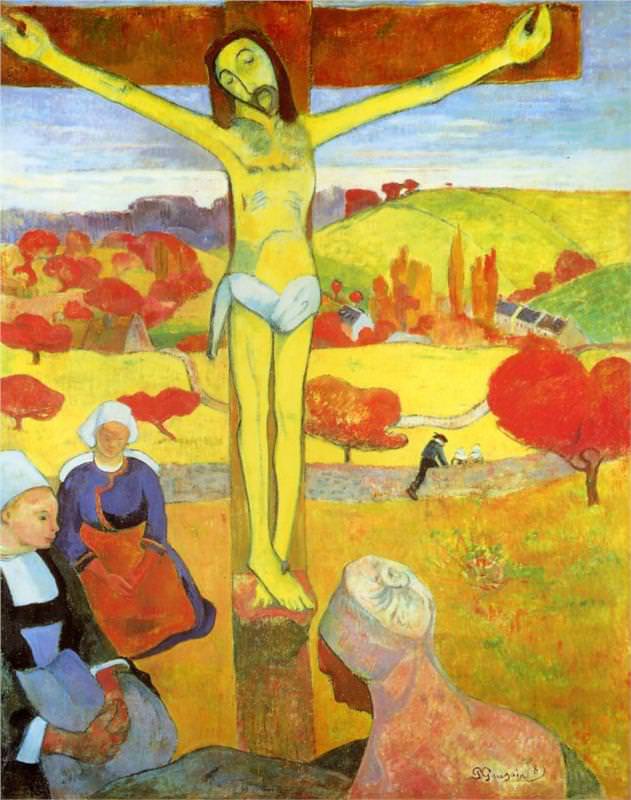
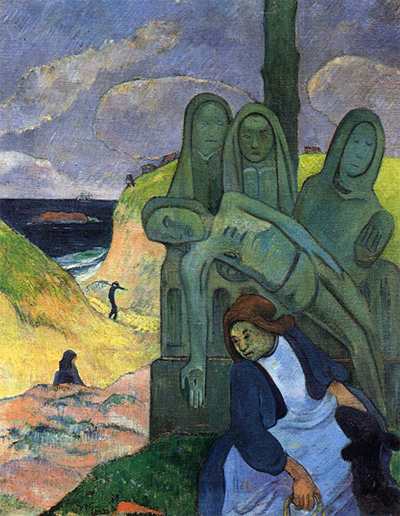
That contradiction shaped everything he made there. Brittany offered lower costs, strong regional identities, Catholic practices, rural work and landscapes unlike the Paris suburbs he had painted. Gauguin selected from those realities to build an anti-modern idea of the place. Pont-Aven was simultaneously a working town, an artists' colony and a screen onto which he projected the spiritual and social distance he wanted his career to represent.
The practical attraction of Pont-Aven
Money was an immediate reason for Gauguin's first journey in 1886. The collapse of his brokerage career and the separation of his household had left him unable to sustain a conventional Paris life. Board at Pension Gloanec could be inexpensive, and the concentration of artists provided company, information and potential buyers. Pont-Aven offered a way to keep working without leaving the art world behind. [1] [2] [3]
The town already possessed the infrastructure of an artists' destination. Visitors found lodgings, shared models and subjects, compared work and carried news between Brittany and metropolitan exhibitions. Local residents, churches, farms, mills and market activity supplied motifs, but they did not exist for the colony's benefit. The artistic community depended on a living economy that continued beyond the images its visitors made.
Gauguin stayed at Pension Gloanec and met artists including Charles Laval and Émile Bernard. His 1886 work did not yet present one fully formed new programme. He was still bringing lessons from Pissarro, Cézanne and Impressionism into contact with sculpture, ceramics and the stronger silhouettes he encountered in Breton subjects. The first stay mattered as a place of comparison and experiment rather than a sudden revelation. [1] [4]
Life at an inn made exchange routine. Paintings could be seen before exhibition, advice could pass across a table, and visiting artists could share information about models, prices and places to work. These encounters were informal; the so-called Pont-Aven School had no fixed enrolment, manifesto or obedient membership. Its later name gathers together people whose methods and commitments differed. [1] [2] That looseness helped the colony generate experiments, but it also makes any story centred on a single leader historically misleading.
After leaving Brittany, Gauguin travelled with Laval through Panama to Martinique in 1887. During the same interval, Bernard and Louis Anquetin pursued bold contours and simplified colour arrangements in France. These parallel experiences mattered when Gauguin and Bernard met again. They returned to the conversation with different recent work behind them. [2] [4]
Exchange in 1888
Gauguin came back to Pont-Aven in 1888, and Bernard's return that summer led to an intense exchange. Bernard was much younger, yet he brought existing experiments rather than waiting to receive Gauguin's instruction. Gauguin contributed his longer experience of modern painting and his growing insistence that observation could be reordered through memory, feeling and design. [1] [7]
Their collaboration helped establish the pictorial approach later called Synthetism. Its movement history belongs to a wider network, but its local effect can be stated simply: a painting no longer had to preserve natural colour, continuous depth or the proportions supplied by a single view. The visible world could be compressed and rearranged to give an idea greater force.
This was not a rejection of place. Breton clothing, worship, buildings and landscape remained recognisable, sometimes with striking specificity. The change lay in what the artist allowed those observed elements to become. Gauguin could enlarge bodies against a distant town, turn a field into a red zone for imagined experience or join a headland to an enigmatic animal shape. Brittany remained present while the picture declared its independence from straightforward description.
People and place remade in paint
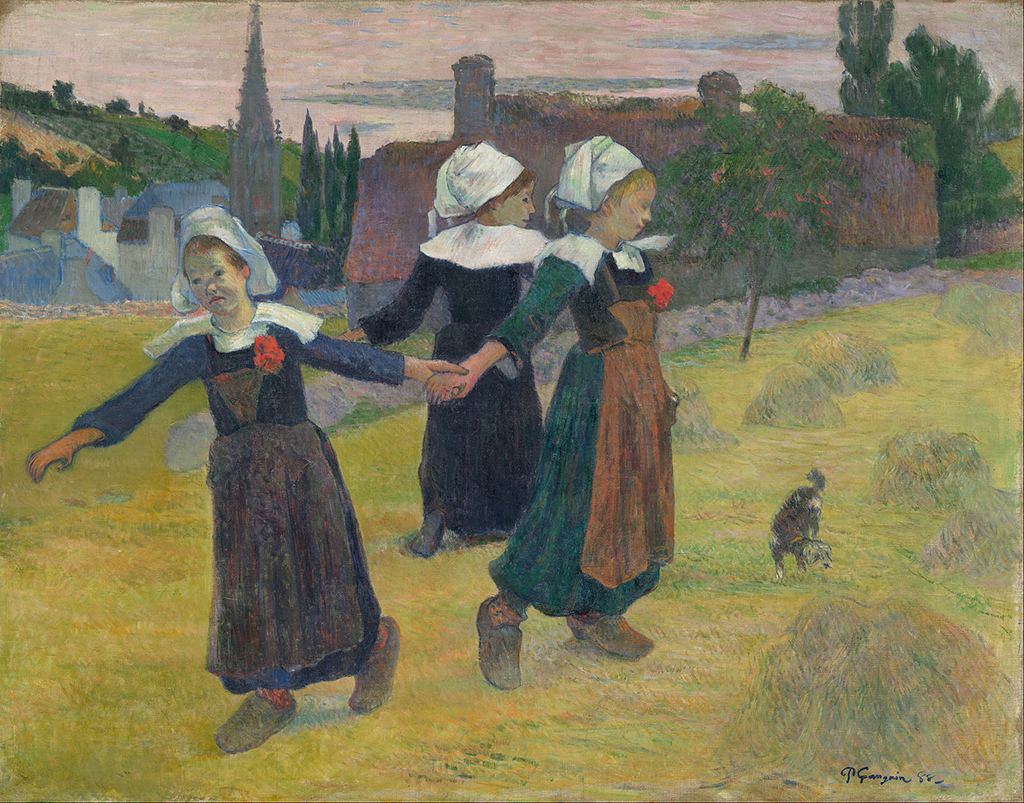
In Breton Girls Dancing, Pont-Aven, three linked figures dominate a much smaller view of the town behind them. Regional headdresses and dark dresses locate the group, while joined arms create a strong lateral rhythm. The girls are not scaled according to the distant buildings. Their size makes human movement the principal structure of the painting. [2] [5]
The work is rooted in observation, yet it cannot be used as a neutral record of a particular dance or of every girl's experience. Gauguin did not supply the identities, thoughts or exact occasion that a modern viewer might wish to know. The painting gives visual authority to the group while also converting represented people into an arrangement governed by his own choices. Its full object history requires a separate account; here it shows how sharply the 1888 work could join local reference to designed pattern.
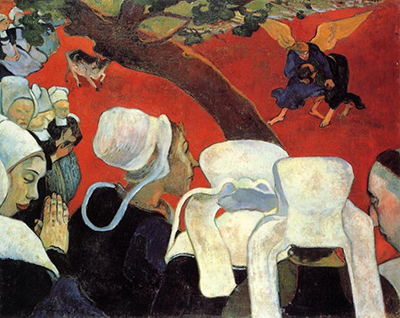
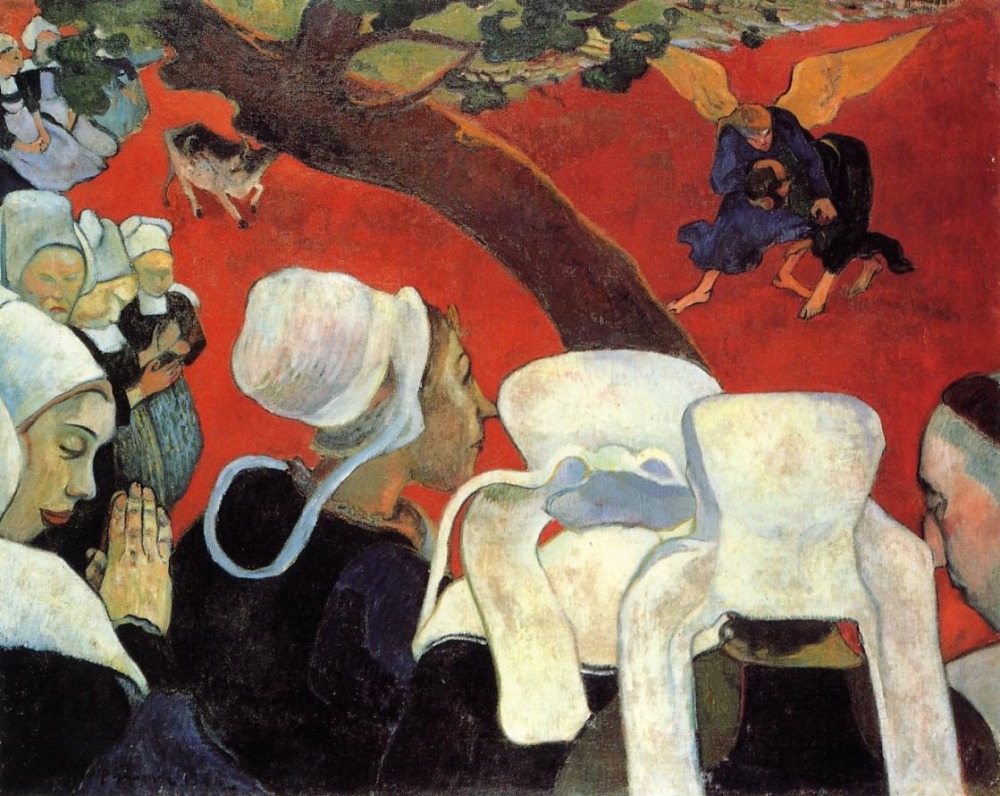
Vision of the Sermon reorganises Breton worship more radically. Women fill the near field after hearing a sermon, while Jacob's struggle with the angel appears at a much smaller scale beyond a diagonal tree. Red replaces plausible earth colour, making the biblical scene occupy an imagined pictorial space. [6] The painting does not reveal the women's inner beliefs. It stages Gauguin's construction of people envisioning a sacred story.
That distinction is especially important in Brittany. Gauguin described the region through nineteenth-century ideas of instinct, remoteness and cultural survival. Such language helped him present himself as an artist escaping bourgeois modernity. It did not objectively describe Breton people, whose regional dress and Catholic practice belonged to contemporary communities connected to tourism, markets and migration. [2] [3]
Guidance, departure and return
During October 1888, Gauguin advised Paul Sérusier while the younger artist worked on a compact Bois d'Amour landscape subsequently titled The Talisman. Sérusier carried the work back to Paris, where its concentrated colour and simplified forms became important to the artists later called the Nabis. [7] It was Sérusier's painting, not an object made by Gauguin, and its later status as an origin story grew through retelling.
The episode shows that Pont-Aven was a point of transmission rather than a sealed retreat. Ideas moved out through paintings, conversations and people. Gauguin himself left for Arles later that month to work with Vincent van Gogh. When he returned to Brittany in 1889, he also remained involved with the Volpini exhibition project in Paris. [1] [4] Geographic distance and metropolitan ambition operated together.
By then, Gauguin complained that Pont-Aven had become crowded and costly. The complaint was partly practical and partly characteristic: once a refuge became visibly connected, he sought another location that could carry the promise of separation. He moved toward Le Pouldu, a smaller coastal settlement where living could again be cheaper. [2] [8]
Le Pouldu and Marie Henry's inn
Le Pouldu was more than a quieter landscape. At the inn run by Marie Henry, Gauguin worked alongside Meijer de Haan and other artists. They painted and decorated the dining environment, carrying images onto walls, panels and architectural surfaces. [1] [9] The shared setting weakened the boundary between isolated artwork and inhabited room.
Marie Henry should not disappear behind the artists who stayed with her. Her premises made the collaborative environment possible, and the later history of its objects is tied to her ownership and preservation. Meijer de Haan likewise brought an independent practice and personal history to the group. Describing the inn as Gauguin's private workshop would repeat the lone-genius story that distorts Pont-Aven as well.
The move also produced a different landscape vocabulary. Harvest: Le Pouldu begins from identifiable coastal topography but rebuilds it in broad, bounded areas. A turned dog introduces a difficult visual note without supplying a clear story. [8] Gauguin could use the headland as evidence of place while making the arrangement answer memory and formal design.
Work at the inn extended this process across media and supports. Motifs could move between pictures, decorated surfaces and objects encountered in the room. The environment was temporary and social: meals, debts, friendships, rivalries and work occupied the same building. That material setting makes Le Pouldu a distinct phase, not merely the quieter end of the Pont-Aven story. [9]
Gauguin left in November 1890 and returned to Parisian Symbolist circles. He visited Brittany once more in 1894 after his first Tahitian stay, but the sustained Breton experiment had ended. [1] [3] The places and people remained available to his memory and public identity long after he moved on.
A real region and an artistic idea
Brittany changed Gauguin's work because it offered actual communities, collaborators and visual experiences. It also changed his career because he made the region stand for a rejection of Paris. Those two roles never fitted perfectly. The established colony, visiting artists and tourists contradicted the image of untouched distance, while Breton people lived within the modern world his rhetoric claimed to escape.
Pont-Aven and Le Pouldu are therefore best understood neither as passive backdrops nor as the birthplace of one man's isolated breakthrough. They were working environments where local life, international exchange, economic necessity and artistic ambition met. Gauguin's paintings transformed that encounter into a powerful idea of Brittany. Keeping the encounter and the idea separate allows both the innovation and its cultural framing to remain visible.
Related Pages
Frequently Asked Questions
Gauguin went to Brittany seeking distance from Paris, but he did not arrive in an undiscovered artistic refuge.
Vision of the Sermon reorganises Breton worship more radically.
Pont-Aven and Le Pouldu are therefore best understood neither as passive backdrops nor as the birthplace of one man's isolated breakthrough.
Discussion
Gauguin went to Brittany seeking distance from Paris, but he did not arrive in an undiscovered artistic refuge.
Reader Insights
Gauguin went to Brittany seeking distance from Paris, but he did not arrive in an undiscovered artistic refuge.
Vision of the Sermon reorganises Breton worship more radically.
Keeping the encounter and the idea separate allows both the innovation and its cultural framing to remain visible.
Join the Conversation
Share the visible detail or source that most changed your reading.
References
- Musée de Pont-Aven, “Histoire du musée et de l'école de Pont-Aven.” View source
- National Gallery of Art, Picturing France 1830–1900 View source
- National Gallery, London, “Gauguin's Journey.” View source
- Cindy Kang, “Paul Gauguin (1848–1903),” Metropolitan Museum of Art, 2011 View source
- National Gallery of Art, “Breton Girls Dancing, Pont-Aven.” View source
- National Galleries of Scotland, “Vision of the Sermon (Jacob Wrestling with the Angel).” View source
- Musée d'Orsay, “Sérusier's ‘The Talisman’, a Prophecy of Colour.” View source
- National Gallery, London, “Paul Gauguin: Harvest: Le Pouldu.” View source
- Art Institute of Chicago, “Portrait of the Artist's Mother (Eve),” in Gauguin Paintings, Sculpture, and Graphic Works at the Art Institute of Chicago View source
 Paul Gauguin.jpg)