 by Tom Gurney
Tom Gurney BSc (Hons) is an art history expert with over 20 years experience
Published on August 14, 2026 / Updated on August 14, 2026
Email: tomgurney1@gmail.com / Phone: +44 7429 011000
Manaò tupapaú (Spirit of the Dead Watching): Introduction
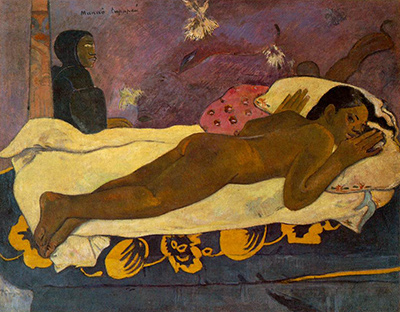
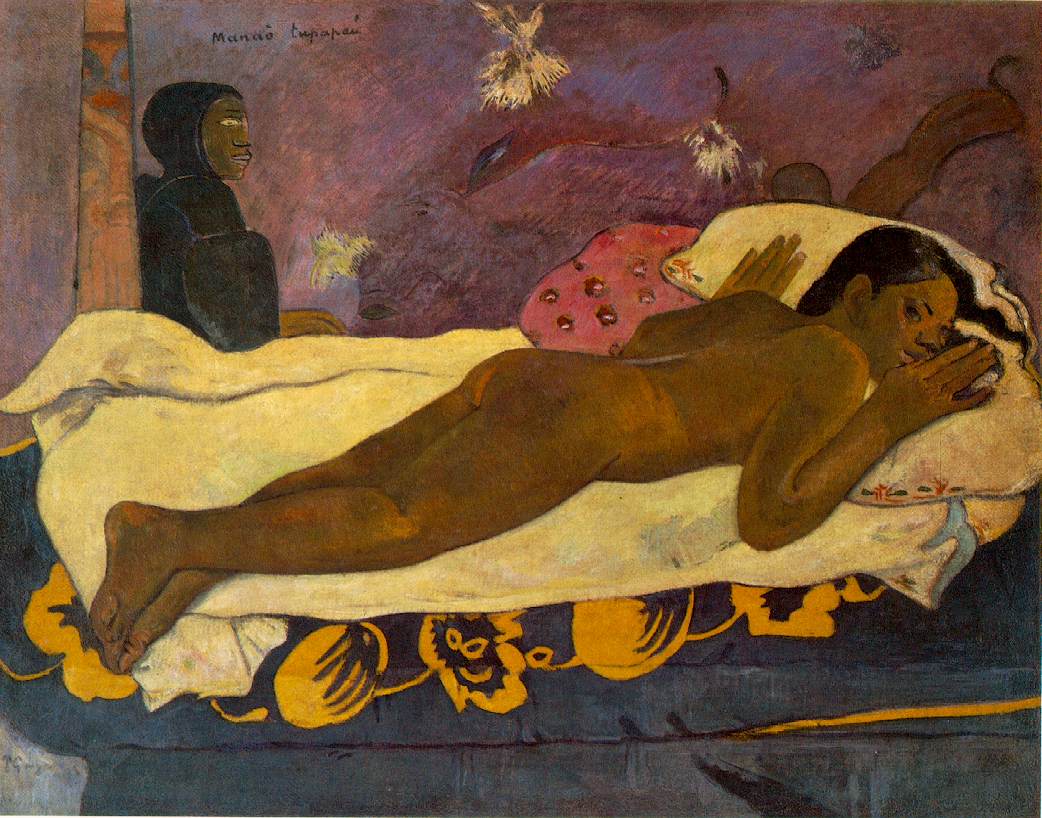
An unclothed child lies face-down across a bed, her head turned outward and her hands drawn close to her face. Pale bedding separates her from a deep-blue textile patterned with large orange forms. At the far left, a smaller dark figure sits upright beside a decorated post. A violet wall carries a winding stem and several pale, feathery marks. [1] The scene is visually clear. What it represents is not.
At a Glance
- ArtistPaul Gauguin [1]
- TitleManaò tupapaú (Spirit of the Dead Watching) [1]
- Date1892 [1]
- Dimensions / object size73.02 by 92.39 centimetres [1]
- Object recordConger Goodyear Collection, entered the museum in 1965 and has accession number 1965:1. [1]
- FocusAn unclothed child lies face-down across a bed, her head turned outward and her hands drawn close to her face.
Contents
- Manaò tupapaú (Spirit of the Dead Watching): Introduction
- A title that reads in two directions
- Look at the painting before accepting the explanation
- Four accounts, not one event
- The child and the adult who controlled the record
- A hybrid image, not an ethnographic record
- The subject changed when Gauguin printed it
- From an unsold painting to Buffalo
Paul Gauguin painted Manaò tupapaú (Spirit of the Dead Watching) in 1892. The Buffalo AKG Art Museum identifies the support as jute mounted on canvas, measuring 73.02 by 92.39 centimetres. The painting belongs to the A. Conger Goodyear Collection, entered the museum in 1965 and has accession number 1965:1. Its Tahitian title appears at the upper left; P. Gauguin 92 is signed and dated at the lower left. [1] The Wildenstein Plattner Institute independently catalogues it as W457. [2]
Those facts establish the object. They do not settle the story Gauguin built around it.
A title that reads in two directions
Buffalo preserves the spelling painted on the canvas: Manaò tupapaú. Art Institute of Chicago scholarship uses the normalised forms mana‘o and tūpāpa‘u. Its language note explains that mana‘o can mean a thought or idea and can also function as a verb for thinking or reflecting; tūpāpa‘u denotes a ghost or apparition, understood as a spirit of the dead. [3]
In his 1893 Cahier pour Aline, Gauguin made the title reciprocal: “Either she thinks of the ghost / Or the ghost thinks of her.” [3] The sentence does not choose which consciousness contains the other. It lets the reclining figure imagine the dark presence, or makes the living figure an object inside that presence's thought.
The familiar English title Spirit of the Dead Watching records another part of the translation history, not a uniquely literal answer. Gauguin's letters of 8 December 1892 moved between thinking of a returning spirit and a spirit watching over her; the 1893 exhibition catalogue used the French L'esprit veille. [4] The same AIC study notes Bengt Danielsson's objection that watch requires a different Tahitian verb. Buffalo's English title remains the correct museum title, while Gauguin's two-way think construction remains essential to understanding the painted words.
Look at the painting before accepting the explanation
The bed creates a stack of broad horizontal zones: dark patterned cloth below, pale sheet and pillows across the middle, violet wall above. The child's body follows that long axis. The dark figure at left interrupts it vertically, as do the post and the painted title. Scale keeps the two figures apart. One stretches nearly across the image; the other occupies a compact block at its edge. [1]
Their sight lines do not produce a simple exchange. The child's face turns towards the viewer's space rather than squarely towards the dark form. That form faces into the room, but its eyes and gesture are not described with enough clarity to establish watching, threatening or guarding. The feathery white forms along the wall are visible; phosphorescent lights is Gauguin's later explanation, repeated and attributed by Buffalo. [1]
AIC research adds that Gauguin called them phosphorescences or flowers of Tupapau and that their shapes resemble hutu blossoms, which open at night. [5] Resemblance does not make them a transcript of one uniform Tahitian belief. They are painted marks that Gauguin subsequently placed inside a verbal system of night, spirit and fear.
Colour also resists a single reading. The body is dark against pale bedding, while the supposed nocturnal field is purple, pink and blue rather than black. Bright white-yellow forms flare across the wall. The lower cloth is almost heraldic in its orange-on-blue pattern. The picture can be described as tense or uncanny, but fear is not a fact readable from a face alone.
Four accounts, not one event
At least four evidence layers have to be kept apart.
First is the 1892 painting: a child on a bed, a dark figure, a post, wall marks and a title. Second is Gauguin's 1893 notebook, where he presented a Genesis of a Picture. AIC notes that this self-analysis was modelled on Edgar Allan Poe's essay The Philosophy of Composition. [3] Gauguin reasoned through sexualised explanations for the child's pose, rejected them as unsuitable and selected fear as the subject that would make his design coherent. That is evidence of how an adult artist rationalised his composition. It is not independent evidence of what the child felt.
Third is Noa Noa, developed after Gauguin returned to France. Its narrator says he came home from Papeete at night and found the literary character Tehura awake in darkness after the lamp had gone out. [3] [5] The scene gives the painting a before-and-after narrative that the canvas itself does not supply. Noa Noa is retrospective, survives in different authorial forms and became collaborative with Charles Morice; current AIC scholarship calls it fictionalised. [3] Tehura's reported terror is therefore part of Gauguin's literary construction, not testimony from the historical Teha'amana.
Fourth is the present museum interpretation. Buffalo identifies the child as Teha'amana and says that, according to Gauguin, she was thirteen. It also describes the dark form as an older woman representing the spirit and explicitly asks whether the child's apprehension might instead concern something beyond the frame. [1] This is responsible openness, but it remains interpretation. The painted evidence does not tell us whether she saw a figure, imagined one or experienced the emotion Gauguin assigned to her.
The child and the adult who controlled the record
Teha'amana's age cannot be treated as a minor biographical footnote. Art Institute research also identifies her as thirteen when the forty-three-year-old Gauguin began an adult-child relationship with her during his first Tahitian stay. [6] He was a French settler-artist; she was a colonised child. He controlled the pose, title, painted image, notebook explanation and later literary narrative. No comparable account by her survives in these records.
Buffalo states plainly that Gauguin was a much older man in a position to take advantage of his subject and that he projected primitivist preconceptions. [1] That power does not disappear when the painting is admired for colour or structure. Nor does acknowledging it authorise invented claims about consent, resistance, belief or private feeling. The most precise statement is also the narrowest: the sources establish her age and Gauguin's representational control, but not her experience of being painted.
The distinction among names helps preserve that boundary. Tehamana is Gauguin's spelling on a separate painted portrait. Teha'amana is the historical name used in current scholarship. Tehura is the character in a later version of Noa Noa. [6] Treating them as one seamless speaking voice would let Gauguin's fiction replace the child's missing testimony.
A hybrid image, not an ethnographic record
The supernatural reading was also shaped by material Gauguin brought from Europe. The Metropolitan Museum of Art attributes the reclining design partly to a photograph of Édouard Manet's Olympia that he carried to Tahiti. [7] AIC scholarship additionally compares the dark figure's relation to the sleeper with Henry Fuseli's The Nightmare, a Western gothic image. [5]
Neither comparison explains every form, and neither cancels the Tahitian words or Gauguin's engagement with local ideas. Together they demonstrate that the canvas is a construction across sources. European nude painting, gothic imagery, Tahitian language, observed vegetation and Gauguin's own invented narrative occupy the same work. It cannot serve as neutral documentation of what all Tahitians believed about the dead.
The subject changed when Gauguin printed it
Gauguin repeatedly returned to Manao tupapau after reaching France. In the 1893–94 Noa Noa Suite woodcut, the recumbent figure no longer faces outward from the bed. She turns her back and curls into a compact, fetal position within a transformed setting. [5] [8] The Met's impression, object 36.6.10, is a colour woodcut on wove paper measuring 20.6 by 34.9 centimetres. [8] It is neither the Buffalo painting nor a mechanical copy of it.
The 1894 L'Estampe Originale sheet stays closer to the painting's horizontal composition but introduces a useful catalogue caution. The Met currently classifies its example as a zincograph, published by André Marty between April and June 1894. [9] AIC calls the corresponding print a lithograph and argues from technical evidence that it appears to have been executed on stone. [3] The institutions agree on the object family and date but not the medium term. That disagreement should remain visible.
Later wood-block variations crop, reverse or redistribute the figures again, and a 1921 edition printed by Gauguin's son Pola is posthumous. [5] The sequence shows sustained revision. Each new medium altered who turns towards whom, how much of the body remains visible, and whether darkness is carried by colour, ink, paper or empty space. The subject was not fixed by the 1892 canvas or finally decoded by the title.
From an unsold painting to Buffalo
Gauguin retained the painting for the rest of his life. It was bought in rather than sold at his Hôtel Drouot sale on 18 February 1895, then passed through deposits or consignments with Lévy, William Molard and Ambroise Vollard. Count Harry Kessler bought it from Vollard likely in November 1903 and certainly by 1904. [1]
It moved through Eugène Druet and a succession of British owners: Sir Michael Sadler, Lord Ivor Spencer Churchill and Percy Moore Turner. Buffalo's record does not assign exact dates to every one of those transfers. De Hauke & Co. acquired it from an unidentified source for A. Conger Goodyear, who purchased it in June 1929. After Goodyear's death in 1964, his estate transferred it to the Albright-Knox Art Gallery; it was allocated to the Goodyear fund on 1 February 1965. [1]
That chain explains how a painting that Gauguin could not sell in 1895 became a Buffalo collection highlight. It also shows how the image's public authority grew through exhibition, reproduction, literature and institutional ownership—almost entirely through records made by adults other than the child at its centre.
Manaò tupapaú remains difficult because several kinds of uncertainty coexist. Translation leaves thought moving in both directions. The painting leaves the dark figure's status open. Gauguin's notebook reveals a composed rationale, while Noa Noa supplies a later literary episode. Current scholarship recovers sources and power without recovering Teha'amana's voice. Close looking can describe the bed, colours, figures and wall marks; ethical reading must also mark the point where description ends and Gauguin's story begins.
Related Pages
Frequently Asked Questions
An unclothed child lies face-down across a bed, her head turned outward and her hands drawn close to her face.
Fourth is the present museum interpretation.
Manaò tupapaú remains difficult because several kinds of uncertainty coexist.
Discussion
An unclothed child lies face-down across a bed, her head turned outward and her hands drawn close to her face.
Reader Insights
An unclothed child lies face-down across a bed, her head turned outward and her hands drawn close to her face.
The painted evidence does not tell us whether she saw a figure, imagined one or experienced the emotion Gauguin assigned to her.
Close looking can describe the bed, colours, figures and wall marks; ethical reading must also mark the point where description ends and Gauguin's story begins.
Join the Conversation
Share the visible detail or source that most changed your reading.
References
- Buffalo AKG Art Museum, Manaò tupapaú (Spirit of the Dead Watching), current object record View source
- Wildenstein Plattner Institute, digital catalogue record W457, Manaò tupapaú View source
- Dario Gamboni and Art Institute of Chicago, Cat. 77, Manao tupapau (She Thinks of the Ghost or The Ghost Thinks of Her) View source
- Art Institute of Chicago, Cat. 73, Manao tupapau from L'estampe originale, title and primary-document notes View source
- Dario Gamboni and Art Institute of Chicago, Cat. 60, Manao tupapau from the Noa Noa Suite View source
- Richard R. Brettell, Genevieve Westerby and Art Institute of Chicago, Cat. 50, Merahi metua no Tehamana View source
- Cindy Kang, Paul Gauguin (1848–1903), Metropolitan Museum of Art View source
- Metropolitan Museum of Art, Spirit of the Dead Watching, from the Noa Noa suite, 1893–94, object 36.6.10 View source
- Metropolitan Museum of Art, Spirit of the Dead Watching (Manao Tupapau), from L'Estampe Originale, April–June 1894, object 22.82.1-53 View source
 Paul Gauguin.jpg)