 by Tom Gurney
Tom Gurney BSc (Hons) is an art history expert with over 20 years experience
Published on August 14, 2026 / Updated on August 14, 2026
Email: tomgurney1@gmail.com / Phone: +44 7429 011000
Te Faaturuma (The Brooding Woman): Introduction
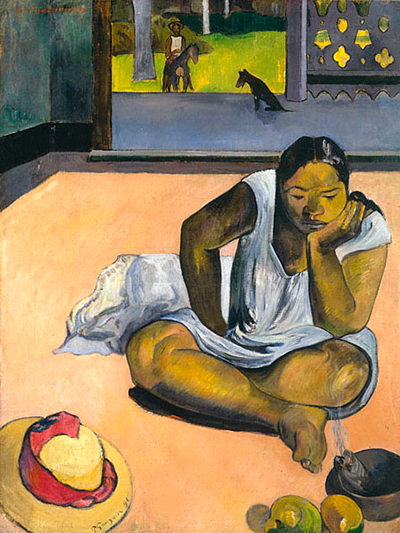
A woman in a pale blue dress sits cross-legged on an orange floor. Her right elbow rests on one knee, her chin in her palm, while her eyes fall towards a small bowl and a burning object. A straw hat with a red ribbon lies beside them. Beyond the room, a dog waits near the threshold and a rider passes or approaches on a black horse. [1] [2] Paul Gauguin gives each part unusual clarity, but he does not explain how the parts belong together.
At a Glance
- ArtistPaul Gauguin [1]
- TitleTe Faaturuma (The Brooding Woman) [1]
- Date1891 [1]
- Mediumoil on canvas [1]
- Dimensions / object size91.1 by 68.7 centimetres [1]
- Object recordThe Worcester Art Museum painting is an oil on canvas of 1891, measuring 91.1 by 68.7 centimetres. [1]
- FocusA woman in a pale blue dress sits cross-legged on an orange floor.
Contents
- Te Faaturuma (The Brooding Woman): Introduction
- First, identify the right painting
- What does *Te Faaturuma* mean?
- A still figure inside a moving world
- A pose developed across works on paper and canvas
- An early Tahitian painting made for a wider art world
- Looking without solving
That uncertainty is central to Te Faaturuma (The Brooding Woman). The National Gallery of Australia calls the picture's combination of woman, rider, dog, bowl and burning object riddle-like. [1] It is a useful description because a riddle promises a relation without necessarily surrendering its answer. The painting permits close looking; it does not grant access to the sitter's thoughts.
First, identify the right painting
The Worcester Art Museum painting is an oil on canvas of 1891, measuring 91.1 by 68.7 centimetres. It was purchased by the museum in 1921 and has accession number 1921.186. [1] [2] The Wildenstein Plattner Institute catalogues it as W440, records the title Te Faaturuma at the upper left, and transcribes the lower-left signature and date as P Gauguin 91. [3] The Art Institute of Chicago gives the width as 68.6 rather than 68.7 centimetres, a one-millimetre cataloguing variation rather than a different object. [4]
This precision matters because Gauguin painted another upright canvas called Faaturuma in the same year. That work belongs to the Nelson-Atkins Museum of Art, measures 94 by 68.3 centimetres and has accession number 38-5. It depicts a woman in a hot-salmon dress sitting in a rocking chair. [2] It is usually titled Faaturuma (Melancholic). The two paintings are related, but their figures, furnishings, dimensions, ownership and catalogue identities are not interchangeable.
The Worcester canvas has sometimes been reproduced or discussed under titles such as Sulking, Silence and Reverie. Those names can make it seem as if the picture has already disclosed a stable emotion. It has not.
What does *Te Faaturuma* mean?
The painted Tahitian words survive more securely than any single English equivalent. WPI records several historical French titles, including La Boudeuse, Le Silence and Être morne. [3] Nelson-Atkins research reports that, in a December 1892 letter to his wife Mette, Gauguin explained the title of the related Worcester painting through the French ideas of silence and gloom. The same study shows how Faaturuma has travelled through translations associated with melancholy and sulking as well as silence. [2]
These terms overlap, but they are not identical. Silence describes an absence of speech. Gloom, melancholy, sulking and brooding all assign different causes or qualities to a person's stillness. The Brooding Woman is now the established English museum title, yet it remains an interpretive label. It should direct attention back to the pose, not convert the sitter into a case history.
Gauguin's painted title also belongs to his authorship. It is not the woman's recorded statement about herself. No inscription names her. The Art Institute's scholarship notes that Teha'amana has been proposed as the model for this and several other first-Tahiti works, but concludes that such identities cannot be established with certainty when inscription and correspondence do not provide the evidence. [5] Resemblance is not enough to recover a name, relationship, age or private experience.
A still figure inside a moving world
The woman's pose is compact. Her crossed legs make a low base, while the raised arm links knee and face. The hand against the cheek slows the upward movement and brings the composition back to her lowered gaze. Her light dress spreads across the orange floor, setting a cool figure against a hot surrounding field. [2]
The room is not fully sealed. Behind the sitter, the view opens towards the dog and rider. Their small scale places them at a distance, while the contrast between a waiting animal, a moving horse and a motionless seated figure creates several possible timings at once. Has someone arrived, departed or merely passed? Is the dog watching the rider, the room or neither? The picture supplies no reliable answer.
The foreground objects deepen the pause. The hat suggests that someone has come in or may go out, but it cannot identify that person. The bowl and burning object create a minute point of activity near the woman's line of sight, yet the material and purpose of what burns are not established by the governing records. [1] [2] Calling it incense, an offering or a domestic task would turn visibility into invention.
Colour prevents stillness from becoming emptiness. The orange floor presses forward; the blue dress holds the centre; small red notes in the hat sharpen the area beside the figure. NGA describes the interior as highly saturated and unnaturally coloured. [1] Gauguin was not simply recording how a room looked under ordinary light. He arranged colour to make the sitter's immobility visually forceful, even while her meaning remains unavailable.
A pose developed across works on paper and canvas
An Art Institute drawing helps to show that the figure was worked rather than merely captured. Seated Tahitian Woman (related to the painting Te faaturuma [Reverie]) is a charcoal drawing dated 1891–93, now numbered 1944.578V. The museum's catalogue connects the direction of the head, the lifted shoulders and the rounded face to the Worcester painting. [4] [6]
The connection is not exact. The same sheet has also been related to the distinct Nelson-Atkins Faaturuma, whose sitter faces the other way and occupies a chair. Even the catalogue title says related to, not portrait of or final study for. [4] The drawing therefore reveals a motif under development across several works. It cannot identify the Worcester sitter, prove that every feature came from one sitting, or collapse two canvases into versions of the same composition.
This distinction changes the role of resemblance. A recurring inclination of the head or curve of the shoulders is evidence of Gauguin revising a pictorial idea. It is not automatic evidence that the same named person appears wherever the pose returns.
An early Tahitian painting made for a wider art world
Gauguin painted Te Faaturuma during the first year of his first Tahitian stay. The National Gallery of Australia describes it as one of his earliest completed paintings there and reports that he considered it the best of his work from that moment. [1] [7] That early status does not make it an untouched record of a culture newly encountered. The picture is an authored arrangement made in colonial Tahiti by a French artist who continued to measure his work against European art and audiences.
NGA also relates the seated pose to Edgar Degas. [1] The later ownership history makes that connection especially striking without proving direct imitation. The Metropolitan Museum of Art's catalogue of Degas's collection records that he acquired the painting from Ambroise Vollard on 11 November 1898 for 300 francs. Degas retained it until his death in 1917. [1] [8]
At the first sale of Degas's collection, the canvas appeared as lot 41 under the generic title Femme assise (Tahiti)—Seated Woman (Tahiti)—and was purchased by Jos Hessel for 14,100 francs. [8] The available institutional sources do not supply every transfer between that purchase and Worcester's. They do establish that Worcester Art Museum purchased the work in 1921, making it, in NGA's account, one of the earliest paintings by Gauguin to enter an American museum. [1]
Those changing titles are part of the painting's history. Te Faaturuma, The Brooding Woman, Sulking and Seated Woman (Tahiti) do not merely label the same neutral content. Each foregrounds language, affect, posture or place. Keeping the histories separate exposes how owners, exhibitions and cataloguers have repeatedly framed the sitter for viewers.
Looking without solving
It is tempting to make the horseman the cause of the woman's stillness, the dog a sign of expectation, and the burning object the key to a ritual or memory. Such a story would be coherent, but coherence is not evidence. Gauguin has made the relations visible and withheld the event that would settle them.
The responsible reading is neither to abandon interpretation nor to pretend certainty. The figure's pose, the division between interior and exterior, the opposition of stillness and movement, and the saturated colour can all be analysed. The title history can show how silence becomes brooding or melancholy in translation. The drawing can reveal a pose tested across works. Provenance can trace how the picture passed through Degas's collection into an American museum. What none of these records can restore is the sitter's name or interior voice.
Te Faaturuma remains compelling because its clarity never becomes disclosure. A woman, a hat, a bowl, a dog and a rider occupy one vivid space, but the links between them stay conditional. The picture asks viewers to notice how quickly observation becomes narrative—and to stop before narrative is mistaken for fact.
Related Pages
Frequently Asked Questions
A woman in a pale blue dress sits cross-legged on an orange floor.
Colour prevents stillness from becoming emptiness.
Te Faaturuma remains compelling because its clarity never becomes disclosure.
Discussion
A woman in a pale blue dress sits cross-legged on an orange floor.
Reader Insights
A woman in a pale blue dress sits cross-legged on an orange floor.
Calling it incense, an offering or a domestic task would turn visibility into invention.
The picture asks viewers to notice how quickly observation becomes narrative—and to stop before narrative is mistaken for fact.
Join the Conversation
Share the visible detail or source that most changed your reading.
References
- National Gallery of Australia, Gauguin's World media kit, entry for Te faaturuma (The brooding woman) View source
- Elizabeth C. Childs, Paul Gauguin, Faaturuma (Melancholic), 1891, Nelson-Atkins Museum of Art, including the Worcester comparison figure and title history View source
- Wildenstein Plattner Institute, digital catalogue record W440, Te Faaturuma View source
- Art Institute of Chicago, Cat. 46, Crouching Tahitian Woman... / Seated Tahitian Woman, including the Worcester and Nelson comparison figures View source
- Art Institute of Chicago, Cat. 50, Merahi metua no Tehamana, discussion of proposed sitter identifications and their limits View source
- Art Institute of Chicago, Seated Tahitian Woman (related to the painting Te faaturuma [Reverie]), current object record View source
- National Gallery of Australia, Moments of Paul Gauguin View source
- Metropolitan Museum of Art, The Private Collection of Edgar Degas: A Summary Catalogue, entry 481, Sulking (Te faaturuma) View source
 Paul Gauguin.jpg)