 by Tom Gurney
Tom Gurney BSc (Hons) is an art history expert with over 20 years experience
Published on August 14, 2026 / Updated on August 14, 2026
Email: tomgurney1@gmail.com / Phone: +44 7429 011000
Merahi metua no Tehamana: Introduction
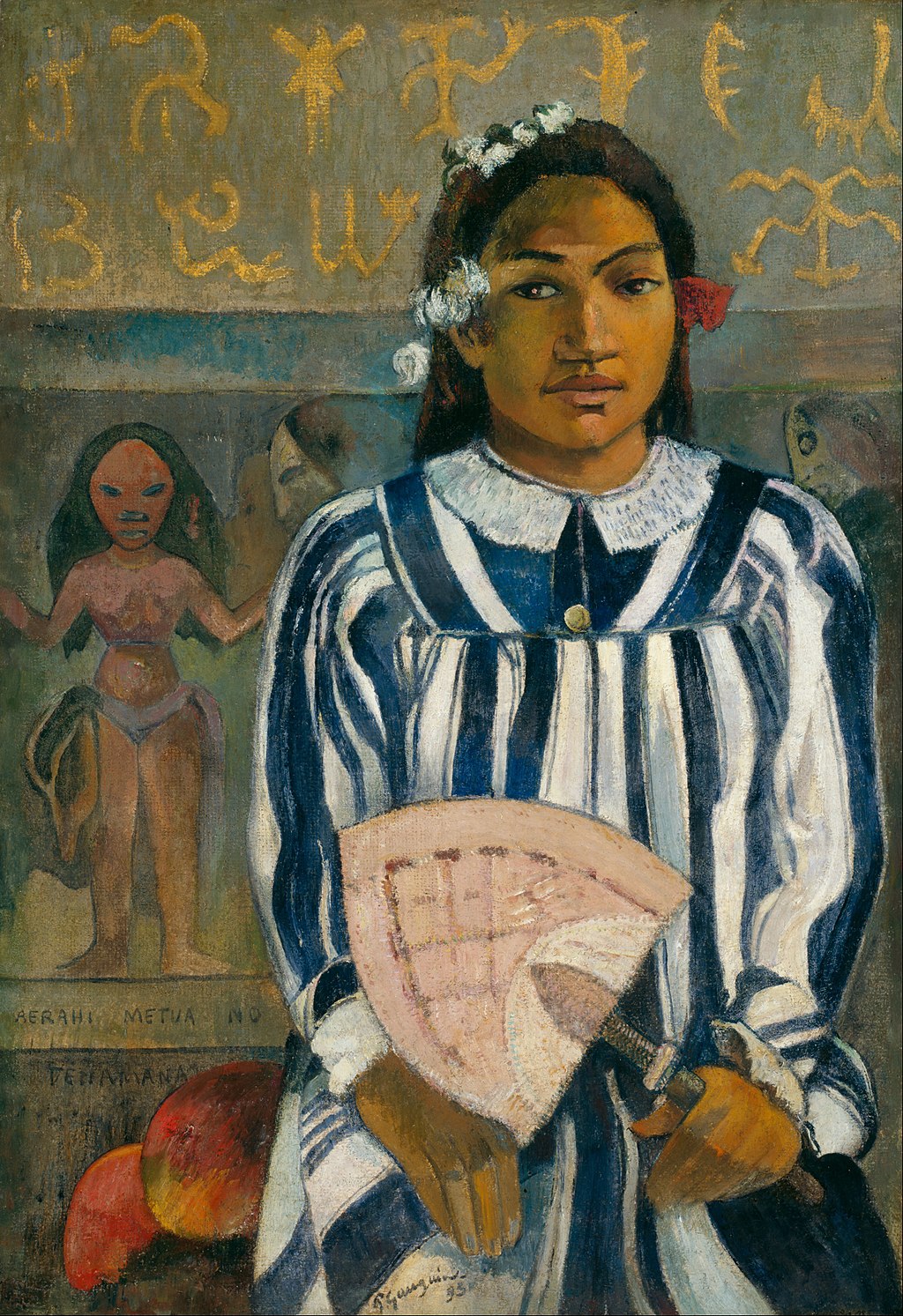
Paul Gauguin places a named young person at the centre of Merahi metua no Tehamana. She sits almost frontally in a high-necked striped dress, holding a fan across her lap. White flowers break across her dark hair. Behind her, a narrow interior becomes a field of yellow signs, a standing figure and profile heads. Two mangoes occupy the lower left, close to the title that Gauguin painted directly onto the canvas. The portrait looks specific and elaborately constructed at the same time.
At a Glance
- ArtistPaul Gauguin [1]
- TitleMerahi metua no Tehamana [1]
- Date1893 [1]
- Mediumoil on jute canvas [1]
- Dimensions / object size75 by 53 centimetres [1]
- Object recordThe Art Institute of Chicago identifies the work as an oil on jute canvas of 1893, measuring 75 by 53 centimetres. [1]
- FocusPaul Gauguin places a named young person at the centre of Merahi metua no Tehamana.
Contents
- Merahi metua no Tehamana: Introduction
- Why the museum keeps two English titles
- Contemporary dress before an invented past
- A portrait revised on coarse jute
- Folding, coatings and the painting now visible
- From an unsuccessful sale to Chicago
The Art Institute of Chicago identifies the work as an oil on jute canvas of 1893, measuring 75 by 53 centimetres. Its reference number is 1980.613, and it entered the collection as a gift from Mr and Mrs Charles Deering McCormick. Gauguin signed and dated it near the lower centre, P. Gauguin. / 93, and inscribed MERAHI METUA NO / TEHAMANA at the lower left. [1] Those words make the painting exceptional within his work: it is the one canvas on which he placed Tehamana's name. [2]
Why the museum keeps two English titles
The Art Institute retains the Tahitian Merahi metua no Tehamana and supplies two English alternatives: Tehamana Has Many Parents and The Ancestors of Tehamana. [1] Those English forms are not interchangeable decorations. They record two histories of interpretation.
The museum's scholarly catalogue reports Bengt Danielsson's argument that Tehamana Has Many Parents is the more direct rendering of the Tahitian. It connects that reading with Polynesian arrangements in which a child could have birth and foster parents, creating an extended family network. The Ancestors of Tehamana, meanwhile, follows the French title Les aïeux de Tehamana under which the painting appeared at Gauguin's Durand-Ruel exhibition in 1893. [2] One version points towards kinship; the other directs attention towards an ancestral past. Keeping both prevents the English title from deciding, before anyone looks, what every object in the picture must mean.
The names require equal care. Tehamana is the spelling in the inscription. Scholarship also writes the historical girl's name as Teha'amana. In a later version of Gauguin's partly fictionalised Noa Noa, the corresponding character is called Tehura. [2] Tehura is a literary construction, not a second documentary identity and not a source for Teha'amana's private thoughts.
The distinction matters because the available account is radically unequal. Art Institute research identifies Teha'amana as thirteen when the forty-three-year-old Gauguin began a relationship with her during his first Tahitian stay; they were together from 1891 until he left in 1893. [2] Naming that adult-child and settler-colonised imbalance is necessary. The painting and Gauguin's writing cannot establish her consent, feelings or interpretation of the portrait. Nor does her name on this canvas justify attaching it to every similar figure in his Tahitian pictures.
Contemporary dress before an invented past
The dress belongs to Teha'amana's colonial present. Its long form, high collar and covered arms are associated with missionary standards of clothing in nineteenth-century Tahiti. [2] [3] It is therefore not a timeless local costume. Gauguin sets that evidence of an already transformed Christian society against forms that suggest antiquity, distance and religious mystery.
At the top of the wall are two rows of yellow marks. National Gallery research identifies their source in carved rongo-rongo memory boards from Rapa Nui, also known as Easter Island. Gauguin never visited Rapa Nui. He worked from a photograph obtained in Papeete, enlarging and rearranging the signs in a painting of a Tahitian sitter. The same research points to Oceanic and Japanese mask forms elsewhere in the backdrop. [3] The Art Institute identifies the standing figure at left as Hina and describes a further mixture of Polynesian and Hindu sources; three profile heads emerge around Teha'amana's shoulders. [1] [2]
These borrowings do not form an inventory of beliefs that Gauguin found in Teha'amana's home. Rapa Nui is not Tahiti, and a photographed inscription is not testimony about her ancestors. The National Gallery argues that the signs were designed to intrigue and baffle the painting's Parisian viewers. [3] Gauguin was constructing the appearance of an ancestral world for European exhibition. The particular girl and her contemporary dress anchor that construction, but they do not authenticate all of it.
The fan and fruit need the same discipline. The Art Institute's current label calls the plaited fan Samoan. [1] The catalogue explores several readings of the mangoes: fecundity, an offering, and an association with Vairaumati, the mortal woman joined to the god 'Oro in a story Gauguin reused. Yet it also notes that even the physical setting of the fruit—table, bench or an ambiguous lower band—cannot be identified with certainty, and that aspects of the mangoes' meaning remain unresolved. [2] These are scholarly interpretations of Gauguin's pictorial language. The fruit does not prove pregnancy, fertility, sexual availability or the sitter's beliefs.
A portrait revised on coarse jute
Technical examination shows that the picture was made through alteration rather than transferred from one complete idea. Gauguin stretched coarse jute to a non-standard format and covered it with an artist-applied chalk ground too thin to suppress the fibres. He drew major contours in charcoal and reinforced parts of the design with dark-blue painted lines. The first plan already contained Teha'amana, the standing Hina figure and the upper signs, but not the three profile heads, which entered later. [2]
The striped dress is both an image and a record of work. Its principal bands were laid out in the underdrawing and painted sketch, while folds in the sleeves changed during painting. Gauguin wiped back many blue stripes to make them translucent. He modelled the whites with thin glazes and scumbles of grey, pink and other pale tones, allowing the rough weave to remain visible. Elsewhere he scraped or abraded the surface deliberately. [2] The apparent simplicity of the broad colour areas depends on repeated additions and removals.
Examination beneath the visible paint has found longer brown hair, a white earring later covered, changes to the width and modelling of the face, and revisions to Hina's features and headdress. [2] These discoveries do not reveal a hidden, more truthful portrait. They show decisions accumulating on the canvas. The profile heads were not simply copied with the sitter from a single observed setting, and the figure called Hina did not arrive in its final form. Material evidence confirms what the mixed sources suggest: the backdrop was authored in stages.
Folding, coatings and the painting now visible
The current 75-by-53-centimetre field also has a history after Gauguin. X-radiography shows paint loss along fold lines just inside the edges, evidence that the canvas was once presented in a smaller format. By the time it entered the Art Institute in 1980, it had already been lined with another canvas. Its borders had been filled, overpainted and covered by two layers of paper tape, with discoloured repaint extending about an inch into the picture. Conservators also recorded abrasion, especially in the blues of the dress, and losses concentrated at the bottom and left. [2]
The surface is not described accurately by the single word varnished. Analysis in 1997 found a later natural-resin varnish over a beeswax coating. The Art Institute considers it possible that Gauguin himself applied the wax before the November 1893 Durand-Ruel exhibition, but the attribution is not certain. The glossy, discoloured resin above it was not his. [2]
During the 1997 treatment, conservators consolidated lifting paint and losses. They thinned the natural-resin varnish but could not remove all of it because parts of the paint were soluble. Insoluble earlier repaint was toned rather than stripped away; small losses and abrasion were inpainted; cloudy areas of wax were adjusted; and a thin matte spray varnish was applied to reduce remaining gloss. [2] The museum judges the painting to be in very good condition, while also recording flattening and skinning caused by the older lining. Some abrasion came from later handling or cleaning, and some runs beneath later layers because Gauguin himself wiped and scraped the paint. Even the inscription contains pre-acquisition retouching. [2]
This history changes how close looking works. A pale interruption may be exposed jute, a deliberate wipe, later abrasion, an old fill or modern inpainting. The present surface is neither an untouched relic nor a replacement for the 1893 painting. It is the surviving work, carrying both Gauguin's revisions and the consequences of its treatment.
From an unsuccessful sale to Chicago
The documented ownership chain begins publicly at Gauguin's sale at the Hôtel Drouot in Paris on 18 February 1895. Listed as lot 32, the painting was bought in for 300 francs rather than sold to a new owner. Gauguin gave it to his friend Daniel de Monfreid. It descended through Monfreid's family before being sold to Jacques Seligmann in 1937, then belonged to Stephen C. Clark in New York by 1938. [1]
Mr and Mrs Chauncey McCormick owned it by 1955. It passed to Charles Deering McCormick, went on extended loan to the Art Institute in 1970 and was given to the museum in 1980. [1] That route explains how a canvas devised for a Paris exhibition eventually became a major Chicago object. It also reminds us that Gauguin controlled the first circulation and framing of Teha'amana's image, while her own account of the portrait has not survived.
Merahi metua no Tehamana is valuable precisely because it cannot be reduced to either a likeness or a symbol. Its inscription identifies a historical girl; its title opens competing paths through kinship and ancestry; its contemporary dress locates her in colonial Tahiti; and its borrowed signs manufacture a past from several cultures and media. The coarse jute, revised design and conserved surface make that construction materially visible. To look responsibly is to keep the named person present without mistaking Gauguin's elaborate setting for her voice.
Related Pages
Frequently Asked Questions
Paul Gauguin places a named young person at the centre of Merahi metua no Tehamana.
Technical examination shows that the picture was made through alteration rather than transferred from one complete idea.
Merahi metua no Tehamana is valuable precisely because it cannot be reduced to either a likeness or a symbol.
Discussion
Paul Gauguin places a named young person at the centre of Merahi metua no Tehamana.
Reader Insights
Paul Gauguin places a named young person at the centre of Merahi metua no Tehamana.
These are scholarly interpretations of Gauguin's pictorial language.
To look responsibly is to keep the named person present without mistaking Gauguin's elaborate setting for her voice.
Join the Conversation
Share the visible detail or source that most changed your reading.
References
- Art Institute of Chicago, Merahi metua no Tehamana (Tehamana Has Many Parents or The Ancestors of Tehamana), current object record View source
- Richard R. Brettell, Genevieve Westerby and Art Institute of Chicago conservation authors, Cat. 50 Merahi metua no Tehamana, in Gauguin Paintings, Sculpture, and Graphic Works at the Art Institute of Chicago View source
- National Gallery, London, A New Chapter: Tahiti and the Marquesas Islands, The Credit Suisse Exhibition: Gauguin Portraits View source
 Paul Gauguin.jpg)