 by Tom Gurney
Tom Gurney BSc (Hons) is an art history expert with over 20 years experience
Published on August 14, 2026 / Updated on August 14, 2026
Email: tomgurney1@gmail.com / Phone: +44 7429 011000
Arearea (Joyousness): Introduction
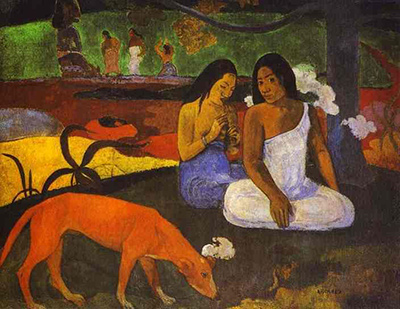
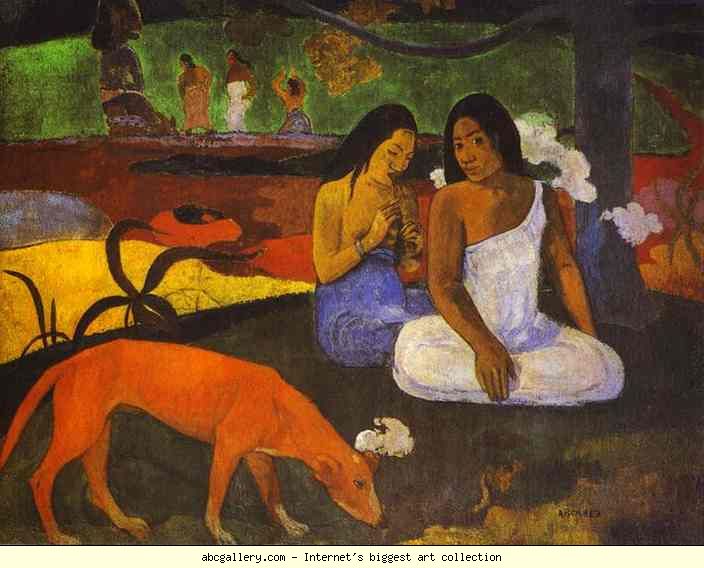
A red dog crosses the bottom of Paul Gauguin's Arearea, too large and too orange-red to disappear into the landscape. Above it, two women sit close to the front of the canvas. One holds a small pipe or flute near her mouth; the other turns outward, her gaze directed near the viewer. A heavy tree trunk rises behind them. Farther back, reduced figures gather near an upright sculptural form. These parts occupy the same picture, but they do not combine into one recoverable event.
At a Glance
- ArtistPaul Gauguin [1]
- TitleArearea (Joyousness) [1]
- Mediumoil on canvas [1]
- Dimensions / object size74.5 by 93.5 centimetres [1]
- Object recordThe painting dates to 1892, measures 74.5 by 93.5 centimetres and is oil on canvas; its accession number is RF 1961 6. [1]
- FocusA red dog crosses the bottom of Paul Gauguin's Arearea, too large and too orange-red to disappear into the landscape.
Contents
- Arearea (Joyousness): Introduction
- What does *Arearea* mean?
- The red dog and the missing sky
- A background that changes the scale of belief
- Studied figures, synthetic scene
- Reception in Paris
- Joy without a single story
The Musée d'Orsay describes the background as an imaginary scene and the rite within it as Gauguin's invention. [1] That distinction is essential. Arearea is compelling not because it records a sacred ceremony, but because observed figures, studied motifs, altered scale and saturated colour have been made to coexist as if everyday life and a vision shared one ground.
What does *Arearea* mean?
Orsay lists Arearea as the original title and Joyeusetés I as an alternate. The familiar English subtitle Joyousness is therefore useful, but it is not a replacement for the painted word. D. T. Tryon's Tahitian–English glossary gives 'arearea as amusement. [2] Joyeusetés, amusement and joyousness overlap without being identical. Each shifts the emphasis slightly between a condition, an activity and a mood.
That uncertainty helps rather than hinders a close reading. The title can direct attention towards pleasure, music or diversion without requiring every person in the picture to embody happiness. The seated women's expressions need not be translated into a shared emotion, and the red dog does not become cheerful merely because an English subtitle says Joyousness.
Gauguin placed the title within the object. Orsay records the lower-right inscription as AREAREA / P. Gauguin 92. The painting dates to 1892, measures 74.5 by 93.5 centimetres and is oil on canvas; its accession number is RF 1961 6. [1] These facts anchor a word whose implications remain deliberately more open.
The red dog and the missing sky
Gauguin does not build the landscape through a smooth recession from foreground earth to a distant horizon. Orsay notes that the conventional sky has disappeared. Broad areas of dark green, yellow and red or pink instead stack and interlock across the canvas. [1] Their edges establish location loosely—ground, water or bank may be suggested—while continuing to function as coloured shapes.
The red dog makes this system impossible to overlook. Its long body extends across the lower edge, parallel to the picture plane, while its lowered head points back into the composition. The animal supplies scale and movement, but its colour refuses ordinary description. It is neither a small accessory nor a code that can be solved from appearance alone.
The tree performs an opposite action. Its upright trunk closes the space behind the right-hand figure, and a long branch stretches across the upper field. The trunk divides foreground figures from the distant group, yet the branch also binds the two zones. Instead of a framed view through trees, the viewer encounters a surface partitioned by a tree.
The two women occupy the most stable dark ground. The figure in white sits cross-legged, her bent arm and pale clothing making a broad compact form. Her companion's blue wrap and yellow-brown torso create a narrower vertical rhythm. The small instrument held near her hands and mouth introduces music without proving a festival, performance or specific narrative. Orsay's subject indexing identifies a recorder or flute, but the exact cultural history of the instrument cannot be established from the image alone. [1]
A background that changes the scale of belief
Behind the seated pair, the picture becomes smaller and stranger. Three distant figures stand or move around an upright image at the left. Their scale separates them from the women in front, while their raised arms and orientation encourage a ritual reading. Orsay describes them as women worshipping a statue. [1]
The museum goes further: it says Gauguin enlarged a small Māori statue to the scale of a great Buddha and invented a sacred rite. [1] This is an art-historical account of Gauguin's construction, not permission to identify the figure simply as Buddha or as a documented Tahitian deity. Māori, moreover, is the museum's wording for the sculptural source. The painted setting does not authenticate a ceremony witnessed in Tahiti.
Scale is the crucial device. A compact sculptural model has become tall enough to preside over the distant group. At the same time, the women closest to us remain monumentally larger than the supposed worshippers. Sacred image, ritual gesture and seated daily life are not arranged in one natural perspective; Gauguin adjusts their relative sizes to make two registers of experience meet.
This method belongs to a colonial history of looking. The Art Institute of Chicago has characterised Gauguin's Tahitian works as reinventions of a past he imagined after encountering a culture already transformed by colonisation, rather than historically accurate records. [5] The National Gallery of Australia's recent exhibition similarly placed the work within his networks, historical impact and contested contemporary legacy. [6] Such framing does not cancel the painting's visual power. It specifies that its sacred world is Gauguin's claim, assembled for viewers, not an unmediated account offered by the people represented.
Studied figures, synthetic scene
Evidence from Gauguin's drawings reinforces that distinction between a source and a complete event. The Art Institute of Chicago identifies the large head in its sheet Heads of Tahitian Women as the model for the woman seated at the right in Arearea. [3] Another catalogue entry gathers studies related to Arearea and Pastorales tahitiennes, including dancer and crouching-figure material. [4]
These links do not reduce the finished painting to a collage. They show how separate observations could be preserved, adjusted and brought into a new pictorial order. A studied head enters one seated body; other figure notes help populate a distant action; colour and scale establish relations that did not need to exist when each motif was first recorded.
The result explains why the scene can feel coherent while resisting literal narration. Repeated curves link the dog's back, the seated bodies and the tree branch. Pale clothing and white flowers punctuate the darker field. Red and yellow carry the eye laterally, while the upright trunk interrupts that movement. Formal echoes make the parts belong together even when historical evidence cannot tell us that the people, animal and sacred image ever occupied one place at one time.
Reception in Paris
Arearea returned to Europe as part of Gauguin's effort to present his Tahitian work. Orsay lists it as number 8 in the Galerie Durand-Ruel exhibition of recent works in Paris in 1893; the museum's account dates that showing to November. [1] It also reports that Tahitian titles irritated many of Gauguin's friends and that the red dog prompted sarcasm. [1]
Those reactions identify points at which the picture withheld familiar reassurance. A title that many Paris viewers could not readily translate denied immediate verbal access. The dog's colour made naturalism an inadequate standard. Yet hostile or mocking response does not prove that Gauguin's imagined Polynesia was culturally accurate. It shows how he marketed difference and how his formal decisions unsettled part of his first audience.
The painting's provenance records a striking act of self-valuation. At Gauguin's Hôtel Drouot sale in 1895, Arearea was lot 8 and was bought back by the artist. It later passed through Ambroise Vollard, Else von Guaita and Galerie J. B. Neumann, then remained with Frédéric and Mme Lung in Algiers until their 1961 bequest to the French national museums. After assignments to the Louvre and Jeu de Paume, it entered the Musée d'Orsay in 1986. [1]
Buying the work back supports Orsay's statement that Gauguin ranked it among his best paintings. [1] It does not reveal what the dog symbolised or prove that the background rite had one fixed interpretation. The decision shows attachment to the completed canvas and perhaps to the public argument it made: that colour, memory, study and invention could produce a world more compelling to him than descriptive consistency.
Joy without a single story
Arearea earns its title through rhythm rather than through a row of demonstrably joyful characters. Music is suggested by the small flute. Pleasure or amusement may be evoked by colour. The background gestures towards collective devotion. But the women's thoughts are not available, and the rite is not a recovered ethnographic fact.
Looking closely means keeping those differences visible. The foreground contains recognisable bodies, an animal and a tree, yet it has been flattened into forceful planes. The distance appears sacred, yet its statue and ceremony are products of transformation. The title offers a field of meaning, not a caption for a single episode. Gauguin made the canvas persuasive by joining these registers; responsible interpretation begins by refusing to confuse their visual unity with historical proof.
Related Pages
Frequently Asked Questions
A red dog crosses the bottom of Paul Gauguin's Arearea, too large and too orange-red to disappear into the landscape.
Scale is the crucial device.
Looking closely means keeping those differences visible.
Discussion
A red dog crosses the bottom of Paul Gauguin's Arearea, too large and too orange-red to disappear into the landscape.
Reader Insights
A red dog crosses the bottom of Paul Gauguin's Arearea, too large and too orange-red to disappear into the landscape.
The painted setting does not authenticate a ceremony witnessed in Tahiti.
Gauguin made the canvas persuasive by joining these registers; responsible interpretation begins by refusing to confuse their visual unity with historical proof.
Join the Conversation
Share the visible detail or source that most changed your reading.
References
- Musée d'Orsay, Arearea, RF 1961 6, current object record, provenance and exhibition history View source
- D. T. Tryon, Conversational Tahitian: An Introduction to the Tahitian Language of French Polynesia, Australian National University Press, 1970, Tahitian–English glossary, p. 149 View source
- Art Institute of Chicago, Heads of Tahitian Women, Frontal and Profile Views (recto), Portrait of Tehamana (verso), cat. 49 View source
- Art Institute of Chicago, Mahna no varua ino (The Devil Speaks), cat. 57, related studies for Arearea and Pastorales tahitiennes View source
- Art Institute of Chicago, Gauguin: Artist as Alchemist, Reinventing the Past View source
- National Gallery of Australia, Gauguin's World: Tōna Iho, Tōna Ao View source
 Paul Gauguin.jpg)