 by Tom Gurney
Tom Gurney BSc (Hons) is an art history expert with over 20 years experience
Published on August 14, 2026 / Updated on August 14, 2026
Email: tomgurney1@gmail.com / Phone: +44 7429 011000
Mahana no atua (Day of the God): Introduction
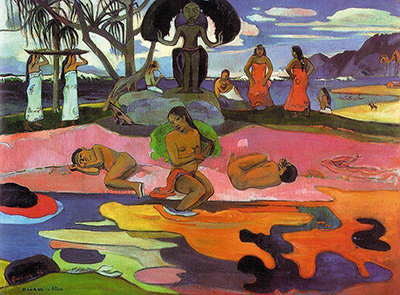
Paul Gauguin built Mahana no atua in three horizontal registers. At the top, a large green statue stands beneath a dark canopy while smaller figures carry objects, dance, play music, embrace or move through the landscape. Across the middle, a seated woman handles her hair between two curled bodies. Below them, blue, yellow, orange, green, red and near-black forms interlock around her feet like water.
At a Glance
- ArtistPaul Gauguin [1]
- TitleMahana no atua (Day of the God) [1]
- Date1894 [1]
- Mediumoil on linen canvas [1]
- Dimensions / object size68 by 91 centimetres [1]
- Object recordThe painting is oil on linen canvas, 68 by 91 centimetres, and carries accession number 1926.198. [1]
- FocusPaul Gauguin built Mahana no atua in three horizontal registers.
Contents
- Mahana no atua (Day of the God): Introduction
- The object and its title
- A deity made for the picture
- Three bodies on the sand
- Figures transferred and moved
- Water as a field of colour
- Recasting the image in wood
The arrangement looks ceremonial, yet it is not evidence of one ceremony observed in Tahiti. Gauguin painted the canvas in Paris in 1894, after returning from his first Polynesian stay. The Art Institute of Chicago describes it as drawn from fantasy and memory, while its scholarly catalogue calls it a combination of invented elements and selected aspects of Tahiti. [1] [2] The painting's ritual force was manufactured in a Paris studio.
The object and its title
The Art Institute's title is Mahana no atua (Day of the God). The painting is oil on linen canvas, 68 by 91 centimetres, and carries accession number 1926.198. At the lower left, Gauguin signed and dated the work in orange paint, Gauguin 94., and added MAHANA no Atua in dark blue. [1] [2]
Even here, title and translation should not be collapsed. Cat. 72 notes that the Tahitian word mahana can carry senses of day, sunlight and heat, while atua can mean god and may also carry warning or curse senses in the dictionary it cites. [2] Day of the God is the current institutional English title, not proof that every possible resonance has been exhausted.
Technical examination adds a small but revealing sequence. The signature and date mixed with still-wet blue paint in the rock; later highlights crossed that area. The title inscription was laid over green paint that had already dried. [2] Gauguin named the painting during its physical construction, but neither inscription converts its figures into a documented ritual.
A deity made for the picture
The upper register centres on a rigid frontal image. Its green body rises from rocks, its arms bend outward, and its dark canopy is cropped by the top edge. The scale and symmetry make it dominate the much smaller figures scattered around it.
The AIC catalogue reports that most commentators identify this figure as one of Gauguin's representations of Hina, a female creator and moon deity. [2] That attribution belongs to a history of interpretation. The canvas itself bears no identifying label beside the figure, and the image is not a record of a surviving Tahitian sculpture.
Cat. 72 makes the limitation especially important. It notes scholarship arguing that Gauguin assigned Hina a prominence disproportionate to modern studies of Tahitian theology. It also traces his images of Polynesian gods through a mixed visual repertory that included reproductions of Javanese reliefs. [2] The central figure can therefore be discussed as Gauguin's Hina without treating it as a transparent representation of a single pre-colonial belief system.
That distinction matters beyond this object. The National Gallery of Australia's recent retrospective framed Gauguin's historical impact and contemporary legacies as subjects of continuing debate, explicitly recognising that his interactions in Polynesia would not be accepted today. [3] Mahana no atua is valuable evidence of how Gauguin imagined sacred authority for European viewers; it is not an ethnographic key to Tahitian religion.
Three bodies on the sand
The middle register is quieter and more ambiguous. A seated nude faces outward, her hands raised to her hair and her feet touching the coloured band below. One curled body lies to each side. The left figure turns outward with legs drawn up; the right turns away, fists and limbs folded close.
The current AIC record offers the possibility that the two prone forms show either two figures or the same person from different angles. [1] Cat. 72 instead follows their different pictorial sources and proposes that the foreground triad evokes the cycle of life. Its left figure has been associated with birth because of its fetal pose, and the right with death through a pose linked in the catalogue to Gauguin's study of a Peruvian mummy. Crucially, the catalogue also says the figures' precise meanings remain unclear. [2]
Those accounts need not be forced into a single answer. Repeated bodies can suggest a sequence without becoming three fixed labels for birth, life and death. Nor does motif history establish the identity, gender or private state of a represented person. The strongest reading preserves the visual progression—curled body, upright bather, curled body—while keeping its story provisional.
The bather herself was not fixed from the beginning. Technical imaging shows that Gauguin reduced an earlier, larger belly and altered her arms, hair and garment. At one point, he removed paint around a hand with solvent down to the canvas or ground before repainting it. A green bush behind her was added and simplified after layers of sand were already in place. [2] The central figure's apparent calm is the end of a material revision, not a single untouched conception.
Figures transferred and moved
The lateral bodies entered still later. Registration marks show that Gauguin transferred the left figure from his 1894 watercolor monotype Reclining Tahitian, reduced and reversed. The right figure followed a different route: the catalogue finds no registration marks for its first painted state, but technical images show that Gauguin then traced and repositioned that form three more times before arriving at its final location. [2]
This evidence gives the pair a precise kind of doubleness. They may operate as related symbolic forms, as the current museum text suggests, but they were not simply one model observed twice beside a pool. One was imported from another work; the other was repeatedly shifted within this canvas.
Changes continue above them. A flute player moved, an embracing couple once stood against a different arrangement of land and water, and two tree trunks were added late. Gauguin wiped colour to expose lower layers, removed passages with solvent, scraped paint and used a palette knife to flatten some surfaces. [2] These are findings about this object. They do not mean that every contour was traced, or that revision proves indecision.
Water as a field of colour
The lower register is the painting's sharpest break from ordinary landscape. It names no shoreline through continuous perspective. Instead, dark blue, orange, yellow, green and black-edged shapes push into one another. A small pale oval beneath the bather's feet can read as a reflection or island within this moving pattern.
The current AIC record calls these forms pools of water arranged in interlocking, abstract zones of colour. [1] That description captures their double role. They belong to the setting, yet they also operate independently as flat shapes whose contours pull the eye across the width of the canvas. No fixed code tells us that one colour means birth, another death and another divinity.
The surface we see is not identical to the appearance of 1894. AIC analysis found that the broad pink sand once included a deeper violet-red component. One red lake faded while another remained more stable; protected edges and paint samples preserve evidence of darker hues. A 1959 wax-resin lining also darkened the canvas and ground, lowered the overall tonality and may have made the weave more prominent. [2] The museum's digital recolourisation is explicitly an aid to visualisation, not a definitive recovery of an original state.
Recasting the image in wood
Gauguin returned to the composition in the 1894–95 woodcut Mahana atua. Cat. 72 shows that the print is not a small facsimile. The deity moves down towards the centre and shares emphasis with the bather. The painting's strict symmetry loosens. Its coloured water band recedes, partly replaced by a cartouche and water plants, while a perpendicular tree trunk disappears. [2]
The changes expose the painting as one arrangement among several possible ones. Statue, bodies, water and landscape could be separated and recombined without preserving a single ritual episode. What persists is not documentary continuity but a repertoire of emphatic forms.
The canvas itself left Gauguin's studio quickly. Edgar Degas bought it directly in December 1894 for 500 francs. At the 1918 Degas sale it appeared under the different title Le Repos au bord de la mer (Tahiti) and sold to Jos Hessel. It subsequently passed through George Bernheim and Frederick Clay Bartlett before entering the Art Institute in 1926. [1] Its early European circulation reinforces the circumstances of its making: an imagined sacred Tahiti assembled, titled and sold in Paris.
Mahana no atua remains powerful because its order never becomes fully legible. Statue, small procession, bather, curled figures and coloured water look deliberately related, but the relations are not a transcript of belief. They are the outcome of borrowing, transfer, revision and selective memory. The painting asks to be read as a constructed religious image—and its own technical history shows just how actively that construction occurred.
Related Pages
Frequently Asked Questions
Paul Gauguin built Mahana no atua in three horizontal registers.
Those accounts need not be forced into a single answer.
Mahana no atua remains powerful because its order never becomes fully legible.
Discussion
Paul Gauguin built Mahana no atua in three horizontal registers.
Reader Insights
Paul Gauguin built Mahana no atua in three horizontal registers.
Technical imaging shows that Gauguin reduced an earlier, larger belly and altered her arms, hair and garment.
The painting asks to be read as a constructed religious image—and its own technical history shows just how actively that construction occurred.
Join the Conversation
Share the visible detail or source that most changed your reading.
References
- Art Institute of Chicago, Mahana no atua (Day of the God), current object record, 1926.198 View source
- Richard R. Brettell, Genevieve Westerby and Kristin Hoermann Lister, Cat. 72 Mahana no atua (Day of the God), 1894, in Gauguin Paintings, Sculpture, and Graphic Works at the Art Institute of Chicago, commentary and technical study View source
- National Gallery of Australia, Gauguin's World: Tōna Iho, Tōna Ao, exhibition overview and contemporary legacy statement View source
 Paul Gauguin.jpg)