 by Tom Gurney
Tom Gurney BSc (Hons) is an art history expert with over 20 years experience
Published on August 14, 2026 / Updated on August 14, 2026
Email: tomgurney1@gmail.com / Phone: +44 7429 011000
The Seed of the Areoi: Introduction
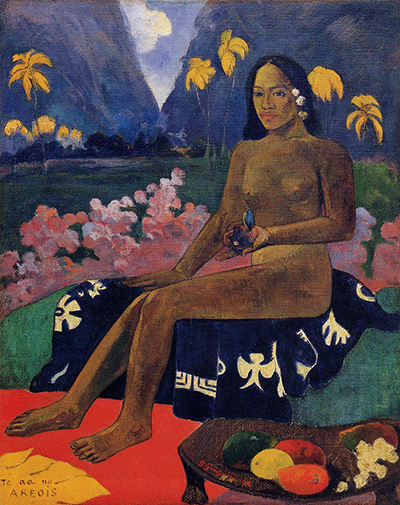
A seated woman occupies almost the full height of Paul Gauguin's The Seed of the Areoi. Her upright torso rises against dark vegetation and a narrow opening of turquoise sky. Pink blossoms spread behind her; yellow palms punctuate blue mountains. One arm crosses her body while the other hand extends along her knee. Near her chest she holds a small green stem.
At a Glance
- ArtistPaul Gauguin [1]
- TitleThe Seed of the Areoi [1]
- Date1892 [1]
- Mediumoil on burlap [1]
- Dimensions / object size92.1 by 72.1 centimetres [1]
- Object recordMoMA identifies the painting as The Seed of the Areoi, made in 1892 in oil on burlap. [1]
- FocusA seated woman occupies almost the full height of Paul Gauguin's The Seed of the Areoi.
Contents
- The Seed of the Areoi: Introduction
- The object and the words on it
- A pose made from several places
- Who were the `‘arioi`?
- Vairaumati: a role assigned to the figure
- Presence against an invented past
The foreground is as deliberately arranged as the figure. Dark blue cloth patterned with pale shapes falls over bright green cushions and a red-pink floor. At lower right, a shallow three-legged table bears green, yellow, red and orange fruit beside pale flowers. Gauguin placed his red signature and the date 1892 on this table. Across the opposite corner, a yellow form carries the Tahitian title. [1]
These details invite connections among woman, growth, fruit and “seed,” but they do not add up to a self-explaining fertility emblem. The picture's title reaches towards a Society Islands past, while its pose, colour and space combine sources from several cultures. It is precisely this tension—between particular history and Gauguin's assembled vision—that gives the painting its force.
The object and the words on it
MoMA identifies the painting as The Seed of the Areoi, made in 1892 in oil on burlap. It measures 92.1 by 72.1 centimetres, belongs to the William S. Paley Collection and carries object number SPC14.1990. [1] The Metropolitan Museum of Art records the fuller title form Te aa no areois (The Seed of the Areoi) for the same work. [2]
The words matter visually as well as linguistically. Rather than placing the title outside the scene, Gauguin painted it into the lower-left corner. The lettering sits opposite the signed fruit table, so naming and authorship anchor the composition's two lower edges. The English title supplies a familiar guide, but it should not be mistaken for proof that every nuance of the Tahitian phrase has been settled.
The support matters too. Burlap leaves a strong woven texture visible through thin passages of paint. Its grid is especially apparent across the body, sky and dark mountains. The surface stops the broad colour zones from looking perfectly smooth; figure and landscape remain materially tied to the same coarse plane.
A pose made from several places
The woman's body is monumental but not modelled like a conventionally illusionistic European nude. Her back is straight, her shoulders nearly frontal, and the crossing arms create a compact circuit over the torso. Shadows do not carve the body into deep volume. Instead, dark outlines and restrained shifts of brown-green establish its weight against the blue cloth and pink blossoms.
MoMA describes this structure as a fusion. It compares the dignified pose to ancient Egyptian art, the limited shadow and broad flat colour to Japanese sources, and the arm position to a relief at Borobudur in Java. The museum also identifies a Western component in Gauguin's use of a figure by Pierre Puvis de Chavannes. [1] This is not a tidy family tree in which each limb can be returned to one original. It is evidence that the apparently direct image was consciously assembled through reproductions and remembered art.
The same applies to colour. Yellow palms do not recede into atmospheric distance; they flare against blue-black mountains. Pink flowers create a band nearly as assertive as the seated body, while green, red and blue areas lock together below. MoMA argues that this chromatic order owes more to Gauguin's aesthetic invention than to the island's appearance. [1] That does not mean no local landscape was observed. It means observation was reorganised until colour served the picture's internal rhythm.
Who were the `‘arioi`?
The historical ‘arioi were more complex than the phrase “secret society” suggests. In a peer-reviewed study of Polynesian and European encounters, anthropologist Deborah Elliston describes a stratified religious association in the Society Islands, dedicated to ‘Oro and connected with dance, theatre, rank and youthful vitality. Members travelled among Tahiti and neighbouring islands, performing in exchange for hospitality and gifts. Status and privilege were important, and performances could carry political criticism of chiefs and priests. [3]
That account changes how the title should be read. The ‘arioi were not simply Gauguin's invented fraternity, yet neither does the painting record their practices. The association was prominent during the eighteenth-century encounter period. Missionisation and chiefly politics then transformed religious life: mass conversions followed Pomare II's conversion, and by the 1830s the Society Islands were nominally Christian. [3] Gauguin painted in 1892, within French-colonial Tahiti, looking retrospectively towards a social world he had not witnessed.
Elliston also demonstrates why European descriptions require scrutiny. Voyagers and missionaries repeatedly interpreted Polynesian institutions through a hierarchy of “savagery” and “civilization,” moralising religion, sexuality and exchange when local expectations did not match European ones. The ‘arioi became a particular focus of this racialised archive. [3] Gauguin inherited such representations as well as historical information. His title cannot be treated as a neutral label carried intact from precolonial Tahiti.
Vairaumati: a role assigned to the figure
MoMA reads the canvas through a story in which a male sun god joins with Vairaumati and founds a new race. On that reading, the seated woman occupies Vairaumati's role and the surrounding fruit and growth acquire associations with descent and renewal. [1] The title, stem and full fruit table make that interpretation plausible. They do not prove that each object has one coded meaning.
Gauguin used the Vairaumati association elsewhere. The Art Institute of Chicago's catalogue connects Vairaumati, ‘Oro and an offering of fruit to the mangoes in the different painting Merahi metua no Tehamana. There the woman's name is inscribed on the object, and the catalogue treats fruit as both offering and a sign of fecundity. [4] The comparison shows Gauguin building a recurring pictorial language. It does not transfer the identity of that named woman to the figure in The Seed of the Areoi.
This is where MoMA's wording needs a boundary. Its interpretation calls the sitter “Tehura.” The AIC catalogue documents Tehamana as the historical name attached to its 1893 portrait and explains that Gauguin changed the corresponding character's name to Tehura in a later draft of his partly fictionalised Noa Noa. [4] The literary name is not an independent identification of the person in MoMA's uninscribed figure. Likeness cannot turn this painting into a secure portrait of Teha'amana.
The safer description is also the more revealing one: Gauguin assigned a Polynesian woman a mythic role for a picture intended to circulate under his title and signature. Her steady gaze and controlled pose are visible. Her name, thoughts, consent and relationship to the story are not.
Presence against an invented past
The landscape looks close yet unreachable. Blossoms nearly touch the woman's back, but the low horizon and steep dark mountains compress any path into depth. Palms repeat across the upper band like signs placed around her rather than trees measured in a continuous view. Cloth, body and fruit table have more physical weight than the distant setting.
That imbalance makes the figure intensely present while the past named by the title remains manufactured. MoMA itself calls Gauguin's vision anachronistic and notes that colonialism had profoundly altered Tahiti by the time he worked there. [1] Yet “loss” should not become another romantic fiction in which Polynesian people disappear so a European artist can recover them. The painting is evidence of Gauguin's claim to cultural continuity, not proof that he possessed what colonial change had displaced.
The small green stem crystallises this ambiguity. It can suggest growth beside a title about seed, but it is also simply a sharply coloured form held against the body. Fruit may evoke abundance, offering or generation, yet it also balances the title panel and repeats the bright palette. Meaning accumulates through placement; it is not disclosed by a single private biography.
The Seed of the Areoi therefore rewards two kinds of attention at once. Close looking reveals how Gauguin joined coarse burlap, flat colour, a composite pose, title lettering and fruit into a highly controlled surface. Historical attention shows that its invocation of the ‘arioi passes through disrupted institutions, European racialisation and the artist's own mythology. The canvas does not restore an old Society Islands world. It stages Gauguin's authority to imagine one—and leaves the seated woman bearing the weight of that invention.
Related Pages
Frequently Asked Questions
A seated woman occupies almost the full height of Paul Gauguin's The Seed of the Areoi.
That account changes how the title should be read.
The Seed of the Areoi therefore rewards two kinds of attention at once.
Discussion
A seated woman occupies almost the full height of Paul Gauguin's The Seed of the Areoi.
Reader Insights
A seated woman occupies almost the full height of Paul Gauguin's The Seed of the Areoi.
That account changes how the title should be read.
It stages Gauguin's authority to imagine one—and leaves the seated woman bearing the weight of that invention.
Join the Conversation
Share the visible detail or source that most changed your reading.
References
- Museum of Modern Art, Paul Gauguin. The Seed of the Areoi. 1892, current object record and interpretation, SPC14.1990 View source
- Metropolitan Museum of Art, Gauguin in New York Collections: The Lure of the Exotic, exhibition object record for Te aa no areois (The Seed of the Areoi) View source
- Deborah Elliston, Navigating “Race” at Tahiti: Polynesian and European Encounters, Comparative Studies in Society and History 66, no. 2 (2024), published online 22 December 2023 View source
- Art Institute of Chicago, Cat. 50 Merahi metua no Tehamana (Tehamana Has Many Parents or The Ancestors of Tehamana), 1893, in Gauguin Paintings, Sculpture, and Graphic Works at the Art Institute of Chicago View source
 Paul Gauguin.jpg)