 by Tom Gurney
Tom Gurney BSc (Hons) is an art history expert with over 20 years experience
Published on August 14, 2026 / Updated on August 14, 2026
Email: tomgurney1@gmail.com / Phone: +44 7429 011000
Mata Mua (In Olden Times): Introduction
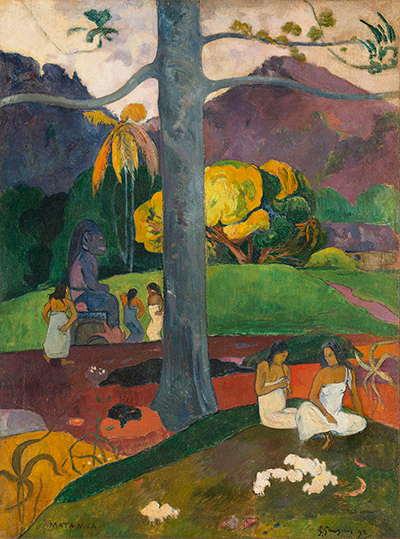
A thick blue-grey tree rises through the centre of Paul Gauguin's Mata Mua. Its trunk divides the canvas, but a long branch crosses the upper field and joins the two sides. At lower right, two women sit together; one plays a flute while the other listens. Across the trunk, three clothed figures move around a large sculptural form. Music and dance occupy adjacent zones without becoming one continuous event.
At a Glance
- ArtistPaul Gauguin [1]
- TitleMata Mua (In Olden Times) [1]
- Date1892 [1]
- Mediumoil painting on canvas [1]
- Dimensions / object size91 by 69 centimetres [1]
- Object recordThe Carmen Thyssen-Bornemisza Collection records Mata Mua (Érase una vez) as an oil painting on canvas from 1892, measuring 91 by 69 centimetres. [1]
- FocusA thick blue-grey tree rises through the centre of Paul Gauguin's Mata Mua.
Contents
- Mata Mua (In Olden Times): Introduction
- The object in Madrid
- A tree separates music from dance
- A scene made from reusable parts
- The 1893 exhibition and *Noa Noa*
- Whose “olden times”?
- From Paris sale to the Carmen collection
The title, painted at lower left, promises “olden times.” The picture does not show how those times could be known. Instead, it assembles colour bands, recurring bodies, remembered motifs and an imagined deity into a scene that looks complete. The central question is therefore not which ceremony Gauguin witnessed, but how he manufactured the appearance of a recovered past.
The object in Madrid
The Carmen Thyssen-Bornemisza Collection records Mata Mua (Érase una vez) as an oil painting on canvas from 1892, measuring 91 by 69 centimetres. Gauguin inscribed Mata Mua at lower left and signed and dated the opposite corner P. Gauguin 92. Its accession is CTB.1984.8. The work belongs to the Carmen Thyssen-Bornemisza Collection and is recorded as located at the Museo Nacional Thyssen-Bornemisza in Madrid. [1]
That wording separates owner from location. It also avoids a more fragile claim that the picture hangs permanently in a particular room. The object has travelled through exhibitions, dealers, private collections and auctions, but its current institutional identity is clear.
The Museo Thyssen uses Mata mua (In Olden Times) in an English thematic publication. [2] Its Spanish collection record uses Érase una vez, or “Once upon a time,” while an older museum record gives the French Autrefois. [1] [3] These institutional forms agree on retrospective distance without establishing one uncontested literal translation from Tahitian. Mata Mua remains the wording Gauguin placed on the canvas; In Olden Times is the established English guide to it.
A tree separates music from dance
The composition unfolds in stacked, shallow zones. A dark green slope and pale blossoms press against the lower edge. Behind them, orange-red and maroon bands carry the seated pair. Higher still, a bright green field supports the dance group, while yellow foliage and pink-violet mountains close the distance. Gauguin does not soften these transitions into atmospheric recession. Each strip retains the force of a separate colour shape.
The tree organises those shapes. Its trunk cuts between the foreground musicians and the figures beyond, concealing part of the middle ground and refusing a complete view. Yet the branch above reaches across both halves. Division and connection are built into the same form.
At the lower right, the two women wear pale cloth against orange, green and brown. The collection identifies the nearer action as flute-playing. [1] Their compact poses contrast with the upright figures left of the trunk. There, three women in pale blue, cream and warm yellow stand near a large blue-grey statue. Their differing turns suggest movement around it, but the painting supplies no beginning or end to a dance.
The collection's specialist account says the women play and dance before an enormous stone idol, identified as Hina, goddess of the moon. [1] The older Reina Sofía text offers the same identification. [3] Hina is therefore a documented museum interpretation of Gauguin's iconography, not a name visible on the statue. A sculptural body and an arranged group can be seen; worship, deity and ceremonial purpose require attribution.
A scene made from reusable parts
The collection expressly rejects the idea that Mata Mua transcribes one real place or incident. Its landscape and figures are recombined from elements that appear in other paintings made between 1892 and 1894. [1] That source trail matters more than identifying every repetition.
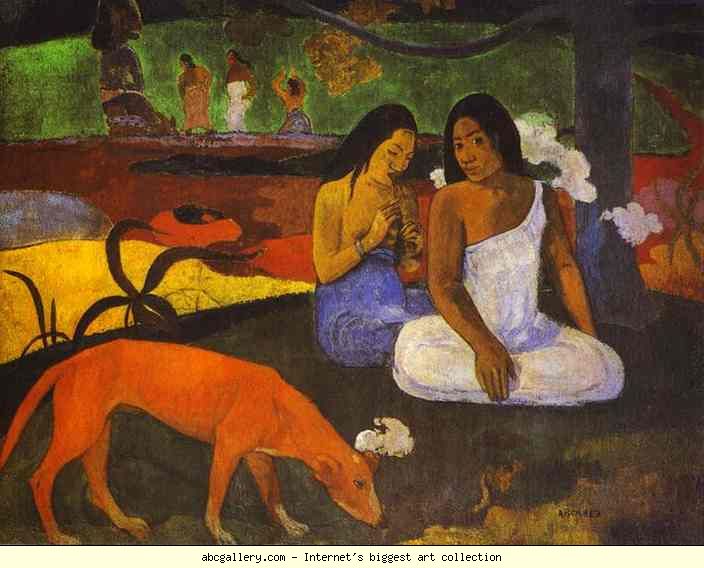
The seated pair recurs in the Arearea compositions. Dancing women reappear in Mahana no Atua, while related trees and the sculptural figure occur in Nave nave Moe and other works. [1] These correspondences do not turn all the canvases into successive views of one gathering. They show Gauguin treating bodies, plants and sacred-looking forms as movable components.
Colour makes the pieces feel inevitable. The foreground pair belongs to a descending curve of pale cloth; the dance group rises as a sequence of narrow verticals; the statue echoes the central trunk in blue-grey. Pink mountains, yellow leaves and red earth are not descriptive accents added to a continuous view. They are the intervals that hold the constructed ensemble together.
This method also changes the role of Hina. Even if the sculptural figure is accepted as Gauguin's version of the moon goddess, the painting does not become evidence that such a statue stood in that landscape or that women performed this rite around it. The deity belongs to the artist's pictorial system: a form enlarged, relocated and made to signify an ancient Tahiti for viewers elsewhere.
The 1893 exhibition and *Noa Noa*
Gauguin showed Mata Mua as number 6 in his exhibition of recent work at Galerie Durand-Ruel in Paris in 1893. The Carmen collection's essay describes an audience unsettled by the brilliant colour, flattened perspective and unfamiliar inscriptions of the 46 exhibited works. [1] The painting's title opened a past, but did not tell those viewers how to interpret it.
Gauguin began Noa Noa after returning to France, intending the Tahiti book to help European readers understand his pictures. The later text framed Mata Mua through abundance, lost gods, moon festivals and women's supposed attachment to an older religion. [1] It is tempting to use that prose as a key that confirms the painted ceremony.
The textual history rules out such simple confirmation. Art Institute of Chicago scholarship distinguishes Gauguin's first full draft, his later materially revised manuscript and the version Charles Morice reshaped for publication. [4] Noa Noa was written retrospectively, revised and directed towards the same European audience that had found the pictures difficult. It records how Gauguin wanted Mata Mua to be read; it does not independently document what Tahitian women did, believed or said.
Whose “olden times”?
The Museo Thyssen's English publication calls the canvas a recreation of the Tahiti of Gauguin's dreams and places that dream within colonisation and Christian evangelisation. [2] Gauguin's title looks backwards from French-colonial Tahiti. The imagined time before European rule is organised by a French painter for exhibition and sale in Paris.
That contradiction is not corrected by calling the work nostalgic. Nostalgia still has an owner. Gauguin could criticise colonial transformation while using Polynesian women, religious fragments and Tahitian words to create his own authority as the interpreter of a supposedly disappearing world. A current National Gallery of Australia overview notes that his nineteenth-century interactions in Polynesia require explicit contemporary reassessment. [5]
The painting's women do not supply their own account of the scene. Their poses are legible; their names, consent, memories and beliefs are not. Nor should “lost paradise” imply that living Tahitian culture ended so that Gauguin might recover it. Mata Mua preserves a European fantasy of return, not a culture sealed in the past.
From Paris sale to the Carmen collection
The work's material history further separates painted timelessness from historical movement. It failed to find a buyer when Gauguin offered it as lot 6 at the Hôtel Drouot on 18 February 1895. The recorded chain then passes through Ambroise Vollard, Gustav Fayet, Paul Rosenberg and several American owners before Sotheby's sales in 1984 and 1989 and entry into the Thyssen collections. [1] Today the Carmen collection record places it at the Museo Nacional Thyssen-Bornemisza.
That provenance need not dominate a close reading, but it restores time to a painting called In Olden Times. The canvas was not a window left open onto an ancient ceremony. It was exhibited, unsuccessfully offered, sold, collected, translated and interpreted.
The central tree finally holds the argument together. It makes two scenes look simultaneous while preventing them from fully joining. Around it, reused figures and colour planes produce a persuasive whole; beneath it, the inscribed title directs the eye backwards. Mata Mua is powerful not because it retrieves an untouched Tahiti, but because it shows how convincingly Gauguin could construct one—and how necessary it is to distinguish that construction from the people and histories it claims to contain.
Related Pages
Frequently Asked Questions
A thick blue-grey tree rises through the centre of Paul Gauguin's Mata Mua.
Colour makes the pieces feel inevitable.
The central tree finally holds the argument together.
Discussion
A thick blue-grey tree rises through the centre of Paul Gauguin's Mata Mua.
Reader Insights
A thick blue-grey tree rises through the centre of Paul Gauguin's Mata Mua.
Dancing women reappear in Mahana no Atua, while related trees and the sculptural figure occur in Nave nave Moe and other works.
Around it, reused figures and colour planes produce a persuasive whole; beneath it, the inscribed title directs the eye backwards.
Join the Conversation
Share the visible detail or source that most changed your reading.
References
- Carmen Thyssen-Bornemisza Collection, Paul Gauguin: Mata Mua (Érase una vez), current object record, provenance, exhibition history and expert report, CTB.1984.8 View source
- Museo Nacional Thyssen-Bornemisza, Paradises Lost, English thematic publication, including Mata mua (In Olden Times) View source
- Museo Nacional Centro de Arte Reina Sofía, Mata Mua: Paul Gauguin (1848–1903), historical 1989 exhibition record View source
- Art Institute of Chicago, The Noa Noa Suite, 1893/94, online scholarly catalogue View source
- National Gallery of Australia, Gauguin's World: Tōna Iho, Tōna Ao, current exhibition overview and contemporary-context statement View source
 Paul Gauguin.jpg)