 by Tom Gurney
Tom Gurney BSc (Hons) is an art history expert with over 20 years experience
Published on August 14, 2026 / Updated on August 14, 2026
Email: tomgurney1@gmail.com / Phone: +44 7429 011000
Vision after the Sermon: Introduction
Paul Gauguin's Vision after the Sermon is built around a reversal of importance. The biblical struggle is small, distant and strange; the Breton worshippers who imagine it are large, close and insistent. The National Galleries of Scotland, which owns the painting, titles it Vision of the Sermon (Jacob Wrestling with the Angel), but the common title Vision after the Sermon usefully points to the picture's timing. It is not the sermon itself. It is the moment after hearing, when a story has become an image in the mind. [1] [4]
At a Glance
- ArtistPaul Gauguin
- TitleVision of the Sermon (Jacob Wrestling with the Angel) [1]
- Common titleVision after the Sermon [1]
- Date1888 [1]
- Mediumoil on canvas [1]
- Dimensions72.20 by 91.00 centimetres [1]
- CollectionNational Galleries of Scotland [1]
- AccessionNG 1643 [1]
Contents
- Vision after the Sermon: Introduction
- Women, Vision and the Red Field
- Gauguin's 1888 Letter
- Pont-Aven, Synthetism and Sources
- The Church Rejection
- Materials, Conservation and Legacy
Women, Vision and the Red Field
The object is a painting made at Pont-Aven in Brittany in 1888. It is oil on canvas, 72.20 by 91.00 centimetres, purchased by the National Galleries of Scotland in 1925 and catalogued as NG 1643. [1] Those facts hold the work in place, but they do not make it orderly. The scene refuses the continuous depth and plausible earth colour that a conventional religious picture might have supplied.
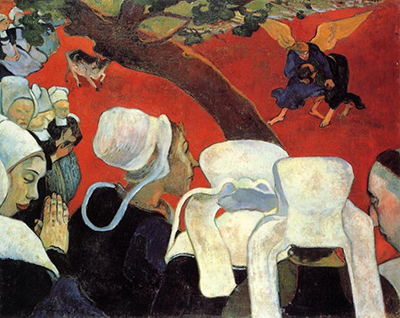
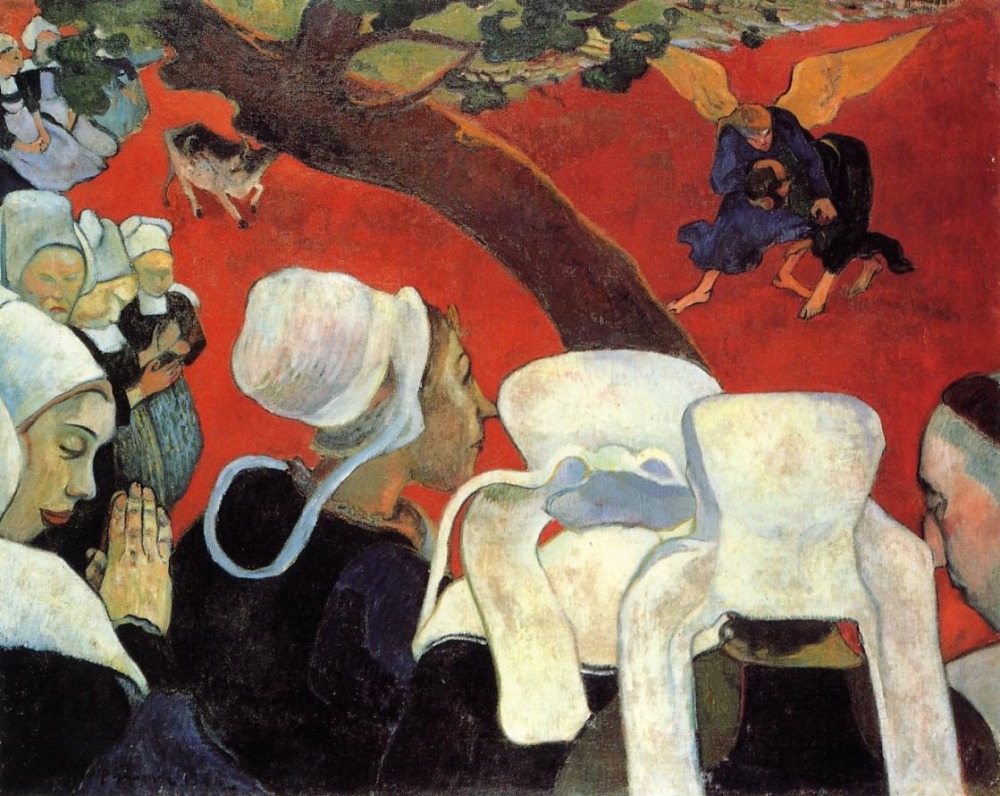
In the foreground, women in regional costume gather in dark dresses and white caps. Their bodies make a compressed near wall of attention. Some heads are bowed, some tilt, and the caps repeat across the surface like bright notes against black cloth. At the lower right, the cropped tonsured head glimpsed at the edge is presumably the priest who has delivered the sermon. [1] Gauguin keeps him partial. The main visual weight belongs to the women and to the image that the sermon has set moving.
Beyond them, Jacob wrestles with the angel on a red field that is not ordinary landscape. The two figures bend into a tight knot of limbs. The angel's wings flare; Jacob's body answers in green. A small cow appears under the tree, so reduced that it becomes a scale marker as much as an animal. The diagonal apple tree cuts through the composition, separating the worshippers from the biblical encounter while tying both halves into one design. [1] [2] [6]
The picture therefore makes looking work in two directions. From below, the viewer is held among the backs, caps and dark shoulders of the worshippers; from above, the eye is pulled toward the wrestling bodies. Neither route settles into normal perspective. The tree is too emphatic to be background detail, and the red ground is too flat to become a believable field. Gauguin turns the surface into a pressure system: near and far, real and imagined, costume and biblical episode all meet without becoming the same kind of space.
The subject comes from Genesis 32, where Jacob wrestles through the night with a mysterious opponent and leaves the encounter wounded and renamed. [1] Gauguin does not recreate the banks of the Jabbok or a historical biblical setting. He transfers the event into the represented imagination of people who have just heard it preached. That is why the painting can feel both blunt and elusive: the story is visible, but its place is mental, not geographical.
Gauguin's 1888 Letter
Gauguin made that intention unusually clear in a letter to Vincent van Gogh written from Pont-Aven on or about 26 September 1888. He described dark costumes, luminous yellow-white bonnets, a purple apple tree, emerald foliage, vermilion earth, an ultramarine angel, bottle-green Jacob, yellow wings and the tiny cow. [2] The list is not a neutral inventory. It shows how deliberately the painting was organised through colour oppositions and ruptures of scale. For Gauguin, the "landscape and the fight" belonged to the praying figures' inward vision, which is why the worshippers and the biblical scene do not share normal proportions. [2] [8]
That letter is strong evidence, but it should not be allowed to close the painting. It tells us what Gauguin wanted the structure to do. It does not give direct access to the faith of Breton women, nor does it prove that every figure in the foreground shares one identical inward experience. The canvas stages a collective religious response through Gauguin's pictorial choices. It also stages his wish to make Brittany stand for a kind of spiritual immediacy he believed modern Paris had lost. [1] [8]
Pont-Aven, Synthetism and Sources
The painting belongs to an intense exchange in Brittany during 1888, especially between Gauguin and the younger Emile Bernard. Museums consistently connect their work at Pont-Aven with simplified shapes, strong outlines, flat colour and the move away from Impressionist naturalism. [3] [4] [5] Vision after the Sermon is therefore not just an unusual religious picture. It is one of the works through which Synthetist and Symbolist ambitions became visible: observation, memory, idea and design are pressed into a single surface rather than arranged as separate layers.
Its sources are plural. The hard outlines and flattened zones recall stained glass, Japanese prints and cloisonne enamel without requiring a single borrowed model for the wrestlers, tree or red ground. [5] [8] That matters because the painting's force comes from combination. The caps and costumes keep the image tied to Brittany; the impossible field and dislocated scale pull it away from report. The result is neither local document nor pure fantasy. It is a modern construction made from both.
The cultural cost of that construction needs to remain visible. Gauguin's own words included the phrase "rustic and superstitious simplicity." [1] [2] That language belongs to the artist, not to the narrator. It reveals an artistic desire to make Breton worship appear direct, severe and anti-modern. Admiring the painting's formal daring does not require accepting that projection as truth. The women are not symbols of timeless belief by nature; they are people represented through an outsider's design.
The Church Rejection
The church-refusal evidence also needs careful separation. In the September 1888 letter, Gauguin records an intended offer to the Pont-Aven church and notes that the church declined it. [2] A later annotation in the Van Gogh letters preserves Bernard's 1904 memory of a Nevez priest rejecting the work as non-religious, while the National Galleries of Scotland summarises the matter as two rejected offers to local churches. [1] [2] The exact sequence and motives remain uncertain. What can be said is narrower and stronger: this was not a conventional devotional commission, and its experimental form seems to have sat uneasily with local ecclesiastical expectations.
That uncertainty is part of the painting's history, not a defect to smooth away. A neat anecdote about a misunderstood genius and conservative clergy would be easier to tell, but it would exceed the evidence. The safer reading is that Gauguin tried to move a radical studio picture into a church context and discovered that his idea of religious modernity was not automatically shared by the institutions whose imagery he was transforming.
Materials, Conservation and Legacy
The physical object has its own afterlife. Technical research undertaken before a major 2005 exhibition found several different drying oils in the paint medium, not the wax medium that had sometimes been speculated. Beeswax and tallow were instead identified in an original surface coating. The study also notes that natural ageing and later human interventions, especially aqueous lining and reframing, changed aspects of the painting's appearance over time. [7] The canvas we see is both Gauguin's 1888 invention and a material survivor.
Shown from 1889 onward, the painting helped establish Gauguin's reputation as an innovator and became important for younger artists looking for alternatives to naturalistic painting. [1] [5] Its continuing power lies in the way it makes viewers occupy two positions at once. We see Jacob and the angel, but we also see Gauguin constructing other people seeing them. The red ground, diagonal tree, crowded caps and tiny cow keep reminding us that faith, artifice and cultural fantasy have been made inseparable.
Related Pages
Frequently Asked Questions
Paul Gauguin's Vision after the Sermon is built around a reversal of importance.
That letter is strong evidence, but it should not be allowed to close the painting.
Shown from 1889 onward, the painting helped establish Gauguin's reputation as an innovator and became important for younger artists looking for alternatives to naturalistic painting.
Discussion
Paul Gauguin's Vision after the Sermon is built around a reversal of importance.
Reader Insights
Paul Gauguin's Vision after the Sermon is built around a reversal of importance.
It tells us what Gauguin wanted the structure to do.
The red ground, diagonal tree, crowded caps and tiny cow keep reminding us that faith, artifice and cultural fantasy have been made inseparable.
Join the Conversation
Share the visible detail or source that most changed your reading.
References
- National Galleries of Scotland, "Vision of the Sermon (Jacob Wrestling with the Angel)." View source
- Van Gogh Museum and Huygens ING, Vincent van Gogh: The Letters, letter 688, Paul Gauguin to Vincent van Gogh, Pont-Aven, on or about 26 September 1888 View source
- National Galleries of Scotland, "Symbolism." View source
- The Metropolitan Museum of Art, Cindy Kang, "Paul Gauguin (1848-1903)." View source
- The Metropolitan Museum of Art, Nicole Myers, "Symbolism." View source
- Smarthistory, Steven Zucker and Beth Harris, "Paul Gauguin, Vision after the Sermon (or Jacob Wrestling with the Angel)." View source
- Lesley Stevenson and Belinda Thomson, "Vision of the Sermon by Paul Gauguin: An Exploration of Making and Meaning," Studies in Conservation 51, no. 3 (2006): 34-40 View source
- National Gallery of Art, Gauguin: Maker of Myth, exhibition brochure, 2011 View source
 Paul Gauguin.jpg)