 by Tom Gurney
Tom Gurney BSc (Hons) is an art history expert with over 20 years experience
Published on August 14, 2026 / Updated on August 14, 2026
Email: tomgurney1@gmail.com / Phone: +44 7429 011000
Paul Gauguin, Synthetism and Symbolism: Introduction
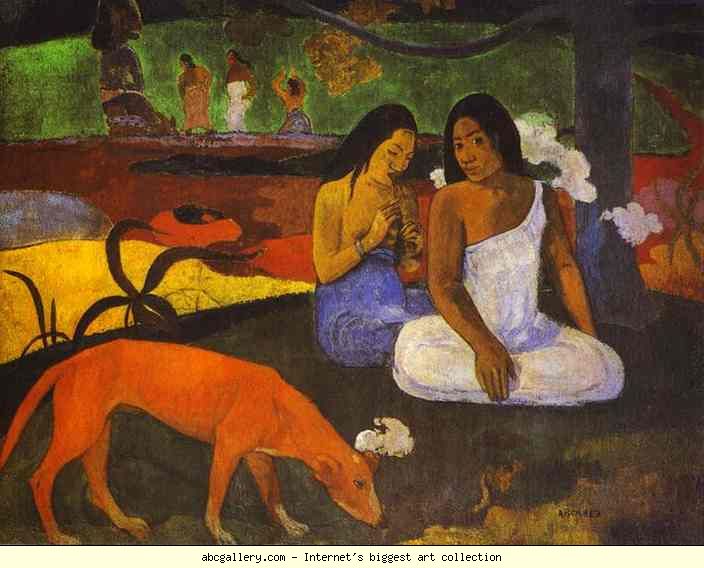
In Gauguin's paintings of the late 1880s, colour begins to refuse an old obligation. A field can become red because the picture needs a zone of visionary intensity, not because the earth before the painter looked red. A dark contour can separate shapes more decisively than light and shadow. Figures may retain weight while the space around them tilts, compresses or breaks into pattern.
At a Glance
- ArtistPaul Gauguin
- GuidePaul Gauguin, Synthetism and Symbolism
- FocusSynthetism and Symbolism
- Key topicsThree related ideas; Observation was transformed, not discarded; A shared development, not a solitary invention; When form becomes vision
- OverviewIn Gauguin's paintings of the late 1880s, colour begins to refuse an old obligation.
Contents
- Paul Gauguin, Synthetism and Symbolism: Introduction
- Three related ideas
- Observation was transformed, not discarded
- A shared development, not a solitary invention
- When form becomes vision
- The method beyond sacred subjects
- Sérusier's lesson and the making of an origin story
- From a group label to Symbolist criticism
- What the terms let us see
Synthetism and Symbolism: Key Works
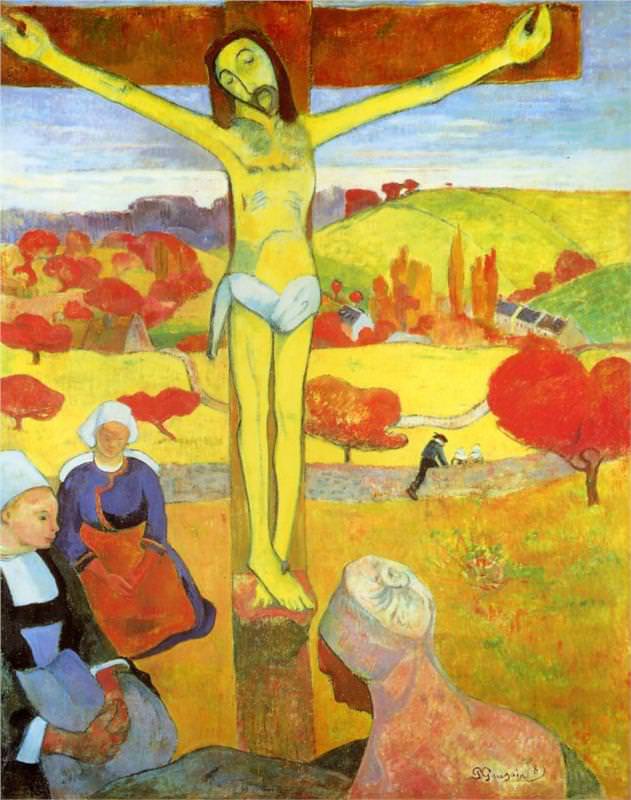
These changes are often gathered under three labels—Cloisonnism, Synthetism and Symbolism. The terms overlap, but they answer different questions. Cloisonnism names a particular visual language. Synthetism describes a broader way of transforming observed material. Symbolism concerns the ideas, visions and subjective states that such transformations could serve. Keeping those differences visible also corrects the notion that Gauguin invented a complete modern style by himself.
Three related ideas
Cloisonnism is the narrowest of the three terms. It refers to simplified colour areas contained by emphatic outlines, an effect compared with the metal-bordered compartments of cloisonné enamel and with stained glass. The language also drew on Japanese prints and forms of popular illustration. It can be recognised in the organisation of an image, but outlines alone do not explain what the image asks the viewer to imagine. [4] [7]
Synthetism concerns the relationship among motif, response and design. The artist begins with something seen—a landscape, person or still life—but does not treat visual appearance as a set of instructions to copy. Memory, emotion and the demands of the composition reshape colour, line, scale and space. The resulting picture is a synthesis, not of three measurable ingredients in a fixed formula, but of outward stimulus and inward/formal decision. [1] [8]
Symbolism is broader still. Across late nineteenth-century art and literature, Symbolist artists resisted the idea that art's highest task was objective description. Dreams, myths, spiritual states, desire and fear could become more important than ordinary plausibility. Symbolism therefore has no single look. A carefully modelled figure and a radically flattened scene might both pursue a Symbolist aim. Gauguin's Synthetic organisation often gave subjective ideas a striking form, but Synthetism and Symbolism are not interchangeable names. [3]
One way to test the distinction is to ask three questions. Does the picture use bounded colour shapes associated with Cloisonnism? Does it reorganise observation through memory and design in a Synthetic way? Does that reorganisation serve an idea or imagined state that can be called Symbolist? A work may answer yes to one, two or all three.
Observation was transformed, not discarded
The new language did not require artists to stop looking at the world. Gauguin's Breton paintings still depend on recognisable clothing, bodies, trees and fields; Bernard's figures remain tied to particular encounters and places. What changed was the authority granted to immediate appearance. A fleeting effect of light no longer had to govern the colour, and continuous perspective no longer had to hold every form inside one plausible space. [4] [10]
This distinction matters because “from memory” can sound like a withdrawal into private fantasy. Memory was one agent among several. It let an artist select, compress and reorder what had been seen, while the shape of the canvas and the relation between colours imposed their own demands. The observed motif could survive clearly even after natural colour and scale had been altered.
The contrast with Impressionism was therefore a change of priority, not a total rupture. Gauguin had learned from Impressionist exhibitions and from artists such as Pissarro before seeking forms that appeared more durable and deliberate. The 1889 group still retained “Impressionniste” in its public name alongside “Synthétiste.” [6] [10] That pairing captures a history in motion: the artists defined a new ambition while remaining close enough to the earlier movement to argue with its methods and inherit its audiences.
A shared development, not a solitary invention
The history began before Gauguin's decisive summer in Brittany. Simplified planes and forceful contours appeared by 1887 in work by Émile Bernard and Louis Anquetin, both younger than Gauguin. Bernard later identified Japanese prints as one source; stained glass and inexpensive popular or Épinal prints also formed part of the visual environment. [4] [7] Treating these sources as one vague taste for the “exotic” erases their different formats and uses.
Gauguin and Bernard worked in close exchange at Pont-Aven during the summer of 1888. Gauguin brought years of experience with Impressionism, Cézanne, ceramics and carving; Bernard brought recent experiments in radical simplification. Their ideas sharpened through encounter and dispute. Museum histories accordingly associate both artists, alongside a wider Breton network, with the development of Synthetism. [1] [7] [10]
Credit matters because later reputation can distort chronology. Gauguin became the more famous artist and a forceful author of his own legend. That prominence does not make Bernard a preliminary assistant or Anquetin a footnote. Bernard's Young Breton Woman, with its strong blue contours and simplified colour fields, shows an artist continuing to work through the language on his own terms. [4]
Nor was the exchange a neat relay in which one artist invented outlines and another supplied meaning. Visual devices travelled among artists, paintings, prints and conversations. Each maker combined them differently. “Synthetism” is most useful when it identifies that shared licence to transform, rather than awarding a patent for a recognisable look.
When form becomes vision
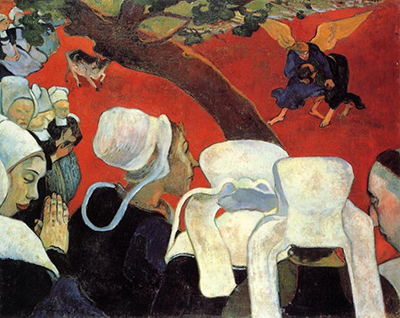
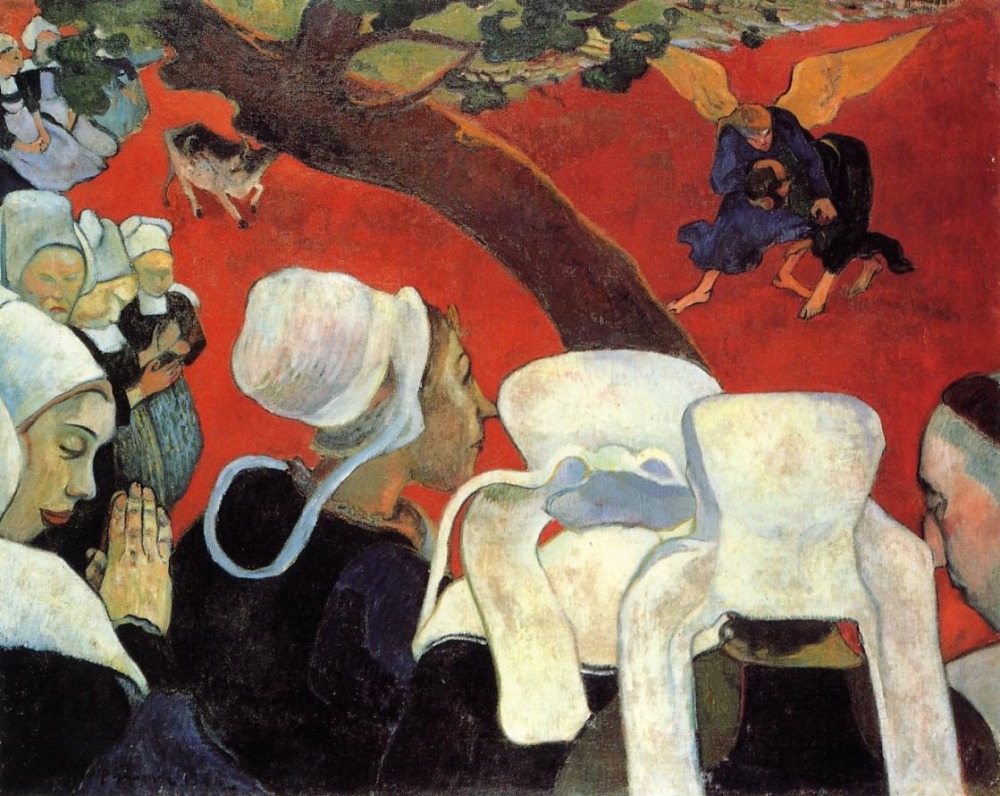
Gauguin's Vision of the Sermon (Jacob Wrestling with the Angel), painted in 1888, is the clearest demonstration of Synthetic form serving a Symbolist purpose. Breton women in white bonnets gather across the foreground. A thick diagonal tree interrupts the surface. Beyond it, Jacob wrestles the angel on a red field that rejects natural landscape colour. [2]
The red does not simply make the painting more expressive. It changes the status of the event. The biblical struggle is not presented as a distant historical episode rendered with archaeological plausibility; it occupies a pictorial zone created by the worshippers' vision. Scale and depth become unstable because ordinary sight is no longer the organising rule. The diagonal tree both separates and joins the viewers and what they imagine.
This construction should not be mistaken for direct access to Breton belief. Gauguin was an outsider selecting clothing, gesture and worship for his own modern argument about spiritual intensity. The represented women are more than coloured shapes, even though their repeated bonnets and profiles help structure the surface. Formal invention and the artist's framing of a living community have to be seen together. [2] [3]
The picture also shows why Cloisonnism cannot carry the whole explanation. Strong boundaries and simplified shapes are clearly present. Yet the painting's force depends on the relation between those devices and the imagined event. Contour provides a grammar; Synthetism reorganises the scene; Symbolist purpose turns that organisation toward vision.
The method beyond sacred subjects
Still Life with Three Puppies, also from 1888, tests the same freedom on a very different subject. Blue outlines divide puppies, fruit and vessels; patterned surfaces compete; the tabletop rises at an angle that unsettles ordinary recession. Relative scale answers the picture's arrangement more readily than a single stable viewpoint. [5]
Nothing in the subject requires a mystical interpretation. That is precisely why the work is useful. It demonstrates that Synthetic transformation was a method rather than a religious genre. Pattern, contour and spatial disruption can make familiar objects newly strange without turning them into a coded spiritual message.
The comparison also prevents one painting from becoming a formula. The red expanse in Vision of the Sermon performs a different task from the tipped table and repeated pattern of the still life. Gauguin's new licence lay in adjusting the visible world to each picture's internal order, not in repeating one arrangement of outlines and bright colour.
Sérusier's lesson and the making of an origin story
In October 1888, Paul Sérusier painted the small landscape later known as The Talisman at the Bois d'Amour under Gauguin's guidance. Areas of strong colour and abbreviated shapes turn the landscape into a compact demonstration of pictorial decision. Sérusier carried the work back to fellow artists in Paris, and it acquired special importance for the group later called the Nabis. [1] [11]
The attribution must remain clear: The Talisman is Sérusier's painting. Gauguin's role was that of guide and catalyst. Later retellings enlarged the episode into a founding revelation, as though modern colour began during a single lesson. Musée d'Orsay's account preserves the event's importance while recognising that its status as an origin story grew retrospectively. [1]
That later memory is historically useful. It shows how groups create lineages as well as styles. A small work can become a portable argument; a remembered exchange can give a generation a point of departure. Sérusier's transmission to the Nabis mattered even though no member followed an identical visual programme. [1] [3]
From a group label to Symbolist criticism
Synthetism became a public identity in Paris in 1889. A catalogue and poster announced an exhibition by the “Groupe Impressionniste et Synthétiste” at the Café des Arts on the grounds of the Volpini display. Gauguin, Bernard, Charles Laval, Émile Schuffenecker and other artists participated. [6] [9] The label distinguished their ambitions from official exhibition culture and from a narrower understanding of Impressionism.
It did not certify a uniform school. The exhibitors differed in subject, technique and commitment, while the show brought little of the commercial success Gauguin wanted. Its importance lies partly in naming a network publicly. What had developed through local exchange and individual works now had a catalogue, poster and collective claim.
In 1891 the critic Albert Aurier offered another influential frame. Writing about Gauguin, he connected subjective idea with simplified, non-naturalistic form and presented the artist as a major Symbolist figure. [3] Aurier's argument helped make formal departure from naturalism seem inseparable from intellectual or spiritual ambition.
That interpretation was powerful, but it was an intervention by a particular critic, not a neutral definition accepted from the beginning. It elevated Gauguin within a collaborative history and encouraged later viewers to seek an idea behind every altered colour. Some works sustain that search; others remind us that Synthetic freedom could organise still life, landscape or portraiture without one hidden message.
What the terms let us see
Gauguin's importance to Synthetism and Symbolism lies neither in sole invention nor in the accidental possession of a few stylistic trademarks. He helped demonstrate how completely a picture could reorganise its starting point. Colour could establish psychological or visionary space. Contour could order a field. Memory and design could challenge the authority of immediate appearance.
Bernard and Anquetin made essential earlier and parallel experiments; Sérusier turned guidance into transmission; the Volpini group made a public claim; Aurier supplied a critical interpretation. The history is a network of objects, conversations, exhibitions and later memories. Seen that way, the labels become tools rather than badges. They direct attention to what colour, line and space are doing—and to the many hands and voices involved in making that change visible.
They also keep uncertainty productive: a painting can participate in this history without conforming to every label, and disagreement about its emphasis can sharpen looking rather than close it down.
Related Pages
Frequently Asked Questions
In Gauguin's paintings of the late 1880s, colour begins to refuse an old obligation.
This construction should not be mistaken for direct access to Breton belief.
They also keep uncertainty productive: a painting can participate in this history without conforming to every label, and disagreement about its emphasis can sharpen looking rather than close it down.
Discussion
In Gauguin's paintings of the late 1880s, colour begins to refuse an old obligation.
Reader Insights
In Gauguin's paintings of the late 1880s, colour begins to refuse an old obligation.
The red does not simply make the painting more expressive.
They also keep uncertainty productive: a painting can participate in this history without conforming to every label, and disagreement about its emphasis can sharpen looking rather than close it down.
Join the Conversation
Share the visible detail or source that most changed your reading.
References
- Musée d'Orsay, “Sérusier's ‘The Talisman’, a Prophecy of Colour.” View source
- National Galleries of Scotland, “Vision of the Sermon (Jacob Wrestling with the Angel).” View source
- Metropolitan Museum of Art, “Symbolism.” View source
- Metropolitan Museum of Art, “Émile Bernard: Young Breton Woman.” View source
- Museum of Modern Art, “Paul Gauguin: Still Life with Three Puppies.” View source
- National Gallery of Art, “Catalogue de L'Exposition de Peintures du Groupe Impressionniste et Synthétiste.” View source
- Museum of Modern Art, The Prints of the Pont-Aven School: Gauguin and His Circle in Brittany View source
- Getty Research Institute, Art & Architecture Thesaurus, “Synthetist.” View source
- National Gallery of Art, “Poster: L'Exposition de Peintures du Groupe Impressionniste et Synthétiste.” View source
- Cindy Kang, “Paul Gauguin (1848–1903),” Metropolitan Museum of Art, 2011 View source
- Musée d'Orsay, “The Talisman, Landscape at the Bois d'Amour.” View source
 Paul Gauguin.jpg)