 by Tom Gurney
Tom Gurney BSc (Hons) is an art history expert with over 20 years experience
Published on August 14, 2026 / Updated on August 14, 2026
Email: tomgurney1@gmail.com / Phone: +44 7429 011000
When Will You Marry? (Nafea faa ipoipo): Introduction
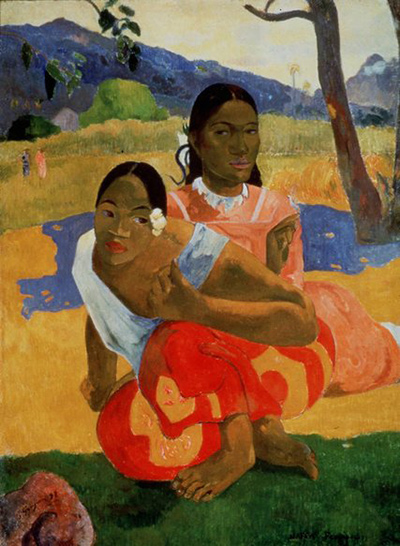
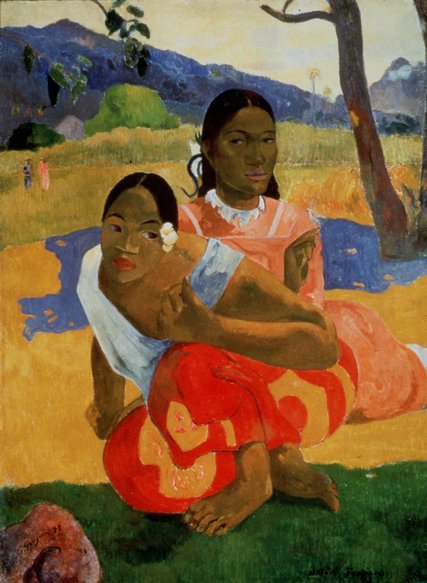
Two women occupy most of this upright canvas. The nearer figure sits or crouches close to the lower edge, turns towards the viewer and folds her arms across a light upper garment and a red-orange patterned wrap. A pale flower rests near one ear. Behind her, a second woman in a coral-pink, high-necked dress holds herself more upright. They share a shallow ochre-yellow zone, bounded below by green and interrupted at the right by a tree trunk. Blue-purple passages gather around their bodies; vegetation and dark mountains recede abruptly, with two tiny figures at the far left. [1]
At a Glance
- ArtistPaul Gauguin [1]
- TitleWhen Will You Marry? (Nafea faa ipoipo) [1]
- Date1892 [1]
- Dimensions / object size101.5 by 77.5 centimetres [1]
- Object recordW454 / PG18a5, 1892, oil on canvas [1]
- FocusTwo women occupy most of this upright canvas.
Contents
- When Will You Marry? (Nafea faa ipoipo): Introduction
- One painting, several title forms
- Near bodies, distant landscape
- A related drawing, not a simple blueprint
- Made in colonial Tahiti, addressed to Paris
- From Gauguin's sale room to a private transfer
- What the question leaves open
The painting's question seems to invite a story. Yet nothing visible identifies a speaker, an addressee or an answer. The women's proximity does not establish their relationship, and the flower does not by itself disclose marital status. A careful reading of When Will You Marry? therefore begins by separating three kinds of evidence: the painted figures, the words Gauguin placed on the canvas, and the meanings that later viewers have attached to both.
One painting, several title forms
The Wildenstein Plattner Institute catalogues the work as W454, with the reference PG18a5. Its current primary title is Nafea Faaipoipo and its secondary French title is Quand te maries-tu ? It dates the oil-on-canvas painting to 1892 and records its dimensions as 101.5 by 77.5 centimetres. At lower left Gauguin signed and dated it P. Gauguin. 92; at lower right he painted NAFEA Faa.ipoipo. [1]
Those forms should not be collapsed into one supposedly perfect spelling. The familiar English When Will You Marry? names the question for many readers, while WPI's primary title removes the dot that appears in Gauguin's inscription. The first documented Paris exhibition, at Durand-Ruel in November 1893, listed it as Nafea faaipoipo? (Quand te maries-tu?). The question and its French gloss were therefore part of the work's early European presentation, not a recent invention. [2]
Other exhibitions changed the emphasis. In Weimar in 1905 it appeared as Sitzende Tahitanerinnen—seated Tahitian women—and at the 1906 Salon d'Automne as Deux Tahitiennes accroupies—two crouching Tahitian women. [2] These labels shift between a question and a description of bodies. They show how cataloguing can direct attention, but none tells us what the women think.
The question-title is not a speech bubble. It cannot establish that one figure addresses the other, that either awaits a proposal, or that a flower encodes a stable social rule. It is better understood as one element in the canvas's presentation: suggestive, early and materially present, but not a transcript of an observed exchange.
Near bodies, distant landscape
Gauguin makes the women feel close without placing them in a continuously measured space. They are seen slightly from above, their bent bodies pressed towards the picture surface. The foreground figure's crossed arms, angled shoulders and folded lower body build a compact shape; the taller silhouette behind her rises more steadily. Pattern and contour carry much of the structure. The warm reds, oranges and ochres of clothing and ground meet cooler greens, blues and purples rather than modelling every form through gradual light and shade. [1] [5]
Scale deepens the compression. The two principal figures fill the lower and middle canvas, while the distant people are minute. The right-hand trunk works less like an opening into deep landscape than a vertical stop inside the coloured field. Mountain, vegetation and ground identify an outdoor setting, but they do not unfold into a neutral survey of a place. The picture is organised around adjacency: one body against another, patterned cloth against a broad plane, warm colour against cool.
Older scholarship has sometimes supplied a named sitter for the foreground woman and described the scene through racialised ideas of availability or exotic mystery. The current WPI record does not identify either figure. [1] An unnamed figure is not an empty one: posture, clothing and pictorial placement remain available to close reading. What is unavailable is a private biography reconstructed from pose and title alone.
A related drawing, not a simple blueprint
The Art Institute of Chicago holds a sketchbook sheet now titled Seated Tahitian Women (related to the painting Nafea faa ipoipo [When Will You Marry?]) and Other Sketches. Dated 1891/93, it is worked in fabricated black chalk, pen and brown ink—originally purple—with traces of graphite on cream wove paper. Two women on the verso relate to the painting. [3]
At first sight, the sheet seems to offer a neat preparatory key. Current AIC research makes that conclusion harder. Other marks, including sketches that appear to relate to dancers by Edgar Degas, were later erased or lost when the sheet was trimmed. Its present concentration on the paired women is therefore partly the result of later alteration. [4] The drawing still matters: it shows Gauguin testing bodies and groupings on paper. But it does not prove that he copied one complete observed scene, unchanged, onto canvas. Selection, removal, repetition and recombination belong to the process.
This distinction matters for interpretation. A repeated pose can reveal an artist's working memory without preserving a sitter's identity. A squared or revised study can assist transfer without turning the finished painting into documentary evidence. The distance between sheet and canvas is where composition happens.
Made in colonial Tahiti, addressed to Paris
Gauguin painted Nafea Faaipoipo during his first stay in Tahiti, then a French colony. His pictures were not produced outside modern exchange: they travelled through letters, dealers, shipping routes, exhibitions and European collections. In November 1893, soon after his return to France, this canvas was among the works shown at Durand-Ruel in Paris. [2] [7]
Art historian Elizabeth C. Childs has framed the painting through the tension between a mythic European idea of the Tahitian vahine and women's social reality in colonial Tahiti. She also stresses that Gauguin intended works from this period for exhibition and sale in Paris. [6] That context changes the reader's task. The canvas is not a transparent record of Tahitian marriage practice. Its question reached a European audience already primed to imagine Polynesian women through fantasies of distance and sexual access.
Recognising that market does not require replacing formal analysis with a single biographical accusation. It requires asking who controlled the image and its circulation. Gauguin chose the bodies, spacing, title and exhibition setting. The represented women did not control the Paris catalogue through which viewers encountered them. The imbalance is historical, while any exact dialogue or interior thought remains unknown.
The clothing also resists a simple opposition between an allegedly traditional island world and European modernity. The coral-pink high-necked dress belongs inside the represented scene just as fully as the vegetation and mountain. Colonial Tahiti contained missionary, commercial and local forms at once. [7] Gauguin's compression turns that inhabited setting into a carefully arranged pictorial field; it should not be mistaken for an untouched world.
From Gauguin's sale room to a private transfer
The painting has an unusually detailed movement through the art market. After its 1893 Durand-Ruel exhibition, it appeared as lot 20 at the Hôtel Drouot on 18 February 1895 and was repurchased by Gauguin. WPI then traces it through Gaston Lévy, Georges-Alfred Chaudet, Maurice Fabre and Fritz Meyer-Fierz. Rudolf Staechelin acquired it through Galerie Moos on 27 June 1917. The Staechelin family foundation later deposited it at the Kunstmuseum Basel, where it remained from 1947 until 2015. [2]
That long public association can obscure the distinction between deposit and ownership. Basel displayed the work, but the family foundation retained it. A 2015 Fondation Beyeler label still named the Staechelin collection and gave a height of 105 centimetres; WPI's current record instead gives 101.5 centimetres and carries the provenance forward. [1] [10]
The private sale became news partly because initial reports proposed a higher figure. The documentary authority is the Court of Appeal of England and Wales. Its 2019 judgment records that on 10 September 2014 the trustees agreed to sell the painting to the Emir of Qatar for $210 million. The case concerned whether intermediary Simon de Pury was entitled to a $10 million commission. [8] The court record supports $210 million as the transaction price; a reported $300 million should not be repeated as though it were the completed sale.
Dates in the later history describe different stages rather than a contradiction. WPI records Sheikh Tamim bin Hamad al-Thani of Qatar as acquiring the painting in 2015 through de Pury. [2] The Phillips Collection subsequently included it in Gauguin to Picasso: Masterworks from Switzerland from October 2015 to January 2016, describing the exhibition as preceding the work's new ownership. [9] The agreement, acquisition record and transitional exhibition are separate events.
WPI's current provenance is the strongest available ownership attribution, but its record supplies no normal location. [1] That absence matters. It does not justify assigning the painting to Qatar Museums, locating it in a palace or store, or claiming that it is presently on display. A precise account ends where the record ends.
What the question leaves open
The modern price is part of the painting's history, but it is not its meaning. Market value cannot tell us who the women were, what they thought or why Gauguin brought their poses together. Nor can an English translation turn an ambiguous arrangement into a solved anecdote.
What survives is more demanding: a dated and inscribed canvas, an early bilingual catalogue title, related but altered work on paper, a compressed colour structure, a colonial route to Paris and an unusually traceable chain of ownership. Taken together, that evidence explains why the painting keeps producing questions. It does not authorise the viewer to answer on the women's behalf.
Related Pages
Frequently Asked Questions
Two women occupy most of this upright canvas.
This distinction matters for interpretation.
What survives is more demanding: a dated and inscribed canvas, an early bilingual catalogue title, related but altered work on paper, a compressed colour structure, a colonial route to Paris and an unusually traceable chain of ownership.
Discussion
Two women occupy most of this upright canvas.
Reader Insights
Two women occupy most of this upright canvas.
Selection, removal, repetition and recombination belong to the process.
It does not authorise the viewer to answer on the women's behalf.
Join the Conversation
Share the visible detail or source that most changed your reading.
References
- Wildenstein Plattner Institute, Nafea Faaipoipo, W454 / PG18a5, current object record: View source
- Wildenstein Plattner Institute, W454 current cataloguing record, including exhibitions and provenance: View source
- Art Institute of Chicago, Seated Tahitian Women (related to the painting Nafea faa ipoipo [When Will You Marry?]) and Other Sketches, 1891/93, 1993.132: View source
- Art Institute of Chicago, scholarly catalogue entry for the related sketchbook sheet: View source
- Museum of Modern Art, Gauguin, 1976 exhibition catalogue, formal discussion of Nafea faa ipoipo: View source
- Phillips Collection, “Painting Tahiti's Women for Paris,” Elizabeth C. Childs lecture, 9 December 2015: View source
- Elizabeth C. Childs, “A New Chapter: Tahiti and the Marquesas Islands,” National Gallery, London: View source
- Accent Delight International Ltd & Anor v Bouvier & Anor [2019] EWCA Civ 817, Court of Appeal judgment: View source
- Phillips Collection, Gauguin to Picasso: Masterworks from Switzerland—The Staechelin and Im Obersteg Collections, exhibition archive, 10 October 2015–10 January 2016: View source
- Fondation Beyeler, Paul Gauguin, 2015 exhibition archive: View source
 Paul Gauguin.jpg)