 by Tom Gurney
Tom Gurney BSc (Hons) is an art history expert with over 20 years experience
Published on August 14, 2026 / Updated on August 14, 2026
Email: tomgurney1@gmail.com / Phone: +44 7429 011000
Paul Gauguin: Colonial Context and Relationships: Introduction
Paul Gauguin's relationships in Polynesia cannot be understood as a private romantic story placed against an exotic background. Tahiti and the Marquesas were under French rule. Gauguin arrived as an adult French man with the freedom to cross oceans, obtain government support, send art to Europe and leave people behind. Teha'amana, Pau'ura and Vaeoho Marie Rose were girls living within colonised communities. Their recorded ages and the structure of power around them belong at the centre of the history.
At a Glance
- ArtistPaul Gauguin
- GuidePaul Gauguin: Colonial Context and Relationships
- FocusColonial Context and Relationships
- Key topicsThe colony was part of the relationship; What the surviving record can—and cannot—say; Teha'amana is not the same as Tehura; Pau'ura, her children and the danger of visual guesswork
- OverviewPaul Gauguin's relationships in Polynesia cannot be understood as a private romantic story placed against an exotic background.
Contents
- Paul Gauguin: Colonial Context and Relationships: Introduction
- The colony was part of the relationship
- What the surviving record can—and cannot—say
- Teha'amana is not the same as Tehura
- Pau'ura, her children and the danger of visual guesswork
- Vaeoho Marie Rose in the Marquesas
- Why a simple claim about legality fails
- Appropriation was a process, not just a borrowed motif
- Criticising colonial officials did not place Gauguin outside empire
- Pacific responses are not one verdict
Works and People in Context
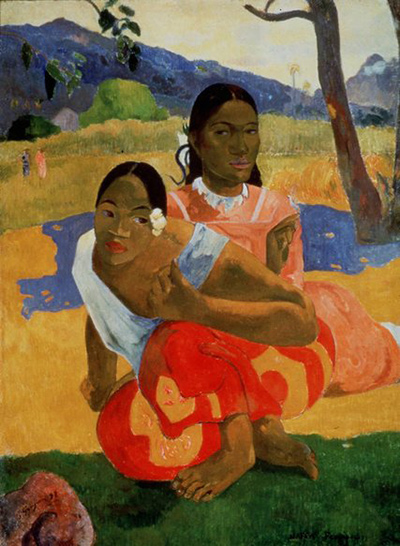
That does not mean turning every painting into evidence about the artist's sex life. A documented person, a painted sitter and a literary character are three different kinds of identity. Gauguin repeatedly blurred those categories in images and writing; a responsible account must separate them again. It must also resist a different simplification: no verdict about one statute can settle questions of childhood, consent, representation and colonial inequality.
The colony was part of the relationship
French rule in eastern Polynesia was neither a timeless condition nor a single clean legal event. France annexed the Marquesas in 1842 and forced a protectorate upon Queen Pōmare IV in Tahiti in the same year. The Tahitian kingdom moved through overlapping institutions until Pōmare V transferred his states to France in 1880. Courts, administrative authority and metropolitan criminal law were introduced in stages, with different rules and jurisdictions coexisting or being extended at different times. [2]
Gauguin entered this system from its privileged side. He was not a colonial governor or missionary, and he sometimes fought bitterly with both church and state. But citizenship, race, sex, age, money and mobility still shaped what he could do. A French male settler could travel away, use the post, appeal to officials, receive money from a Paris dealer and turn local encounters into commodities for foreign buyers. The girls and women he knew did not possess equivalent choices or an equal share in the resulting cultural authority. [2] [3]
The erotic image of Tahiti had already helped empire hide such inequalities. Historian Matt K. Matsuda describes how French representations displaced histories of seizure, civil war and anticolonial resistance with the idea of Pacific islands of love. In that story, welcoming female bodies made possession appear natural and violence disappear. Gauguin inherited and amplified the convention even when he claimed to reject European civilisation. [1] [8]
What the surviving record can—and cannot—say
Much of the evidence was created by Gauguin: his letters, manuscripts, titles and pictures. Museum catalogues can test those materials against inscriptions, civil records, chronology and technical examination, but the archive remains uneven. Gauguin's voice is abundant; the voices of the girls are scarce. Silence is not proof of acquiescence, resistance, affection or indifference. It is a limit on what can honestly be claimed.
Relationship labels can conceal that limit. Wife, lover, mistress, partner, model, muse and the Tahitian word vahine occur in sources written for different purposes. None automatically establishes legal status or free and equal consent. This page uses relationship where the exact status is uncertain, then supplies the facts that matter: each person's age, the adult's age where known, the colonial setting and the quality of the record.
Family involvement needs the same care. A family could participate in arranging a household or recognise a relationship within local practice. That fact may be historically important, but it does not transform a child into an adult or remove the advantages held by a forty-three-year-old settler. Nor can a European category simply be projected onto Polynesian kinship. The task is to hold the documented structure and the child's unequal position together without inventing what she thought. [4]
Teha'amana is not the same as Tehura
Art Institute of Chicago scholarship identifies Teha'amana as thirteen when Gauguin, then forty-three, met her during his first Tahitian stay. Its main narrative evidence is Gauguin's semifictional Noa Noa: an early draft places the meeting at Faone and says he spoke with members of her family before taking her to his home. The relationship lasted from 1891 until his departure in 1893. [4]
Every part of that statement needs its source boundary. The Art Institute's painting bears the spelling Tehamana; scholarship also gives her name as Teha'amana. In a later version of Noa Noa, Gauguin calls the corresponding character Tehura. Tehura is a literary construction, not a second documentary name that gives transparent access to Teha'amana's experience. Dialogue, emotions and scenes assigned to the character cannot safely be returned to the historical child. [4]
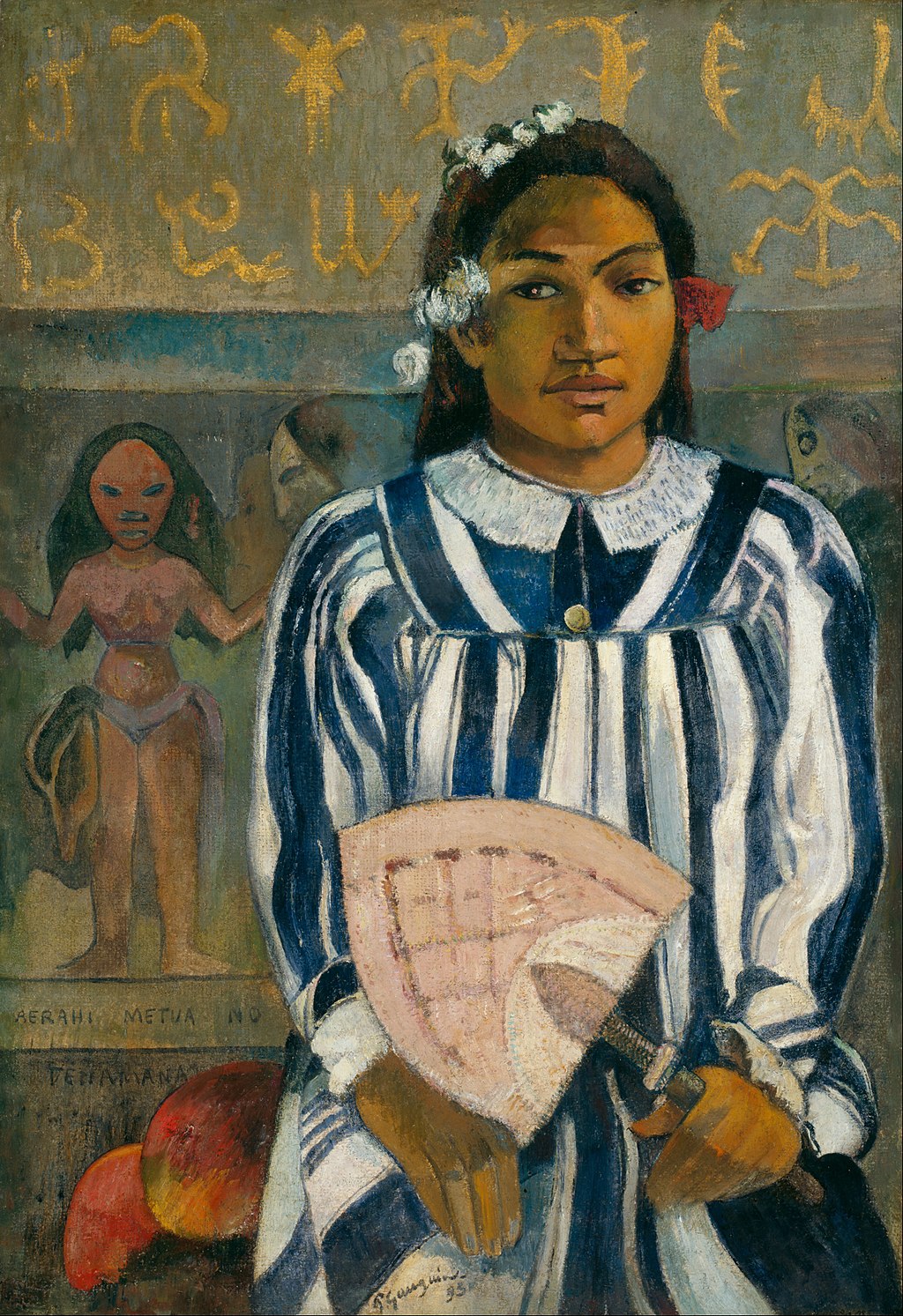
The same distinction governs the paintings. Merahi metua no Tehamana is the one work Gauguin inscribed with her name. Other identifications have been proposed from resemblance, but the catalogue stresses that no photograph can be securely identified and that Gauguin did not consistently make portrait likenesses. Calling every similar young woman Teha'amana would not recover her identity; it would place more bodies under a name selected through his art. [4]
Even the named Chicago portrait is constructed rather than transparent. Teha'amana wears a missionary dress associated with the contemporary Christian history Gauguin often deplored. Behind her he enlarged signs from a Rapa Nui tablet known through a photograph, and combined them with figures reinvented from Tahitian, Southeast Asian and European sources. The painting joins a particular girl to Gauguin's authored vision of an ancient Pacific. It cannot tell us that its symbolic past was hers. [3] [4]
Pau'ura, her children and the danger of visual guesswork
Pau'ura belongs to a different period and record. The Art Institute gives her birth date as 27 June 1881 and says she was fourteen when the relationship with Gauguin began in January 1896. Gauguin wrote her name as Pahura; the catalogue identifies that spelling as his error, not another person. [5]
Two children are documented. A girl born in 1897 died soon after birth. Émile Marae a Tai was born on 19 April 1899. His civil record, dated two days later in Papeete, names Pau'ura and carries Gauguin's signature. A separate Art Institute entry confirms that Émile was still an infant when Gauguin left Tahiti for Hiva Oa in 1901. [5] [6]
These records give dates, names and a small part of family history; they do not make every mother-and-child picture a family portrait. The catalogue for Polynesian Woman with Children considers whether one child might relate to Émile, but rejects a secure identification of the seated woman as Pau'ura: she would have been no older than nineteen when the work was painted, whereas the figure appears much older. Technical changes also generalised the face. The responsible conclusion is uncertainty, not a more emotionally satisfying identification. [5]
The archive around a possible earlier pregnancy is even thinner. Gauguin told a correspondent in 1892 that Teha'amana was pregnant, but no birth record or later reference has been found. Noa Noa cannot fill the gap because its literary counterpart has no child. Several outcomes are possible, and the evidence does not choose among them. Preserving that blank is more accurate than using it to produce either tragedy or romance. [5]
Vaeoho Marie Rose in the Marquesas
After Gauguin moved to Hiva Oa in 1901, he entered another relationship with Vaeoho Marie Rose. The Art Institute identifies her as the fourteen-year-old daughter of a local chief. Their daughter, Tahiatikaomata, was born on 14 September 1902. [5]
This is not an appendix to the Tahitian relationships. Vaeoho was a separate person in a different archipelago, and the Marquesas had their own colonial history: France had formally annexed the islands nearly sixty years before Gauguin arrived, although the reach of administration developed unevenly. [2] Her father's position does not cancel the disparity between a child and an adult European settler. The sources used here do not preserve her account of the relationship, so none is invented.
Why a simple claim about legality fails
Public discussion often asks for a single age-of-consent figure followed by a declaration that Gauguin either broke or obeyed the law. The available specialist legal history does not support that shortcut. It shows a gradual and sometimes contradictory reception of French criminal law: Tahitian institutions, protectorate authority, colonial courts and metropolitan codes interacted over decades; the Marquesas followed a related but not identical administrative path. [2]
Without resolving the exact island, date, jurisdiction, personal status and provision, a numeric threshold would create false precision. This article therefore does not declare the relationships legal or illegal under a specified nineteenth-century statute. That is an evidential boundary, not an ethical escape route. We know that Teha'amana was thirteen, Pau'ura fourteen and Vaeoho Marie Rose fourteen; that Gauguin was an adult French settler; and that the encounters occurred in territories governed through colonial power. [2] [4] [5]
Historical law and ethical judgement also answer different questions. A colonial legal order may define an offence while leaving domination untouched, or enforce rules differently across race, citizenship and locality. Even a firmly demonstrated absence of prosecution would not establish meaningful consent. Conversely, moral seriousness does not permit a writer to invent a criminal charge. Precision requires stating both what the law source cannot resolve and what the age and power evidence makes impossible to romanticise.
Appropriation was a process, not just a borrowed motif
Gauguin's cultural appropriation involved access, selection, renaming and circulation. He drew from local encounters, but also from photographs, books, museum study and reproductions carried across imperial routes. In Merahi metua no Tehamana, material from Rapa Nui and Southeast Asia helps manufacture an ancestral aura around a Tahitian girl in contemporary missionary clothing. Cultural difference is made available for Gauguin's symbolic system, while his signature and market control determine where the picture travels and who is credited. [3] [4]
His writings reveal a similar transfer of authority. Art Institute research traces supposedly ancient religious material in Gauguin's Ancien culte mahorie to Jacques-Antoine Moerenhout's 1837 book. Reworking a printed European account can be artistically generative, but it is not the same as receiving direct testimony from an Indigenous knowledge holder. When Gauguin writes as though he can restore a lost Pacific past, the borrowed route must remain visible. [7]
Appropriation does not mean that nothing in the work arose from observation, or that combination itself is unique to colonial art. The relevant questions are more exact. Which culture supplied a form? Through whose photograph or text did he encounter it? Was a living person's identity absorbed into an allegory? Who could publish, exhibit and profit? Once those routes are named, influence no longer serves as a polite word for every unequal transfer.
Criticising colonial officials did not place Gauguin outside empire
In Tahiti and especially on Hiva Oa, Gauguin attacked Catholic missionaries, judges and administrators. He produced polemical publications and became involved in litigation. Some accusations addressed genuine institutional power, and disagreement with colonial officers should not be dismissed merely because the critic was compromised. [3]
Yet opposition to one part of the colonial order is not decolonisation. Gauguin could confront a priest while benefiting from the status of a French man; criticise sexual misconduct by others while entering relationships with girls; and condemn cultural destruction while treating diverse Pacific traditions as material for his own authority. These are not contradictions to be solved by choosing the heroic or monstrous Gauguin. They describe how privilege can coexist with rebellion against selected institutions.
Pacific responses are not one verdict
Contemporary artists and commentators from the Pacific do not speak with a single voice about Gauguin. The National Gallery of Australia's The Gauguin Dilemma, hosted by Sāmoan-Australian journalist Sosefina Fuamoli, places sharp rejection beside arguments for keeping the history visible and available for active reinterpretation. Artist and curator Rosanna Raymond insists that Pasifika artists are not merely a counter-narrative but the narrative of a living Pacific; poet Selina Tusitala Marsh warns that a one-word monster verdict can close down the work of making and repair. Their differences matter. [9]
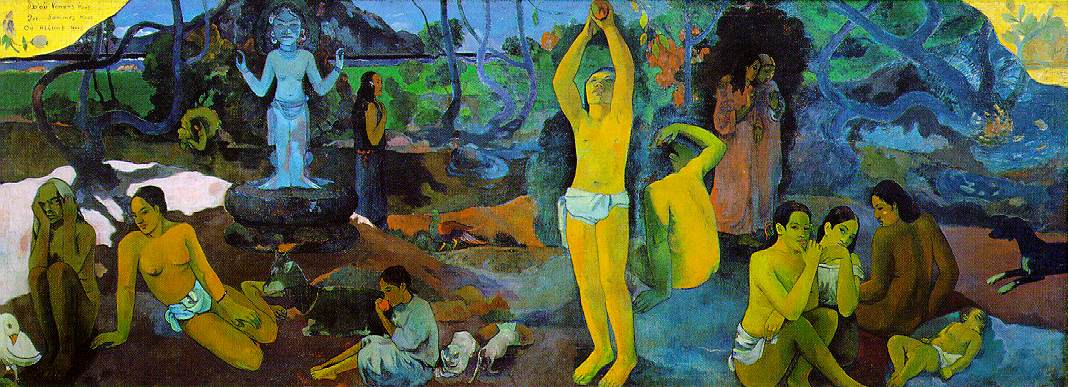
Yuki Kihara offers a visual re-authoring rather than a final judgement. Kihara, an artist of Japanese and Sāmoan descent who is part of the fa'afafine community, made Fonofono o le Nuanua: Patches of the Rainbow (after Gauguin) in 2020. The photographic work repurposes the broad composition of Gauguin's late panorama while centring Sāmoan gender knowledge, relationships, environmental responsibility and the agency of its participants. Kihara also asks who has profited from images of Te Moana Nui and who has been authorised to represent it. [10]
Such works do not need to redeem Gauguin. They change the distribution of authorship in the present. The colonial archive made his images and explanations extraordinarily durable; contemporary Pacific practice can quote, refuse, mock, redirect or outgrow them on its own terms.
Looking without evasion
An ethical history of Gauguin should neither hide the paintings nor use formal beauty to quarantine their conditions. It should identify Teha'amana, Pau'ura and Vaeoho Marie Rose as separate people; keep literary characters and uncertain sitters distinct; name their documented ages; and acknowledge the children without converting them into pictorial clues. It should explain the colonial structures that enlarged Gauguin's choices and restricted those of others.
That precision changes looking. Colour, contour and symbolic compression remain available to study, but so do the routes by which a French artist moved people, names and cultural forms into a European art market. The result is not a simpler Gauguin. It is a history in which his achievement no longer requires other lives to become scenery.
Related Pages
Frequently Asked Questions
Paul Gauguin's relationships in Polynesia cannot be understood as a private romantic story placed against an exotic background.
The archive around a possible earlier pregnancy is even thinner.
That precision changes looking.
Discussion
Paul Gauguin's relationships in Polynesia cannot be understood as a private romantic story placed against an exotic background.
Reader Insights
Paul Gauguin's relationships in Polynesia cannot be understood as a private romantic story placed against an exotic background.
These records give dates, names and a small part of family history; they do not make every mother-and-child picture a family portrait.
It is a history in which his achievement no longer requires other lives to become scenery.
Join the Conversation
Share the visible detail or source that most changed your reading.
References
- Matt K. Matsuda, Four Society Islands: Tahitian Archives, in Empire of Love: Histories of France and the Pacific, Oxford University Press View source
- Emmanuelle Gindre and Bruno de Loynes de Fumichon, La réception du droit pénal français à Tahiti (1842–2000), Archives de politique criminelle, 2014/1, no. 36, pp. 89–109 View source
- National Gallery, London, Elizabeth C. Childs, A New Chapter: Tahiti and the Marquesas Islands View source
- Art Institute of Chicago, Merahi metua no Tehamana (Tehamana Has Many Parents or The Ancestors of Tehamana), scholarly catalogue entry View source
- Art Institute of Chicago, Polynesian Woman with Children, scholarly catalogue entry View source
- Art Institute of Chicago, Seated Tahitian Youth, scholarly catalogue entry View source
- Art Institute of Chicago, Noa Noa / Ancien culte mahorie, scholarly catalogue entry View source
- National Gallery of Art, Gauguin: Maker of Myth, exhibition brochure View source
- National Gallery of Australia, The Gauguin Dilemma, four-part institutional podcast and transcripts hosted by Sosefina Fuamoli View source
- National Gallery of Australia, Yuki Kihara, learning resource on Fonofono o le Nuanua: Patches of the Rainbow (after Gauguin) View source
 Paul Gauguin.jpg)