 by Tom Gurney
Tom Gurney BSc (Hons) is an art history expert with over 20 years experience
Published on August 14, 2026 / Updated on August 14, 2026
Email: tomgurney1@gmail.com / Phone: +44 7429 011000
Street in Tahiti: Introduction
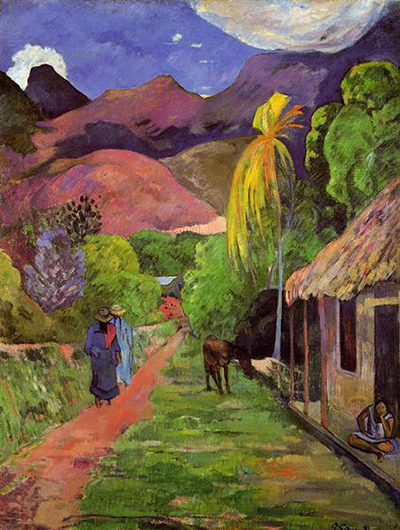
The painting once circulated in English as Road in Tahiti is catalogued by the Toledo Museum of Art as Street in Tahiti. That current title belongs with a precise object: Paul Gauguin's oil on canvas of 1891, measuring 115.6 by 88.6 centimetres and numbered 1939.82. Calling it a street rather than an anonymous road directs attention to something easily screened by the vegetation and mountains. This is an inhabited, built environment, not a path through untouched nature. [1]
At a Glance
- ArtistPaul Gauguin [1]
- TitleStreet in Tahiti [1]
- Date1891 [1]
- Mediumoil on canvas [1]
- Dimensions / object size115.6 by 88.6 centimetres [1]
- Object recordThat current title belongs with a precise object: Paul Gauguin's oil on canvas of 1891, measuring 115.6 by 88.6 centimetres and numbered 1939.82. [1]
- FocusThe painting once circulated in English as Road in Tahiti is catalogued by the Toledo Museum of Art as Street in Tahiti.
Contents
- Street in Tahiti: Introduction
- A street built from diagonals
- People and buildings are part of the landscape
- Observation assembled from other images
- The colonised place behind the imagined paradise
- What the painting holds together
The title has never been entirely stable. The work appeared in Berlin in 1928 as Die Berge—The Mountains—and a 1930 publication listed by Toledo reproduced it under a Martinique landscape title. Neither description governs now. Toledo identifies the place of origin as Tahiti, while the 1891 date places the canvas near the beginning of Gauguin's first stay there. The old titles are useful because they show how readily one part of the picture, whether mountains or tropical scenery, could displace the street itself. [1]
A street built from diagonals
The National Gallery of Australia calls the painting an urban scene and identifies its central spatial device. The road, a hut and an embankment form diagonals that converge on a red shrub in the distance. They pull the lower half of the canvas sharply inward, producing what the museum describes as a plunging perspective. The street is therefore not merely a strip of colour across the foreground. It is the mechanism that carries the viewer past the nearest figure, alongside built edges and towards the centre of settlement. [2]
Above that rapid recession, the mountain ranges behave differently. Relatively uniform strokes make them appear flatter, even while their stacked contours close the view. The picture holds two spatial systems together: the lower road drives into depth; the upper landscape returns the eye to the surface. Toledo's account of strong contours, flattened shapes, repeated curves and tightly patterned brushwork describes the same tension from another angle. [1] [2]
Curving forms prevent the diagonals from becoming a rigid diagram. Vegetation bends around the route, the mountain silhouettes repeat one another, and colour zones interrupt any smooth movement into the distance. Gauguin provides enough perspective to make the street traversable, then checks it with pattern. The viewer is pulled forward but never allowed to forget the canvas's designed surface.
People and buildings are part of the landscape
The settlement is not empty. Two small figures walk away into the distance, and a woman occupies the doorway of the hut. Together with the road and embankment, they make human presence structural rather than incidental. The figures mark different depths, while the doorway joins a person to the architecture that frames her. [2]
Nothing in the current records identifies these people. Their names, relationships, occupations and thoughts are unknown, and their scale does not reduce them to decorative signs. Toledo interprets the nearer woman as brooding and sees sadness or disquiet in her presence and in heavy clouds above. That is a curatorial reading of posture, weather and composition—not evidence of her interior life. [1]
The distinction matters because the picture's formal pressure can produce mood without explaining its human subject. A low cloud mass may make the upper field feel heavy. A still or withdrawn pose may interrupt the road's momentum. Viewers can recognise those effects while leaving the represented woman her unknowability.
Observation assembled from other images
The scene also resists the idea of an unmediated record. National Gallery of Australia research says that Gauguin constructed both this painting and the related Te raau rahi (The large tree) from multiple drawings in his sketchbooks. The two figures walking into the distance are among the elements carried from those studies. The woman in the doorway was likely modelled on Edgar Degas's Dancers Resting of 1881–85. [2]
That likely European source does not make the whole painting fictitious, nor does it identify the sitter. It shows how Gauguin joined observations and portable visual memories. A Tahitian road, a hut, distant walkers, mountains, vegetation and a pose associated with Degas could be reorganised within one scene. The result is a composition made from Tahiti but not a transparent document of one instant there.
This assembly helps explain the coexistence of depth and flatness. Gauguin could use the converging street to make the lower space convincing while treating the mountains as broad patterned bands. The painting's coherence comes from the way those parts were fitted together, not from a claim that the canvas reproduces everything the artist saw from a fixed viewpoint.
The colonised place behind the imagined paradise
Gauguin arrived in Tahiti in June 1891 with an idea of the island already formed. Displays of French colonies at the 1889 Exposition Universelle and romantic travel accounts had encouraged an image of an unspoiled paradise. Current museum scholarship instead emphasises that Tahitian society had long been transformed by colonial government, Christian missions and trade. [3] [4]
Toledo's own label now makes the contradiction explicit. Gauguin found the island deeply affected by French colonisation and missionaries, then created fantasy visions of a supposedly more primitive culture. The museum also characterises his encounters with Pacific Islanders as largely exploitative and abusive. Those facts cannot be corrected by admiring the painting's colour, and they should not be replaced with a story in which the artist merely discovered a natural Eden. [1]
Street in Tahiti is especially revealing because settlement remains visible despite the fantasy. Its road, hut, embankment and figures belong to a lived environment. Yet the steep mountains, heavy vegetation, brilliant colour and compressed architecture can make that environment seem enclosed from modern history. The painting does not erase every sign of colonised society; it reorganises those signs within an image designed to satisfy Gauguin's formal and imaginative aims.
The word street therefore carries interpretive weight. It does not prove an exact location, and the museum does not identify a town. It does keep the built and social character of the scene in view. Road can sound like transit through empty land; Street asks who lives beside it, even when the painting does not give those people names.
What the painting holds together
Toledo acquired the canvas with funds from the Libbey Endowment, the gift of Edward Drummond Libbey. Its present institutional identity is secure even though its older titles wandered between mountains, Martinique and Tahiti. [1]
What remains compelling is the picture's controlled contradiction. A steep road opens depth while mountains flatten it. Figures inhabit the settlement but resist biography. Observed Tahitian elements coexist with a pose probably adapted from Degas. Most importantly, a street made under colonial rule is presented through the visual language of Gauguin's desired elsewhere. Looking closely means seeing both the force of that construction and the history it cannot make disappear.
Related Pages
Frequently Asked Questions
The painting once circulated in English as Road in Tahiti is catalogued by the Toledo Museum of Art as Street in Tahiti.
The scene also resists the idea of an unmediated record.
What remains compelling is the picture's controlled contradiction.
Discussion
The painting once circulated in English as Road in Tahiti is catalogued by the Toledo Museum of Art as Street in Tahiti.
Reader Insights
The painting once circulated in English as Road in Tahiti is catalogued by the Toledo Museum of Art as Street in Tahiti.
National Gallery of Australia research says that Gauguin constructed both this painting and the related Te raau rahi (The large tree) from multiple drawings in his sketchbooks.
Looking closely means seeing both the force of that construction and the history it cannot make disappear.
Join the Conversation
Share the visible detail or source that most changed your reading.
References
- Toledo Museum of Art, Street in Tahiti, 1891, object 1939.82, current collection record View source
- National Gallery of Australia, Gauguin's World: Tōna Iho, Tōna Ao, stop 16, Te raau rahi (The large tree) and Street in Tahiti, current audio transcript View source
- National Gallery of Australia, Gauguin's World: Tōna Iho, Tōna Ao, stop 15, Tahitian women, current audio transcript View source
- National Gallery of Art, Gauguin: Maker of Myth, exhibition brochure View source
 Paul Gauguin.jpg)