 by Tom Gurney
Tom Gurney BSc (Hons) is an art history expert with over 20 years experience
Published on August 14, 2026 / Updated on August 14, 2026
Email: tomgurney1@gmail.com / Phone: +44 7429 011000
Paul Gauguin in Martinique: Introduction
Paul Gauguin's Martinique paintings came from a French colony, not from a world outside European power. He and the painter Charles Laval left France for Panama on 10 April 1887 and reached Martinique on 11 June. Gauguin worked there until the end of October, returning to Paris on 14 November. In those four and a half months he made paintings and drawings whose brilliant vegetation, patterned colour and repeated figures would enter his European reputation. [1] [2] [3]
At a Glance
- ArtistPaul Gauguin
- GuidePaul Gauguin in Martinique
- Focusin Martinique
- Key topicsFrom Panama to a French Caribbean colony; The people Gauguin made into motifs; Preparation rather than tropical spontaneity; Pictures made for return
- OverviewPaul Gauguin's Martinique paintings came from a French colony, not from a world outside European power.
Contents
- Paul Gauguin in Martinique: Introduction
- From Panama to a French Caribbean colony
- The people Gauguin made into motifs
- Preparation rather than tropical spontaneity
- Pictures made for return
- What Martinique changed—and what it did not
The journey mattered artistically, but Gauguin's reason for making it cannot be accepted on his terms alone. Before leaving, he told his wife Mette that he intended to go to Panama “to live like a savage”. The phrase was already an act of self-invention: a European artist imagining that movement through imperial territory could release him from European life. Martinique was connected to France by colonial administration, shipping, plantation production and an art market to which Gauguin expected to return. [1] [2] [10]
From Panama to a French Caribbean colony
Gauguin and Laval had met at Pont-Aven in 1886. The National Gallery of Art's research chronology places them in Panama and Martinique from April to October 1887. Their Panama interlude was brief; Martinique became the sustained working campaign. Current Van Gogh Museum scholarship dates Gauguin's stay from mid-June through late October and identifies seventeen paintings, one more than the sixteen listed in the 2001 catalogue raisonné. [2] [7]
They settled near Saint-Pierre, then Martinique's capital and commercial harbour. Gauguin lived in a hut on a small fruit plantation about two kilometres south of the town. The building type had housed Black plantation workers and, before slavery was abolished in Martinique in 1848, enslaved people. That history makes the location very different from the vacant tropical refuge of Gauguin's fantasy. The landscape was lived and worked; the plantation linked it to commerce and to the long consequences of enslavement. [2]
Laval should not disappear inside Gauguin's biography. The two travelled together, but Laval stayed on Martinique for approximately six months after Gauguin left. When he returned to Brittany in 1888, he brought watercolours that Gauguin praised to Vincent van Gogh as art worth seeing. A sheet now at the Art Institute of Chicago also keeps the companionship visible: Gauguin drew Martinican figures and foliage on one side and Laval in profile with a palm tree and other sketches on the other. It is evidence of a shared journey, not a reason to assign Laval's work to Gauguin. [4] [5]
The people Gauguin made into motifs
Gauguin was especially drawn to the porteuses, Black Martinican women who carried sugar cane and other produce from plantations to Saint-Pierre's markets and harbour. In an early July letter to his friend Emile Schuffenecker, he described them in racialised and objectifying language. The important evidence is not the slur but the working sequence he set out: he was making “sketch after sketch” and would later “make them pose”. [3]
The distinction between looking, sketching and posing matters. These women were not incidental marks added to landscapes observed in a single moment. Gauguin first accumulated rapid notations, then made three larger chalk studies from life. He transferred and recombined their forms in paintings. The Mango Trees, Martinique, for example, is based on a large study of two women; On the Banks of the River, Martinique reverses and joins a body from one drawing with a head and headdress from another. [2] [3]
The women were also workers. Van Gogh Museum research identifies the porteuses as descendants of Martinique's enslaved African population. Although legally free after 1848, many remained structurally underpaid and dependent upon plantation owners. Gauguin's pictures do not explain those conditions. They emphasise dress, gesture, fruit and vegetation, turning labour into a rhythmic and saleable image. A reader can recognise the paintings' formal energy without mistaking their selectivity for a complete record of Martinican life. [2]
Clothing carried history as well as colour. In The Mango Trees, the foreground women wear the wide douillette, with bright Madras headcloths and, in one case, a shoulder scarf. The museum's catalogue connects this Creole dress to restrictions imposed under slavery, when enslaved Black people were barred from wearing the same clothes as white colonists. Gauguin studied these garments closely because they located his figures, yet he presented them to European viewers as signs of difference. Description therefore needs both halves: what the clothing meant within Martinique and how the artist made it serve his search for marketable local colour. [2]
Preparation rather than tropical spontaneity
The surviving materials contradict an image of Gauguin simply setting up before an untouched view. He travelled with prepared artistic supplies and portable repositories of motifs. For The Mango Trees, he cut canvas from a roll brought from Europe and mounted it locally on a standard-size stretcher. He coated it with a thin, absorbent layer of animal glue and chalk, transferred studied figures in diluted blue paint, and organised the scene with an initial arrangement of orange and greens. [2]
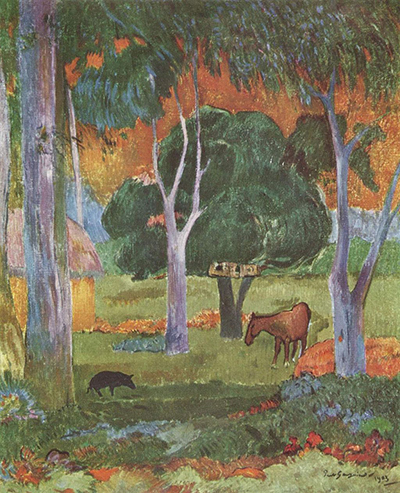
Directional hatching then helped differentiate parts of the picture: horizontal strokes in water, diagonals in foliage and verticals in grass. The method grew from Gauguin's earlier engagement with Cézanne rather than appearing fully formed in the Caribbean. The Mango Trees also borrows a slender tree from a Munich Martinique Landscape and adapts a papaya tree from the large Edinburgh painting of the same English title. Even within one short campaign, Gauguin treated his canvases as a store of reusable forms. [2]
Drawings worked the same way. The Art Institute's reconstruction shows that the so-called Martinique sketchbook contains material from Paris and Brittany as well as the island. Its mixed contents followed Gauguin between places and later supplied paintings, ceramics and carvings. Calling it a Martinique sketchbook is convenient, but it should not disguise the movement and reassembly recorded in its pages. [5] [6]
This preparation does not make the work detached from experience. Gauguin observed people, clothing, animals and plants with sustained attention. It does show that observation was only the beginning. Posed studies, imported supports, earlier French precedents and motifs transferred between works all helped turn what he saw into carefully devised pictures. [2] [3] [6]
Pictures made for return
Gauguin's tropical escape always had a return route. Current Van Gogh Museum scholarship argues that he knew colourful colonial scenes could attract buyers in Paris and shaped his Martinique pictures accordingly. The foreground figures of The Mango Trees seem absorbed in everyday actions, but the composition omits the underpayment and dependence surrounding the labour represented. Its invitation to look is therefore inseparable from what it withholds. [2]
Nor can his departure be reduced to one cause. The National Galleries of Scotland says ill health forced his return from Martinique. Letters examined by the Van Gogh Museum add another factor: in August, Gauguin heard that a collector had bought two of his ceramic works and might finance a renewed partnership with the ceramicist Ernest Chaplet. He asked friends for money to travel home. The larger investment failed to materialise, but the prospect joined health and finances in drawing him back to Paris. [1] [8]
The paintings quickly entered that European network. Soon after Gauguin's return, Theo van Gogh bought The Mango Trees, Martinique for 400 francs. The purchase helped establish Theo as Gauguin's dealer and brought the painting into the close attention of Vincent van Gogh and Emile Bernard. Its Martinican subject was not sealed off from Parisian modernism; it became part of the exchanges through which Gauguin's work was seen, sold and discussed. [2]
In 1889 he repackaged the journey again. The Grasshoppers and the Ants: A Souvenir of Martinique, a zincograph printed on chrome-yellow paper, appeared in the Volpini suite shown on the grounds of the Paris World's Fair. Women carrying baskets and resting by the sea were translated from a colonial labour setting into a portable souvenir for a European exhibition. That afterlife makes the traffic in images explicit: Martinique supplied people and motifs; Gauguin selected and rearranged them; Paris supplied the audience. [9]
What Martinique changed—and what it did not
Martinique gave Gauguin an intensive campaign of figure study, landscape painting and material experiment. It sharpened his use of hatching, strong contours, large colour structures and motifs carried from drawing to painting and later media. But it was not a miraculous origin point for everything that followed. Cézanne, Pissarro, Degas, Brittany, ceramics and Gauguin's existing habits of collection and reuse were already present in the work. [2] [6]
The stay also exposes the limits of Gauguin's outsider legend. He sought difference and presented himself as escaping Europe, yet travelled with European materials, depended on colonial infrastructure and shaped pictures for European sale. The people he observed had histories and economic conditions that his most inviting scenes suppressed. Seeing those conditions does not require dismissing the paintings' formal invention. It requires recognising where that invention happened: within colonial Martinique, through encounters Gauguin turned into art and then carried back to Paris. [2] [10]
Related Pages
Frequently Asked Questions
Paul Gauguin's Martinique paintings came from a French colony, not from a world outside European power.
The surviving materials contradict an image of Gauguin simply setting up before an untouched view.
The stay also exposes the limits of Gauguin's outsider legend.
Discussion
Paul Gauguin's Martinique paintings came from a French colony, not from a world outside European power.
Reader Insights
Paul Gauguin's Martinique paintings came from a French colony, not from a world outside European power.
The surviving materials contradict an image of Gauguin simply setting up before an untouched view.
It requires recognising where that invention happened: within colonial Martinique, through encounters Gauguin turned into art and then carried back to Paris.
Join the Conversation
Share the visible detail or source that most changed your reading.
References
- Van Gogh Museum, Cleopatra Pot, current scholarly catalogue entry, including the 1887 departure and return correspondence View source
- Van Gogh Museum, The Mango Trees, Martinique, current scholarly catalogue entry View source
- Van Gogh Museum, Study of a Martinican Woman, current scholarly catalogue entry and transcription of Gauguin's July 1887 letter to Emile Schuffenecker View source
- Van Gogh Museum, Charles Laval: Self-Portrait, current scholarly catalogue entry View source
- Art Institute of Chicago, Sketches of Figures and Foliage (recto); Profile of Charles Laval with Palm Tree and Other Sketches (verso), reference 1991.223 View source
- Art Institute of Chicago, Gauguin Paintings, Sculpture, and Graphic Works at the Art Institute of Chicago, sketchbook reconstruction and cat. 6 View source
- National Gallery of Art, Center for Advanced Study in the Visual Arts, Conservation Research 1993, A Brief Chronology of Gauguin's Life View source
- National Galleries of Scotland, Paul Gauguin: Martinique Landscape, current object record View source
- Metropolitan Museum of Art, The Grasshoppers and the Ants: A Souvenir of Martinique, 1889, 22.82.2(4) View source
- Van Gogh Museum, Inclusive Language Style Guide, colonial-context discussion arising from Gauguin & Laval in Martinique View source
 Paul Gauguin.jpg)