 by Tom Gurney
Tom Gurney BSc (Hons) is an art history expert with over 20 years experience
Published on August 14, 2026 / Updated on August 14, 2026
Email: tomgurney1@gmail.com / Phone: +44 7429 011000
Martinique Landscape: Introduction
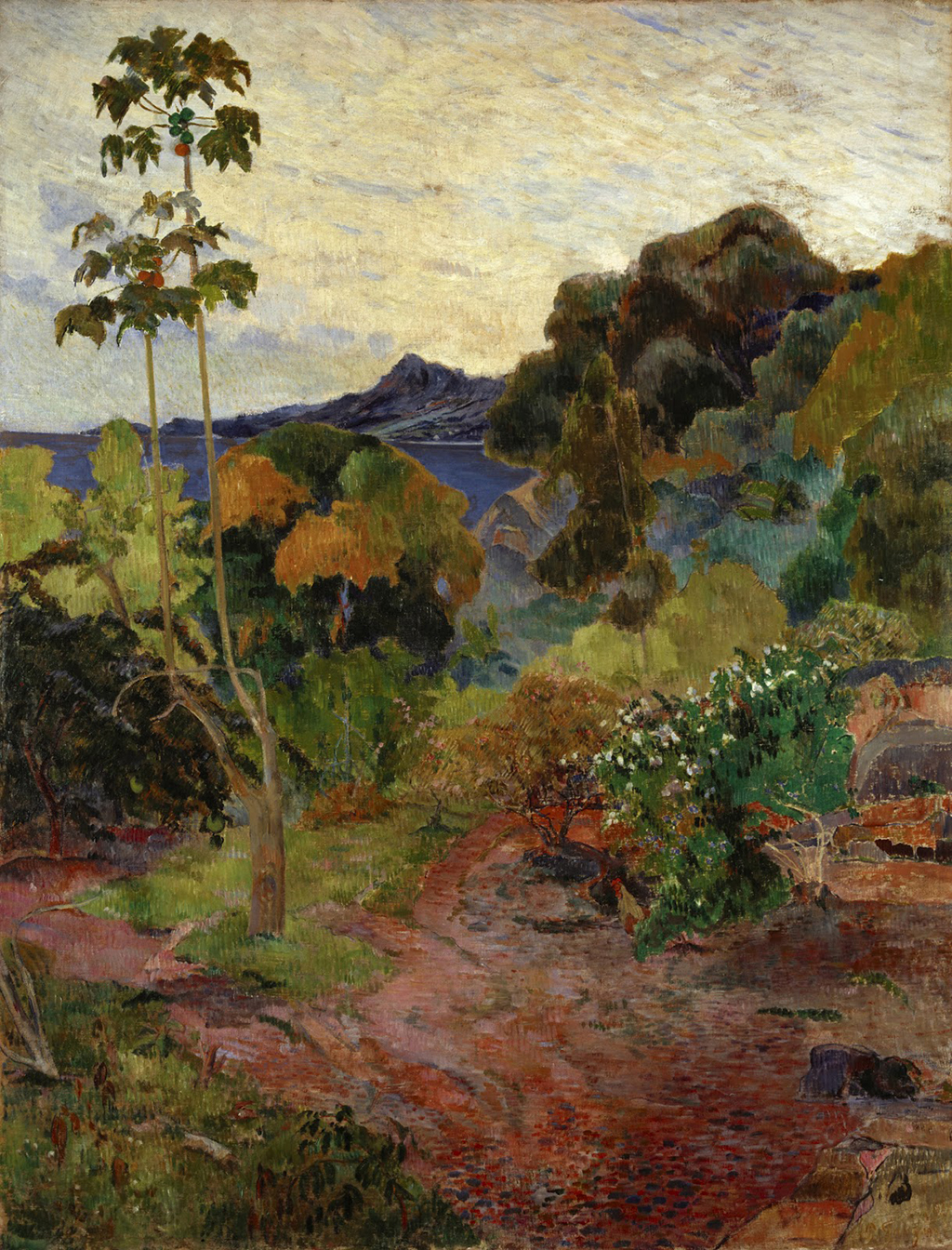
Paul Gauguin's Martinique Landscape in Edinburgh is an oil painting of 1887, measuring 117 by 89.8 centimetres. Its accession number is NG 2220 at the National Galleries of Scotland. Those details matter because another large Gauguin canvas of the same year is also commonly called Martinique Landscape. The Munich work is horizontal, 90.2 by 116.1 centimetres, and belongs to the Bayerische Staatsgemäldesammlungen as inventory 8653. The Edinburgh painting is the upright one: a landscape made emphatically vertical. [1] [2]
At a Glance
- ArtistPaul Gauguin [1]
- TitleMartinique Landscape [1]
- Date1887 [1]
- Mediumoil painting [1]
- Dimensions / object size117 by 89.8 centimetres [1]
- Object recordPaul Gauguin's Martinique Landscape in Edinburgh is an oil painting of 1887, measuring 117 by 89.8 centimetres. [1]
- FocusPaul Gauguin's Martinique Landscape in Edinburgh is an oil painting of 1887, measuring 117 by 89.8 centimetres.
Contents
- Martinique Landscape: Introduction
- A view above Saint-Pierre
- Paths, planes and hatched colour
- One tree, more than one painting
- Beyond the tropical-paradise story
- From a private collection to Edinburgh
That format changes how the scene works. Rather than offering a broad panorama, the canvas stacks near ground, rising vegetation and distant terrain. A ruddy path occupies the foreground, then turns through dense growth. A greatly extended papaya tree stands at the left, its narrow trunk carrying the eye upward as other forms lead back towards the mountain. The National Galleries describes the composition as balanced and carefully structured. Its stability is not the calm of an untouched view; it was achieved by selecting, moving and enlarging what the artist found. [1] [3]
A view above Saint-Pierre
The site has been identified more precisely than the generic title suggests. The Courtauld's collection scholarship places the viewpoint on a headland called Le Trou, high above Saint-Pierre, with Mount Pelée in the distance. Gauguin did not simply copy that prospect. He left out the busy city below, enlarged the mountain and lengthened the papaya tree to what the catalogue calls impossible proportions. The changes give the painting its clear hierarchy: tree, route and mountain hold together a complex field of plants, earth and rock. [3]
The missing city is one of the picture's most consequential choices. Saint-Pierre was the commercial capital of colonial Martinique, yet the painted landscape offers no urban counterweight to its vegetation. It would be easy to read that absence as evidence of a remote tropical world. It is better understood as construction. Gauguin had a populated colonial city beneath his viewpoint and removed it from the image. What looks secluded was made so in paint. [3]
This does not mean that every alteration hides a single ideological message. Lengthening a tree can solve a compositional problem; enlarging a mountain can strengthen depth and scale. But formal decisions also govern what viewers imagine about a place. Here the same adjustments that organise the canvas suppress the most visible sign of colonial commerce and make vegetation appear to possess the entire terrain.
Paths, planes and hatched colour
The path is the picture's invitation. Its warm earth separates masses of green and creates a route through an otherwise thick surface. Instead of carrying the eye into a deep, continuous distance, it moves between adjoining zones. Rocks and vegetation become juxtaposed colour planes; the mountain closes the sequence rather than opening an unlimited horizon. The result is spatially legible but deliberately compressed. [3]
At close range, that structure does not dissolve into smooth finish. The National Galleries notes that visible brushstrokes fuse into broader, flatter areas of colour. Courtauld scholarship describes the thin, short strokes more specifically as producing a hatched effect. These two qualities coexist: repeated marks keep the surface active, while the larger fields of green, ochre and ruddy brown give the scene its architectural clarity. [1] [3]
The hatching has sometimes been connected to Gauguin's admiration for Cézanne, whose work he collected. Yet the painting need not be treated as a simple step on a predetermined road to Synthetism. Its interest lies in the tension already present in 1887—between observed terrain and altered design, flickering marks and flatter zones, an identifiable viewpoint and a place remade for the canvas. [3]
One tree, more than one painting
The papaya tree also reveals how actively Gauguin reworked his Martinique material. Current Van Gogh Museum research distinguishes three unusually large canvases from the campaign. In The Mango Trees, Martinique, the fruit-bearing papaya at the left was loosely based on the specimen in the Edinburgh painting. A slender tree on the right of The Mango Trees came instead from the Munich Martinique Landscape. [4]
This is more than a useful catalogue distinction. It shows that Gauguin treated one painting as a source for another. The tall tree in Edinburgh is not merely botanical information recorded once before a view; it is a form that could be lengthened, shifted and reused. The three canvases therefore preserve a working process of recombination. Their shared motifs do not make them versions of one object, and their shared English title does not make Edinburgh and Munich interchangeable.
The distinction also limits what can responsibly be said about technique. Technical research into The Mango Trees has reconstructed that canvas's preparation and transfer process, but those findings cannot automatically be assigned to NG 2220. For the Edinburgh painting, the secure evidence is what its own institutional records establish: short hatched strokes, larger colour planes and purposeful topographical change. [1] [3] [4]
Beyond the tropical-paradise story
The language historically used around the painting has often repeated Gauguin's desired story about himself. The National Galleries record, while offering exact current metadata, also preserves descriptions of an escape from urban civilization towards the exotic, mysterious and sensuous life of a tropical paradise. Such terms are useful evidence of reception, but they are not neutral descriptions of Martinique. [1]
The Van Gogh Museum's inclusive-language guidance, developed in part through research on Gauguin and Charles Laval in Martinique, makes the underlying problem explicit: colonialism and enslavement stood behind the imagined artists' paradise. The Edinburgh canvas does not display that history directly. Its omission of Saint-Pierre and concentration on luxuriant growth help explain why European viewers could overlook it. [3] [5]
Recognising this selectivity does not cancel the painting's achievements. It makes them more exact. Gauguin organised a difficult upright field with a forceful tree, a winding earthen route and a distant enlarged mountain. He let short strokes remain visible while binding them into broad structures of colour. At the same time, he transformed a view above a colonial city into an image of apparent isolation. Formal invention and historical omission operate together.
From a private collection to Edinburgh
The painting's later history carried it through another network of selection and display. Samuel Courtauld bought it from Alex Reid & Lefèvre in October 1928 for £3,000, then sold it before 1932. Alexander and Rosalind Maitland acquired it by that year. In 1960 Sir Alexander presented it to the National Galleries of Scotland in memory of Rosalind, the credit under which NG 2220 is held today. [1] [3]
Its current title remains broad, but the object is specific. This is the tall Edinburgh canvas, not Munich's horizontal namesake: a view from above Saint-Pierre in which path, papaya and mountain were made to carry the whole composition. Looking closely means attending both to that control and to the inhabited colonial place the painting chose not to show.
Related Pages
Frequently Asked Questions
Paul Gauguin's Martinique Landscape in Edinburgh is an oil painting of 1887, measuring 117 by 89.8 centimetres.
The papaya tree also reveals how actively Gauguin reworked his Martinique material.
Its current title remains broad, but the object is specific.
Discussion
Paul Gauguin's Martinique Landscape in Edinburgh is an oil painting of 1887, measuring 117 by 89.8 centimetres.
Reader Insights
Paul Gauguin's Martinique Landscape in Edinburgh is an oil painting of 1887, measuring 117 by 89.8 centimetres.
Courtauld scholarship describes the thin, short strokes more specifically as producing a hatched effect.
Looking closely means attending both to that control and to the inhabited colonial place the painting chose not to show.
Join the Conversation
Share the visible detail or source that most changed your reading.
References
- National Galleries of Scotland, Paul Gauguin: Martinique Landscape, NG 2220, current object record View source
- Bayerische Staatsgemäldesammlungen, Landschaft auf Martinique, inventory 8653, current collection record View source
- The Courtauld Collection, Martinique Landscape 1887, cat. 46, p. 232, institutional collection publication View source
- Van Gogh Museum, The Mango Trees, Martinique, current scholarly catalogue entry View source
- Van Gogh Museum, Inclusive Language Style Guide, colonial-context discussion arising from Gauguin & Laval in Martinique View source
 Paul Gauguin.jpg)