 by Tom Gurney
Tom Gurney BSc (Hons) is an art history expert with over 20 years experience
Published on August 14, 2026 / Updated on August 14, 2026
Email: tomgurney1@gmail.com / Phone: +44 7429 011000
Paul Gauguin in Tahiti and the Marquesas: Introduction
Paul Gauguin made two distinct stays in Tahiti before spending his final twenty months on Hiva Oa in the Marquesas. The first Tahitian period ran from 1891 to 1893. After two years in France, he returned in 1895 and remained in Tahiti until 1901, when he moved to Atuona. Treating these years as a single withdrawal into the South Seas obscures the changes between them. It also repeats Gauguin's preferred story: that distance from Europe carried him towards a simpler, older world. [1]
At a Glance
- ArtistPaul Gauguin
- GuidePaul Gauguin in Tahiti and the Marquesas
- Focusin Tahiti and the Marquesas
- Key topicsImagining Tahiti before seeing it; Papeete and the royal funeral; Mataiea: distance from the capital, not from history; France between the two journeys, 1893–95
- OverviewPaul Gauguin made two distinct stays in Tahiti before spending his final twenty months on Hiva Oa in the Marquesas.
Contents
- Paul Gauguin in Tahiti and the Marquesas: Introduction
- Imagining Tahiti before seeing it
- Papeete and the royal funeral
- Mataiea: distance from the capital, not from history
- France between the two journeys, 1893–95
- Auckland and the second arrival
- Puna‘auia, 1895–1901
- Hiva Oa and the Maison du Jouir
- A Pacific history made from specific places
Selected Tahiti and Marquesas Works
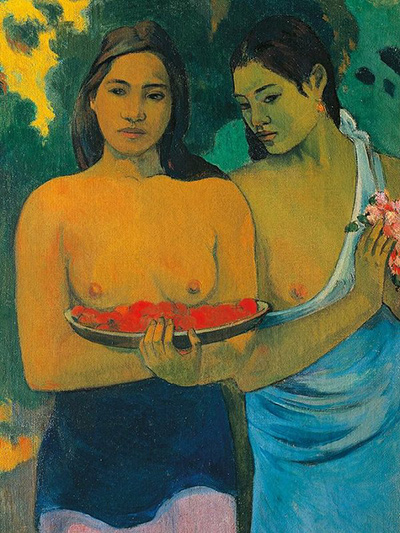
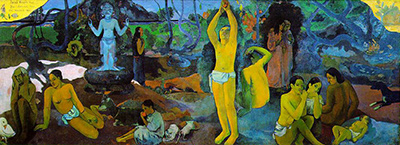
The documented journey tells a different story. French colonial displays, government support and imperial shipping routes enabled his travel. Papeete and Atuona belonged to colonial societies, while letters, dealers, exhibitions and imported images kept his work connected to Europe. Gauguin's Pacific art grew from encounters in particular places, but it also reorganised Tahitian, Marquesan, Māori, Rapa Nui, Asian and European sources for viewers elsewhere. [1] [4] [6]
Imagining Tahiti before seeing it
Gauguin's destination existed in his mind before he sailed. At the 1889 Exposition Universelle in Paris, pavilions representing French colonies and other overseas territories offered Europe a staged survey of distant peoples and objects. Romantic travel writing described Tahiti as plentiful, sexually permissive and removed from industrial life. Those sources encouraged the belief that an artist could escape financial pressure and modern society by travelling within the French empire. [1] [6]
An application to work in Tonkin, in northern Vietnam, failed. Early in 1891 the French government instead granted Gauguin an artistic mission to Tahiti. The official purpose was to study the country's customs and landscapes from the point of view of art. That wording matters because it defines an artistic assignment, not scientific training or cultural authority. The grant helped him travel and gave the venture public standing; it did not make his later images neutral records. [1] [2]
He sailed for about two months, travelling through the Suez Canal and making stops that included Mauritius, Madagascar, Australian ports and New Caledonia before reaching Papeete in June 1891. The itinerary itself belonged to modern maritime and colonial networks. Gauguin did not arrive by stepping outside them. [1] [4]
Papeete and the royal funeral
Tahiti had become a French colony in 1880. In Papeete, European fashions, technology, churches, commerce and government were conspicuous. Gauguin had expected a refuge from modern France and instead found the administrative centre of French power in the Pacific. His disappointment reveals the strength of his prior fantasy more clearly than it describes the people who lived there. [1] [4] [6]
Pōmare V died soon after Gauguin's arrival. The funeral followed European and Protestant forms, making the recent political and religious transformation of the island visible. Gauguin later responded with Arii Matamoe (The Royal End), but the painting is not a portrait of the king or a report of the ceremony. It shows a severed head in an ornate setting assembled from multiple sources. [3] [4]
Gauguin acknowledged the construction in an 1892 letter to Daniel de Monfreid. He described the palace and its women as being of my invention. The Getty record also notes that he borrowed the head from an existing carved source. A witnessed death in colonised Tahiti had become an imagined, supposedly older scene designed to impress and unsettle an audience abroad. [3] [7]
This difference between event and image is central to the whole period. Gauguin did not simply paint what stood before him, yet neither did he work without local observation. His art selected from encounters, drawings, photographs, reproductions, memories and objects, then brought those elements together within new compositions.
Mataiea: distance from the capital, not from history
Portrait commissions in Papeete brought little success, and Gauguin moved to Mataiea on Tahiti's southern coast. He lived there for more than a year. The change offered different landscapes and a smaller settlement, but it did not recover a society untouched by colonial rule. Christian mission culture, imported clothing, trade and French administration had long altered daily life across the island. [1] [4]
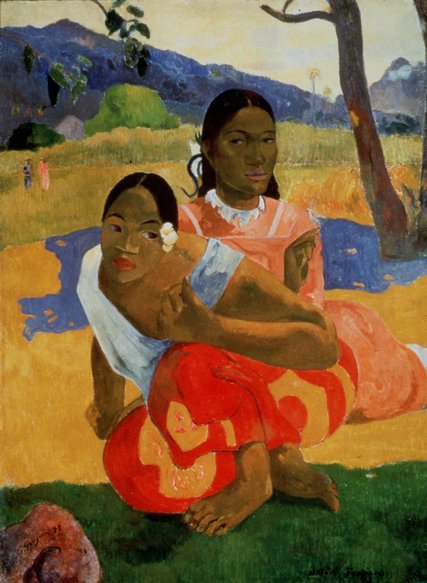
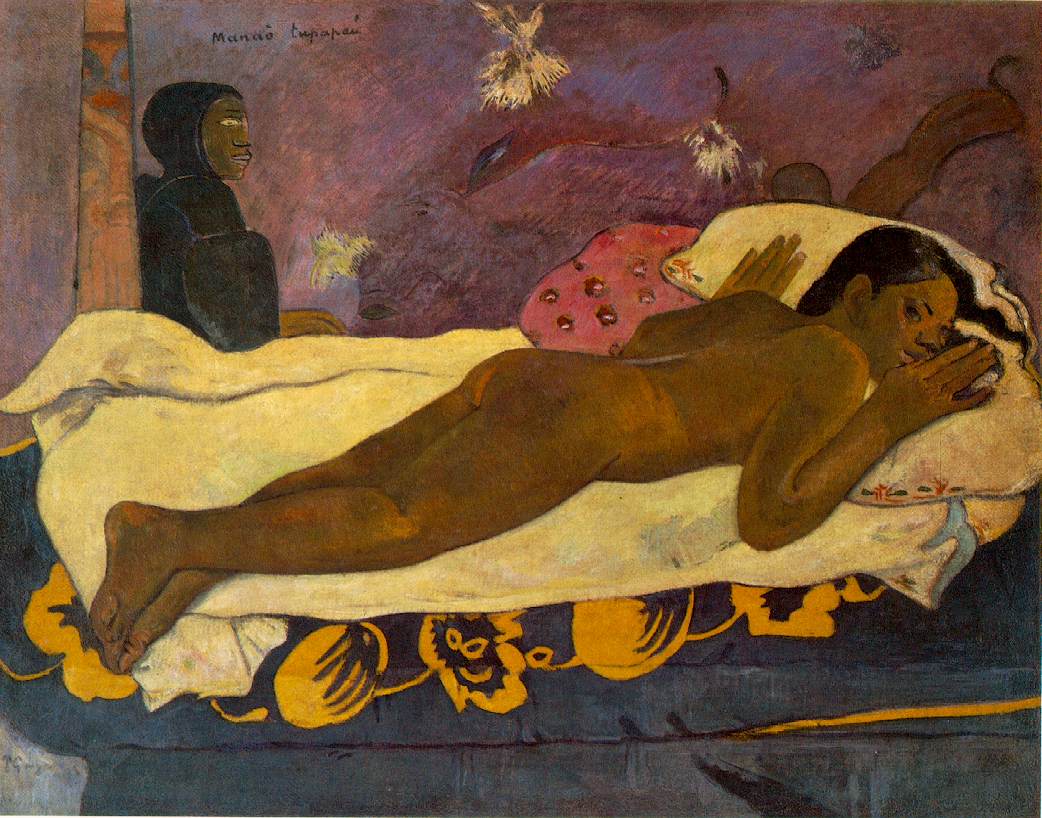
Gauguin's pictures often turn that historical condition into visual tension. In Merahi metua no Tehamana, for example, the sitter wears a modest dress associated with missionary culture, while signs behind her derive in part from rongo-rongo boards from Rapa Nui. National Gallery research says Gauguin copied those signs from a photograph obtained in Papeete. The canvas therefore joins a named person and contemporary dress to material from another island culture, mediated through photography and arranged for a Parisian viewer. [4]
Parahi te marae (The Sacred Mountain) makes the process still clearer. Although its title suggests a particular sacred location, the landscape is invented. A foreground barrier is related to Marquesan ornament, while the distant stone figure resembles the moai of Rapa Nui. The National Gallery notes that Tahitian marae were usually set within dense vegetation, unlike Gauguin's exposed scene. The picture creates a sacred atmosphere by relocating culturally distinct forms rather than documenting one site. [1] [2]
These examples should not be reduced to a catalogue of influences. The source, route and change matter. Rapa Nui signs seen in a photograph are not Tahitian writing. Marquesan design is not a generic emblem of all Polynesia. A missionary dress is evidence of contemporary history, not proof that a sitter had lost an imagined authentic identity. Naming the distinctions makes Gauguin's acts of combination more legible—and prevents his private visual world from replacing the cultures from which he drew. [2] [4] [8]
By 1893 ill health and lack of money had restricted his position. Gauguin sought and eventually received help with a return passage to France. He brought works made in Tahiti back into the European systems of exhibition, criticism and sale for which many had always been intended. [1]
France between the two journeys, 1893–95
The two-year interval in France was not an interruption to the Pacific project. Gauguin mounted an exhibition at Durand-Ruel in Paris, arranged his studio as a performance of his new identity and began developing Noa Noa as a written frame for the Tahitian work. The text combined experience with compilation, invention and later revision; its detailed publication history belongs to Gauguin's writings rather than to a chronological account. [1] [8]
Commercial success remained limited. A confrontation in Brittany left him with a broken ankle, and an auction of his work in February 1895 helped raise funds for another departure. He left Marseille in July. This was a planned return launched through sales, publicity and shipping connections, not a spontaneous disappearance from the European art world. [1] [6]
Auckland and the second arrival
The second route passed through Albany, Adelaide, Melbourne and Sydney before a ten-day stop in Auckland, Aotearoa New Zealand. Gauguin visited Auckland Art Gallery and Auckland Museum, where he studied Māori art. He was particularly interested in carving and in the decorated entrances of wharenui, or meeting houses. He made sketches or used photographs, adding these sources to the portable visual archive he carried onward. [1] [5]
Gauguin reached Tahiti in September 1895 and settled at Puna‘auia, southwest of Papeete. The change of settlement helps distinguish this stay from the earlier Mataiea period. It also makes clear that return to Tahiti does not describe a repetition. His health and finances were worse, his artistic reputation had changed, and the images, writings and experiences of the France interval accompanied him. [1]
Puna‘auia, 1895–1901
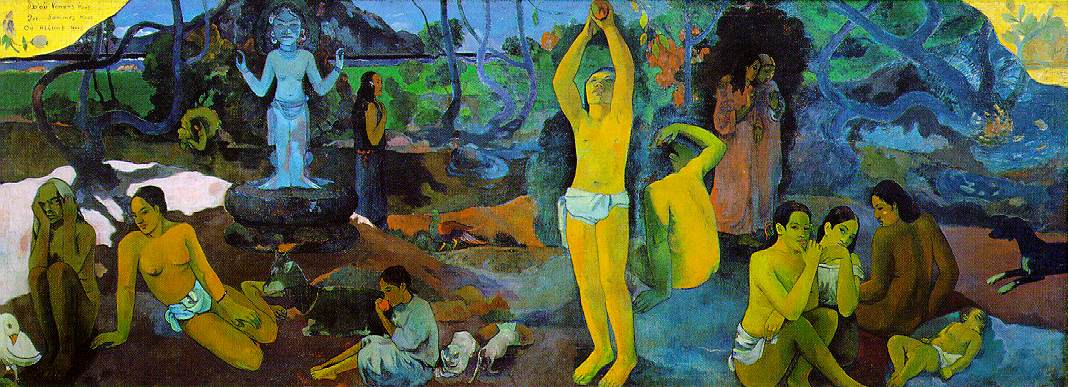
Poverty and illness disrupted Gauguin's work during the early years at Puna‘auia, but the second stay produced paintings of exceptional scale and ambition. In December 1897 he began the mural-sized work commonly shortened to Where Do We Come From?, drawing together figures and motifs developed across different pictures. Its questions can sound universal, yet the image is not a summary of Tahitian belief. Christian, Asian, Pacific, literary and art-historical materials meet within Gauguin's own construction. [1]
The second period also exposes the limits of the isolated-genius story. Gauguin remained a correspondent and watched his reputation abroad. A monthly stipend from the Paris dealer Ambroise Vollard, exchanged for an annual supply of paintings, eventually brought greater financial security. European demand shaped production even when the works were made thousands of miles away. [1] [8]
Writing became increasingly important when illness restricted physical work. Gauguin edited the satirical Catholic publication Les guêpes and established Le sourire, using caricature and polemic against parts of Tahitian colonial society. These activities show direct engagement with local institutions. They also formed another route by which he fashioned a public voice, argued with opponents and tried to control his own history. [1]
The images he used were equally mobile. Māori carving studied in Auckland, Marquesan and Tahitian forms, Rapa Nui signs, Japanese prints, photographs and reproductions of European paintings could all enter the same working environment. Such mixture is not evidence that the cultures were interchangeable. It is evidence of Gauguin's method: accumulation, selection and transformation across media and distance. [1] [4] [5]
Hiva Oa and the Maison du Jouir
Gauguin moved to the Marquesas in 1901, arriving in September and settling at Atuona on Hiva Oa. Conflict with French authorities and dissatisfaction with Tahiti contributed to the decision, as did another search for a place he believed less changed by European rule. Yet Hiva Oa was also French colonial territory. Moving farther from Papeete did not take him beyond empire. [1] [5]
At Atuona he built a house-studio called the Maison du Jouir, usually translated as the House of Pleasure. Its carved panels and entrance drew on the Māori work he had studied in Auckland as well as Marquesan tattooing, sculpture and carving. Inside were Japanese prints and photographs or reproductions of European art. The building joined local materials, portable images, provocation and self-display; it was a workshop and another authored setting for the Gauguin persona. [1] [5]
The final twenty months were productive rather than merely terminal. Gauguin continued to paint and carve, and he devoted sustained time to writing, including Avant et après. His polemics attacked Catholic missionaries and colonial officials. Those conflicts could be serious and, in particular cases, directed at abuses of power. They did not make him independent of the racial, sexual and legal advantages available to a French male settler. [1] [9]
Legal conflict intensified near the end of his life. A colonial court found Gauguin guilty following published accusations against an official. He appealed a sentence that included imprisonment and a fine. His worsening health limited his movement, but it did not end his work or correspondence. His life ended in Atuona on 8 May 1903. The National Gallery of Australia's present account identifies heart failure after years of poor health; a fuller retrospective diagnosis is unnecessary to understand the period. [1] [9]
A Pacific history made from specific places
Gauguin's Pacific work cannot be separated either from the places where it was made or from the routes that carried it elsewhere. Papeete confronted him with a colonised modernity that his reading had screened out. Mataiea supplied sustained contact with a different part of Tahiti without restoring a lost past. Auckland added specific Māori sources. Puna‘auia became the setting for ambitious late painting, polemical publication and renewed dealings with Europe. Atuona housed a final synthesis of carving, painting, writing and persona.
The paintings are not field reports from those places. They transform what Gauguin observed through photographs, objects, texts, memory and art from several cultures. Recognising that construction does not make the works visually unimportant. It makes their achievement historically precise. Their colour, scale and symbolic force belong beside the colonial networks that enabled Gauguin's travel, the distinctions among the cultures he used and the people whose worlds cannot be reduced to his imagined paradise.
Related Pages
Frequently Asked Questions
Paul Gauguin made two distinct stays in Tahiti before spending his final twenty months on Hiva Oa in the Marquesas.
The two-year interval in France was not an interruption to the Pacific project.
The paintings are not field reports from those places.
Discussion
Paul Gauguin made two distinct stays in Tahiti before spending his final twenty months on Hiva Oa in the Marquesas.
Reader Insights
Paul Gauguin made two distinct stays in Tahiti before spending his final twenty months on Hiva Oa in the Marquesas.
The two-year interval in France was not an interruption to the Pacific project.
It makes their achievement historically precise.
Join the Conversation
Share the visible detail or source that most changed your reading.
References
- National Gallery of Australia, Gauguin's World: Tōna Iho, Tōna Ao, media kit and chronology View source
- National Gallery of Australia, Gauguin's World, stop 11, Parahi te marae (The Sacred Mountain), audio transcript View source
- National Gallery of Australia, Gauguin's World, stop 12, Arii Matamoe (The Royal End), audio transcript View source
- National Gallery, London, Elizabeth C. Childs, A New Chapter: Tahiti and the Marquesas Islands View source
- National Gallery of Australia, Gauguin's World, stop 14, Historic frame, audio transcript View source
- National Gallery of Art, Gauguin: Maker of Myth, exhibition brochure View source
- Getty Vocabulary Program, Arii Matamoe (The Royal End), CONA 700008097, including Gauguin's 1892 letter to Daniel de Monfreid View source
- Art Institute of Chicago, Gauguin Paintings, Sculpture, and Graphic Works at the Art Institute of Chicago, digital scholarly catalogue View source
- National Gallery of Australia, Gauguin's World, stop 20, Sister of Charity, final-years audio transcript View source
 Paul Gauguin.jpg)