 by Tom Gurney
Tom Gurney BSc (Hons) is an art history expert with over 20 years experience
Published on August 14, 2026 / Updated on August 14, 2026
Email: tomgurney1@gmail.com / Phone: +44 7429 011000
Paul Gauguin Biography: Introduction
Paul Gauguin made paintings of extraordinary visual force and built an equally forceful story about the person who made them. In that story, a conventional European life gave way to poverty, wandering and a supposedly instinctive art recovered far from modern France. The story was useful to him. It helped turn repeated departures, commercial disappointments and conflicts into proof that he was an uncompromising outsider.
At a Glance
- ArtistPaul Gauguin
- GuidePaul Gauguin Biography
- FocusBiography
- Key topicsFrom Peru to a prosperous life in Paris; When security broke; Brittany, collaboration and a new pictorial language; Making and marketing an outsider
- OverviewPaul Gauguin made paintings of extraordinary visual force and built an equally forceful story about the person who made them.
Contents
- Paul Gauguin Biography: Introduction
- From Peru to a prosperous life in Paris
- When security broke
- Brittany, collaboration and a new pictorial language
- Making and marketing an outsider
- First Tahiti: the colony and the invented elsewhere
- France again, 1893–1895
- The second Tahitian period
- Hiva Oa: opposition within empire
- The inheritance of Gauguin's life
Explore Gauguin's Career
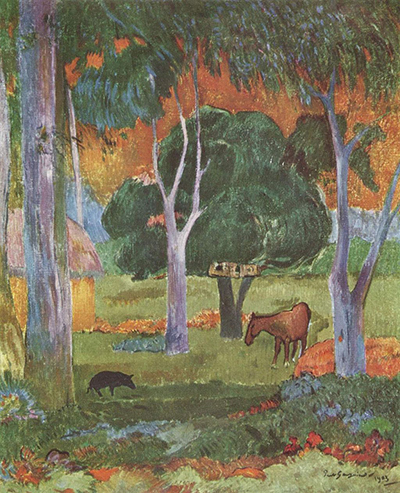
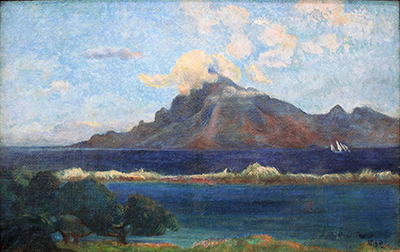
The documented life is more difficult. Gauguin was a husband and father who left a family under financial strain; a former securities broker who understood collectors and markets; and an artist formed inside Impressionist circles before he rejected their commitment to observed light. In Brittany and Polynesia, he represented living communities through fantasies of spiritual authenticity and escape. His relationships with Polynesian girls took place across stark inequalities of age and colonial power. At the same time, his experiments with colour, surface, print, clay and carved wood changed the possibilities of modern art. Biography matters here because it can separate those histories without pretending that one cancels the other.
From Peru to a prosperous life in Paris
Paris was Gauguin's birthplace, on 7 June 1848; his full name was Eugène Henri Paul Gauguin. Clovis, his father, worked as a republican journalist. His mother, Aline Chazal, was a daughter of the socialist writer and activist Flora Tristan. Political upheaval after the 1848 Revolution contributed to the family's decision to sail for Peru, where Aline had relatives. Clovis died during the voyage. Paul spent part of his early childhood in Lima before Aline returned with him and his sister to France in the mid-1850s. [1] [3]
Gauguin later made much of this childhood and claimed Inca ancestry. The claim fitted the identity he cultivated as someone at odds with European convention, but National Gallery of Art scholarship traces the relevant family connection to the Spanish viceregal line in Peru rather than to the Inca. The distinction is revealing: travel and family memory were facts, while the ancestry Gauguin advertised was part of an authored persona. [3]
He went to sea in 1865, first in the merchant marine and later in the French navy. Those voyages gave him experience of movement across empires and ports, but they did not set an inevitable course toward the artist he became. On returning to Paris after the Franco-Prussian War, he entered the brokerage world. He joined the office of Paul Bertin, earned a good income and participated in the increasingly confident life of the capital's professional middle class. [1] [2]
In 1873 he married the Danish-born Mette Gad. They eventually had five children: Émile, Aline, Clovis, Jean-René and Pola. Gauguin collected modern art and painted in his spare time, encouraged by the collector and family friend Gustave Arosa and, crucially, by Camille Pissarro. He absorbed lessons from Pissarro's landscapes, admired and collected Cézanne, and knew Degas and other artists in the Impressionist network. This formation complicates the familiar image of a stockbroker who suddenly exchanged finance for instinct. Gauguin learned as a collector, exhibitor and participant within the Paris art world before he defined himself against it. [2] [4]
He showed work in the Impressionist exhibitions of 1879, 1880, 1881, 1882 and 1886. [1] [2] Early landscapes and domestic scenes reveal close attention to observed settings and the example of Pissarro and Cézanne. Yet his participation was never simply that of a disciple. Modelling clay, carving and assembling a collection encouraged him to think about pictures as made objects. The later emphasis on broad shapes and material surfaces developed through this practical education as well as through rejection.
His progress was visible before financial necessity made art his full-time occupation. A landscape was accepted at the Salon in 1876, and by the early 1880s he was attempting ambitious figure paintings as well as views of the suburbs and the family's domestic world. Degas admired the large nude study Gauguin exhibited in 1881, a work whose awkward space and emphatic body already resist easy classification as light-filled Impressionism. [2] [4] Such moments matter because the mature artist did not replace a commercial identity with an instantly complete new style. For more than a decade he learned how exhibitions worked, watched prices and reputations form, collected pictures he could compare at home and tested his own work before a community of exacting peers.
When security broke
The financial downturn of the early 1880s, including the market crash of 1882, destroyed the security of Gauguin's brokerage career. His decision to rely increasingly on art carried consequences for the whole family. The Gauguins tried life in Rouen and then Copenhagen, where Mette had family support and Gauguin attempted unsuccessful commercial work. He found little artistic recognition there. Gauguin went back to Paris in 1885, taking their son Clovis with him; Mette and the other four children remained in Denmark. [1] [2] [4]
It is tempting to describe this as the brave renunciation that Gauguin later wished it to be. Such language turns Mette and the children into scenery within an artist's legend. The separation instead marked a long, painful shift of labour and responsibility. Mette supported the family while Gauguin pursued a career that remained precarious, and their marriage continued through correspondence, visits, financial requests and conflict rather than ending in one clean dramatic break. [1] [4]
Copenhagen had confronted him with a practical problem as well as an emotional one: paintings did not become valuable merely because their maker had chosen sacrifice. His exhibition there attracted little support, and attempts to sell tarpaulins and other goods did not establish an alternative income. [1] Back in Paris, he took poorly paid work when necessary and depended on friends, dealers and credit. The material insecurity was genuine, but Gauguin increasingly converted it into a claim about artistic purity. That claim could make dependence look like independence and allow the costs borne by his family to disappear behind the image of the misunderstood painter.
Poverty changed where and how Gauguin could work. In 1886 he went to Pont-Aven in Brittany, where board could be cheap and an international community of artists had formed. He also worked with the ceramicist Ernest Chaplet, treating stoneware as a field for modelling, incision, colour and deliberately irregular form. Clay was not a diversion from painting: it sharpened his interest in touch, silhouette and the expressive character of a material. [2] [5]
In 1887 he travelled with the younger artist Charles Laval through Panama to Martinique, then a French colony. Illness and lack of money curtailed the stay, but the paintings he made there intensified his colour and simplified landscape into rhythmic areas. Gauguin subsequently presented tropical travel as release from European exhaustion. Martinique was not an untouched world outside history, however. It was a colonised society organised by labour, trade and racial hierarchy, and his images selected from that reality to construct their own sense of abundance and distance. [1] [2]
Brittany, collaboration and a new pictorial language
Back in Brittany in 1888, Gauguin worked in close exchange with Émile Bernard. Bernard and Louis Anquetin had already experimented with emphatic contours and simplified colour areas. Gauguin's encounter with Bernard helped turn these devices into a broader practice in which observation was reorganised through memory, feeling and design. The development later called Synthetism therefore belonged to collaboration and argument, not to a solitary revelation. [2] [3]
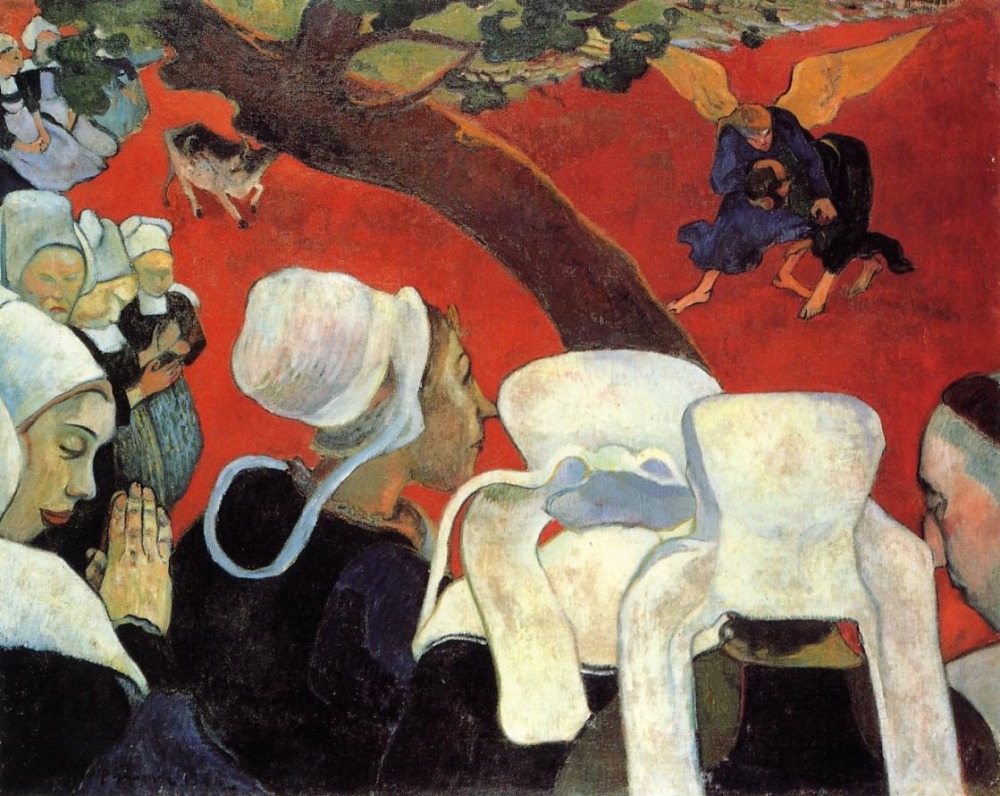
Vision after the Sermon made the change unmistakable. Breton women occupy the foreground while a diagonal tree divides them from the small biblical figures they imagine; an improbable red field joins worship and vision on one compressed surface. The painting did not record rural faith transparently. It constructed an outsider's image of Breton religious experience, using clothing, gesture and place to stage the spiritual intensity Gauguin wanted modern painting to recover. [3]
The shift also coincided with increasingly theatrical self-presentation. Gauguin cast himself by turns as rebel, saint, sinner and social outcast. Self-portraits and letters did not merely disclose a private personality; they tested roles through which the art could be seen. That distinction—between a life experienced and an identity manufactured—became central to his career.
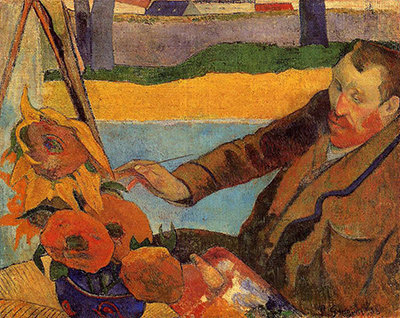
In October 1888 Gauguin joined Vincent van Gogh in Arles. Theo van Gogh, who hoped the arrangement might support both artists, helped make the visit possible. For nine weeks Gauguin and Vincent painted, talked and argued in the Yellow House. They shared subjects while working very differently. Van Gogh often pressed toward immediate contact with the motif; Gauguin increasingly advocated reconstruction from memory. Their exchanges were productive precisely because agreement was limited. [2] [6]
The collaboration ended after the crisis of 23 December, when Van Gogh injured his ear. Gauguin left Arles two days later. Later accounts attached a razor and a confrontation to the episode, but the secure institutional chronology does not establish every dramatic detail that accumulated around it. [6] Nor can Gauguin be made the single cause of Van Gogh's breakdown. What can be said is that artistic ambition, difficult living conditions and personal conflict had made the shared experiment untenable.
Making and marketing an outsider
The 1889 Exposition Universelle brought millions of visitors to Paris, yet Gauguin and his associates were not part of its official artistic triumph. They organised a display at the Café des Arts, on the grounds of the Volpini exhibition, under the name “Groupe Impressionniste et Synthétiste.” The show brought little commercial reward. Its catalogue and poster nevertheless gave public form to an emerging group identity. [2] [14]
Gauguin used the occasion to present recent work through prints, a medium that could repeat and transform images while circulating them beyond a single canvas. He also continued to fashion himself as the artist rejected by a materialist culture. Commercial frustration was real, but the outsider role became a career strategy as well as a grievance. He cultivated critics, corresponded with dealers and patrons, made emphatic self-portraits and turned hardship into part of the work's interpretive frame. [2] [3]
By 1890 his thoughts had fixed on Tahiti. He described Europe as artistically depleted and imagined the Pacific as a place where life and art might begin again. These ideas drew on a long European tradition of treating other peoples as answers to European dissatisfaction. They also ignored contemporary Tahiti: a French colony transformed by disease, missionary activity, military power, trade and the administrative life of Papeete. [7] [8]
The disparity between the island he imagined and the island he could actually reach was fundamental. Christianity had been established for generations; imported cloth and European dress were part of everyday life; colonial institutions regulated land, work and movement. Gauguin would sometimes include evidence of those changes, yet his publicity and writing made them signs of cultural loss against which he could pose as a seeker of what remained. The result was never a simple record of disappearance. It was a selective modern image made by an artist who needed Tahiti to answer an argument he had begun in France. [7] [8]
First Tahiti: the colony and the invented elsewhere
Gauguin sailed in 1891 with an official mission from the French state, a designation that assisted his travel and public ambitions. He arrived in June. Papeete disappointed the fantasy of cultural distance he had brought with him, and he moved away from the colonial centre. Yet geographical movement could not place him outside colonial structures. He remained a French citizen and adult European settler with access to resources and authority unavailable to many of the people he represented. [1] [7] [8]
During this first stay he entered a relationship with Tehamana, whom Art Institute of Chicago scholarship identifies as thirteen. Gauguin was forty-three. The inequality was one of age as well as colonial power. Calling her only a “muse,” “companion” or “Tahitian wife” conceals that reality and substitutes Gauguin's preferred story for the conditions under which the relationship occurred. [5] [9]
Tehamana also became material for different identities created by Gauguin. In paintings he placed her beside European and Asian visual references and signs presented as ancestral or sacred. In his later writing he transformed her into “Tehura,” a literary figure who helped authenticate his account of immersion in a supposedly unspoiled culture. The documented girl, the painted figure and the written character cannot simply be treated as the same person. [3] [5] [9]
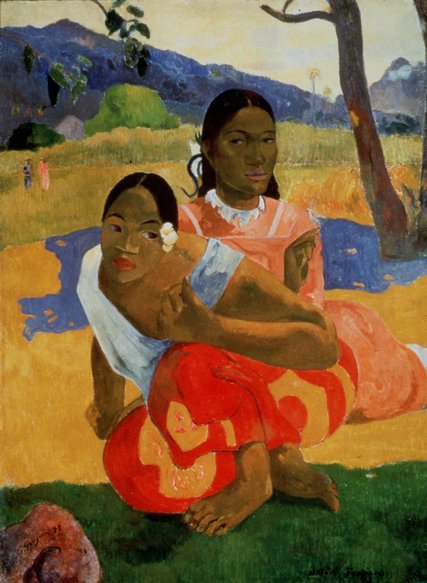
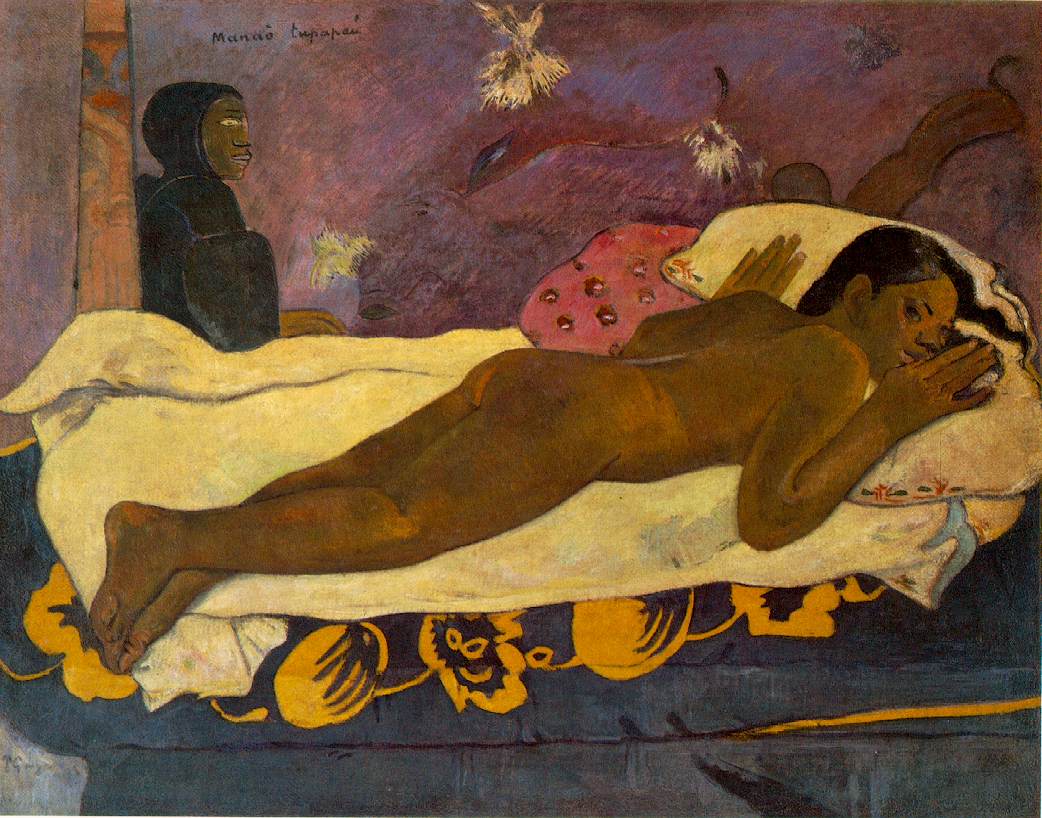
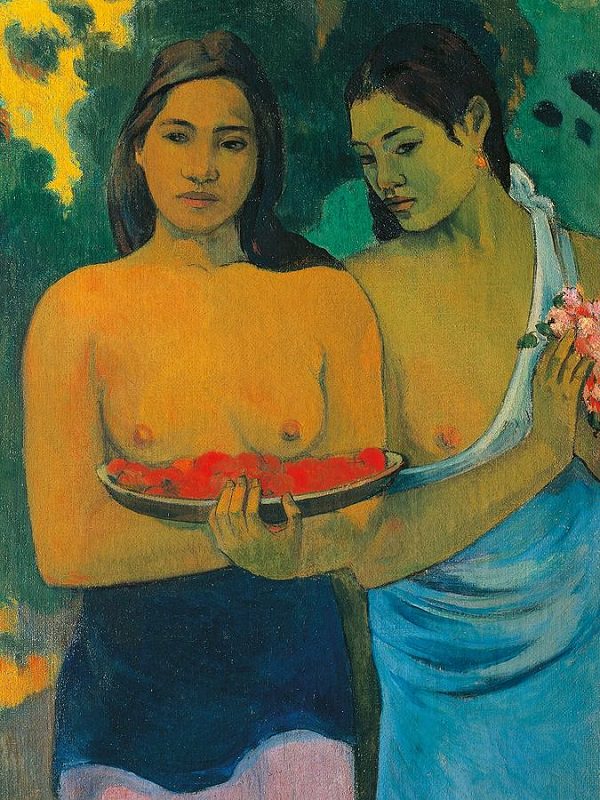
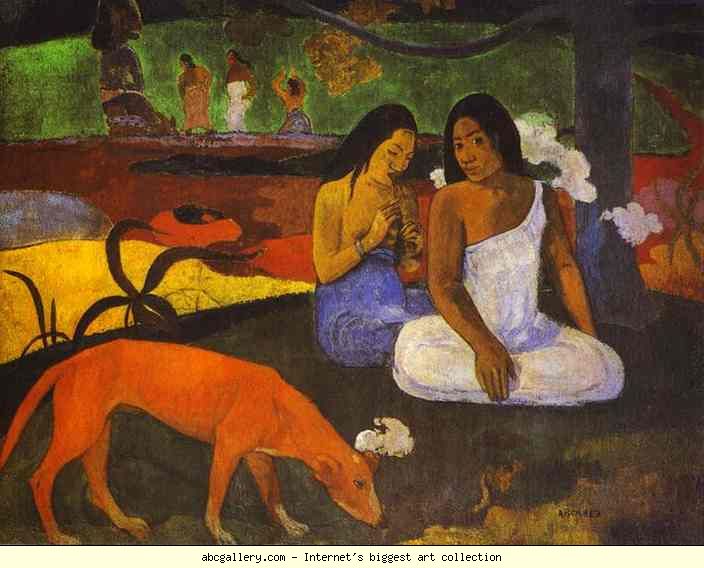
The art of 1891–93 is often described as though Gauguin found a ready-made symbolic language in Tahiti. His images were more constructed. They brought together observation, missionary-era clothing, photographs, European artworks, Asian and Javanese sources, Polynesian objects, colonial publications and motifs borrowed or recombined from different cultures. Some Tahitian titles were uncertain or grammatically unstable. Images that appear to describe inherited belief may instead stage new myths suited to Gauguin's desire for spiritual and artistic authority. [3] [5] [7]
That process did not make the paintings formally simple. Gauguin moved figures across pictures, drawings and prints; altered scale; compressed space; and varied paint from thin, absorbent passages to worked or scraped surfaces. He pursued printmaking, carving and writing alongside painting. The repeated motif became a tool: it could remember an earlier work, acquire a new setting or make a borrowed image seem part of a continuous private world. [5]
When Gauguin returned to France in 1893, he brought a substantial body of work and expected success. The response was limited. His exhibition at Durand-Ruel attracted attention but insufficient sales, and many viewers approached the paintings through the same fantasy of remoteness that Gauguin had helped construct. [1] [2] The market wanted the story of Tahiti even when it resisted the pictures.
France again, 1893–1895
Gauguin performed his Pacific identity in Paris. His studio displayed paintings and objects as an environment, and his dress and behaviour made his travels part of his public image. He began developing Noa Noa, an account intended to accompany and explain the Tahitian work. The text drew on memory but also on invention, borrowed writings and later collaboration and revision. It cannot be read as a transparent diary of either Tahitian life or Gauguin's own conduct. [3] [5] [14]
The return also exposed how little place he retained in his former family life. Relations with Mette and the children were strained by absence and money. During a visit to Brittany in 1894, a confrontation with local sailors left him with a badly injured ankle, a wound that caused lasting difficulty. Neither Paris nor Denmark offered the recognition or stability he wanted. [1] [2]
He raised funds through a sale and prepared to leave again. In 1895 Gauguin sailed from France for the Pacific, travelling through Australian ports and Aotearoa New Zealand before reaching Tahiti in September. Encounters with Māori art added another distinct source to a visual repertoire that already crossed cultures and media. Gauguin often blended such sources; responsible biography has to name their differences rather than repeat that flattening. [1] [7]
The second Tahitian period
Material conditions during the second stay were severe. Gauguin suffered recurring ill health, carried debt and depended increasingly on sales arranged at a distance. His criticism of colonial society grew sharper, but he continued to live within it and to exercise the privileges of an adult French settler.
The work did not simply repeat the brighter paintings of his first visit. Gauguin drew on remembered figures, earlier canvases, photographs and works by other artists, shifting them into increasingly dense arrangements. Sacred and everyday signs could occupy the same shallow space without forming a single readable story. This reuse helped him produce continuity across years of unstable living, but it also strengthened the impression of a private Polynesian mythology over which he appeared to hold special authority. [3] [5] [7]
Art Institute scholarship records that Pau'ura was fourteen in January 1896 when she became Gauguin's partner. As with Tehamana, the terms of the relationship cannot be separated from age and colonial inequality. [10] Records indicate at least two known children with Tahitian partners, while some identities and outcomes remain uncertain. Those gaps should remain visible. They are not an invitation to fuse several lives into one supporting character in Gauguin's story. [10]
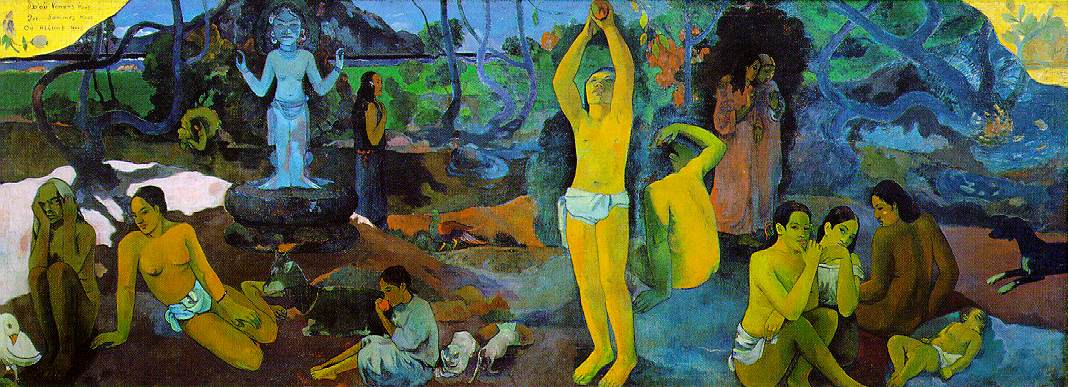
In 1897 his daughter Aline died in Europe. Gauguin was already contending with sickness, isolation and financial crisis. Late that year he began the monumental painting usually shortened to Where Do We Come From?, a large frieze-like work that reused figures and motifs from earlier pictures. Three questions inscribed across it—about origin, identity and destination—and the procession of bodies encouraged him to present the canvas as a culminating statement. [1] [11] Its ambition is clear without treating the painting as a coded confession or accepting every later account of its making as literal fact.
Writing became increasingly important. Gauguin used essays, letters and autobiographical texts to attack critics, defend his choices and shape how future readers would encounter him. A later arrangement with the dealer Ambroise Vollard provided more regular income in exchange for work, though it did not end his illness or dissatisfaction. [1] The artist who claimed to have abandoned the European market remained tied to dealers, exhibitions, patrons and an audience thousands of miles away.
Hiva Oa: opposition within empire
In 1901 Gauguin moved to Atuona on Hiva Oa in the Marquesas. He built a house he named the Maison du Jouir, decorated it with carved panels and organised it as another environment in which art, writing and persona merged. He continued painting and carving while producing polemical texts against the Catholic Church and colonial administration. [1] [7] [12]
Some of his complaints addressed genuine abuses. He opposed particular officials and criticised missionary control, including interference in Marquesan life. He also encouraged local challenges to certain church and school practices. These conflicts became serious enough to bring surveillance and legal action. Yet they did not turn Gauguin into someone outside empire. He occupied settler property, used colonial courts and communications, and carried the authority of race, gender, age and citizenship into his relationships. Resistance to selected authorities could coexist with participation in the system that empowered him. [7] [12]
His final years included physical decline, dependency on pain relief, disputes and further work. Shortly before his death he was convicted in a case arising from his attacks on an official and faced a fine and prison sentence while pursuing an appeal. [1] [12] He died at Atuona on 8 May 1903. A current National Gallery of Australia account relates his death to heart failure after years of poor health. [12] [15]
The immediate handling of his possessions underlined the imbalance that had shaped his Pacific life. Colonial and church authorities assessed, dispersed or destroyed parts of the environment he had made. European dealers and museums would later turn the surviving works into valuable emblems of modernism, while the people represented in them rarely controlled the images or the stories attached to them. [7]
The inheritance of Gauguin's life
Gauguin's formal legacy is substantial. He demonstrated that colour need not imitate local appearance, that contour and pattern could organise a picture more forcefully than conventional depth, and that the same motif could be transformed across canvas, paper, clay and wood. Later artists found permission in those choices, although influence was never a simple line from one inventor to his followers. [2] [5]
His self-made legend proved just as durable. The tale of a European artist who rejected civilisation helped museums, dealers and writers frame the work, often leaving Mette and the children at the edge and Polynesian girls behind Gauguin's names for them. It also encouraged viewers to mistake invented myths for cultural record. Correcting that legend does not require denying the paintings' visual intelligence. It requires asking more exact questions about who had power to travel, represent, name, possess and profit.
Contemporary Pacific artists have answered Gauguin rather than merely appearing as subjects within his afterlife. The Sāmoan-Japanese artist Yuki Kihara, for example, has restaged and redirected Gauguin-associated imagery to examine gender, colonial looking and the economics of cultural representation. [13] Such work does more than add a moral footnote. It changes who speaks in the history and exposes the supposedly universal outsider story as a European construction.
Gauguin died far from the Paris in which he had learned to paint, but he never stood outside the modern systems he claimed to reject. Markets, reproduction, empire, travel and publicity made his career possible. His biography is therefore not a straight journey from convention to freedom. It is the history of an artist who transformed modern art while repeatedly transforming other people and places into evidence for his own legend. Seeing both achievements and costs is the beginning of seeing the work clearly.
Related Pages
Frequently Asked Questions
Paul Gauguin made paintings of extraordinary visual force and built an equally forceful story about the person who made them.
Gauguin sailed in 1891 with an official mission from the French state, a designation that assisted his travel and public ambitions.
Gauguin died far from the Paris in which he had learned to paint, but he never stood outside the modern systems he claimed to reject.
Discussion
Paul Gauguin made paintings of extraordinary visual force and built an equally forceful story about the person who made them.
Reader Insights
Paul Gauguin made paintings of extraordinary visual force and built an equally forceful story about the person who made them.
The disparity between the island he imagined and the island he could actually reach was fundamental.
Seeing both achievements and costs is the beginning of seeing the work clearly.
Join the Conversation
Share the visible detail or source that most changed your reading.
References
- National Gallery of Australia, Gauguin's World: Tōna Iho, Tōna Ao — Media Kit, 2024 View source
- Cindy Kang, “Paul Gauguin (1848–1903),” Metropolitan Museum of Art, 2011 View source
- Lynn Kellmanson Matheny, Gauguin: Maker of Myth, National Gallery of Art, 2011 View source
- National Gallery, London, “Gauguin's Journey.” View source
- Gloria Groom and Genevieve Westerby, eds., Gauguin Paintings, Sculpture, and Graphic Works at the Art Institute of Chicago, Art Institute of Chicago, 2016 View source
- Van Gogh Museum, “Van Gogh and Gauguin in Arles,” permanent-collection gallery texts View source
- National Gallery of Australia, “Gauguin's World: Tōna Iho, Tōna Ao.” View source
- National Gallery, London, “A New Chapter: Tahiti and the Marquesas Islands.” View source
- Art Institute of Chicago, “Merahi metua no Tehamana (Tehamana Has Many Parents or The Ancestors of Tehamana).” View source
- Art Institute of Chicago, “Polynesian Woman with Children,” in Gauguin Paintings, Sculpture, and Graphic Works at the Art Institute of Chicago View source
- Museum of Fine Arts Boston, Gauguin Tahiti View source
- National Gallery of Australia, “Gauguin's World Audio Tour: Final Years.” View source
- National Gallery of Australia, “Yuki Kihara: Fonofono o le nuanua — Patches of the Rainbow (after Gauguin).” View source
- Richard Brettell et al., The Art of Paul Gauguin, National Gallery of Art, 1988 View source
- Musée d'Orsay, “Paul Gauguin.” View source
 Paul Gauguin.jpg)