 by Tom Gurney
Tom Gurney BSc (Hons) is an art history expert with over 20 years experience
Published on August 14, 2026 / Updated on August 14, 2026
Email: tomgurney1@gmail.com / Phone: +44 7429 011000
Paul Gauguin: Exhibitions, Reception and Legacy: Introduction
Paul Gauguin's reputation was not discovered all at once after years of neglect. He exhibited inside the Paris art world, helped organise alternatives to it, worked with dealers, wrote about himself and watched audiences respond. Some exhibitions disappointed him; some pictures found buyers or collectors; some critics admired the work while objecting to the artist's claims. After his death, large displays and museum acquisitions widened access, but they did not produce one stable verdict.
At a Glance
- ArtistPaul Gauguin
- GuidePaul Gauguin: Exhibitions, Reception and Legacy
- FocusExhibitions, Reception and Legacy
- Key topicsLearning how exhibitions made reputations; Tahitian work before Paris audiences; Dealers, collectors and museums; Retrospectives do not merely celebrate
- OverviewPaul Gauguin's reputation was not discovered all at once after years of neglect.
Contents
- Paul Gauguin: Exhibitions, Reception and Legacy: Introduction
- Learning how exhibitions made reputations
- Tahitian work before Paris audiences
- Dealers, collectors and museums
- Retrospectives do not merely celebrate
- Influence without an origin myth
- The problem with “primitivism”
- Pacific artists and institutions change the conversation
- What Gauguin's legacy now requires
Explore Reception and Legacy
 Paul Gauguin.jpg)
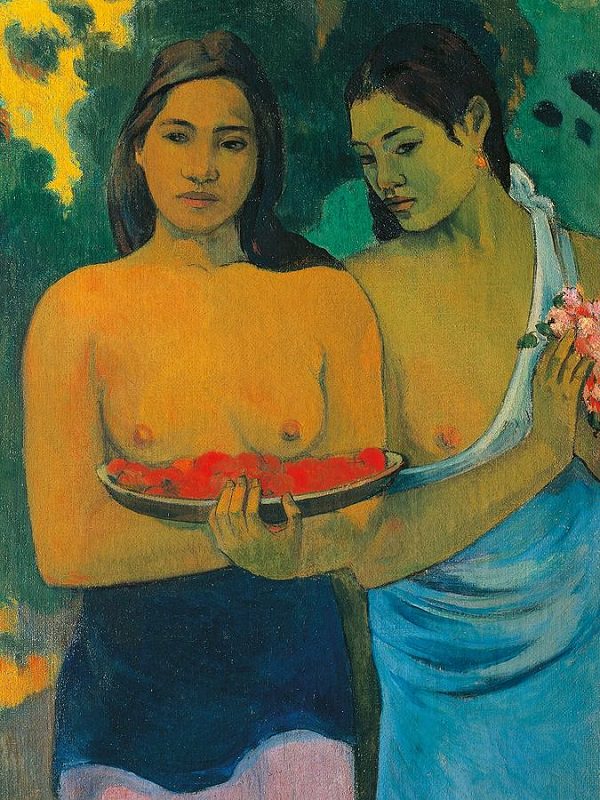
Reception is therefore more than popularity. It includes the circumstances in which art became visible, the language used to classify it, the people and institutions that acquired it, and the later artists or curators who changed its meaning. Gauguin's formal importance and his use of colonial fantasies can both belong to this history. Neither needs to erase the other.
Learning how exhibitions made reputations
Before Gauguin presented himself as an outsider, he learned within an established avant-garde network. He contributed to five Impressionist exhibitions: those of 1879, 1880, 1881, 1882 and 1886. [1] Participation gave him access to artists, critics and collectors, while also showing him that an independent exhibition could construct a public identity outside the official Salon. It does not make him a founder of Impressionism, nor does it mean his work received a single response.
The 1889 display at the Café des Arts near the Exposition Universelle made self-positioning unusually explicit. Its catalogue and poster used the name Groupe Impressionniste et Synthétiste. The poster named Gauguin alongside Émile Schuffenecker, Émile Bernard, Charles Laval and other participants. [2] [3] The documents establish a public label and a collective bid for attention. They do not prove that everyone exhibited the same kind of art.
Commonly called the Volpini exhibition after the café's proprietor, the show did not bring the commercial result Gauguin wanted. [4] Yet poor sales are only one part of its legacy. The catalogue, poster and prints made a group identity portable. An event could fail as a market opportunity while succeeding as a declaration that later histories would remember.
Tahitian work before Paris audiences
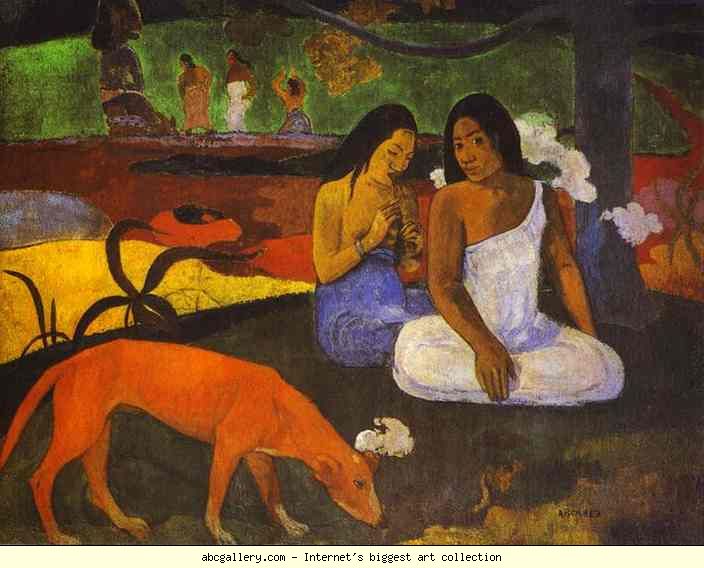
When Gauguin returned from his first Tahitian journey, the dealer Paul Durand-Ruel exhibited his work in November 1893. The Musée d'Orsay records Arearea as number 8 and notes that the exhibition did not receive the response Gauguin had hoped for. Its Tahitian title irritated some viewers, while the red dog became an object of mockery. [5] Those details recover particular reactions; they do not establish that every critic dismissed every picture.
Camille Pissarro's response, as presented in the Fine Arts Museums of San Francisco's exhibition research, was hostile in a different way. He accused Gauguin of borrowing from others and used racist period language to characterise the Oceanic people and cultures from which Gauguin took material. [6] The criticism is historically revealing because it joins a serious dispute about artistic appropriation to vocabulary that cannot be adopted as neutral description today.
Market evidence was equally uneven. At an 1895 sale at the Hôtel Drouot, Arearea again appeared as number 8, and Gauguin bought the painting back. [5] That transaction says something precise about one object and one sale. It cannot stand for the value of the whole oeuvre, just as a dealer's exhibition cannot be treated as proof that all its contents sold.
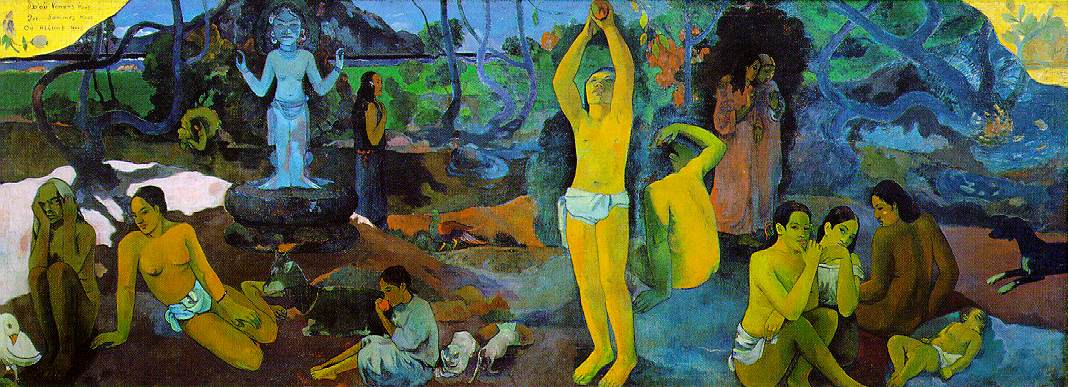
Ambroise Vollard later supplied another route to Paris. His exhibition Peintures de Paul Gauguin, held from 17 November to 10 December 1898, included the first public showing of the monumental three-question canvas now in Boston. Contemporary reviews preserved in the current catalogue record range from attention to its force and scale to difficulty with its obscurity. [7] The painting's later fame should not be projected backwards as though its first audience already knew what place it would occupy.
Dealers, collectors and museums
After Gauguin died in May 1903, circulation accelerated without becoming orderly. Vollard mounted an Exposition Paul Gauguin from 4 to 28 November. Contes barbares, now in Museum Folkwang, was number 24; it then appeared at the Folkwang Museum in Hagen in December and entered that pioneering collection around 1904. [8] Exhibition, sale and museum acquisition were related mechanisms, but they were not interchangeable.
The Salon d'Automne retrospective in Paris made the scale of the posthumous claim much greater. Its official catalogue dates the exhibition at the Grand Palais from 6 October to 15 November 1906. A specialist reception study records 227 works supplied by 24 collectors, covering the artist's different periods. [9] [10] The number reveals the strength of a lender network and the breadth available to visitors. It does not amount to a complete oeuvre count or prove that critics agreed about what they saw.
Private circulation also preceded some French museum recognition. The same study identifies Lyon's 1913 purchase of Nave nave Mahana as the first acquisition by a French museum, followed in 1923 by Grenoble's Portrait of Madeleine Bernard. [10] The national qualifier matters: Folkwang had acquired major work in Germany far earlier. Canonisation did not move from Paris outward in one straight line.
Collector taste, dealer stock, loans, gifts and public purchase each shaped what could be studied. They also shaped absence. A work held privately might become influential through an exhibition; another could remain known mainly through reproduction. Price may record competition or scarcity, but it is not a substitute for critical understanding.
Retrospectives do not merely celebrate
Large exhibitions repeatedly reorganised Gauguin rather than simply increasing his fame. The 1949 centenary display at the Orangerie ran from 6 July to 14 November and contained 116 catalogue entries. [11] Four decades later, the National Gallery of Art, Art Institute of Chicago and Musée d'Orsay collaborated on a far larger retrospective and scholarly catalogue. The Washington presentation catalogued 280 works across painting, sculpture, carving, ceramics, prints and books; the Paris presentation of 1989 was described by Orsay as France's most important Gauguin exhibition since 1949. [12] [13]
Those totals describe exhibitions, not the number of paintings Gauguin made. More importantly, scale creates its own arguments. Bringing different media together can restore ceramics, woodcarving and print to a history often dominated by famous canvases. A chronological installation can show recurrence and revision, yet it can also make a varied career appear to advance inevitably towards late masterpieces.
The 2003–04 exhibition Gauguin Tahiti: L'atelier des Tropiques assembled more than 200 items, including about 50 paintings, 30 sculptures or objects, more than 60 graphic works, manuscripts, photographs and Polynesian material. [14] That breadth made workshop practice and cultural sources more visible. At the same time, parts of the archive's framing retain the language of remoteness, the “savage” and the supposedly primitive. A current reader can use its object research while recognising that exhibition language is itself historical evidence.
Smaller thematic shows can revise the canon differently. The National Gallery's 2019–20 exhibition, the first devoted to Gauguin's portraits, brought together about 50 works in several media. [15] Its premise shifted attention from an exoticised image of place towards acts of portrayal and self-invention. No thematic lens is complete, but a good one can expose questions that a career survey leaves compressed.
Influence without an origin myth
Gauguin's importance to modern art is best described through documented encounters and specific formal problems. Broad claims that he “invented modernism” erase collaborators, other precedents and the decisions of later artists. The Metropolitan Museum of Art's account of Fauvism offers a more responsible model: Henri Matisse's development followed experiments with the work of Van Gogh, Gauguin and Cézanne, as well as Neo-Impressionists such as Seurat, Cross and Signac. [16]
Within that field, Gauguin offered powerful examples of broad colour zones, simplified contours, anti-naturalistic colour, repeated motifs and movement across painting, print, clay and carved wood. Later artists could take one element without accepting his subject matter or his theories. Influence is not obedience, and resemblance does not by itself prove a source.
The 1906 retrospective gave a younger generation an unusual opportunity to see many works together. But chronological proximity between a visit and a later painting cannot establish a single causal chain. Modernism was made through overlapping exhibitions, reproductions, friendships, rivalries, collections and acts of rejection. Gauguin belonged to those networks; he did not stand above them as their lone origin.
The problem with “primitivism”
For much of the twentieth century, museums and textbooks treated Gauguin's search for the supposedly primitive as evidence of courageous escape from Europe. That story made colonial Tahiti and the Marquesas into scenery for an artist's renewal. It also helped separate formal innovation from the power that allowed European objects, stories and bodies to be taken, renamed and circulated.
The Museum of Modern Art's 1984 exhibition “Primitivism” in 20th Century Art paired modern works, including Gauguin's, with Indigenous objects through claimed formal affinities. MoMA's own later institutional history records the criticism: the comparison suppressed the original objects' contexts and exposed the unequal terms on which “tribal” art had been made useful to a Western modernist story. [17] [18] This controversy did not settle Gauguin's reception. It made the museum's method part of what needed examination.
Current ethical criticism also returns biography to view. Gauguin worked within French colonial systems and had sexual relationships with Polynesian girls, including adolescents, across severe inequalities of age and power. Acknowledging that history does not require every painting to be decoded as private confession. It does require museums to stop presenting the represented people as timeless material awaiting a European artist.
Pacific artists and institutions change the conversation
Recent exhibitions have not produced one authorised Pacific response. They have created space for named artists and speakers to contest inherited frames. For its 2018–19 exhibition Gauguin: A Spiritual Journey, the Fine Arts Museums of San Francisco and Ny Carlsberg Glyptotek commissioned the Sāmoa-based artist Yuki Kihara's First Impressions: Paul Gauguin. The film turns scrutiny back towards Western looking and the colonial gaze rather than treating Pacific people as silent background. [6]
This is more than adding a corrective label beside an unchanged canon. A contemporary artwork can interrupt who observes whom, which bodies appear as types, and whose knowledge structures the encounter. Kihara's intervention is specific to her practice and Sāmoan positioning; it cannot be enlarged into the opinion of Oceania.
The National Gallery of Australia's 2024 Gauguin's World: Tōna Iho, Tōna Ao was presented as the first major Gauguin exhibition in Australia and the Pacific. It combined works across media with scholarship on influences, networks, historical impact and contemporary legacies. Its publication named contributors including Nicholas Thomas, Vaiana Giraud, Norma Broude and Miriama Bono rather than hiding different arguments beneath one institutional voice. [19]
The associated programme with Aotearoa/Pasifika artist, poet and activator Rosanna Raymond placed Tangata Moana perspectives and contemporary artistic agency inside the exhibition conversation. [20] The value of such a programme is not that it supplies a final verdict on whether the art may be admired. It changes the conditions of discussion: people connected to the cultures Gauguin represented become interpreters and makers, not merely subjects of European images.
What Gauguin's legacy now requires
Gauguin's legacy includes formal experiments that later artists found useful, a sophisticated campaign of self-presentation, and institutions that made selected works canonical. It also includes racialised language, colonial fantasies, unequal relationships and museum habits that once converted Pacific cultures into evidence for a European idea of freedom.
A responsible reception history does not ask readers to choose between aesthetic attention and ethical knowledge. It asks what kind of attention the evidence permits. Who organised an exhibition? Which works were available? Was a hostile review objecting to form, appropriation or both? Did a museum acquisition widen study, or did its interpretation preserve an older hierarchy? Which contemporary artist is speaking, from what position, and through which work?
Those questions keep legacy active rather than ceremonial. Gauguin remains important not because every judgement has converged, but because the pictures, objects, archives and counter-works continue to test how modern art was made—and who paid for the stories it told.
Related Pages
Frequently Asked Questions
Paul Gauguin's reputation was not discovered all at once after years of neglect.
The 2003–04 exhibition Gauguin Tahiti: L'atelier des Tropiques assembled more than 200 items, including about 50 paintings, 30 sculptures or objects, more than 60 graphic works, manuscripts, photographs and Polynesian material.
Those questions keep legacy active rather than ceremonial.
Discussion
Paul Gauguin's reputation was not discovered all at once after years of neglect.
Reader Insights
Paul Gauguin's reputation was not discovered all at once after years of neglect.
Four decades later, the National Gallery of Art, Art Institute of Chicago and Musée d'Orsay collaborated on a far larger retrospective and scholarly catalogue.
Gauguin remains important not because every judgement has converged, but because the pictures, objects, archives and counter-works continue to test how modern art was made—and who paid for the stories it told.
Join the Conversation
Share the visible detail or source that most changed your reading.
References
- National Gallery of Art, Gauguin chronology in The Art of Paul Gauguin, 1988, online scholarly catalogue: View source
- National Gallery of Art, Catalogue de l'exposition de peintures du Groupe Impressionniste et Synthétiste, 1889: View source
- National Gallery of Art, Poster for L'Exposition de Peintures du Groupe Impressionniste et Synthétiste, 1889: View source
- Cindy Kang, “Paul Gauguin (1848–1903),” Metropolitan Museum of Art: View source
- Musée d'Orsay, Arearea, 1892, RF 1961 6, current object and exhibition-history record: View source
- Fine Arts Museums of San Francisco, Gauguin: A Spiritual Journey, exhibition research and Yuki Kihara commission: View source
- Wildenstein Plattner Institute, D'où venons-nous ? Que sommes-nous ? Où allons-nous ?, W561, cataloguing and exhibition record: View source
- Wildenstein Plattner Institute, Contes barbares, PGSGN3/W625, provenance and exhibition record: View source
- Bibliothèque nationale de France, Catalogue des ouvrages de peinture, sculpture, dessin, gravure, architecture et art décoratif exposés au Grand Palais des Champs-Élysées du 6 octobre au 15 novembre 1906: View source
- Isabelle Cahn, “An echoing silence: the critical reception of Gauguin in France, 1903–49,” Van Gogh Museum Journal, 2003: View source
- Musée du Louvre, Département des Arts graphiques, Gauguin: Exposition du Centenaire, Orangerie des Tuileries, 1949: View source
- National Gallery of Art, The Art of Paul Gauguin, 1988, exhibition record: View source
- Musée d'Orsay, Gauguin, Grand Palais, 10 January–24 April 1989: View source
- Musée d'Orsay, Gauguin Tahiti: L'atelier des Tropiques, 2003–04: View source
- National Gallery, London, The Credit Suisse Exhibition: Gauguin Portraits, 2019–20: View source
- Metropolitan Museum of Art, “Fauvism,” Heilbrunn Timeline of Art History: View source
- Museum of Modern Art, “Primitivism” in 20th Century Art: Affinity of the Tribal and the Modern, 1984–85 exhibition archive: View source
- Museum of Modern Art, “The infamous ‘Primitivism’ exhibition,” MoMA Through Time: View source
- National Gallery of Australia, Gauguin's World: Tōna Iho, Tōna Ao, 2024: View source
- National Gallery of Australia, “We need to talk about Gauguin with Rosanna Raymond,” 2024: View source
 Paul Gauguin.jpg)