Paul Gauguin.jpg)
 by Tom Gurney
Tom Gurney BSc (Hons) is an art history expert with over 20 years experience
Published on August 14, 2026 / Updated on August 14, 2026
Email: tomgurney1@gmail.com / Phone: +44 7429 011000
Paul Gauguin: Sculpture and Ceramics: Introduction
Paul Gauguin's work in clay and wood was not a hobby conducted beside his painting. Over roughly two decades, vessels became bodies, carved panels became coloured images, furniture carried sculpture, and words entered objects as physical incisions. These experiments changed what a picture, a pot or a relief could be. They also depended on skills and conditions beyond Gauguin alone: Ernest Chaplet's ceramic workshop, Émile Bernard's carving, carpentry, firing and the unpredictable behaviour of materials. [1] [3]
At a Glance
- ArtistPaul Gauguin
- GuidePaul Gauguin: Sculpture and Ceramics
- FocusSculpture and Ceramics
- Key topicsLearning through Chaplet's workshop; A cabinet made by Gauguin and Bernard; Colour and words cut into wood; When pots acquire faces
- OverviewPaul Gauguin's work in clay and wood was not a hobby conducted beside his painting.
Contents
- Paul Gauguin: Sculpture and Ceramics: Introduction
- Learning through Chaplet's workshop
- A cabinet made by Gauguin and Bernard
- Colour and words cut into wood
- When pots acquire faces
- Relief becomes architecture
- Why the categories still matter
Sculpture, Ceramics and Still Life
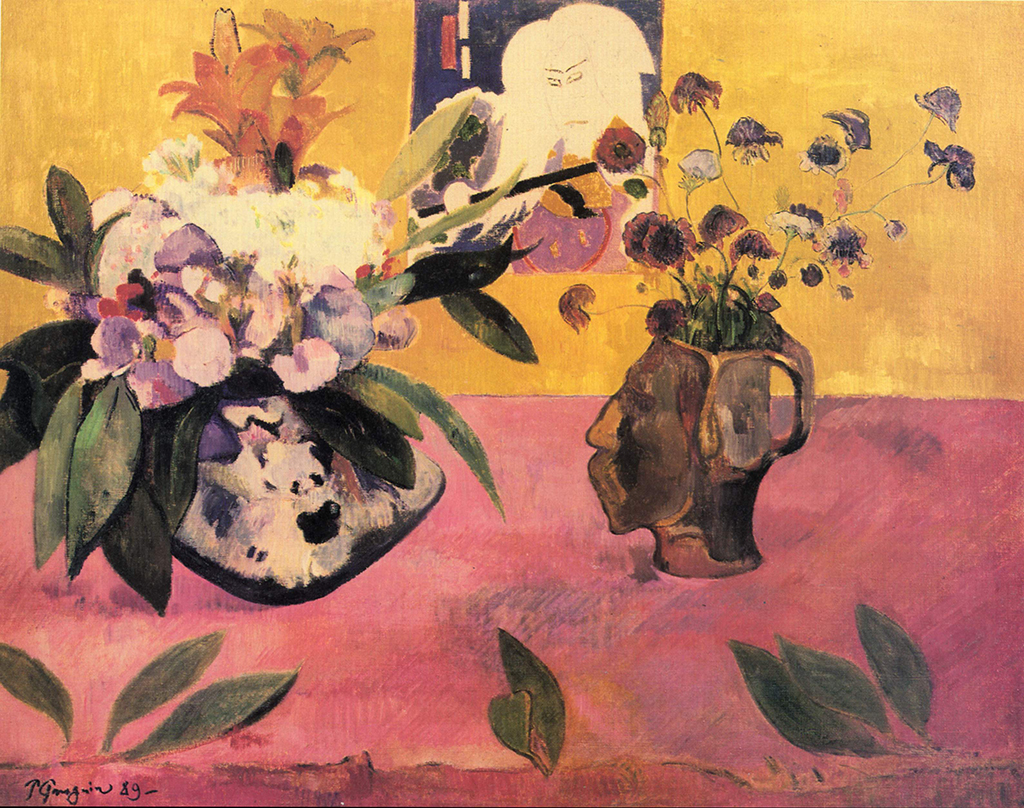
Current institutional accounts estimate that Gauguin made about one hundred ceramic objects, of which around sixty survive. Both numbers are approximate, not a final census. More important than the total is the range: stoneware built by hand, glazed anthropomorphic pots, partly glazed figures, painted terracotta, polychrome wood, furniture assembled from several materials and architectural reliefs cut for his last house. [1] [2]
Learning through Chaplet's workshop
Gauguin began working with the ceramicist Ernest Chaplet in 1886, after Félix Bracquemond introduced them. A painter entering a ceramics studio might ordinarily decorate a vessel made by a specialist. Gauguin moved from that role towards building his own forms, while Chaplet's workshop supplied the practical environment in which clay could be prepared, dried, glazed and fired. [1]
The Art Institute of Chicago's scholarly catalogue describes Gauguin using coils and slabs instead of relying on the potter's wheel. This did not eliminate skilled production; it shifted the kind of control he sought. A wheel encourages regular rotation and symmetry. Joined pieces of clay can swell, tilt, crease and carry modelled figures directly on their walls. Gauguin wanted the vessel to retain the pressure of hands and the effects of great heat rather than hide them beneath mechanical smoothness. [1]
The AIC's Vase in the Form of a Tropical Plant with Bird and Deity shows how quickly a container could become an image. Dated 1887/88, it is stoneware painted with slip and gold, measuring 21.5 by 17 by 12 centimetres, accession 2011.306. Plant, bird and figure do not sit on a neutral pot like a painted label. They participate in its rim, swelling body and irregular silhouette. [1]
Slip, glaze and gold are not interchangeable decorations. Slip adds a clay-rich surface layer; glaze changes under firing into a glassier coating; gold catches light without erasing the stoneware beneath. The object's effects depend on their difference. Even its incised P Go/60, placed near the goose's tail, belongs to a body that is simultaneously signed sculpture, decorated surface and usable-looking vessel. [1]
The Metropolitan Museum of Art's Vessel with Women and Goats, made around 1887–89, provides a useful comparison. This stoneware object is only 20 centimetres high, weighs one kilogram and is numbered 2013.471. Its profile slopes rather than settling into a perfect axis. Human and animal forms rise from and press into the same walls that make the container. [2]
The Met calls the form representative of Gauguin's hand modelling and suggests that imagery may draw on Brittany and Martinique. That plural geography matters. The vessel does not emerge from one timeless source of “primitive” form. It joins observations, memories and workshop experiments produced through travel, metropolitan exhibitions and European collecting culture. [2]
A cabinet made by Gauguin and Bernard
Clay was only one route across artistic categories. Earthly Paradise, made in 1888, combines wood, paint, glass and metal in an object 101 centimetres high, 120 wide and 60.5 deep. It is furniture as well as painting, carpentry and sculpture. The AIC records it under number 2007.247 and credits both Paul Gauguin and Émile Bernard. [3]
That joint authorship is not a courtesy added after the fact. Bernard carved the left panel and possibly the lower panel. The uncertainty around the bottom section should remain uncertainty, but the left-hand contribution is documented. Calling the entire cabinet Gauguin's work would erase the collaboration that made its challenge to fine and decorative art possible. [3]
The panels also resist a single geographic story. AIC identifies animals, trees and village figures connected with the artists' work in Brittany, while figures on the right were informed by Gauguin's 1887 stay in Martinique. Glass and metal sit beside carved wood; rural French motifs occupy the same construction as Caribbean recollection. The object is less a pure return to origins than an assemblage made by two competitive, inventive artists. [3]
Colour and words cut into wood
In 1890, before his first voyage to the Pacific, Gauguin carved Soyez mystérieuses at Le Pouldu in Brittany. Musée d'Orsay records the work as a polychrome limewood bas-relief with traces of dark coloured pencil, 73 by 95 by 5 centimetres without its frame, accession RF 3405. Paul Gauguin / 90 is incised at lower right; the command Soyez mystérieuses—“Be mysterious”—is engraved at upper left. [4]
The relief matters partly because its date defeats a common shortcut. A carved, frontal body with simplified planes is not automatically a direct record of Tahitian experience: Gauguin had not yet travelled there. Orsay instead traces a much less tidy field of reference, including his childhood in Peru, objects known through collections and the Paris Universal Exhibitions, and his continuing exchange with Bernard. [4]
Colour makes the carving behave differently from monochrome sculpture. Polychromy crosses ridges and shallow planes, while pencil traces introduce another kind of mark. The inscription is neither a caption outside the object nor a title supplied only by a museum; it occupies the carved field. Word, body, colour and frame become parts of one constructed surface.
When the relief appeared at Les XX in Brussels in 1891, hostile reviewers treated it as incomprehensible and indecent. Their insults reveal the limits of the categories brought to the work more reliably than they explain its imagery. A coloured, inscribed relief could look wrong to viewers expecting sculpture to be modelled in the round, painting to stay on canvas and decorative carving to remain subordinate to furniture. [4]
When pots acquire faces
The Orsay's Pot anthropomorphe of 1889 is glazed stoneware, 28.4 centimetres high and 21.5 in diameter, accession OA 9050. Its inventory title describes a pot shaped as a human presence; an alternate title identifies a grotesque head-like portrait of Gauguin. An autograph label beneath dedicates the object to Émile Schuffenecker and calls it La Sincérité d'un Songe, the sincerity of a dream. [5]
Those labels make identity deliberately unstable. The object can be read as vessel, head, gift, caricature and self-image, but the alternate portrait title does not prove that every face Gauguin made in clay represents himself. What the pot establishes more securely is a method: opening, wall, mouth, brow and handle can force domestic function and bodily recognition into the same form.
Materials continued to vary. Orsay's Objet décoratif carré avec dieux tahitiens, dated 1893–95, is not stoneware but terracotta with painted additions. It measures 34.4 by 14.1 by 14.1 centimetres, weighs 3.5 kilograms and is numbered OA 9514. [6] The museum classifies it as a decorative element. Its descriptive title does not authenticate every figure as a traditional Tahitian deity; it records how the object is currently catalogued.
The 1894 Oviri moves still farther from the expectation of a container. The partly glazed stoneware figure is 75 centimetres high and weighs 20 kilograms, making it an independent standing presence rather than a pot with modelled additions. [7] Its animal group, uncertain title-language and later tomb history require their own close reading. Here its role is categorical: the route from vessel to ceramic sculpture did not require clay to become smooth, pale or imitative of bronze.
Relief becomes architecture
Late in his life, Gauguin brought carving, colour and inscription into his built surroundings at Hiva Oa. La Paix et la Guerre of 1901 is an oak relief with traces of paint and gilded additions, measuring 29.5 by 66 by 4 centimetres, Orsay RF 4681. A relief signature, PGO, hides in the tree foliage while the title is incised through the centre. [8]
The combination matters: oak supplies structure; shallow cutting establishes figures and plants; residual paint and gold complicate the idea of bare, direct carving; words occupy the same wooden field. The work is not a ceramic and not simply a small sculpture. It is a coloured, titled relief whose surface behaves at once as image and object.
The surviving Maison du Jouir lintel extends that logic to architecture. Made in 1901–02, it is a partly polychrome giant-sequoia bas-relief 40 centimetres high and 244 wide, accession RF 2723. MAISON DU JOUIR is carved into the long panel that formed part of Gauguin's house at Atuona. [9]
Musée d'Orsay describes the panels as directly cut in sequoia for the doorway and connects them with related commands about mystery, love and happiness. Such phrases constructed Gauguin's private environment; they do not document a timeless Marquesan household or an uncomplicated local “golden age”. The house stood in a French colonial setting, and its programme joined European fantasies, Pacific motifs and Gauguin's own public persona. [9]
The distinction between lintel and house is also essential. RF 2723 is a surviving architectural component, not the entire building. Museum display removes it from the doorway and presents it at eye level, where viewers can examine carving and colour as autonomous art. Its original function nevertheless remains part of what it is.
Why the categories still matter
Gauguin's paintings became easier to circulate, exhibit and narrate than a heavy cabinet, fragile ceramic or carved doorway. An Art Institute account of the non-painting work notes that many objects stayed with family and friends while paintings moved through dealers and built his reputation. [10] The later imbalance in fame does not reflect the scale of his material attention.
Nor does restoring these works require celebrating solitary genius. Chaplet's workshop made ceramic experiment possible; Bernard visibly co-authored Earthly Paradise; kilns transformed what hands built; carpentry and architecture imposed their own demands. Material could resist, crack, slump or survive. Authorship in this field is a record of choices made within collaboration and contingency.
Seen together, the objects make Gauguin's categories porous but not meaningless. Stoneware is not terracotta; glaze is not paint; an oak relief is not a sequoia lintel; a cabinet made with Bernard is not a sculpture by Gauguin alone. Preserving those differences reveals the larger experiment. He did not merely apply the same imagery to different supports. Each material altered what a body, vessel, word and surface could do.
Related Pages
Frequently Asked Questions
Paul Gauguin's work in clay and wood was not a hobby conducted beside his painting.
Colour makes the carving behave differently from monochrome sculpture.
Seen together, the objects make Gauguin's categories porous but not meaningless.
Discussion
Paul Gauguin's work in clay and wood was not a hobby conducted beside his painting.
Reader Insights
Paul Gauguin's work in clay and wood was not a hobby conducted beside his painting.
Polychromy crosses ridges and shallow planes, while pencil traces introduce another kind of mark.
Each material altered what a body, vessel, word and surface could do.
Join the Conversation
Share the visible detail or source that most changed your reading.
References
- Art Institute of Chicago, Gauguin Paintings, Sculpture, and Graphic Works at the Art Institute of Chicago, “Vase in the Form of a Tropical Plant with Bird and Deity, 1887/88”, object and ceramics study: View source
- Metropolitan Museum of Art, “Vessel with Women and Goats”, current collection record: View source
- Art Institute of Chicago, “Earthly Paradise”, current collection record: View source
- Musée d'Orsay, “Soyez mystérieuses”, current collection record: View source
- Musée d'Orsay, “Pot anthropomorphe”, current collection record: View source
- Musée d'Orsay, “Objet décoratif carré avec dieux tahitiens”, current collection record: View source
- Musée d'Orsay, “Oviri”, current collection record: View source
- Musée d'Orsay, “La Paix et la Guerre”, current collection record: View source
- Musée d'Orsay, “Maison du Jouir”, current collection record: View source
- Art Institute of Chicago, “Paul Gauguin: Beyond the Brush”, interview published 11 August 2017: View source
 Paul Gauguin.jpg)