 by Tom Gurney
Tom Gurney BSc (Hons) is an art history expert with over 20 years experience
Published on August 14, 2026 / Updated on August 14, 2026
Email: tomgurney1@gmail.com / Phone: +44 7429 011000
Barbarous Tales: Introduction
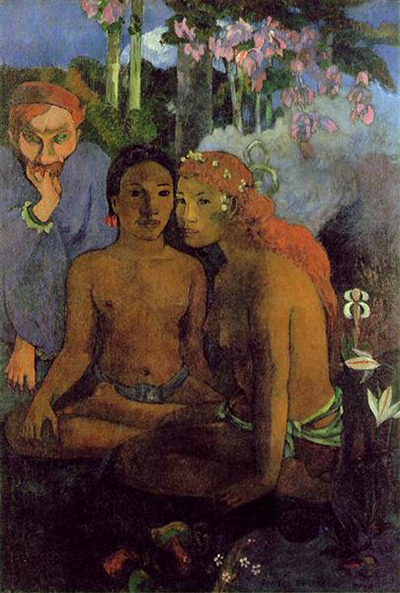
The English title Barbarous Tales requires an immediate caution. Paul Gauguin painted the French words CONTES BARBARES into the lower right of the canvas. Museum Folkwang now keeps that phrase untranslated on its label because it regards the artist's chosen title as racist. The English wording used here is therefore a reader-facing translation of Gauguin's title, not a description of the people in the picture. [1] [2]
At a Glance
- ArtistPaul Gauguin [1]
- TitleBarbarous Tales [1]
- Date1902 [1]
- Mediumoil on canvas [1]
- Dimensions / object size131.5 by 90.5 centimetres [1]
- CollectionMuseum Folkwang Essen G54 [1]
- FocusThe English title Barbarous Tales requires an immediate caution.
Contents
- Barbarous Tales: Introduction
- Three figures held in a narrow space
- Why Meijer de Haan appears at Hiva Oa
- A pose is not a complete religion
- What the title makes the viewer confront
- From a late canvas to an early museum acquisition
- A painting that withholds its tale
The painting was made in 1902 at Hiva Oa in the Marquesas. It is oil on canvas, measuring 131.5 by 90.5 centimetres, and belongs to Museum Folkwang in Essen as G 54. The Wildenstein Plattner Institute catalogues it as PGSGN3, formerly W625. Its full lower-right inscription reads CONTES BARBARES / Paul Gauguin- / 1902 / Marquises. [1] [4] [5]
Three figures held in a narrow space
Two seated figures fill most of the foreground. One turns more directly towards the viewer; the other appears in profile, the two bodies overlapping without forming a single shared action. A third figure crouches or leans at the upper left, one hand pressed against the side of the face. Reddish hair and beard, blue-violet clothing and a pale face separate this figure from the warmer bodies below. [2]
Dark blue-green vegetation closes around the group. Small red and orange flower or fruit forms gather near the lower edge, while a pale, glyph-like figure appears at the right. The setting has depth, but not ordinary continuous recession: bodies, foliage and small motifs are stacked into a tall surface. The rear figure seems both present in the same place and detached from it.
Nothing in that arrangement securely establishes the names, ethnicities, ages, beliefs or relationship of the two foreground sitters. Museum Folkwang's current commentary describes Gauguin's Polynesian portraits as invented, complex scenes that assemble elements from different cultures rather than true-to-life records of people. It also warns that their content may resist clear decipherment. [2]
That current position is important because an older museum partner text offered specific sitter names and fixed meanings for flowers, fruit and smoke. The direct Folkwang record no longer presents those claims. Close looking can register hair, gesture, colour and proximity without turning every visible difference into biography or symbolic code.
Why Meijer de Haan appears at Hiva Oa
National Gallery of Art scholarship identifies the crouching rear figure as a portrait of Meijer de Haan, the Dutch artist who worked with Gauguin in Brittany. The National Gallery in London likewise records that Gauguin represented de Haan several times around 1889–90, in paintings and carved wood. [3] [6]
De Haan did not pose for this 1902 canvas in the Marquesas. Gauguin imported and transformed an earlier likeness. The hand beside the face, bright hair and compressed head function like a remembered portrait embedded in a later, invented gathering. A European colleague from the Breton years enters an image made more than a decade later on Hiva Oa.
This is not merely a hidden identity to be solved. The borrowed likeness changes the painting's time. The three figures cannot belong to one observed moment because one of them comes from an earlier portrait history and another continent. Memory becomes a visible participant rather than background information.
The identification has often encouraged sinister or demonic descriptions of de Haan's face. Such language adds religious and ethnic stereotypes rather than evidence. The useful question is not whether he personifies evil, but what happens when a recognisable portrait is made strange by scale, colour and displacement.
A pose is not a complete religion
The NGA publication compares one seated figure's pose with a traditional pose of the Buddha. [3] That formal comparison expands the painting's field of reference, but it does not establish that the sitter was Buddhist or that the scene illustrates a coherent Buddhist narrative.
Gauguin's paintings repeatedly joined poses and motifs encountered through photographs, prints, exhibitions, earlier artworks and his own reused compositions. Here the Buddha comparison sits beside a Brittany portrait and forms developed in the Marquesas. These references coexist; they do not automatically reconcile into one universal faith.
The painting becomes less convincing when every gesture is translated into doctrine. Its visual power depends on the opposite condition: recognisable clues remain close enough to invite connection but too discontinuous to produce a complete story. The seated bodies are monumental, the de Haan likeness is intimate and compressed, and the surrounding foliage binds them without explaining why they meet.
What the title makes the viewer confront
Contes barbares is part of the painted object, not a nickname invented after Gauguin's death. It was the phrase he chose to place beside his signature, year and location. The word barbares establishes a hierarchy: it labels lives, stories or cultural mixtures from the imagined position of someone entitled to classify them as outside civilisation.
Museum Folkwang's decision not to translate the phrase interrupts that inheritance. Its current account argues that Gauguin used Polynesian references to encourage a European fantasy of a mysterious Pacific paradise and to make his art desirable to that audience. [2] Mystery was therefore not simply discovered at Hiva Oa. It could be designed, titled and directed towards viewers elsewhere.
That does not mean the painting's formal complexity is fraudulent. It means that beauty and cultural power operate together. The dark colour harmonies, compact bodies and layered time genuinely resist a single narrative, while the title tries to control that difficulty through a colonial value judgement. The task is to see both operations rather than letting one excuse the other.
Geography also matters. The canvas was made in the Marquesas, not Tahiti. [5] Treating every Pacific work as a generic Tahitian scene would repeat the very flattening that the title analysis needs to expose. The inscription Marquises places Gauguin's act of naming at a specific point in his final years.
From a late canvas to an early museum acquisition
WPI records Ambroise Vollard acquiring the painting from Gauguin around October 1903, after the artist's death in May. Vollard exhibited it in Paris from 4 to 28 November as number 24 in an exhibition devoted to Gauguin. It was then shown at the Folkwang Museum in Hagen from 4 to 28 December. [1]
The present museum summarises the acquisition as 1903/04. WPI gives the more specific, still approximate sequence: Museum Folkwang, Hagen, acquired the canvas from Vollard through its founder Karl Ernst Osthaus around 1904. The collection moved to Essen in 1922. [1] [2] The painting therefore entered a pioneering German museum context with unusual speed.
That early movement matters to interpretation. The picture was made at Hiva Oa, but its title, first exhibition and institutional destination were bound to European circulation almost immediately. A work that stages cultural distance was never outside the market and museum systems through which that distance acquired value.
A painting that withholds its tale
The strongest evidence establishes several things with precision: the canvas's place and date, the painted title, the de Haan likeness, the pose comparison and the rapid route through Vollard to Folkwang. None supplies a final narrative joining all three figures. [1] [2] [3]
That gap should remain open. The work is neither a transparent document of Marquesan life nor a private code unlocked by Gauguin's biography. It is a deliberately constructed encounter among sitters, remembered portrait, borrowed pose, vegetation and inscription. The title tries to name their difference. The painting itself keeps showing how inadequate that name is.
Related Pages
Frequently Asked Questions
The English title Barbarous Tales requires an immediate caution.
Gauguin's paintings repeatedly joined poses and motifs encountered through photographs, prints, exhibitions, earlier artworks and his own reused compositions.
That gap should remain open.
Discussion
The English title Barbarous Tales requires an immediate caution.
Reader Insights
The English title Barbarous Tales requires an immediate caution.
That formal comparison expands the painting's field of reference, but it does not establish that the sitter was Buddhist or that the scene illustrates a coherent Buddhist narrative.
The painting itself keeps showing how inadequate that name is.
Join the Conversation
Share the visible detail or source that most changed your reading.
References
- Wildenstein Plattner Institute, “Contes barbares”, 1902, WPI PGSGN3 (W625), current object record: View source
- Museum Folkwang, “Contes barbares”, current Collection Online record and commentary: View source
- National Gallery of Art, Gauguin: Maker of Myth, exhibition publication, 2011: View source
- Museum Folkwang, Renoir, Monet, Gauguin, current English press material: View source
- National Gallery, London, Gauguin Portraits immunity-from-seizure report, 2019: View source
- National Gallery, London, “Gauguin Portraits”, exhibition overview, 2019–20: View source
 Paul Gauguin.jpg)