 by Tom Gurney
Tom Gurney BSc (Hons) is an art history expert with over 20 years experience
Published on August 14, 2026 / Updated on August 14, 2026
Email: tomgurney1@gmail.com / Phone: +44 7429 011000
Paul Gauguin Prints and Woodcuts: Introduction
Paul Gauguin's prints are multiples, but sameness is rarely their governing condition. He changed matrices between printings, shifted inks and papers, altered pressure and registration, transferred textures from cloth or glass, and sometimes worked over an impression with watercolour. The carved or drawn image provided a structure; each act of printing could reinterpret it.
At a Glance
- ArtistPaul Gauguin
- GuidePaul Gauguin Prints and Woodcuts
- FocusPrints and Woodcuts
- Key topicsZinc before wood: the Volpini Suite; Matrix, state and impression; The changing blocks of Noa Noa; What two impressions can reveal
- OverviewPaul Gauguin's prints are multiples, but sameness is rarely their governing condition.
Contents
- Paul Gauguin Prints and Woodcuts: Introduction
- Zinc before wood: the Volpini Suite
- Matrix, state and impression
- The changing blocks of `Noa Noa`
- What two impressions can reveal
- Monotype: one transfer, several possible routes
- Late blocks and `Le Sourire`
- Repetition as revision
Related Prints, Drawings and Objects
 Paul Gauguin.jpg)
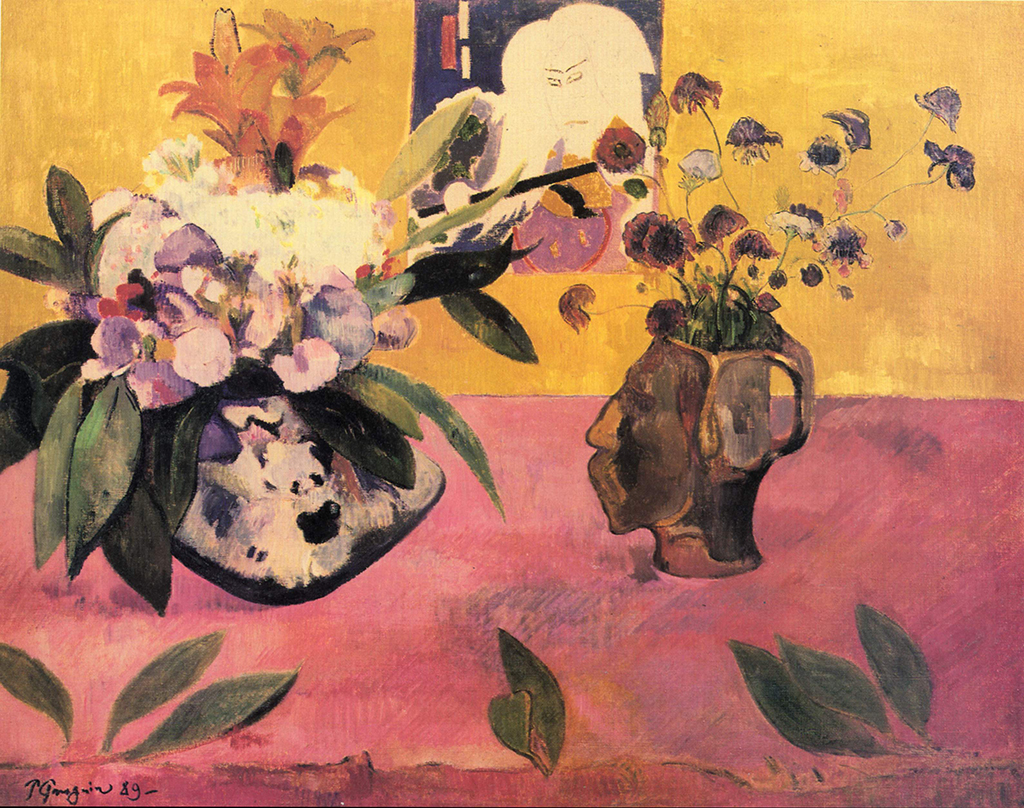
That distinction matters because Gauguin did not practise one form of printmaking. His 1889 Volpini Suite consists of zincographs, not woodcuts. The Noa Noa project of 1893–94 used end-grain boxwood. Monotypes relied on a prepared surface transferring drawn or painted material, while the rougher wood-block prints of 1899 responded to different timber and working conditions. These processes share an interest in repetition, but they do not share one recipe. [1] [4] [7] [9]
Zinc before wood: the Volpini Suite
Gauguin prepared the Volpini Suite for an exhibition at the Café des Arts during the Paris Exposition Universelle of 1889. Current Art Institute of Chicago scholarship counts eleven zincographs, gathered as a portable summary of recent work associated chiefly with Brittany and Martinique. The pictures were printed on large sheets of vivid yellow paper, so the support surrounded each comparatively small image with a field of colour. [1] [4]
A zincograph uses a zinc plate where a lithograph would ordinarily use stone. On the plate, Gauguin worked with lithographic crayon and water-based tusche applied by pen, brush, sponge or cloth. In Human Miseries, granular passages came from a tusche effect known as peau de crapaud, or “toad skin”. The phrase describes a particular broken texture produced on zinc; it is not a general name for Gauguin's graphic style. [1] [2]
The Art Institute's Human Miseries is an only-state impression of 1889 in reddish-brown ink on chrome-yellow wove paper. Its image measures 284 by 234 millimetres, while the sheet expands to 498 by 650 millimetres. Most lifetime impressions in the group used black ink, making the brown image an object-specific variation rather than the suite's standard colour. [1]
Printing also involved another practitioner. An older account credited Édouard Ancourt, but research cited by the Art Institute found a note in an early Gauguin sketchbook naming an M. Labbé for le tirage, the printing of the suite. The initial is all the evidence supplies; expanding it to a full identity would manufacture certainty. The credit nonetheless changes the production story: Gauguin made the images, but a press and a named printer helped turn the zinc plates into the lifetime sheets. [2]
Their lifetime edition is estimated at roughly thirty and no more than fifty, rather than secured by one complete edition ledger. Later impressions require another distinction. Ambroise Vollard published a posthumous edition after 1911 on smaller ivory-toned paper; wear and scratches in the plates, as well as differences in ink and paper, can separate those sheets from the 1889 printing. [2] [12]
The Metropolitan Museum of Art's The Grasshoppers and the Ants: A Souvenir of Martinique shows how this first print campaign gathered earlier motifs. Its figures and landscape refer back to work from the Caribbean island, yet the chrome-yellow sheet and zincographic surface make the result a new Paris object rather than a neutral copy of a Martinique painting. [3]
Matrix, state and impression
Three terms clarify what followed. A *matrix is the worked surface from which an image is transferred: it may be a zinc plate, a carved wooden block, prepared glass or even a drawing repeatedly used to take counterproofs. An impression is one transferred image. A state* records a stage in the matrix itself; further cutting or other permanent alteration creates another state.
An impression can therefore change without the matrix entering a new state. Different ink, paper, pressure, wiping, hand colouring or registration may transform its appearance. Conversely, impressions from different states preserve actual changes to the block. Edition describes a publishing or printing campaign, so lifetime and posthumous editions can use the same surviving matrix while belonging to different histories. [4] [5] [6]
The changing blocks of `Noa Noa`
After returning to France in August 1893, Gauguin began the ten end-grain boxwood blocks now grouped as the Noa Noa Suite. End grain—cut across rather than along the tree's fibres—provided a hard, even surface that could take both fine engraving tools and broader gouges or knives. It offered a markedly different resistance from zinc. [4]
Gauguin did not carve ten blocks and then print one definitive set. The Art Institute reconstructs successive campaigns in which he printed the group, cut further, and printed again using new combinations of material and method. His first lifetime campaign took place in 1893–94; a second around 1894 involved his friend Louis Roy. In 1921 Gauguin's son Pola supervised a Christian Cato portfolio printed from eight surviving matrices. The later black-and-white sheets record final carved information clearly, but they are not substitutes for Gauguin's and Roy's materially varied lifetime impressions. [5]
The intended publication linking images and the developing Noa Noa text never appeared in the form Gauguin envisaged, and his preferred sequence for the blocks remains uncertain. The prints should therefore not be forced into a fixed illustrated narrative. Their relationship to the writing is real, but their states and impressions form an independent material history. [4] [5]
What two impressions can reveal
The Art Institute's Noa Noa (Fragrant), dated 1893–94, is a second state of four. It is printed in black on tan wove paper, yet its surface also holds the impression of twill cloth. The textile was laid on the inked block while excess ink was removed; when paper was pressed against the block, the cloth's diagonal weave remained as transferred texture. What looks like part of the paper is evidence of preparation on the matrix. [5]
Te po (The Night) is more elaborate. The Chicago example is a third state of four, printed first in brown and again in black. Gauguin selectively wiped black ink so that the brown layer remained visible, tolerated or created off-register relations between the two printings, and then added red, orange, yellow, blue, silver-grey and black watercolour. He laminated two different Japanese papers to make a support strong and absorbent enough for printing and washes. [6]
The sequence matters: brown ink, selectively wiped black, then colour by hand. It prevents colour woodcut from concealing how the object was built. Conservation study also shows that some watercolours have faded, with stronger traces surviving on the reverse. The present sheet is not a timeless record of an original palette; light exposure and the behaviour of paper and pigment belong to its history. [6]
These objects demonstrate why unique impression needs explanation. Their imagery could be repeated, yet ink mixtures, wiping, registration, transferred media, paper construction and hand colour produced visible differences. The matrix enabled multiplication, while printing decisions prevented mechanical uniformity.
Monotype: one transfer, several possible routes
Gauguin's monotypes extend the same inquiry without becoming woodcuts. The Art Institute catalogues Aha oe feii? (What! Are You Jealous?) of 1894 as a watercolour monotype from a glass matrix, with gouache and watercolour on cream wove paper. Its likely reconstruction places dampened paper over glass bearing drawn and painted material, then uses pressure to transfer that material. Likely is essential: the physical evidence supports the method but does not preserve the complete act. [7]
Other matrices complicate the category further. Two Tahitian Women in a Landscape, about 1892, survives as a worked paper matrix rather than the transferred image. Layers of watercolour, gouache and green ink lie over graphite on Japanese paper. Lifted colour and repeated applications of gouache support the conclusion that it was used to make counterproofs, but no resulting impressions are known. The sheet could transfer directly to damp paper or guide related work made on glass; the evidence does not select one exclusive route. [8]
Calling it a matrix restores its productive function. Calling it an impression would reverse that relation. It also shows why printmaking could connect painting and drawing without merely reproducing either: a figure might be reversed, shifted, simplified, recoloured or recombined as it passed through another support.
Late blocks and `Le Sourire`
By 1899, in Tahiti, Gauguin was cutting another group of wood blocks under materially different conditions. In the first-state Chicago impression of Soyez amoureuses, vous serez heureuses (Love, and You Will Be Happy), dark-orange ink sits on cream wove paper. The Art Institute's study links the print's grain and surface irregularities to the softer plank wood then available to him. Those marks are not simply failures measured against polished boxwood engraving; the cutting adapted to what the plank could do. [9]
Printing also entered Gauguin's small satirical journal, Le Sourire. The National Gallery of Art holds a 1899 title page, a woodcut on Japan paper carrying Le Sourire, P G and No. 3 in the block. At only 10 by 18.7 centimetres for the image, it brings the carved mark into the scale and function of a periodical heading. [10]
These late works should not be romanticised as products of isolation. Wood, paper, ink, previous matrices, correspondents, publishers and later printers all belong to their histories. So does the colonial setting in which Gauguin selected and recirculated images of Polynesian people. Technical originality does not turn those images into transparent records of lives or beliefs.
Repetition as revision
MoMA's Gauguin: Metamorphoses placed prints and transfer works at the centre of a cross-media practice rather than at the edge of a career in painting. That emphasis is justified by the objects themselves: zinc plates condense earlier paintings; wooden blocks change through successive states; monotype matrices generate reversed or displaced forms; late planks make grain visible; posthumous campaigns reveal what survives when another printer returns to the matrix. [11]
The most useful way to view these prints is therefore comparative. Ask not only what picture is represented, but which matrix, which state, who printed it, on what support, with what additions, and at what date. Those questions do more than classify an object. They reveal Gauguin's printmaking as an art of revision, in which repetition opens an image to further material decisions instead of closing it as a finished design.
Related Pages
Frequently Asked Questions
Paul Gauguin's prints are multiples, but sameness is rarely their governing condition.
The intended publication linking images and the developing Noa Noa text never appeared in the form Gauguin envisaged, and his preferred sequence for the blocks remains uncertain.
The most useful way to view these prints is therefore comparative.
Discussion
Paul Gauguin's prints are multiples, but sameness is rarely their governing condition.
Reader Insights
Paul Gauguin's prints are multiples, but sameness is rarely their governing condition.
Their relationship to the writing is real, but their states and impressions form an independent material history.
They reveal Gauguin's printmaking as an art of revision, in which repetition opens an image to further material decisions instead of closing it as a finished design.
Join the Conversation
Share the visible detail or source that most changed your reading.
References
- Art Institute of Chicago, “Human Miseries, from the Volpini Suite”, 1889, Cat. 21, current scholarly catalogue: View source
- Art Institute of Chicago, “Breton Bathers, from the Volpini Suite”, 1889, Cat. 13, current technical study: View source
- Metropolitan Museum of Art, “The Grasshoppers and the Ants: A Souvenir of Martinique”, 1889, object 22.82.2(4): View source
- Art Institute of Chicago, “The Noa Noa Suite, 1893/94”, current scholarly catalogue overview: View source
- Art Institute of Chicago, “Noa Noa (Fragrant), from the Noa Noa Suite”, 1893/94, Cat. 51.1: View source
- Art Institute of Chicago, “Te po (The Night), from the Noa Noa Suite”, 1893/94, Cat. 52.1: View source
- Art Institute of Chicago, “Aha oe feii? (What! Are You Jealous?)”, 1894, Cat. 65: View source
- Art Institute of Chicago, “Two Tahitian Women in a Landscape”, c. 1892, Cat. 64: View source
- Art Institute of Chicago, “Soyez amoureuses, vous serez heureuses (Love, and You Will Be Happy)”, 1899, Cat. 105.1: View source
- National Gallery of Art, “Title Page for ‘Le Sourire’ (Titre du Sourire)”, 1899, 1943.3.4612: View source
- Museum of Modern Art, “Gauguin: Metamorphoses”, exhibition overview, 2014: View source
- Art Institute of Chicago, “Old Women of Arles, from the Volpini Suite”, 1889, printed after 1911, Cat. 19.2: View source
 Paul Gauguin.jpg)