 by Tom Gurney
Tom Gurney BSc (Hons) is an art history expert with over 20 years experience
Published on August 14, 2026 / Updated on August 14, 2026
Email: tomgurney1@gmail.com / Phone: +44 7429 011000
Still Life with Head-Shaped Vase and Japanese Woodcut: Introduction
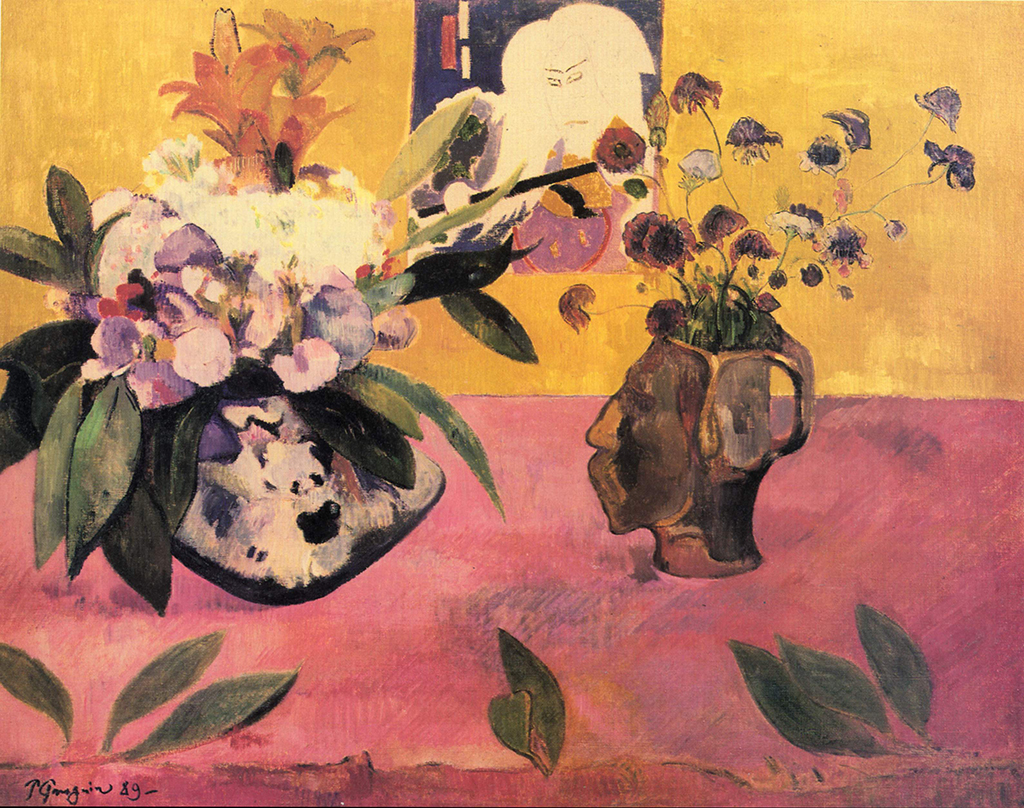
Paul Gauguin's still life brings together objects that already behave like pictures. A ceramic jug has the profile of a human head. Flowers turn it into a functional vase while partly obscuring its form. Behind it, a Japanese print inserts another cropped figure into the painted room. Leaves, blossoms and small fruits lie across a tabletop that is less a neutral support than a broad field of colour.
At a Glance
- ArtistPaul Gauguin [1]
- TitleStill Life with Head-Shaped Vase and Japanese Woodcut [1]
- Date1889 [1]
- MediumWoodcut [1]
- Dimensions / object size72.4 by 93.7 centimetres [1]
- CollectionTehran Museum of Contemporary Art [1]
- FocusPaul Gauguin's still life brings together objects that already behave like pictures.
Contents
- Still Life with Head-Shaped Vase and Japanese Woodcut: Introduction
- The current object record
- A shallow stage of objects
- The jug as a self-quotation
- What can be said about the Japanese print
- A painting with several titles
The familiar English title Still Life with Head-Shaped Vase and Japanese Woodcut describes those ingredients, but it is not the title used by the current catalogue raisonné. The Wildenstein Plattner Institute (WPI) calls the painting Fleurs, céramique et estampe japonaise sur fond jaune—Flowers, Ceramic and Japanese Print on a Yellow Background—and dates it to summer 1889. [1]
The current object record
WPI catalogues the work as oil on canvas, 72.4 by 93.7 centimetres. It is signed and dated at the lower left P Gauguin 89, carries the current reference PGPUEM and retains W375 as its 1964 catalogue number. The painting belongs to the Tehran Museum of Contemporary Art. [1]
Those measurements resolve a real discrepancy. An Art Institute of Chicago scholarly figure rounds the canvas to 73 by 90 centimetres, while older catalogues offered other conversions. WPI explains that its measurements come from committee examination, vetted owner information or its archives; its current 72.4-by-93.7-centimetre record is therefore the governing figure here. [2] [3]
The direct Tehran object page is presently unavailable, so no museum accession number should be inferred from mirrors. WPI supplies a secure ownership endpoint: Tehran purchased the painting at the Rosensaft collection sale held by Sotheby Parke Bernet in New York on 17 March 1976. [1]
A shallow stage of objects
The composition is divided into two large zones: a yellow upper field and a pink-red tabletop. At left, a pale rounded vessel supports a dense mass of flowers and long leaves. A second, smaller bouquet rises from the head-shaped jug near the centre-right. The print stands behind both, its dark blue area and pale cropped figure interrupting the yellow. Detached green leaves and two small pieces of fruit or plant matter spread across the lower foreground. [1]
Depth is possible but not insistent. The tabletop tilts upward; objects overlap without settling into a measured box of space. The large bouquet presses towards the surface, while the Japanese sheet behaves almost like another block of colour. Its rectangular fragment answers the upright jug, and its printed head meets the ceramic profile below. Still life and portrait are therefore not cleanly separated: one face is printed, one is modelled in clay and both are repainted in oil.
The exact species of the flowers, leaves and fruit are not secured by the current record. Naming them would add apparent precision without evidence. Their pictorial roles are clearer than their botanical ones: the bouquets mass colour around the two vessels, while scattered leaves extend the arrangement across the table.
The jug as a self-quotation
Art Institute scholarship identifies the painted vessel as Gauguin's ceramic self-portrait of 1889, catalogue Gray 65, here filled with flowers. [3] The identification changes how the still life works. Gauguin is not simply painting a studio prop; he is placing one of his own objects inside another work and giving the sculpted head a temporary use as a container.
Designmuseum Danmark describes its 1889 Jug Self-portrait as a union of portrait and vessel, emphasising its material surface and oxblood glaze. [4] In the painting, however, glaze is translated into brushwork, three-dimensional profile into silhouette, and the open top into a support for stems. The ceramic remains recognisable while oil paint recasts its weight and texture.
Not every anthropomorphic pot by Gauguin is this jug. Musée d'Orsay's Pot anthropomorphe, OA 9050, is another work from 1889, catalogued as Gray 66 and measuring 28.4 centimetres high. Its alternate title also presents it as a portrait of Gauguin, but the different catalogue number prevents it from being substituted automatically for Gray 65. [5]
The vase can support psychological interpretations, yet the painted relation is already rich without turning it into a diagnosis or death-mask story. The head is an authored object that becomes useful, floral and pictorial. Gauguin quotes himself across media, but the quotation changes function.
What can be said about the Japanese print
The WPI title securely calls the background object a Japanese print. The current reproduction shows a cropped pale head and upper figure against deep blue, but the governing sources do not securely identify the artist, represented person or actor, work, publisher or date. [1] Those details should remain open.
A Metropolitan Museum of Art study placed the painting within the wider French encounter with Japanese woodcuts. It noted that Siegfried Bing's Paris exhibition of Japanese prints in spring 1888 may have encouraged Gauguin's interest, while Japanese books and prints circulated in his and Vincent van Gogh's surroundings. The study also connected Japanese design principles with the flattened forms and brilliant yellow supports of Gauguin's eleven 1889 zincographs. [6]
That context does not prove a single source for this painting. The print is not merely an influence absorbed and discarded; Gauguin represents it as a physical object, cropped and partly blocked by European flowers and ceramic work. It retains its otherness as a print while being made to participate in a new arrangement. Japonisme names that European culture of collecting, selecting and adapting Japanese art—it does not make the exchange equal or culturally neutral.
A painting with several titles
The painting's names reveal what different viewers noticed. WPI records that Ambroise Vollard held it by 1905 as Bouquet de fleurs. Exhibitions in 1910 stressed flowers on a yellow background. The 1913 Armory Show listed Fleurs sur un fond jaune, while the later Chicago and Boston venues shortened it to Flowers. A 1949 Basel title named the flowers, head vase and Japanese woodcut; MoMA used Still Life with a Japanese Print in 1955; the Art Institute used Still Life with a Head-Shaped Vase in 1959. [1]
The current WPI title gathers the three main components without pretending that one is the secret key. That is the most productive way to look. The ceramic contributes self-portraiture and material memory. The print introduces another image tradition and another face. Flowers and leaves both conceal those sources and bind them together. Gauguin's achievement lies not in choosing between still life, portrait and quotation, but in making one tabletop carry all three.
Related Pages
Frequently Asked Questions
Paul Gauguin's still life brings together objects that already behave like pictures.
Art Institute scholarship identifies the painted vessel as Gauguin's ceramic self-portrait of 1889, catalogue Gray 65, here filled with flowers.
The current WPI title gathers the three main components without pretending that one is the secret key.
Discussion
Paul Gauguin's still life brings together objects that already behave like pictures.
Reader Insights
Paul Gauguin's still life brings together objects that already behave like pictures.
Gauguin is not simply painting a studio prop; he is placing one of his own objects inside another work and giving the sculpted head a temporary use as a container.
Gauguin's achievement lies not in choosing between still life, portrait and quotation, but in making one tabletop carry all three.
Join the Conversation
Share the visible detail or source that most changed your reading.
References
- Wildenstein Plattner Institute, “Fleurs, céramique et estampe japonaise sur fond jaune”, summer 1889, PGPUEM (W375), current digital catalogue raisonné: View source
- Wildenstein Plattner Institute, “Guide to the Gauguin Catalogue Raisonné”, current title, date and measurement methodology: View source
- Art Institute of Chicago, “Vase in the Form of a Tropical Plant with Bird and Deity”, Cat. 7, including fig. 7.17 and the Gray 65 still-life identification: View source
- Designmuseum Danmark, “Jug Self-portrait, 1889”, Director's Choice: View source
- Musée d'Orsay, “Pot anthropomorphe”, 1889, OA 9050, current object record: View source
- Colta Feller Ives, Metropolitan Museum of Art, The Great Wave: The Influence of Japanese Woodcuts on French Prints, 1980: View source
 Paul Gauguin.jpg)