 by Tom Gurney
Tom Gurney BSc (Hons) is an art history expert with over 20 years experience
Published on August 14, 2026 / Updated on August 14, 2026
Email: tomgurney1@gmail.com / Phone: +44 7429 011000
Matamoe (Landscape with Peacocks): Introduction
Two peacocks occupy the nearest edge of Paul Gauguin's Matamoe, yet the human action takes place farther away. A worker stands to the right of the painting's centre with an axe raised beside cut timber and a pale smoking or burning form. Between birds and figure, a clearing bends through patches of green, coral and orange. Dark trees close the left side; higher bands of yellow, pink and blue carry the landscape towards its distant slopes. [1]
At a Glance
- ArtistPaul Gauguin [1]
- TitleMatamoe (Landscape with Peacocks) [1]
- Date1892 [1]
- Mediumoil on canvas [1]
- Dimensions / object size116.5 by 89 centimetres [1]
- CollectionPushkin State Museum of Fine Arts Moscow [1]
- FocusTwo peacocks occupy the nearest edge of Paul Gauguin's Matamoe, yet the human action takes place farther away.
Contents
- Matamoe (Landscape with Peacocks): Introduction
- Which painting is Matamoe?
- A title with more than one history
- How the landscape holds the action
- The woodcutter across several works
- The later story is not a key
- From Gauguin's exhibition to Moscow
The interval matters. Gauguin does not bring labour forward as a portrait or anecdote. He places it within a landscape whose colour divisions are as emphatic as its people, plants and animals. Even the title has moved between those elements: the painting has been called Matamoe, Mort (Death), The Woodcutter of Pia, The Peacocks and Landscape with Peacocks. [1]
Which painting is Matamoe?
The Wildenstein Plattner Institute (WPI) catalogues this work as Matamoe, an oil on canvas of 1892, numbered W484. Gauguin titled, signed and dated it at the lower right: MATAMOE P. Gauguin. 92. The current owner, the Pushkin State Museum of Fine Arts in Moscow, records it under museum number Ж-3369 and uses the English title “Death”. Landscape with Peacocks. [1] [2]
The two authorities publish different measurements. Pushkin gives 116.5 by 89 centimetres; WPI gives 115 by 86 centimetres. Because the museum is the direct holder, its figures are preferred here, while the catalogue-raisonné measurement remains a documented discrepancy rather than being silently averaged away. [1] [3]
Similar names make object control essential. Mata Mua (In Olden Times) is another 1892 painting, with a ceremonial subject and a separate history. Arii matamoe is also distinct: it is the horizontal Getty canvas showing a severed head, catalogued by WPI as W453 and measuring 45.1 by 74.3 centimetres. The royal-death material attached to that work does not explain the Pushkin landscape. [4]
A title with more than one history
The word MATAMOE is physically part of the painting. Pushkin lists it as the title in the original language, but its catalogue adds an important qualification: the museum says the title Death was introduced by curator M. A. Bessonova, who interpreted the picture through a translation supplied by Bengt Danielsson. [3] That wording documents a scholarly decision; it does not by itself settle modern Tahitian usage or turn every form in the landscape into an emblem of death.
There is also earlier evidence for the gloss. WPI records the canvas as no. 2 in Gauguin's November 1893 exhibition at Durand-Ruel, where it appeared as Matamoe (Mort). The same catalogue records Le Bûcheron de Pia, or The Woodcutter of Pia, among its alternate titles. [1] The apparent contradiction is useful. Death has nineteenth-century exhibition history, while the Pushkin explains how that term entered its own catalogue through later scholarship. Neither fact authorises a simple dictionary equation followed by a closed interpretation.
Gauguin's own shifting labels may instead show him testing what the picture was about. The Art Institute of Chicago notes that he listed it at different moments as The Woodcutter of Pia and Death. One name directs attention to action and possible place; the other proposes a condition or theme. Later owners and exhibitions often chose the birds or the landscape instead. [5]
How the landscape holds the action
The peacocks make a dark, low counterweight to the worker. The larger bird extends diagonally across the lower left while the smaller one stands nearer the centre. Above them, red-orange accents interrupt the green foreground. The path or clearing then draws the eye towards the figure, but cut wood and an angular bank partly absorb him into the setting. [1]
Gauguin builds depth by overlap and stacked colour rather than by smooth recession. Dense vegetation presses forward on the left. The open middle ground narrows around the worker. Beyond it, orange, rose and yellow shapes rise steeply, checked by blue and dark green. The landscape can be read spatially, yet each zone also retains the force of a painted patch.
This arrangement prevents the title from monopolising what can be seen. If Death encourages attention to the felled tree and the fire, the living birds remain conspicuous. If The Woodcutter of Pia centres the worker, his scale and distance keep him from dominating the canvas. If Landscape with Peacocks foregrounds the birds, it still leaves the raised axe unresolved in the middle distance.
The woodcutter across several works
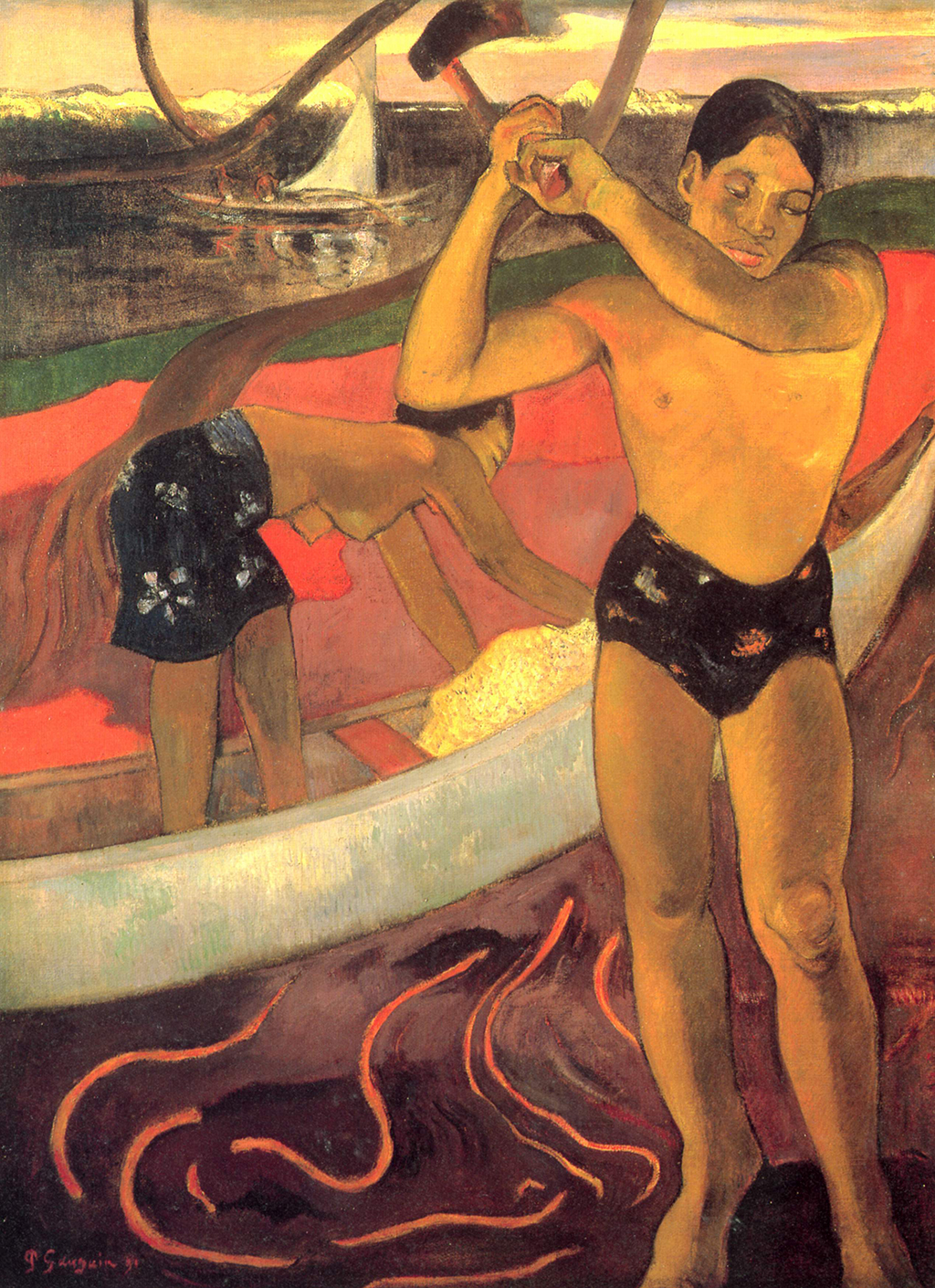
The worker was not a one-off invention. Art Institute scholarship follows the axe-bearing figure through an important 1891 painting, a gouache and drawings, as well as Matamoe. In the 1891 painted version, a bending woman and a sailboat place the man within a broader community. In Matamoe, the setting is inland and the figure appears relatively isolated. Gauguin retained the recognisable pose while changing the surrounding relations. [5]
That repetition argues against treating a single version as a transparent report. It also weakens the temptation to identify the figure confidently. The catalogue notes that Gauguin sometimes used forms of the name Jotefa, but it keeps the model's identity uncertain. The public evidence does not establish the worker's name, biography or relationship to Gauguin. [5]
The repeated design is more securely informative. Gauguin could move a figure between media and settings while altering what viewers noticed: communal activity in one painting, solitude and landscape in another, patterned land and water in a gouache. Motif was a working resource, not a fixed code.
The later story is not a key
Gauguin subsequently wrote a related woodcutting episode in Noa Noa. The Art Institute stresses the chronology: the account followed the canvas, although it probably preceded illustrations derived from the composition. In the text, a neighbour lifts an axe against the sky before striking a dead tree. That retrospective scene is relevant to the motif's development, but it cannot function as a diary entry that existed before and dictated Matamoe. [5]
The distinction matters because the later account has generated extensive biographical and sexual interpretations. Those arguments concern Gauguin's writing, self-presentation and possible models as much as the painting. They cannot securely identify the distant worker here, and they should not displace the canvas's visible structure.
The pale fire beside the cut wood has likewise attracted symbolic readings. The Art Institute proposes that destruction in Matamoe may also suggest rebirth. [5] This is a productive possibility, not a final answer. Burning wood can connect the action to the title Mort; it can also describe what happens after cutting. The peacocks, bright ground and proliferating vegetation keep the scene from resolving into a single allegory.
From Gauguin's exhibition to Moscow
The painting entered public view quickly. After the 1893 Durand-Ruel exhibition, Gauguin included it in his artist-consigned Paris sale of February 1895. It passed through Armand Seguin and Ambroise Vollard. In 1906 Prince de Wagram acquired it under a description emphasising an upright landscape with peacocks in the foreground; that year's Salon d'Automne called it Les Paons. Ivan Morozov bought it from Vollard in May 1907, also as Paons. [1]
After the Russian Revolution it moved through Moscow's modern Western-art museums and entered the Pushkin in 1948. [1] [3] This history did more than carry the object from Paris to Moscow. Its successive names redistributed attention: death, worker, tree, birds and landscape each became a way of presenting the same painted field.
That is why the most responsible reading begins with the title but does not end there. Matamoe contains work, cutting, smoke and a recorded association with death. It also contains two emphatic birds, brilliant colour and a landscape that resists becoming mere backdrop. Gauguin kept the image open by changing its labels and reworking its central motif elsewhere. The painting's uncertainty is not a gap to fill with one private story; it is part of how the work operates.
Related Pages
Frequently Asked Questions
Two peacocks occupy the nearest edge of Paul Gauguin's Matamoe, yet the human action takes place farther away.
This arrangement prevents the title from monopolising what can be seen.
That is why the most responsible reading begins with the title but does not end there.
Discussion
Two peacocks occupy the nearest edge of Paul Gauguin's Matamoe, yet the human action takes place farther away.
Reader Insights
Two peacocks occupy the nearest edge of Paul Gauguin's Matamoe, yet the human action takes place farther away.
This arrangement prevents the title from monopolising what can be seen.
The painting's uncertainty is not a gap to fill with one private story; it is part of how the work operates.
Join the Conversation
Share the visible detail or source that most changed your reading.
References
- Wildenstein Plattner Institute, “Matamoe”, 1892, PGZADF (W484), current digital catalogue raisonné: View source
- Pushkin State Museum of Fine Arts, “Death”. Landscape with Peacocks, current English object record, Ж-3369: View source
- Pushkin State Museum of Fine Arts, MATAMOE ("Смерть"). Пейзаж с павлинами, current Russian object record, including dimensions and title comment: View source
- Wildenstein Plattner Institute, “Arii matamoe”, 1892, PGF6ZX (W453), current digital catalogue raisonné: View source
- Nancy Ireson, “Man with an Ax, 1891/93”, Cat. 47, Gauguin Paintings, Sculpture, and Graphic Works at the Art Institute of Chicago, including the related Matamoe figure and motif commentary: View source
 Paul Gauguin.jpg)