 by Tom Gurney
Tom Gurney BSc (Hons) is an art history expert with over 20 years experience
Published on August 14, 2026 / Updated on August 14, 2026
Email: tomgurney1@gmail.com / Phone: +44 7429 011000
Riders on the Beach I: Introduction
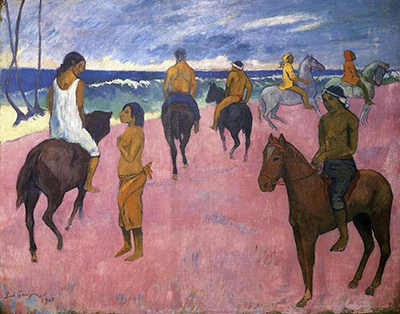
Five mounted figures cross a broad pink beach beneath a narrow strip of blue sea. Two riders enter from the left while three, seen mainly from behind, move towards the water. Paul Gauguin has not arranged them in one line or a single procession. The groups meet at different angles, so the painting holds arrival, crossing and departure in the same shallow space. [1] [2]
At a Glance
- ArtistPaul Gauguin [1]
- TitleRiders on the Beach I [1]
- Date1902 [1]
- Mediumoil on canvas [1]
- Dimensions / object size65.6 by 75.9 centimetres [1]
- CollectionMuseum Folkwang Essen [1]
- Accession / inventoryG 52 [1]
- FocusFive mounted figures cross a broad pink beach beneath a narrow strip of blue sea.
Contents
- Riders on the Beach I: Introduction
- The Folkwang painting
- A frieze that changes direction
- Hiva Oa: possible setting, not documentary proof
- What the Degas comparison explains
- The Dürer link—and its limit
- From Vollard to Folkwang
The numeral in Riders on the Beach I performs important work. Museum Folkwang currently calls the painting Cavaliers sur la plage (I) and gives the English form Riders on the Beach (I). The Wildenstein Plattner Institute heads its record simply Cavaliers sur la plage, but identifies it as W619. A second 1902 canvas, W620, is a different, larger composition. The I tells readers which beach, riders and object history belong together. [1] [2] [3]
The Folkwang painting
Gauguin painted W619 in 1902. It is oil on canvas, 65.6 by 75.9 centimetres, signed and dated Paul Gauguin/ 1902 at the lower left. It belongs to Museum Folkwang in Essen as inventory G 52 and carries the current WPI reference PGIEA5. [1] [2]
The museum database also lists a larger three-part measurement for the overall object. Because WPI and Folkwang's institutional publication agree on the 65.6-by-75.9-centimetre canvas, that is the useful painting measurement. The database's objectId=3008 belongs to its web address; it is not an accession number. The actual inventory is G 52. [1] [2]
W620, now in a private collection, is titled Cavaliers sur plage rouge by WPI. It measures 73 by 92 centimetres and is also signed and dated 1902. Its current reproduction shows a wider, more populated scene, with a standing figure near the foreground and a prominent mounted figure at the right. Later catalogues often call it Riders on the Beach II. Those figures, dimensions and private provenance do not belong to the Folkwang canvas. [3]
A frieze that changes direction
In W619 the pink to pink-violet sand occupies most of the surface. A high horizon compresses sea and pale blue-grey sky into slim horizontal bands. The riders are placed across that open colour field like a loose frieze, but their unequal scale and direction prevent a decorative march. [2]
Three pale horses gather on the left. The first two riders enter laterally, their bodies and mounts overlapping the group ahead. Museum Folkwang describes them as galloping and wearing hooded jackets; their faces are absent or reduced to mask-like forms at this scale. The description should not be turned into a supernatural identity. Simplification, distance and overlap are enough to make the figures hard to read. [2]
The three darker horses nearer the centre and right are seen mainly from behind. Their riders form an irregular sequence: two larger bodies anchor the middle while the rightmost pair narrows towards the shore. Repeated horse legs and backs establish a slow visual beat, yet each mount occupies a slightly different axis. The sea seems both their destination and a flat blue barrier.
At the right, two thin palm trunks rise beyond a wedge of ochre-green vegetation. A few pale forms appear near the lower-left foreground but are too indistinct to identify securely. These peripheral marks keep the enormous beach from becoming empty, while the broad exposed sand makes the five riders look temporarily gathered rather than rooted to one place.
Colour carries as much structure as drawing. Pale mounts merge partly with the pink ground, whereas the dark central horses create the canvas's heaviest vertical accents. Orange-brown clothing repeats the warmer shore; blue on a rider and the thin ocean band pull cool colour through the group. Gauguin makes the figures legible by alternately joining them to and separating them from the beach.
Hiva Oa: possible setting, not documentary proof
Gauguin had moved to Atuona on Hiva Oa in the Marquesas in 1901. Museum Folkwang says the scene may have taken place there. That wording is appropriately cautious: no current source identifies a precise beach, and the picture supplies no names for its riders. [2] [6]
The distinction from Tahiti matters. Hiva Oa belongs to the Marquesas, and Gauguin's move occurred within French colonial territory. The shoreline was not a timeless refuge outside modern history. Nor does a plausible local activity make the painting an ethnographic record or establish how any pictured person understood being represented. [6]
At the National Gallery of Australia's 2024 Gauguin symposium, historical anthropologist Nicholas Thomas recalled seeing young men bring horses to drink at the beach on Ua Pou, another Marquesan island, before riding away. His later experience made the painted riders feel recognisable to him. [4] It does not prove that Gauguin saw these five people, locate the canvas on Ua Pou or identify its subject. It does something more useful: it separates the everyday plausibility of horses on a Marquesan shore from the claim that the composition simply records one encounter.
What the Degas comparison explains
Thomas immediately added that the arrangement draws on a Degas painting of racehorses and jockeys. Museum Folkwang likewise finds a Degas reference in the painting's construction. [2] [4] Neither source names one exact Degas work here, so the connection should remain formal rather than become a claim of direct copying.
The useful comparison lies in how mounted bodies are staged: horses overlap at different depths, riders turn away from the viewer, and lateral movement meets movement into space. Subject matter alone would be weak evidence—many artists painted horses—but the Folkwang composition treats changing pose and direction as its organising problem. Gauguin joins a possible Marquesas beach scene to a pictorial problem associated with an artist he valued in France.
That dual source defeats two simple readings. The riders are not merely imported Parisian racecourse figures dressed for another setting, and they are not transparent local observations untouched by European art. The painting makes those histories operate together.
The Dürer link—and its limit
Museum Folkwang also relates the rider motif to Albrecht Dürer's 1513 engraving Knight, Death, and the Devil. It states that Gauguin pasted a reproduction of the print onto the cover of his manuscript Avant et après, completed near the end of his life. [2]
The Met notes that Dürer called the engraving simply Reuter, or Rider. Its armoured knight advances through a dark gorge while Death displays an hourglass and the Devil follows. [5] W619 is structurally different: five riders cross an open, brightly coloured shore, with no identified Death or Devil. Gauguin's possession of the reproduction makes the comparison historically grounded, but a shared horse-and-rider motif does not turn the beach scene into a coded announcement of his death.
This is where attributed comparison is more revealing than iconographic certainty. Dürer's solitary rider offers one remembered model of equestrian resolve; Degas offers bodies, mounts and changing positions. Gauguin's canvas does not reproduce either source. It recasts the rider as a group problem in colour and direction.
From Vollard to Folkwang
The painting did not remain remote from Europe for long. WPI records Ambroise Vollard acquiring it from Gauguin around December 1902. It appeared in Vollard's posthumous Gauguin exhibition in Paris from 4 to 28 November 1903 under the title Cavaliers au bord de la mer. The catalogue number is uncertain—39 or 42—and should remain so. [1]
Karl Ernst Osthaus acquired the canvas for the Museum Folkwang in Hagen through Vollard in March 1904. The museum moved to Essen in 1922, taking the painting with it. [1] [2] Within about two years of its making in the Marquesas, W619 had entered a European dealer's exhibition and a pioneering German museum collection.
That trajectory belongs to the picture's meaning without determining it. The canvas joins a possibly observed activity, European artistic memories and a market route that Gauguin knew his work would travel. Its riders cannot be reduced to any one of those contexts. Their five bodies keep crossing: between left edge and sea, between recognisable movement and withheld identity, and between Hiva Oa and the European collection for which the painting was soon destined.
Related Pages
Frequently Asked Questions
Five mounted figures cross a broad pink beach beneath a narrow strip of blue sea.
The distinction from Tahiti matters.
That trajectory belongs to the picture's meaning without determining it.
Discussion
Five mounted figures cross a broad pink beach beneath a narrow strip of blue sea.
Reader Insights
Five mounted figures cross a broad pink beach beneath a narrow strip of blue sea.
Museum Folkwang says the scene may have taken place there.
Their five bodies keep crossing: between left edge and sea, between recognisable movement and withheld identity, and between Hiva Oa and the European collection for which the painting was soon destined.
Join the Conversation
Share the visible detail or source that most changed your reading.
References
- Wildenstein Plattner Institute, “Cavaliers sur la plage”, 1902, PGIEA5/W619, current object record: View source
- Museum Folkwang, “Cavaliers sur la plage (I) / Riders on the Beach (I)”, G 52, current Collection Online record and commentary: View source
- Wildenstein Plattner Institute, “Cavaliers sur plage rouge”, 1902, PGG68G/W620, current object record: View source
- National Gallery of Australia, “Gauguin's World Symposium”, 2024, Nicholas Thomas contribution and video transcript: View source
- Metropolitan Museum of Art, Albrecht Dürer, “Knight, Death, and the Devil”, 1513, 43.106.2, current object record: View source
- National Gallery, London, Elizabeth C. Childs, “A New Chapter: Tahiti and the Marquesas Islands”: View source
 Paul Gauguin.jpg)