 by Tom Gurney
Tom Gurney BSc (Hons) is an art history expert with over 20 years experience
Published on August 14, 2026 / Updated on August 14, 2026
Email: tomgurney1@gmail.com / Phone: +44 7429 011000
The Yellow Christ: Introduction
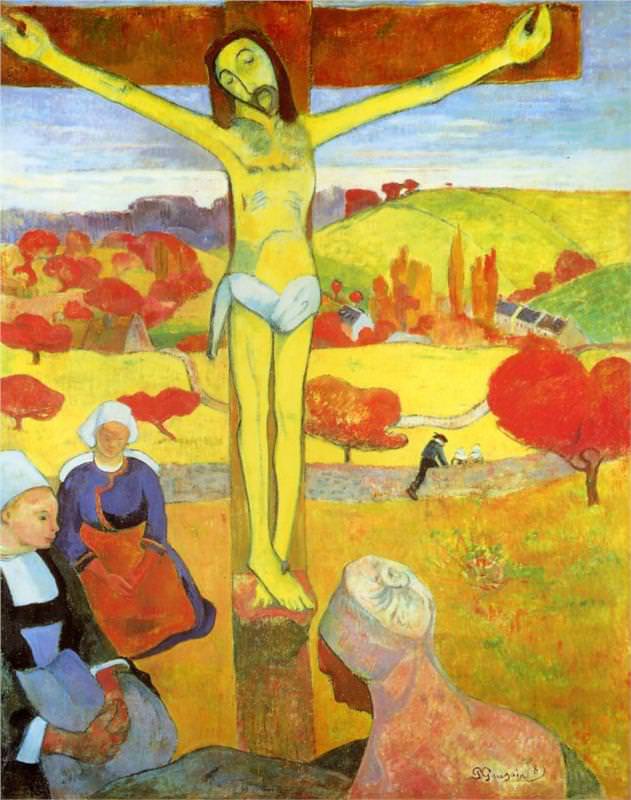
Paul Gauguin's The Yellow Christ begins with a local object and ends as a painting that refuses to stay local. The figure on the cross derives from the painted wood Christ preserved at Notre-Dame de Trémalo, the chapel outside Pont-Aven that became central to the picture's history, but Gauguin moves that devotional source into a cold, sharpened Breton landscape and paints the body of Christ a strong, uneasy yellow. [1] [3] [4] The result is not a church copy, a village record or a simple Symbolist emblem. It is a modern picture built from the pressure between a real sacred object, a represented rural setting, women at prayer and Gauguin's own desire to make Brittany carry meanings he could not find in Paris.
At a Glance
- ArtistPaul Gauguin
- TitleLe Christ jaune (The Yellow Christ) [1]
- Date1889 [1]
- Mediumoil painting [1]
- Dimensions92.07 by 73.34 centimetres [1]
- CollectionBuffalo AKG Art Museum [1]
- Signature and dateP Gauguin 89 [1]
- Sourceseventeenth-century wood and polychrome Christ en croix [3]
Contents
- The Yellow Christ: Introduction
- The Buffalo Painting and Its Trémalo Source
- From Chapel Crucifix to Breton Landscape
- Yellow, Synthetism and the Pont-Aven Idea
- Compared with Vision after the Sermon
- Artist-Myth and Self-Portraiture
- Provenance, Looting and Restitution
The Buffalo Painting and Its Trémalo Source
The active object is the 1889 oil painting now in the Buffalo AKG Art Museum. The museum's title is Le Christ jaune (The Yellow Christ); the support measures 92.07 by 73.34 centimetres, and the canvas is signed and dated at the lower right, P Gauguin 89. [1] Those facts matter because the painting sits among several related things that can easily blur together: the wooden crucifix at Trémalo, Gauguin's preparatory study, the Art Institute of Chicago's later toned photograph/card connected with the composition, The Green Christ, and the Musée d'Orsay self-portrait in which Gauguin painted himself beside The Yellow Christ. [2] [5] The discussion begins with the Buffalo canvas.
The source sculpture is not vague folklore. The French Ministry of Culture's Palissy record identifies a statue known as the Christ Jaune, a wood and polychrome Christ en croix, located in the Trémalo chapel at Nizon, Pont-Aven, and dated to the seventeenth century. [3] The Mérimée record for the chapel locates Notre-Dame de Trémalo at Trémalo Penanros and describes a fifteenth- and sixteenth-century building whose polychrome wooden crucifix inspired Gauguin and was represented in both Le Christ Jaune and Portrait de l'artiste au Christ jaune. [4] That official evidence anchors the painting in a specific chapel and object before any interpretation begins.
Gauguin did not simply reproduce what he saw. Nancy Ireson's Art Institute of Chicago catalogue essay places the painting's working moment around September 1889 and notes that the source crucifix may have been encountered in relation to the chapel's annual pardon on 8 September. [2] The same scholarship points to preparatory drawing evidence that Gauguin began from in-situ observation, while also stressing that the final image is a transformation rather than a slavish copy. [2] That distinction is the painting's core. The carved body gave Gauguin a model, but the canvas makes it operate in a different world.
From Chapel Crucifix to Breton Landscape
In the chapel, the crucifix belongs to an interior and to devotional use. In the painting, it stands outdoors like a Calvary in the Breton countryside. Christ's yellow body hangs against a dark brown cross; the land around him is divided into bands of field, path, trees and distant houses. [1] [2] The relocation matters because it turns a church object into a landscape event. Gauguin lets the source remain recognisable enough to carry Christian weight, then surrounds it with the signs of rural Brittany and the pictorial simplification of his late-1880s style.
The body dominates the surface, but it is not anatomically persuasive in a conventional academic sense. The head bends with a blunt, exhausted angle; the limbs are narrowed; the torso is described by strong contours rather than modelling; the cloth around the hips becomes another flattened shape. AIC's account of the motif notes that Gauguin accentuated and simplified features of the carved Christ, making formal reduction part of the meaning rather than an incidental weakness. [2] The yellow therefore works with drawing. It is not just pigment applied to a figure; it is a way of making the body feel separate from ordinary flesh and strangely continuous with the autumn land around it.
At the foot of the cross, Breton women kneel in regional dress. Their dark garments and white caps form a low, compact counterweight to the upright cross. [1] [2] They are essential to the painting, but interpretations of them require care. They are not available to us as transparent examples of pure faith, indifference or superstition. Gauguin represents them through his own pictorial construction, and later writers have often made their silence do too much explanatory work. Their bodies gather around the cross; their faces and gestures remain restrained. The painting stages devotion, habit, distance and uncertainty without letting any one of those states become a documented psychology.
Buffalo AKG connects the kneeling women with the Angelus, the Catholic prayer recited at set times of day, and relates the autumn harvest to Christian ideas of birth, death and rebirth. [1] That interpretation helps explain why the landscape is not neutral scenery. Fields, crops, paths and the hour of prayer can make Christ's Passion seem tied to seasonal cycles. But the claim should stay attributed. The painting does not prove that Gauguin witnessed one exact prayer gathering, nor does it grant access to the inner lives of the women he painted. It shows how he made a devotional source, a landscape and regional costume work together.
The surrounding landscape keeps this tension active. Paths wind away from the cross; a wall interrupts the field; small figures move in the distance, including a person near or crossing a wall; houses and trees recede without creating deep atmospheric space. [2] These details prevent the picture from becoming an isolated icon. Christ is central, but he is set among ordinary movement and rural structure. The sacred image and everyday place coexist, while the strong outlines keep both from settling into naturalistic report.
Yellow, Synthetism and the Pont-Aven Idea
The colour is often the first thing a viewer remembers, and it deserves more than a single symbolic label. Yellow can read as autumnal, luminous, sickly, radiant or estranged, sometimes all at once. Buffalo records Gauguin's association of the colour with his feeling about Breton isolation and piety, while the National Gallery of Art's Gauguin: Maker of Myth describes the painting as radicalising the church crucifix through acid yellow and a prismatic landscape. [1] [7] Those accounts support the importance of yellow, but they do not turn it into a fixed code. The colour's power lies in its instability. It links Christ to the land and separates him from flesh; it warms the surface and makes it uneasy.
This is also where the painting belongs to Gauguin's move away from Impressionist description. The Met's broad account of Gauguin's career describes the late 1880s as the period when he left the broken touch and softer palette associated with his earlier Impressionist contacts for simplified shapes, broad colour and more abstract construction. [6] The National Gallery of Art brochure links the Brittany works to flat, bold colours and dark outlines, with effects reminiscent of stained glass, Japanese prints and cloisonné enamels. [7] In The Yellow Christ, that language is not decorative theory. It is visible in the way the cross, caps, fields, body and trees become interlocking areas on the canvas surface.
Yet the painting should not be praised by repeating Gauguin's primitivising fantasy as if it were fact. The National Gallery of Art brochure quotes his statement that he found Brittany "wild" and "primitive", hearing in its granite ground the sound he wanted in painting. [7] That sentence reveals a great deal about his self-fashioning. It does not describe Breton people from the inside. Gauguin wanted Brittany to stand against modern Paris: older, harder, more spiritual, less urban, more available to symbolic art. The painting draws energy from that desire, but the desire itself was selective and often patronising.
Compared with Vision after the Sermon
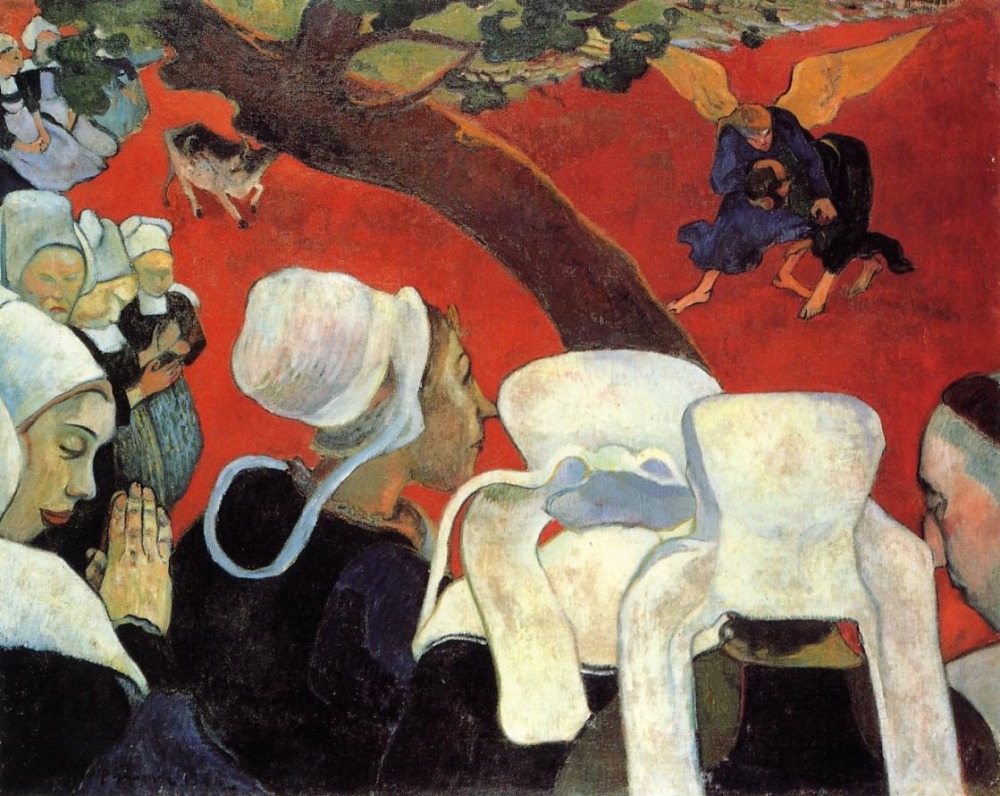
The comparison with Vision after the Sermon clarifies the difference. In the 1888 painting, Gauguin makes the biblical struggle appear in the represented imagination of Breton worshippers. Its red ground and divided scale show a sermon becoming vision. [7] The Yellow Christ is quieter and more static. The sacred figure is not a small imagined episode beyond the women; it is the dominant object before them. The women do not appear enthralled by a newly heard story. They kneel before a cross that has been made at once local, theatrical and strangely remote.
Ireson's AIC essay makes that contrast sharper, reading The Yellow Christ as more wearied and estranged than the visionary absorption of Vision after the Sermon. [2] The point is useful if kept bounded. It does not mean the women are factually indifferent, or that Brittany itself had lost spiritual force. It means Gauguin's painting creates a mood in which devotion seems heavy, repeated and opaque. Christ is physically large, but emotionally isolated. The women are close to the cross, yet their presence does not dissolve its solitude.
Artist-Myth and Self-Portraiture
That solitude soon became part of Gauguin's own artist-myth. In September 1889 he told Emile Bernard that The Yellow Christ and the related self-portrait "nearly express" what he wanted to say at that moment. [2] The phrase is revealing partly because it stops short of explanation. Gauguin did not provide a neat symbolic key. He pointed to the works as approximations of a state: artistic ambition, isolation, religious imagery and self-dramatisation all pressing together.
The later Orsay self-portrait makes the personal dimension explicit without rewriting the Buffalo painting as a literal self-portrait. In Portrait de l'artiste au Christ jaune, dated by the Musée d'Orsay to 1890-1891, Gauguin paints himself between The Yellow Christ and an anthropomorphic pot. [5] Orsay calls the work a kind of manifesto and a triple portrait, with the Yellow Christ at left and the ceramic head at right as different facets of the artist's self-presentation. [5] That matters for The Yellow Christ because it shows Gauguin returning to the image as a tool for self-definition. It does not mean every woman, field or path in the 1889 canvas should be decoded as private autobiography.
The painting's early reception pushed the same artist-martyr narrative into public language. AIC's catalogue discusses Octave Mirbeau's 1891 response, in which the critic emphasised Christ's isolation and used the work to support Gauguin's need to leave Brittany, eventually for Tahiti. [2] The reception is important, but also risky. Mirbeau's rhetoric made the women and the landscape serve a story of misunderstood genius seeking solitude elsewhere. That story helped Gauguin, but it also folded Brittany into a larger fantasy of escape.
The Tahiti horizon should therefore be handled as context rather than destiny. The National Gallery of Art brochure notes that Gauguin's 1891 departure was shaped by idealised, colonial-era images of Tahiti, and that the island he reached was already a French colony deeply altered by European disease, missions and administration. [7] The Yellow Christ predates that voyage, but its reception helped build the self-image of an artist who would leave Europe in search of a supposedly freer world. The painting is not a Tahitian work. It is one of the Breton works through which Gauguin learned to turn place, religion and self-myth into a public artistic identity.
Provenance, Looting and Restitution
Its later history adds another layer of seriousness. Buffalo AKG records the provenance from Gauguin to Emile Schuffenecker, then to Gustave Fayet, and by 1928 to Paul Rosenberg in Paris. [1] In 1940 the German Army confiscated the painting. The museum's record traces it through the ERR system, including movement through the German embassy, the Louvre-related process, the Jeu de Paume by 5 September 1941 and a Göring-associated notation dated 24 July 1942. [1] It was returned to Rosenberg in 1945 or 1946, then purchased by the Albright Art Gallery in Buffalo on 22 July 1946. [1]
That provenance should not be treated as a separate footnote. It changes the modern life of the object. A painting about a transformed devotional image, made by an artist constructing his own isolation, later became an object taken in the organised looting of Jewish-owned art and then restored to its owner before entering an American museum. The record does not need embellishment. Its exactness is enough: the canvas has a history of possession, violence, restitution and public display that sits beside its painted history of faith and alienation. [1]
Seen whole, The Yellow Christ holds several kinds of distance at once. There is distance between the chapel sculpture and Gauguin's painted Calvary; between Breton women and the meanings projected onto them; between devotional imagery and modern surface; between Gauguin's self-myth and the people whose place he used to build it; and between the 1889 canvas and its twentieth-century wartime displacement. The yellow body keeps drawing the eye back to the centre, but the painting's force comes from everything that centre cannot settle. It is a crucifixion in Brittany, a constructed modern surface, a work of artistic self-positioning and a survivor of later historical rupture.
Related Pages
Frequently Asked Questions
Paul Gauguin's The Yellow Christ begins with a local object and ends as a painting that refuses to stay local.
This is also where the painting belongs to Gauguin's move away from Impressionist description.
Seen whole, The Yellow Christ holds several kinds of distance at once.
Discussion
Paul Gauguin's The Yellow Christ begins with a local object and ends as a painting that refuses to stay local.
Reader Insights
Paul Gauguin's The Yellow Christ begins with a local object and ends as a painting that refuses to stay local.
Yet the painting should not be praised by repeating Gauguin's primitivising fantasy as if it were fact.
It is a crucifixion in Brittany, a constructed modern surface, a work of artistic self-positioning and a survivor of later historical rupture.
Join the Conversation
Share the visible detail or source that most changed your reading.
References
- Buffalo AKG Art Museum, "Le Christ jaune (The Yellow Christ), 1889." View source
- Nancy Ireson, "The Yellow Christ (recto), Female Bather Wading through a Brook (verso), c. 1889," in Gauguin Paintings, Sculpture, and Graphic Works at the Art Institute of Chicago View source
- French Ministry of Culture, "statue dite du Christ Jaune : Christ en croix," Palissy PM29000845 View source
- French Ministry of Culture, "Chapelle Notre-Dame de Trémalo," Mérimée PA00090288 View source
- Musée d'Orsay, "Portrait de l'artiste au Christ jaune." View source
- The Metropolitan Museum of Art, Cindy Kang, "Paul Gauguin (1848-1903)." View source
- National Gallery of Art, Gauguin: Maker of Myth, exhibition brochure View source
 Paul Gauguin.jpg)