 by Tom Gurney
Tom Gurney BSc (Hons) is an art history expert with over 20 years experience
Published on August 14, 2026 / Updated on August 14, 2026
Email: tomgurney1@gmail.com / Phone: +44 7429 011000
The Green Christ: Introduction
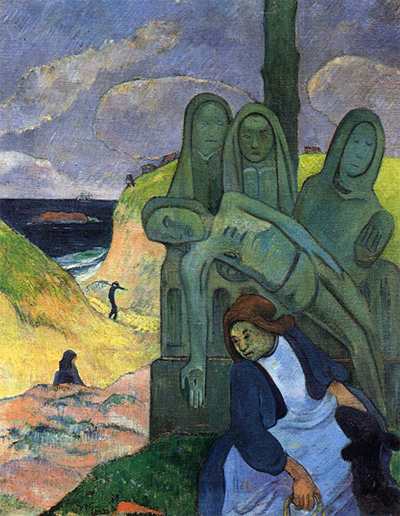
Paul Gauguin's The Green Christ is not a greener version of The Yellow Christ. The Belgian museum that owns the painting titles it Le calvaire breton, and that title points to a different kind of religious image: not Christ alive on the cross, but a Breton calvary or Deposition/Pietà motif translated into Gauguin's late-1880s pictorial language. [1] [3] [4] The common English title is useful because the green body and sombre colour are what many viewers remember first. But the stronger starting point is the museum title, because it keeps the painting attached to its Breton sculptural source and prevents it from becoming only a colour anecdote.
At a Glance
- ArtistPaul Gauguin
- Museum titleLe calvaire breton [1]
- Date1889 [1]
- Mediumoil on canvas [1]
- Dimensions92 by 73.5 centimetres [1]
- CollectionRoyal Museums of Fine Arts of Belgium [1]
- Inventory4416 [1]
- Signature and date89 / P.Gauguin [1]
- AcquisitionM. Jos Breckpot, Brussels, in 1922 [1]
Contents
- The Green Christ: Introduction
- The Brussels Painting and Its Breton Source
- A Calvary Transformed
- Colour, Form and Synthetist Space
- Brittany Between Devotion and Construction
- Why The Green Christ Stands Apart
The Brussels Painting and Its Breton Source
The active object is the 1889 oil painting in the Royal Museums of Fine Arts of Belgium, Brussels, inventory number 4416. The museum records the medium as oil on canvas, the dimensions as 92 by 73.5 centimetres, and the signature/date toward the lower left as 89 / P.Gauguin. [1] It also records the origin as an acquisition from M. Jos Breckpot, Brussels, in 1922. [1] These facts distinguish the Brussels canvas from the Buffalo Yellow Christ, from the Trémalo chapel crucifix, and from later title collisions around Gauguin's calvary imagery.
The source-motif question needs careful wording. The Brussels object page locks the title, date, medium, size, inventory and acquisition, but it does not, in the visible record, identify the exact real-world calvary that Gauguin used. [1] Local heritage sources around Pont-Aven and Nizon do make that link. De Concarneau à Pont-Aven Tourisme states that Le Christ Vert was inspired by the Descent-from-the-Cross scene of the Nizon calvary, a few kilometres from the Trémalo chapel, and that Gauguin moved the sculptural group into a landscape associated with Le Pouldu. [3] Fondation du patrimoine likewise describes the Saint-Amet church, fountain and classified calvary at Nizon as an ensemble whose Pietà inspired Gauguin's 1889 painting. [4] That is enough to use Nizon as a sourced heritage tradition; it is not enough to pretend that every detail of the canvas has been documented by the museum as direct transcription.
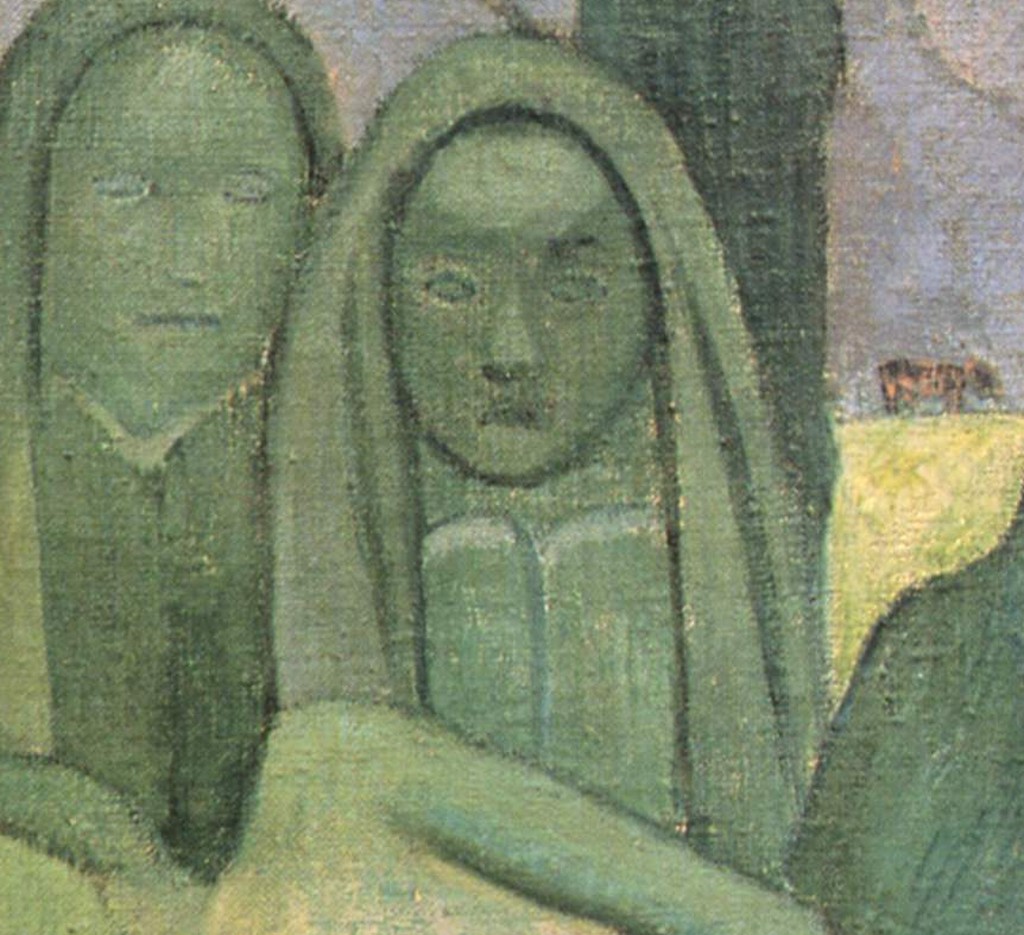
That distinction helps the painting. Gauguin was not making a topographical inventory of a Breton monument. He was taking a religious sculptural form and making it behave as a painting. The source tradition centres on a Pietà or Deposition grouping: Mary with the dead Christ, accompanied by holy women such as Mary Magdalene and Mary Salome in the local tourism account. [3] [5] In the canvas, this devotional cluster becomes a greenish, monumental presence set into an invented or transformed landscape. The religious group is recognisable, but it has been pulled away from its architectural and parish setting.
A Calvary Transformed
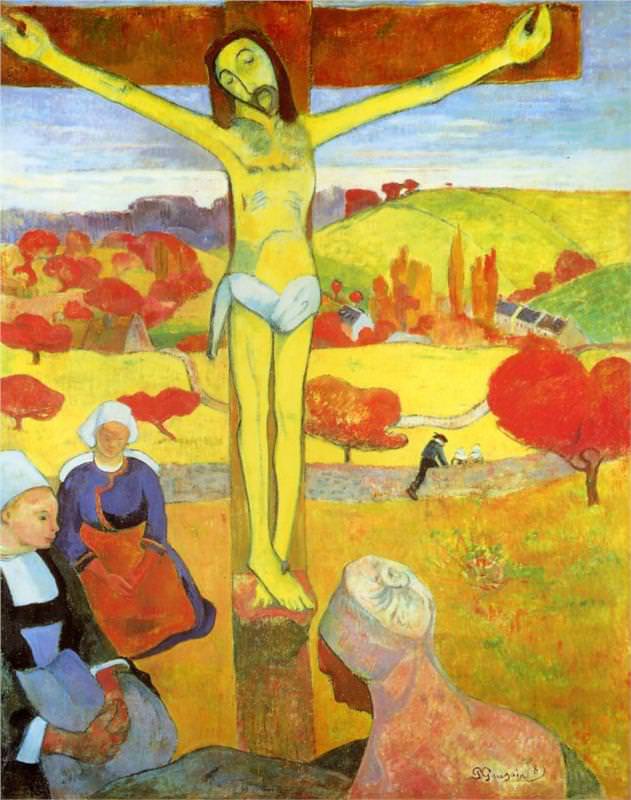
The difference from The Yellow Christ is therefore structural, not just chromatic. In the Buffalo painting, the Trémalo crucifix is relocated outdoors and Christ hangs vertically before kneeling Breton women. [7] In Le calvaire breton, the body is already dead, lowered and held. The drama is after the Crucifixion rather than during it. This change alters the emotional temperature. The cross and upright sacrifice of The Yellow Christ give way here to mourning, weight and removal. The green body does not blaze against autumn fields; it sinks into a colder field of blues, greys and greens.
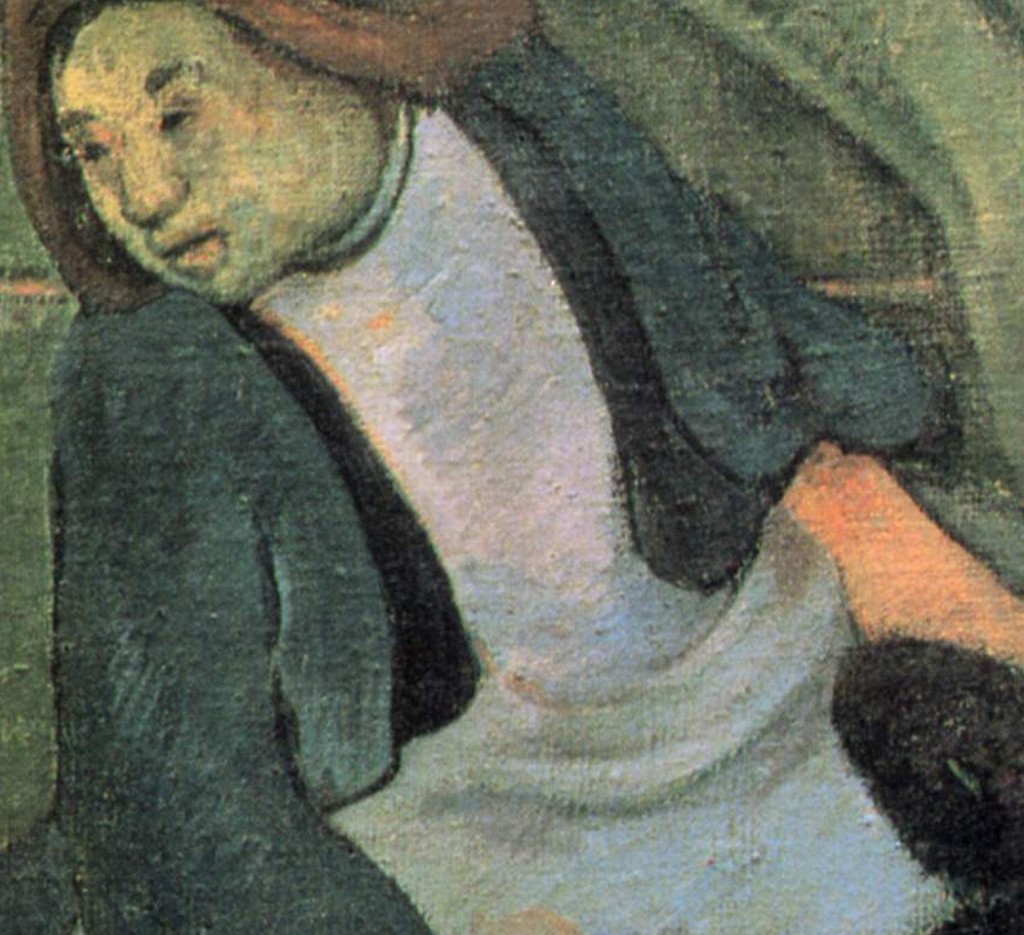
The foreground figure is also different from the praying group in The Yellow Christ. Local descriptions note a person passing before the calvary with an animal that may be read as a lamb or dog, apparently not attending directly to the sacred group. [3] That detail should not be forced into a single psychological story. The figure's relation to the calvary is ambiguous: near it, visually connected to it, but not necessarily shown as devout, indifferent or unaware in any recoverable factual sense. Gauguin gives us a visual relation, not a transcript of belief.
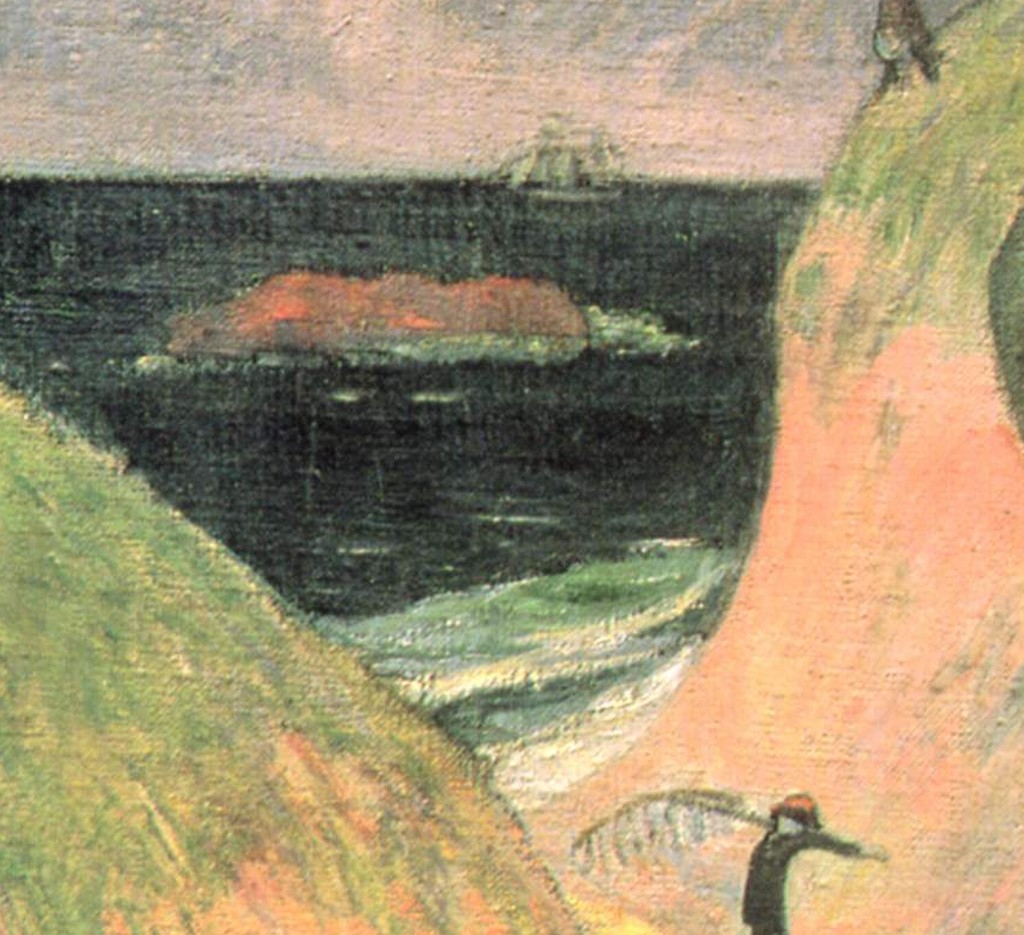
This is where The Green Christ becomes one of Gauguin's sharpest Breton inventions. A calvary or Pietà is normally a public religious object, bound to worship, memory and local place. Gauguin sets such a motif into a landscape where the sacred image and ordinary movement coexist without comfortably explaining one another. The sacred group is large and still; the passing figure and animal introduce everyday motion. The painting does not ask the viewer to decide whether faith is present or absent. It stages the difficulty of seeing faith when devotional imagery has been turned into modern art.
Colour, Form and Synthetist Space
Its colour pushes the same difficulty. The title The Green Christ can make the palette sound simple, but the effect is not simply "Christ is green." The body, land and surrounding tones create a cool, heavy atmosphere. An archival OKV discussion of the Brussels painting describes the impression as melancholy and mysterious before symbolic interpretation begins, and notes the use of cold blue and grey-green colours rather than the jubilant colour often associated with Gauguin's later tropical works. [6] That is a useful observation if kept as reception/context, not as a diagnosis of Gauguin's inner life.
Formally, the painting belongs to the same Pont-Aven shift as Vision after the Sermon, Breton Girls Dancing and The Yellow Christ, but it should not repeat their pages. Smarthistory describes the Pont-Aven/Synthetist language through simplified drawing, clearly defined contours, intensified colour and flattened space. [2] In The Green Christ, those features serve the calvary subject. The sculptural group is not modelled into deep illusion; it reads as an arrangement of hard, mournful masses. The landscape does not open into atmospheric depth so much as hold the religious form close to the picture plane.
That closeness matters because Gauguin's source is already an artwork. With a painted landscape, he might have transformed nature into composition. Here he transforms one artwork into another: carved or sculptural religious imagery becomes oil on canvas. The change of medium is not neutral. Stone or carved devotional form carries local, public and liturgical associations; Gauguin's canvas turns those associations into a portable, exhibitable object within modern art circuits. The Brussels acquisition history, with the work entering the museum from Jos Breckpot in 1922, is part of that later movement from local motif to collected painting. [1]
Brittany Between Devotion and Construction
The painting also needs to be separated from older romantic habits around Brittany. Smarthistory's account of the Pont-Aven School explicitly warns that Gauguin and his circle often turned Brittany into a fantasy of rural authenticity, and that Breton women in these works were made to stand for faith, costume and tradition against modern urban life. [2] That warning is directly relevant here. The foreground figure should not be treated as a timeless Breton type, and the calvary should not be used to claim an undifferentiated "deep faith of the Bretons" in narrator voice. The painting is evidence of Gauguin's construction of Brittany, not transparent proof of Breton inner life.
At the same time, the critical caution should not flatten the religious source into mere decoration. Nizon's church and calvary were not invented by Gauguin. Fondation du patrimoine describes Saint-Amet, its fountain and its classified calvary as a real heritage ensemble, and the local tourism page identifies the calvary in front of the church as the inspiration for Le Christ Vert. [4] [5] The painting's modernity depends on that reality. Gauguin could only transform the motif because it already had local devotional and sculptural weight.
Why The Green Christ Stands Apart
Compared with The Yellow Christ, The Green Christ is quieter and less publicly famous, but it may be more difficult. The Buffalo canvas sets a yellow crucifix before kneeling women in a way that still lets a viewer grasp a direct devotional confrontation. The Brussels canvas is more oblique. Its source is a mourning group rather than a single crucified body; its colour is colder; its foreground figure complicates the relationship between religious image and lived landscape. It therefore needs to be considered on its own terms rather than treated as a variant of The Yellow Christ.
The safest reading is object-led. Gauguin took a Breton calvary/Pietà source associated by local heritage sources with Nizon, translated it into a cool, flattened and strongly contoured oil painting, and placed ordinary presence beside sacred mourning. [1] [3] [4] In doing so, he made a work that belongs to Pont-Aven Synthetism while exposing the cultural problem inside that project: a modern painter using Breton religious art and Breton women to build an anti-modern image for modern audiences. [2] The green body is the memorable sign, but the painting's force lies in the unresolved relation between source, surface and witness.
Annotated Details from The Green Christ
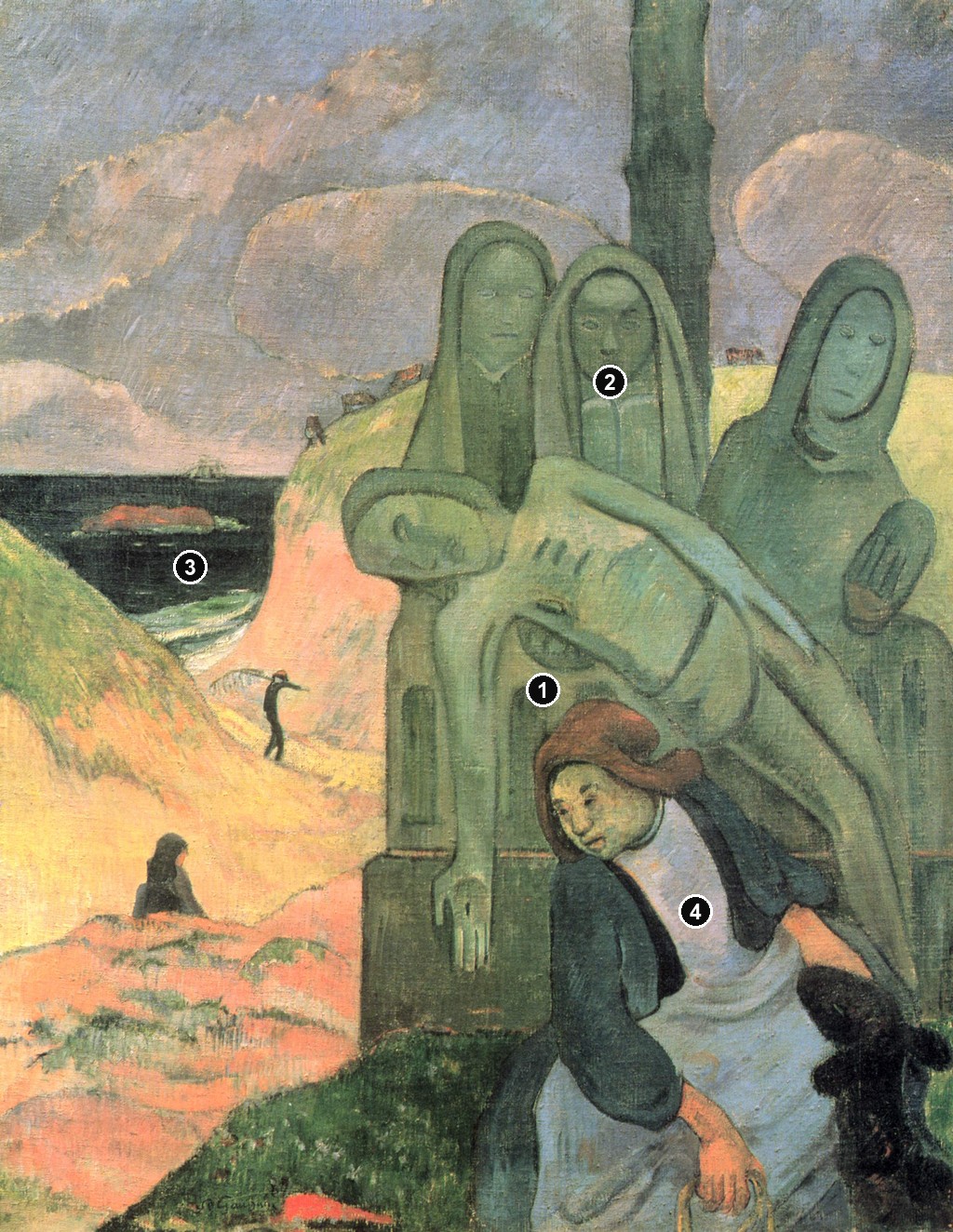
The religious group is recognisable, but it has been pulled away from its architectural and parish setting.
Details from THE GREEN CHRIST
Gauguin gives us a visual relation, not a transcript of belief.
The lowered body
In Le calvaire breton, the body is already dead, lowered and held.
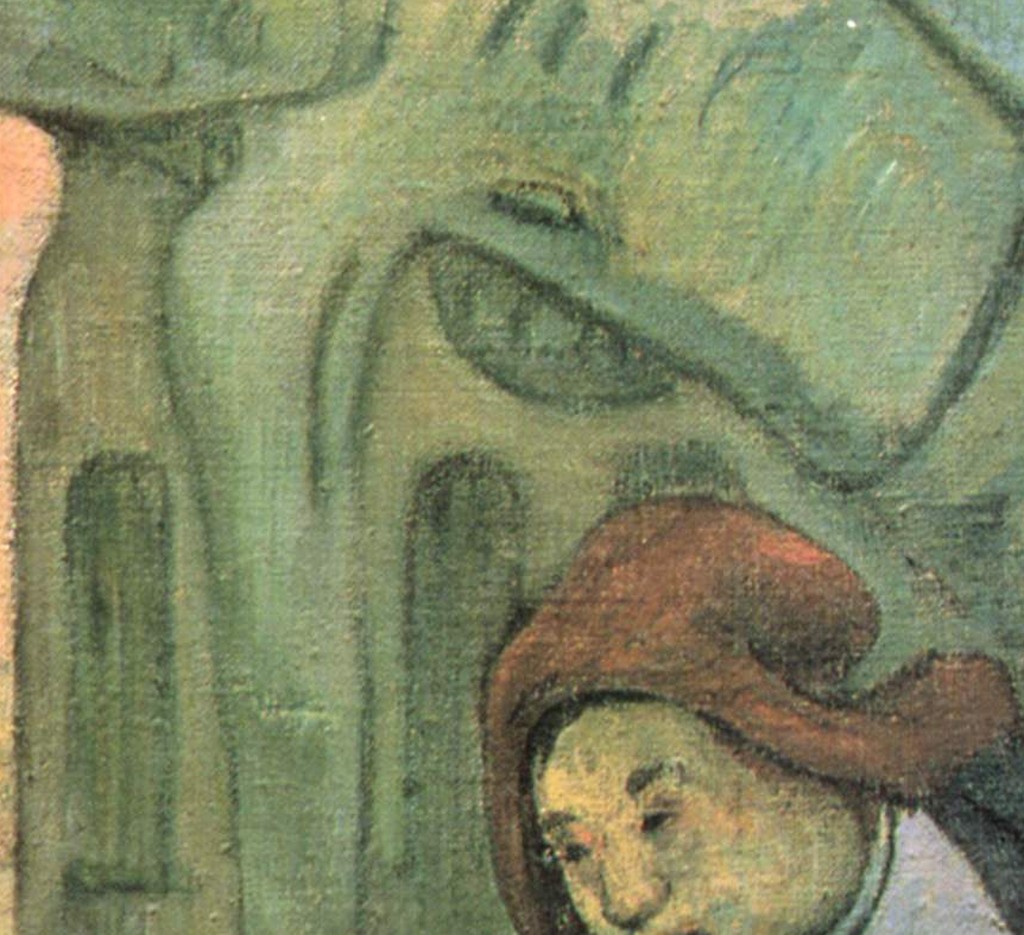
The mourning group
The source tradition centres on a Pietà or Deposition grouping: Mary with the dead Christ, accompanied by holy women such as Mary Magdalene and Mary Salome in the local tourism account.[3][5]
Sacred image and landscape
Gauguin sets such a motif into a landscape where the sacred image and ordinary movement coexist without comfortably explaining one another.
The foreground figure and animal
The figure's relation to the calvary is ambiguous: near it, visually connected to it, but not necessarily shown as devout, indifferent or unaware in any recoverable factual sense.
Related Pages
Frequently Asked Questions
Paul Gauguin's The Green Christ is not a greener version of The Yellow Christ.
Its colour pushes the same difficulty.
The safest reading is object-led.
Discussion
Paul Gauguin's The Green Christ is not a greener version of The Yellow Christ.
Reader Insights
Paul Gauguin's The Green Christ is not a greener version of The Yellow Christ.
Gauguin sets such a motif into a landscape where the sacred image and ordinary movement coexist without comfortably explaining one another.
The green body is the memorable sign, but the painting's force lies in the unresolved relation between source, surface and witness.
Join the Conversation
Share the visible detail or source that most changed your reading.
References
- Musées royaux des Beaux-Arts de Belgique, "Paul Gauguin, Le calvaire breton." View source
- Dr. Charles Cramer and Dr. Kim Grant, "The Pont-Aven School and Synthetism," Smarthistory View source
- De Concarneau à Pont-Aven Tourisme, "Le Christ vert, œuvre de Paul Gauguin." View source
- Fondation du patrimoine, "Eglise Saint-Amet de Nizon à Pont-Aven." View source
- De Concarneau à Pont-Aven Tourisme, "L'église Saint-Amet de Nizon." View source
- OKV, "Paul Gauguin - Calvarie." View source
- Buffalo AKG Art Museum, "Le Christ jaune (The Yellow Christ), 1889." View source
 Paul Gauguin.jpg)