 by Tom Gurney
Tom Gurney BSc (Hons) is an art history expert with over 20 years experience
Published on August 14, 2026 / Updated on August 14, 2026
Email: tomgurney1@gmail.com / Phone: +44 7429 011000
Self-Portrait with the Yellow Christ: Introduction
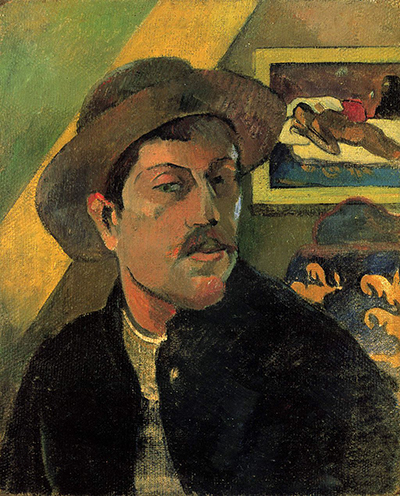
Paul Gauguin's Self-Portrait with the Yellow Christ is a portrait built out of three selves. At the centre is Gauguin's living face, turned toward the viewer with a guarded stare. At the left is the cropped image of The Yellow Christ, the Breton religious painting he had made the previous year. At the right is an anthropomorphic pot, a head-like ceramic object that was also Gauguin's own work. [1] [2] [3] The painting is therefore more than a likeness. It is a compact argument about how an artist can construct identity through other images, other materials and staged symbolic roles.
At a Glance
- ArtistPaul Gauguin [1]
- TitleSelf-Portrait with the Yellow Christ [1]
- Date1890–1891 [1]
- Mediumoil painting [1]
- Dimensions / object size38 by 46 centimetres [1]
- Object recordThe active object is the oil painting now in the Musée d'Orsay, whose title is Portrait de l'artiste au Christ jaune. [1]
- FocusPaul Gauguin's Self-Portrait with the Yellow Christ is a portrait built out of three selves.
Contents
- Self-Portrait with the Yellow Christ: Introduction
- The Orsay Object and Date
- A Triple Portrait in One Studio
- The Yellow Christ as a Separate Work
- The Anthropomorphic Pot
- Self-Portraiture and Selected Attributes
- Before Tahiti: Persona and Colonial Language
- Provenance and the Orsay Exhibition
The Orsay Object and Date
The active object is the oil painting now in the Musée d'Orsay, whose title is Portrait de l'artiste au Christ jaune. The current Orsay record dates it between 1890 and 1891, gives its dimensions as 38 by 46 centimetres, and lists the accession number RF 1994 2. [1] Those details govern the object's identity even though older Orsay exhibition material also uses the 1889–1890 range. [2] The current object record matters because the painting is easy to fold into the 1889 Yellow Christ story. It belongs to that story, but it is a later, separate Orsay object with its own provenance and composition.
A Triple Portrait in One Studio
The arrangement is compressed. Gauguin's bust occupies the foreground, while the two works behind him press close rather than receding into a spacious studio. The Yellow Christ appears as a cropped quotation, not as a full painting within a room. [1] [2] The anthropomorphic pot sits on a shelf at the right, red and head-shaped, visibly different in substance from the painted Christ and from Gauguin's flesh. [1] [3] One oil painting is representing another oil painting and a fired stoneware object. That cross-media construction is central to its force.
Orsay describes the painting as a manifesto and a triple portrait, and that institutional reading is useful if kept attributed. [1] The three presences do not simply illustrate a mood. They offer different forms of self-presentation: the central artist who meets the viewer, the suffering Christ image that Gauguin had already made into a powerful Breton emblem, and the grotesque ceramic head that turns self-portraiture into object, mask and fired material. [1] [2] [3] The painting asks us to compare them without collapsing them into a single code.
The Yellow Christ as a Separate Work
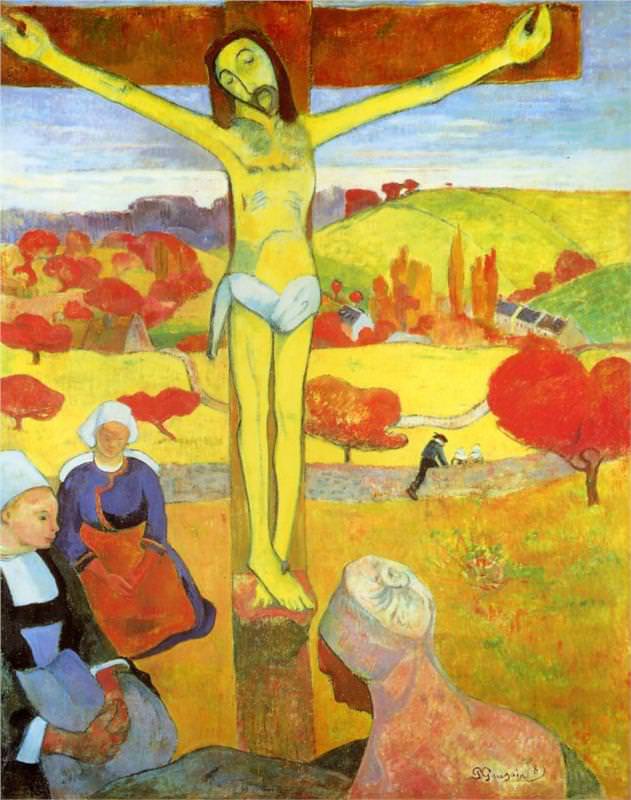
The Yellow Christ at left is the easiest element to recognise and the easiest to overuse. The Buffalo painting's object history includes the Trémalo crucifix source, the kneeling Breton women, the Angelus and harvest interpretation, the Mirbeau reception and the wartime provenance. [4] Here, the same image has a different function. It is quoted as part of Gauguin's self-construction. Orsay reads it as an image of sublimated suffering, and notes that Christ's arm above Gauguin's head can suggest a protective gesture. [1] The word "suggest" matters. The arm need not become a fixed blessing, and the portrait need not become a simple declaration that Gauguin is Christ.
The Orsay exhibition Gauguin et le Christ jaune, held from 16 October 1996 to 5 January 1997, makes the construction clearer. The exhibition text says that Gauguin's project involved a triple self-portrait: his mirror-reversed image, a mirror-reversed part of The Yellow Christ, and a tobacco pot that represented his own head. [2] That statement explains why the painting feels designed rather than casually assembled. It is not just Gauguin standing before things he owned or remembered. It is a controlled arrangement of self-images, one living, one sacred-pictorial, one ceramic.
The Anthropomorphic Pot
The pot is not a strange prop invented for the portrait. Orsay's separate object record identifies Pot anthropomorphe, also titled Portrait de Gauguin en forme de tête de grotesque, as an 1889 glazed stoneware object, 28.4 centimetres high and 21.5 centimetres in diameter, accession OA 9050. [3] The same record preserves Gauguin's autograph label under the piece: La Sincérité d'un Songe / à l'idéaliste Schuffenecker, Souvenir / Paul Gauguin. [3] The object therefore has its own material and social history before it appears inside the oil painting.
Understanding that materiality changes the portrait. The pot is fired, glazed and three-dimensional; in the self-portrait it is translated back into paint. Its head-like form answers Gauguin's living head without becoming the same kind of likeness. Orsay's current record connects it to Gauguin's harsher self-image, while the 1996 exhibition text describes its mask as one facet of the painter's persona. [1] [2] The language around the pot can become loaded quickly. If Gauguin or Orsay uses terms such as "savage" or "primitive" in relation to the work, those words should be treated as historical self-fashioning and institutional rhetoric, not narrator fact. [1] [2]
The colour opposition also belongs to Orsay's reading. The museum contrasts the yellow of The Yellow Christ with the red of the pot. [1] That opposition is visible and useful, but it is not a moral diagram that solves the painting. Yellow does not simply equal suffering or sanctity, and red does not simply equal violence or animal energy. The colours pull the two background objects apart, while Gauguin's central figure stands between them. He is not choosing one side. He is making a self-image out of the tension.
Self-Portraiture and Selected Attributes
This is why the painting belongs within Gauguin's broader portrait practice. The National Gallery in London, in its Gauguin portraits exhibition, notes that Gauguin used selected attributes and suggestive settings to make portraits express meanings beyond the sitter's personality. [8] That description fits the Orsay painting closely. Gauguin does not rely on facial likeness alone. He surrounds himself with works that convert likeness into role, myth and artistic claim.
The comparison with the National Gallery of Art's 1889 Self-Portrait helps, provided it stays bounded. In that painting, Gauguin appears with a halo, apples and a snake, making the self-image oscillate between saint, sinner and artist-magician; the NGA records the medium as oil on wood, accession 1963.10.150, with dimensions 79.2 by 51.3 centimetres. [7] The Orsay portrait is less emblematic at first glance, but it is no less staged. Instead of halo and serpent, it uses a prior religious painting and a ceramic head. Both self-portraits show Gauguin testing how attributes can make identity unstable.
The National Gallery exhibition also highlights Gauguin's Christ in the Garden of Olives as another 1889 self-image, one in which he depicts himself as Christ in anguish before betrayal and persecution. [8] That comparison matters because the Orsay portrait is part of a cluster of self-personifications, not an isolated confession. Gauguin repeatedly tried on sacred, suffering, divided or morally charged roles. The danger is to treat those roles as direct autobiography. They are better understood as deliberate self-fashioning: persuasive, strategic and visually inventive, but not transparent records of inner truth.
Before Tahiti: Persona and Colonial Language
The pre-Tahiti context adds pressure to the painting without making it prophecy. Orsay's current prose places the work on the eve of Gauguin's first trip to Tahiti and says he was little known, misunderstood and having trouble obtaining an official mission to settle in the colonies. [1] That is useful context for the manifesto reading. Gauguin was preparing a public identity that could support a risky career move. But the later voyage should not be romanticised as redemption or escape into innocence. The Met and the National Gallery of Art both frame Gauguin's Tahiti as part of a self-myth built around European primitivist fantasy, while the historical Tahiti he reached was already a French colony altered by European power, disease, missions and administration. [5] [6]
The painting's title and composition therefore sit inside a larger ethical problem. Gauguin's self-description and some older institutional language use the vocabulary of the supposedly "primitive" or "savage". [1] [2] [6] Here, those words belong only to attributed historical language. They are not neutral descriptions of Gauguin, Brittany, Tahiti, Polynesian people or artistic form. The Orsay portrait can be formally brilliant and culturally compromised at the same time. Its brilliance lies partly in how efficiently it stages identity; its risk lies in the kinds of identity Gauguin wanted to claim.
Provenance and the Orsay Exhibition
Provenance should stay factual. Orsay records the painting in Daniel de Monfreid's Paris collection, then at Galerie Ambroise Vollard in 1902, then in Maurice Denis's collection in 1903. In 1994 it was acquired by the national museums with the participation of Philippe Meyer and Japanese patronage coordinated by Nikkei, and assigned to the Musée d'Orsay. [1] That sequence is enough. It places the work within the circulation of Gauguin's reputation without requiring unsupported claims about each owner's role.
The 1996 Orsay exhibition gives the object a useful afterlife. For the first time, the museum says, it brought together the self-portrait, the seventeenth-century polychrome wooden Christ from Trémalo, the Buffalo Yellow Christ and the anthropomorphic pot. [2] That reunion matters because the Orsay painting itself is a reunion on canvas. It gathers the living artist, the religious source mediated through The Yellow Christ, and the ceramic head into one compressed field. The later exhibition made that structure physically visible by bringing the related objects and images together around it.
Seen whole, Self-Portrait with the Yellow Christ is strongest when its three selves remain distinct. The central Gauguin looks out; the painted Christ carries a borrowed and transformed language of suffering; the pot turns the artist's head into fired, grotesque material. The painting does not ask for one key. It asks the viewer to watch Gauguin assemble a persona out of quotation, object, colour, medium and myth. That assembly is exactly what makes the portrait modern, and exactly what makes it ethically unstable.
Related Pages
Frequently Asked Questions
Paul Gauguin's Self-Portrait with the Yellow Christ is a portrait built out of three selves.
The colour opposition also belongs to Orsay's reading.
Seen whole, Self-Portrait with the Yellow Christ is strongest when its three selves remain distinct.
Discussion
Paul Gauguin's Self-Portrait with the Yellow Christ is a portrait built out of three selves.
Reader Insights
Paul Gauguin's Self-Portrait with the Yellow Christ is a portrait built out of three selves.
Yellow does not simply equal suffering or sanctity, and red does not simply equal violence or animal energy.
That assembly is exactly what makes the portrait modern, and exactly what makes it ethically unstable.
Join the Conversation
Share the visible detail or source that most changed your reading.
References
- Musée d'Orsay, "Portrait de l'artiste au Christ jaune." View source
- Musée d'Orsay, "Gauguin et le Christ jaune." View source
- Musée d'Orsay, "Pot anthropomorphe." View source
- Nancy Ireson, "The Yellow Christ (recto), Female Bather Wading through a Brook (verso), c. 1889," in Gauguin Paintings, Sculpture, and Graphic Works at the Art Institute of Chicago View source
- The Metropolitan Museum of Art, Cindy Kang, "Paul Gauguin (1848-1903)." View source
- National Gallery of Art, Gauguin: Maker of Myth, exhibition brochure View source
- National Gallery of Art, "Self-Portrait." View source
- National Gallery, London, "The Credit Suisse Exhibition: Gauguin Portraits." View source
 Paul Gauguin.jpg)