 by Tom Gurney
Tom Gurney BSc (Hons) is an art history expert with over 20 years experience
Published on August 14, 2026 / Updated on August 14, 2026
Email: tomgurney1@gmail.com / Phone: +44 7429 011000
Paul Gauguin Self-Portraits: Introduction
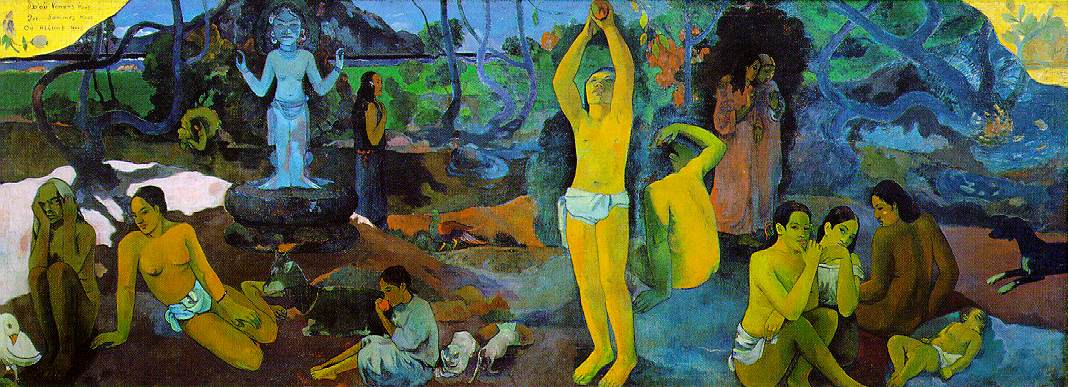
Paul Gauguin's self-portraits are not just records of how he looked. They are staged arguments about what kind of artist he wanted to appear to be: renegade, victim, saint, sinner, martyr, maker of myths, or modern painter working against ordinary likeness. The National Gallery's 2019–2020 exhibition Gauguin Portraits gives the right starting point. Gauguin often used selected attributes and suggestive settings so that portraits expressed meanings beyond the sitter's personality. [1] In the self-portraits, the sitter was also the maker, so the problem becomes sharper: Gauguin was not only representing an identity, but manufacturing one.
At a Glance
- ArtistPaul Gauguin
- GuidePaul Gauguin Self-Portraits
- FocusSelf-Portraits
- Key topicsThe 1885 self-portrait; Les Misérables; Halo and Snake; Self-Portrait with the Yellow Christ
- OverviewPaul Gauguin's self-portraits are not just records of how he looked.
Contents
- Paul Gauguin Self-Portraits: Introduction
- The 1885 Self-Portrait
- Les Misérables and the Portrait Exchange
- Self-Portrait with Halo and Snake
- Christ, Saint and Outsider Roles
- Self-Portrait with the Yellow Christ
- Reading the Group without One Fixed Key
Selected Self-Portraits
That method also explains why the self-portraits should be read as a group rather than as isolated confessions. The National Gallery exhibition included portraits in paintings, works on paper and three-dimensional objects, and it stressed how Gauguin returned to sitters and roles across different media. [1] For self-portraiture, this variety matters. Gauguin could build identity through a painted face, through a background portrait, through biblical attributes, through a quoted earlier canvas or through a ceramic object that behaves like another distorted head. The continuity is not appearance alone. It is the repeated decision to make the self into a constructed image.
The 1885 Self-Portrait
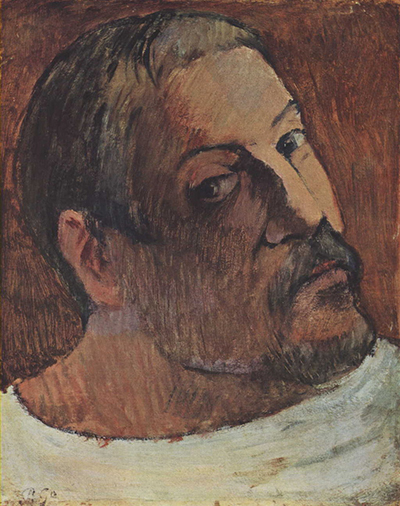
The useful pattern is visible early. The Kimbell Art Museum's 1885 Self-Portrait is an oil on canvas, 65.2 by 54.3 centimetres, accession AP 1997.03. [5] Kimbell's account places it at a decisive moment, when Gauguin was leaving Copenhagen and committing himself more fully to Paris and art; the museum also notes that technical examination shows changes as he made the image more direct and stark. [5] That early work matters because it shows that self-portraiture was already a testing ground. Gauguin did not wait until the famous Symbolist works to make the face carry decision, defiance and career drama.
The Kimbell painting is useful precisely because it is not yet the spectacular symbolic Gauguin of 1888–1891. The museum's account says that infrared and radiographic examination revealed an earlier arrangement in which Gauguin appeared in profile and included reproductions of his own works on the wall. [5] In the finished painting, the self becomes more confrontational: the artist turns towards the viewer and occupies a cramped, cold interior. [5] Even before the better-known religious and literary masks, Gauguin was revising the image of himself. The change from side-view artist to direct, severe presence is a technical fact with interpretive force.
Les Misérables and the Portrait Exchange
By 1888, the self-portrait had become a way to build an artistic network. The Van Gogh Museum catalogue entry for Self-Portrait with Portrait of Emile Bernard (Les misérables) explains that Vincent van Gogh wrote from Arles asking Gauguin and Bernard, then in Pont-Aven, to exchange portraits. [2] Gauguin and Bernard altered the request. Rather than painting each other directly, each made a self-portrait with a simplified portrait of the other in the background. [2] The result was not only an image of Gauguin. It was a statement about affiliation, rivalry and how avant-garde artists could present themselves to one another.
The inscription les misérables makes that statement more deliberate. The Van Gogh Museum catalogue shows that Gauguin connected the portrait to Victor Hugo's Jean Valjean and to an image of the misunderstood artist as an oppressed outsider. [2] This should be read as self-fashioning, not as diagnosis. Gauguin was not proving that he was a noble criminal or a social victim. He was choosing a literary role that made his marginal position in the art world sound charged, heroic and morally serious. A close reading of that painting needs the full letter evidence, but for a survey of the self-portraits the important point is the method. Gauguin used text, literature and portrait exchange to enlarge the meaning of a face.
The same painting also shows how style itself became part of the persona. The Van Gogh Museum catalogue records Gauguin's claims that the portrait was abstract, far from nature and related in his mind to decorative sources such as Persian carpets; it also records Van Gogh's mixed reaction after seeing the work, including his sense that it looked studied and sombre. [2] The important point is not who was right. The exchange shows two artists arguing through self-portraiture about what modern identity should look like. Gauguin wanted a face that carried an idea; Van Gogh still wanted the portrait to convey a more immediate human state.
Self-Portrait with Halo and Snake
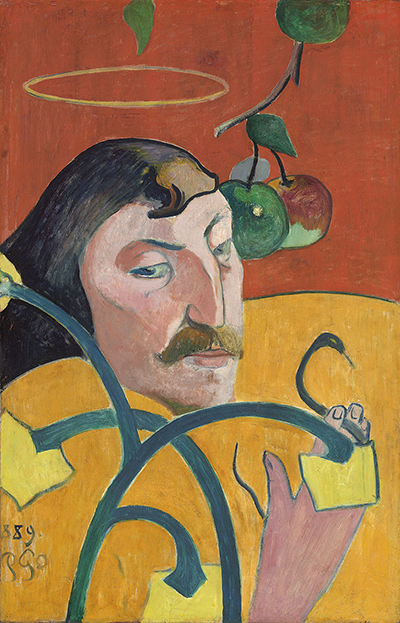
In 1889, Gauguin's National Gallery of Art Self-Portrait pushed symbolic role-play further. The NGA object record identifies the work as oil on wood, 79.2 by 51.3 centimetres, accession 1963.10.150, from the Chester Dale Collection. [3] The image is now commonly described as Self-Portrait with Halo and Snake, although the institution title is simply Self-Portrait. The distinction matters because the public title names the symbols, while the museum title keeps the object from becoming only a riddle.
NGA's visual description and interpretation make the contradiction explicit. Gauguin places his head against red and golden-yellow fields; a thin halo hovers above him; apples hang near a branch; a green vine-like form becomes a serpent's head near his fingers; and the green inscription includes 1889 and P Go. [3] The museum reads the upper half as saintly and the lower half as sinful, with Gauguin appearing as both saint and tempter. [3] That is a strong reading, but it should remain an interpretation. The picture does not reveal a settled moral essence. It stages an unstable artist-role through colour, biblical signs and artificial flatness.
Christ, Saint and Outsider Roles
The National Gallery's portrait exhibition helps connect these individual works. It notes that Gauguin's self-portraits include personifications such as Christ in the Garden of Olives, 1889, in which he presents himself through the anguish and persecution of Christ. [1] The National Gallery of Art's Gauguin: Maker of Myth similarly describes Gauguin extending outsider and martyr themes into self-portraits and even into severe, grotesque forms of self-image. [7] These examples should not be flattened into autobiography. They show a repertoire. Gauguin repeatedly tried on roles that made artistic suffering look meaningful.
That repertoire can look contradictory because it was meant to hold contradiction. The outlaw of the Van Gogh Museum portrait, the saint-sinner of the NGA painting and the suffering Christ-personification named by the National Gallery are not interchangeable symbols. [1] [2] [3] They are different solutions to the same public problem: how could Gauguin make artistic independence visible? Sometimes he answered by borrowing literature, sometimes by borrowing Christian imagery, sometimes by placing his own art beside his face. The comparisons are strongest when they stay specific. The point is not that every self-portrait says the same thing, but that each one turns likeness into an argument.
Self-Portrait with the Yellow Christ
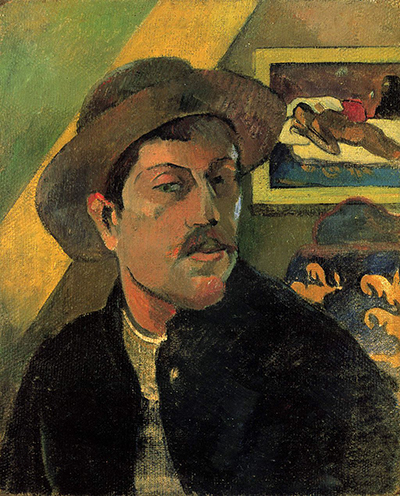
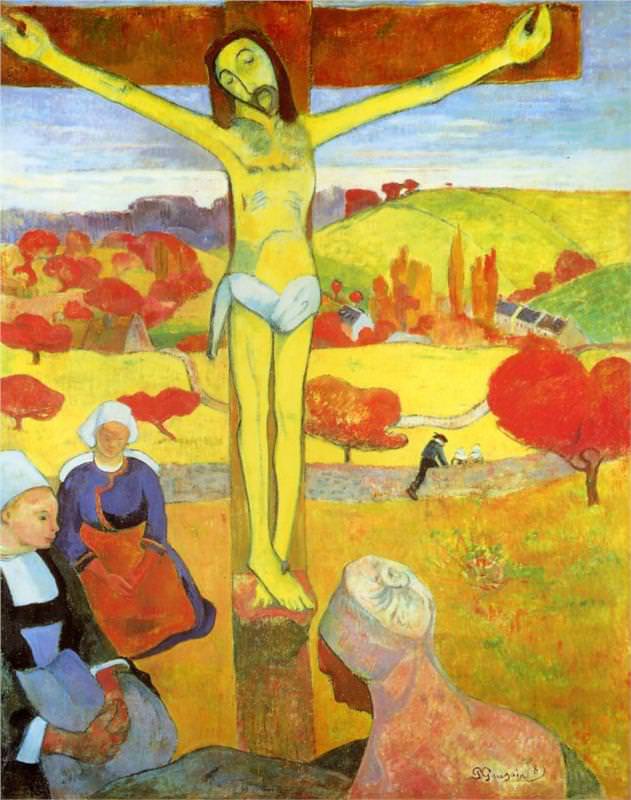
That repertoire reaches a different kind of complexity in the Orsay Portrait de l'artiste au Christ jaune. The Musée d'Orsay dates the oil painting to 1890–1891, gives its dimensions as 38 by 46 centimetres and records accession RF 1994 2. [4] Orsay interprets it as a manifesto and a triple portrait: Gauguin at the centre, The Yellow Christ at one side and the anthropomorphic pot at the other. [4] Here self-portraiture becomes quotation. Gauguin constructs identity by placing earlier works beside himself, turning painting and ceramic into supporting versions of the artist.
That makes the Orsay portrait different from the Halo and Snake image. In the NGA painting, symbols attach to Gauguin's head and hand: halo, apples, snake, colour zones. In the Orsay painting, the surrounding presences are finished works of his own. [3] [4] One method builds an allegorical self through attributes; the other builds a composite self through quotation and media. Both methods depend on staging. Neither should be treated as a private confession simply because the artist's face appears.
Reading the Group without One Fixed Key
This is also why Gauguin's self-portraits matter across his work. They connect Brittany to the Arles exchange, the religious pictures to portraiture, and the ceramics to the wider problem of self-invention. The face is never just a face. It may stand beside Bernard, beside Christ, beside a snake, beside a pot, or inside a biblical role. Each setting changes what the portrait asks the viewer to believe about the artist.
The group also helps prevent a common misreading of Gauguin. If one picture is isolated, its symbols can be overread as a direct key to the whole man. Seen together, the self-portraits are more tactical. They show an artist who understood that reputation was built through images, inscriptions, exchanges, exhibition contexts and later stories. That does not make the works insincere, but it means their claims are mediated. They need to be interpreted as paintings made for viewers, patrons and other artists, not as unfiltered access to a private self.
The ethical limit is equally important. Gauguin's self-myth often drew on loaded ideas of the outsider, the supposedly "savage" artist and the flight from modern civilisation. The Met and the NGA brochure both show how much of his later public identity depended on myth-making, primitivist fantasy and the contrast between Europe and imagined elsewhere. [6] [7] Those terms should not be repeated as neutral description. They were part of a racialised and colonial vocabulary that helped Gauguin promote himself while simplifying other people and places.
The self-portraits are therefore double-edged. They are inventive, compact and often formally daring. They also show how carefully Gauguin turned difficulty into public persona. The strong lesson is not that he was truly saint, sinner, Valjean or Christ. It is that he understood portraiture as a theatre of identity. Across these works, Gauguin made the modern artist visible by surrounding his own face with signs, stories, quotations and myths, then leaving viewers to sort out which parts were likeness and which were performance.
Related Pages
Frequently Asked Questions
Paul Gauguin's self-portraits are not just records of how he looked.
NGA's visual description and interpretation make the contradiction explicit.
The self-portraits are therefore double-edged.
Discussion
Paul Gauguin's self-portraits are not just records of how he looked.
Reader Insights
Paul Gauguin's self-portraits are not just records of how he looked.
The picture does not reveal a settled moral essence.
It is that he understood portraiture as a theatre of identity.
Join the Conversation
Share the visible detail or source that most changed your reading.
References
- National Gallery, London, "The Credit Suisse Exhibition: Gauguin Portraits." View source
- Joost van der Hoeven, "Paul Gauguin, Self-Portrait with Portrait of Emile Bernard (Les misérables), 1888," in Contemporaries of Van Gogh 1: Works Collected by Theo and Vincent, Van Gogh Museum View source
- National Gallery of Art, "Self-Portrait." View source
- Musée d'Orsay, "Portrait de l'artiste au Christ jaune." View source
- Kimbell Art Museum, "Self-Portrait." View source
- The Metropolitan Museum of Art, Cindy Kang, "Paul Gauguin (1848-1903)." View source
- National Gallery of Art, Gauguin: Maker of Myth, exhibition brochure View source
 Paul Gauguin.jpg)