 by Tom Gurney
Tom Gurney BSc (Hons) is an art history expert with over 20 years experience
Published on August 14, 2026 / Updated on August 14, 2026
Email: tomgurney1@gmail.com / Phone: +44 7429 011000
Self-Portrait with Halo and Snake: Introduction
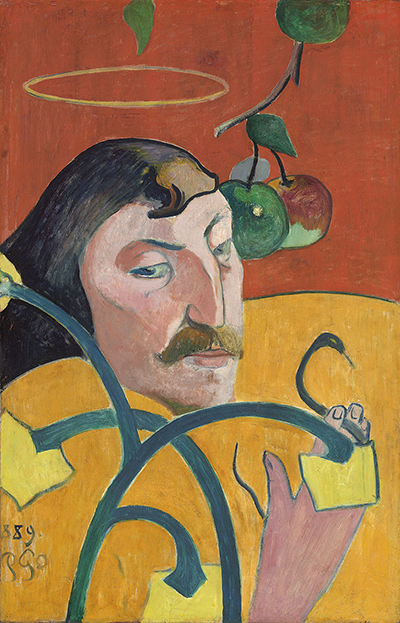
Paul Gauguin's Self-Portrait with Halo and Snake does not ask viewers to choose between a virtuous artist and a guilty one. It puts both roles into play at once. A narrow halo, two apples and a serpent surround a disembodied head, while red, yellow and green turn the background into a set of emphatic colour zones. The result is less a confession than a deliberately unstable performance: Gauguin presents his face, then makes every accompanying sign complicate it.
At a Glance
- ArtistPaul Gauguin [1]
- TitleSelf-Portrait with Halo and Snake [1]
- Date1889 [1]
- Mediumoil on wood [1]
- Dimensions / object size79.2 by 51.3 centimetres [1]
- Object recordIt dates from 1889, is painted in oil on wood, and measures 79.2 by 51.3 centimetres. [1]
- FocusPaul Gauguin's Self-Portrait with Halo and Snake does not ask viewers to choose between a virtuous artist and a guilty one.
Contents
- Self-Portrait with Halo and Snake: Introduction
- The National Gallery of Art Object
- A Cupboard Door from Le Pouldu
- Halo, Apples, Serpent and Colour Zones
- Saint and Sinner: An Attributed Interpretation
- The Unresolved Yellow Form
- Self-Portraiture and Artistic Persona
- Comparison with Neighbouring Self-Portraits
The National Gallery of Art Object
The National Gallery of Art calls the work simply Self-Portrait. It dates from 1889, is painted in oil on wood, and measures 79.2 by 51.3 centimetres. It belongs to the Chester Dale Collection and carries accession number 1963.10.150. [1] The familiar extended title is useful because it names the two most conspicuous attributes, but the museum's shorter title is a reminder that the painting remains a portrait rather than an iconographic puzzle with one guaranteed answer.
A Cupboard Door from Le Pouldu
The support is part of the work's history. An NGA audio-tour account says Gauguin painted it on a cupboard door from the dining room of an inn at Le Pouldu, the Breton coastal village where he worked in 1889. [2] That improvised origin does not make the image casual. Gauguin used the tall wooden panel to create a tightly controlled field in which the head and right hand appear detached from an ordinary body or room. A domestic surface became the setting for an unusually theatrical artist-image.
Halo, Apples, Serpent and Colour Zones
The head occupies the centre, turned towards the viewer but looking down and to the side. Above it, the background is tomato red; below it, a golden yellow zone rises around the face. A thin green line divides the two areas. Two apples hang at the upper right, and the slight yellow halo floats nearby. From the lower edge, a dark green vine-like form curves upwards beside flat yellow shapes that the NGA cautiously identifies as perhaps abstracted flowers or fruit. At lower right, a hand holds the green form between two fingers, after which it seems to acquire a serpent's head. [1]
These details are crisp enough to recognise but too compressed to behave like ordinary still-life objects. The apples have no naturalistic tree or garden around them. The halo is a slender loop rather than a radiant sacred atmosphere. The green plant is simultaneously foliage, pattern and snake. Even the hand enters without a visible arm. Gauguin therefore makes recognition and uncertainty operate together. The viewer can name biblical-looking signs, yet the picture refuses to arrange them into a conventional narrative scene.
Colour reinforces that refusal. Broad red and yellow fields do not describe a room, daylight or measurable distance. They push the face forward and make each attribute read as a separate emblem. The NGA's audio commentary connects the large flat zones and strong boundaries with Cloisonnism, while also noting the importance of Japanese prints and Symbolist interest in floating heads. [2] Those comparisons help explain the painting's departure from observed space. Form has been simplified so that colour and placement can carry the pressure normally supplied by setting and action.
The work also declares its making. In green at the lower left, Gauguin placed 1889 and the abbreviated signature P Go. [1] Their colour links the inscription to the dividing line and serpent-vine. Date and name are not tucked away as neutral documentation; they participate in the design. Against the red ground, the inscription acts almost like another sign in the portrait's symbolic vocabulary.
Saint and Sinner: An Attributed Interpretation
The National Gallery of Art proposes that the upper part shows Gauguin as a saint, with the halo above him and his gaze turned from the apples, while the lower part makes him the sinner or tempter who holds the snake. The museum then suggests that the modern artist places himself beyond conventional divisions of good and evil. [1] This is a strong and coherent institutional reading, but it should not be mistaken for the painting's single decoded message. Gauguin may be staging moral contradiction without resolving it, and the strange objects retain deliberate ambiguity.
The Unresolved Yellow Form
One unresolved passage is especially instructive. The yellow shape rising on either side of the head has been compared with angelic wings, a tabletop or even a platter beneath the face; the NGA audio account concludes that its meaning is unclear. [2] That uncertainty matters. If every form is forced into a fixed biblical scheme, the painting becomes simpler than it looks. Its visual power comes partly from allowing sacred, comic, threatening and decorative possibilities to coexist.
Self-Portraiture and Artistic Persona
The wider portrait practice supports this open reading. The National Gallery in London notes that Gauguin used carefully selected attributes and suggestive contexts to make portraits communicate beyond a sitter's personality. [3] Here the attributes do not merely tell us who Gauguin believed himself to be. They show him controlling how identity is made visible. Halo and serpent offer recognisable roles, but their simultaneous presence prevents either one from winning.
This strategy belongs to Gauguin's broader construction of an artistic persona. The NGA's Gauguin: Maker of Myth brochure describes his personal stories as mixtures of fact and fiction used to establish identity and artistic credibility. Its discussion of this portrait stresses the reversals: saint and sinner, tempted and tempter, angel and Lucifer. [4] The Metropolitan Museum likewise observes that Gauguin promoted divided roles for himself, including the supposedly untamed outsider and the sensitive martyr. [5] Such descriptions reveal a publicity strategy as much as an inner state.
That context also requires care with Gauguin's own vocabulary. He repeatedly presented himself through racialised ideas of the supposedly "savage" artist, making claims about ancestry and freedom from civilisation that museums now identify as self-mythologising. [4] [5] Those historical claims should not become the narrator's language. In this 1889 portrait, moral and religious signs already show how readily Gauguin converted identity into a dramatic opposition. Later myths about culture and colonial elsewhere intensified that habit and carried much greater ethical consequences.
Comparison with Neighbouring Self-Portraits
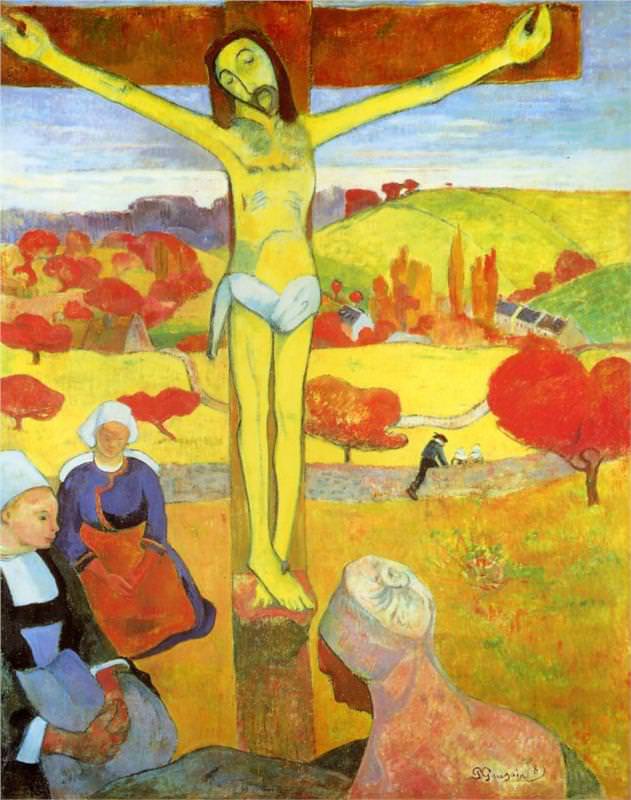
Comparison with two neighbouring self-portraits clarifies the Washington portrait without making them interchangeable. In the 1888 Self-Portrait with Portrait of Emile Bernard (Les misérables), Gauguin used a literary role, an inscription and an exchange between artists to fashion himself as a misunderstood outsider. In the Orsay Self-Portrait with the Yellow Christ, he surrounded his central face with quotations from his own painting and ceramic work. The Washington portrait is more radically stripped down. Attributes attach directly to the head and hand, while colour removes almost all ordinary setting.
The object's provenance begins at Le Pouldu. According to the NGA, Gauguin consigned it to the innkeeper Marie Henry in place of rent. It was sold in 1919 through François Norgelet to Galerie Barbazanges, later passed through dealers and British ownership, and reached Kraushaar Galleries in New York in 1925. Chester Dale bought it on 6 September 1928; his 1963 gift brought it to the National Gallery of Art. [1] The chain matters because an object made on an inn cupboard door eventually became part of a major American museum collection.
That journey did not settle the portrait's meaning. If anything, the work survives because its signs remain active without becoming fully obedient. The halo does not erase the serpent; the serpent does not cancel the halo. Apples, hand, inscription and colour establish a moral theatre in which Gauguin is actor, designer and subject. Self-Portrait with Halo and Snake is most revealing not as proof that the artist was saint or sinner, but as evidence that he understood identity could be manufactured through contradiction—and that a portrait could make the contradiction more compelling than any answer.
Related Pages
Frequently Asked Questions
Paul Gauguin's Self-Portrait with Halo and Snake does not ask viewers to choose between a virtuous artist and a guilty one.
The National Gallery of Art proposes that the upper part shows Gauguin as a saint, with the halo above him and his gaze turned from the apples, while the lower part makes him the sinner or tempter who holds the snake.
That journey did not settle the portrait's meaning.
Discussion
Paul Gauguin's Self-Portrait with Halo and Snake does not ask viewers to choose between a virtuous artist and a guilty one.
Reader Insights
Paul Gauguin's Self-Portrait with Halo and Snake does not ask viewers to choose between a virtuous artist and a guilty one.
The museum then suggests that the modern artist places himself beyond conventional divisions of good and evil.
Apples, hand, inscription and colour establish a moral theatre in which Gauguin is actor, designer and subject.
Join the Conversation
Share the visible detail or source that most changed your reading.
References
- National Gallery of Art, “Self-Portrait.” View source
- National Gallery of Art, “West Building Tour: Featured Selections stop 195.” View source
- National Gallery, London, “The Credit Suisse Exhibition: Gauguin Portraits.” View source
- Lynn Kellmanson Matheny, Gauguin: Maker of Myth, National Gallery of Art exhibition brochure, 2011 View source
- Cindy Kang, “Paul Gauguin (1848–1903),” Heilbrunn Timeline of Art History, Metropolitan Museum of Art, 2011 View source
 Paul Gauguin.jpg)