 by Tom Gurney
Tom Gurney BSc (Hons) is an art history expert with over 20 years experience
Published on August 14, 2026 / Updated on August 14, 2026
Email: tomgurney1@gmail.com / Phone: +44 7429 011000
Night Café, Arles (Madame Ginoux): Introduction
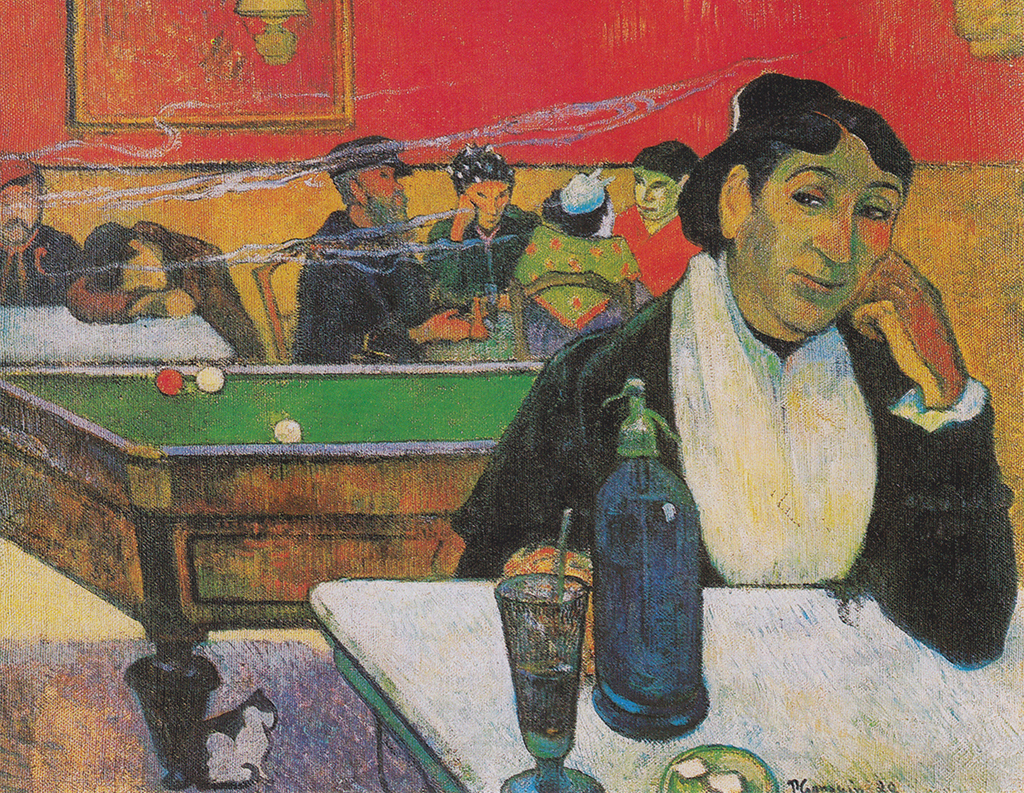
Paul Gauguin's Night Café, Arles (Madame Ginoux) is officially titled Cafe at Arles by the Pushkin State Museum of Fine Arts. Painted in 1888, it is an oil on canvas measuring 72 by 92 centimetres and carries the museum inventory number Ж-3367. The Art Institute of Chicago's specialist exhibition checklist identifies the support more precisely as jute and dates the work to 4–12 November. Those descriptions are compatible: jute is the particular canvas fabric, while the Pushkin record supplies the governing collection metadata. [1] [2] [3]
At a Glance
- ArtistPaul Gauguin [1]
- TitleNight Café, Arles (Madame Ginoux) [1]
- Date1888 [1]
- Mediumoil on canvas [1]
- Dimensions / object size72 by 92 centimetres [1]
- Object recordPainted in 1888, it is an oil on canvas measuring 72 by 92 centimetres and carries the museum inventory number Ж-3367. [1]
- FocusPaul Gauguin's Night Café, Arles (Madame Ginoux) is officially titled Cafe at Arles by the Pushkin State Museum of Fine Arts.
Contents
- Night Café, Arles (Madame Ginoux): Introduction
- Who was Madame Ginoux?
- From portrait study to café composition
- Gauguin's café and Van Gogh's café
- How should Marie Ginoux be read?
- Why the painting matters
The title needs care because Gauguin's picture is not Vincent van Gogh's The Night Café. Van Gogh painted his separate interior in September 1888, before Gauguin arrived in Arles; it is now at the Yale University Art Gallery. Café Terrace at Night is another distinct Van Gogh work, this time an exterior. Gauguin's painting shares a venue and a period with these familiar titles, but its central problem is different. It builds a café scene around Marie Ginoux and a portrait drawing made during the two artists' brief collaboration. [4] [5]
Who was Madame Ginoux?
Marie Ginoux, born Marie Julien in 1848, ran the Café de la Gare with her husband, Joseph-Michel Ginoux. Van Gogh had lodged above the café for several months after reaching Arles, before moving into the Yellow House. By the time Gauguin arrived on 23 October, the Ginoux were therefore already part of Van Gogh's local circle. [6]
At the beginning of November, Marie sat for both artists. Van Gogh used oils on a large canvas and worked with conspicuous speed. In Letter 717 to his brother Theo, he described an Arlésienne completed in about an hour. Gauguin chose paper, charcoal and coloured chalk, heightened with white. His sheet, now in the Fine Arts Museums of San Francisco, measures 56.1 by 49.2 centimetres and is titled L’Arlésienne (Mme Ginoux, née Marie Julien, 1848–1911). [6] [7]
This was not simply a race to produce two likenesses. The Van Gogh Museum's current catalogue uses the sitting to distinguish their procedures. Van Gogh developed a painted portrait directly in front of the model. Gauguin made a portable study and then treated it as material for another work. His chalk-and-charcoal Marie became the foreground figure of Cafe at Arles. [6] [8]
That sequence also prevents a common identity error. The woman is Marie Ginoux, not an anonymous type, and she should not be confused with Joseph Ginoux, who sat for separate portraits later in the year. Nor does the title L'Arlésienne name one unique object: it applies to Van Gogh's oil portraits of Marie as well as Gauguin's drawing. The Pushkin canvas is the café painting constructed from that study. [5] [6]
From portrait study to café composition
In the drawing, Marie is the subject. In the painting, her likeness becomes an anchor within a larger arrangement. She occupies the lower foreground beside the sharply angled table, while the room and its other figures are compressed into the upper part of the canvas. Strong bands and diagonals divide the surface. The result does not read like a continuous, neutral view through ordinary perspective; foreground portrait and social interior have been fitted together as distinct pictorial zones. [1] [8]
The method is documented, not merely guessed from style. Van Gogh told Theo in early November that Gauguin was working on a painting of the same night café that he himself had already painted. The following weeks brought sustained rain. In a letter of 14 November quoted by the Van Gogh Museum, Gauguin complained that the weather hindered outdoor work and said the artists were turning to painting from memory. The museum links Night Café, Arles directly with his use of an existing portrait drawing. [7] [8] [9]
Memory here did not mean inventing without observation. Gauguin had studied Marie from life. He knew the café and its proprietors, and the painted ensemble contains recognisable furniture, figures and interior elements. What changed was the status of those observations. They could be retained in a drawing, selected, enlarged and repositioned rather than bound to one uninterrupted sitting. The canvas is therefore better understood as a construction from observed material than as a report of a single night. [8] [9]
Names sometimes given to the background figures should be treated cautiously. They establish a populated nocturnal setting, but the current institutional evidence does not securely turn each person into a known biography. In particular, a male figure should not automatically be called Joseph Ginoux. The Van Gogh Museum notes uncertainty even around related patron and sitter identifications in the Ginoux material. [6]
Gauguin's café and Van Gogh's café
The two café paintings answer different questions. Van Gogh's Yale canvas shows the room with a billiard table, harsh illumination and a floor that drives towards the rear. His letters explain that he used opposed reds and greens to communicate what he saw as the disturbing moral atmosphere of an all-night café. That interpretation belongs to Van Gogh's painting and should not simply be transferred to Gauguin's. [4]
Gauguin brings Marie forward until portrait and interior compete for attention. The café is no longer organised around a deep central floor; its setting presses behind a large figure and an oblique tabletop. The Art Institute's account of the Arles collaboration describes the artists as producing divergent results from shared subjects. Here the divergence is especially clear. A common place becomes, for Van Gogh, an expressive room and, for Gauguin, a composite encounter between a known sitter and a constructed social setting. [5]
The comparison should not harden into a rule that Van Gogh always painted direct observation while Gauguin only imagined. Van Gogh transformed colour and space deliberately; Gauguin depended on drawings made from life. Their difference lies in emphasis and sequence. For this painting, Gauguin separated the encounter with Marie from the final act of composition. The drawing stored the likeness so that the canvas could rearrange it. [6] [8]
How should Marie Ginoux be read?
Marie's position is visually dominant, but dominance is not the same as psychological disclosure. Her lowered head and resting pose have prompted descriptions of boredom, melancholy or resignation. None can be recovered as her actual state of mind from the image. Gauguin's compositional decisions tell us how he used the figure; they do not give unmediated access to the sitter's feelings. [6]
It is more revealing to ask what the transformation does. The source study records attention to a particular woman. The finished painting enlarges that record and sets it against an interior crowded with other presences. Marie is at once an identifiable person, a café proprietor connected to both artists, and the structural weight that holds the composition together. Keeping those levels separate respects the sitter while explaining the work. [6] [8]
Why the painting matters
Cafe at Arles condenses the practical exchanges of the Yellow House period without requiring the later rupture to explain it. It connects a shared model, two working methods, a drawing in San Francisco, a painting in Moscow and a second artist's competing café image at Yale. The evidence shows Gauguin gathering a motif from life and rebuilding it through scale, placement and memory. [3] [5] [8]
That is why the work deserves more than a title-based comparison with Van Gogh. Its distinctive achievement is the conversion of portrait study into pictorial structure. Once the collisions are cleared away, Marie Ginoux is neither an incidental customer nor a symbol whose feelings can be freely invented. She is the observed starting point from which Gauguin constructed the entire café. [6] [8]
Related Pages
Frequently Asked Questions
Paul Gauguin's Night Café, Arles (Madame Ginoux) is officially titled Cafe at Arles by the Pushkin State Museum of Fine Arts.
Memory here did not mean inventing without observation.
That is why the work deserves more than a title-based comparison with Van Gogh.
Discussion
Paul Gauguin's Night Café, Arles (Madame Ginoux) is officially titled Cafe at Arles by the Pushkin State Museum of Fine Arts.
Reader Insights
Paul Gauguin's Night Café, Arles (Madame Ginoux) is officially titled Cafe at Arles by the Pushkin State Museum of Fine Arts.
He knew the café and its proprietors, and the painted ensemble contains recognisable furniture, figures and interior elements.
She is the observed starting point from which Gauguin constructed the entire café.
Join the Conversation
Share the visible detail or source that most changed your reading.
References
- Pushkin State Museum of Fine Arts, Cafe at Arles, English collection record View source
- Pushkin State Museum of Fine Arts, Картина. Кафе в Арле, Russian collection record View source
- Art Institute of Chicago, complete works checklist, Van Gogh and Gauguin: The Studio of the South View source
- Yale University Art Gallery, Le café de nuit (The Night Café), accession 1961.18.34 View source
- Art Institute of Chicago, Studio of the South, archived exhibition interpretation View source
- Joost van der Hoeven, Paul Gauguin, Portrait of Joseph-Michel Ginoux, 1888, Contemporaries of Van Gogh 1, Van Gogh Museum, 2023 View source
- Vincent van Gogh, Letter 717 to Theo van Gogh, on or about 3 November 1888, Vincent van Gogh: The Letters View source
- Joost van der Hoeven, Paul Gauguin, Study Sheet with Portraits of Camille Roulin, 1888, Contemporaries of Van Gogh 1, Van Gogh Museum, 2023 View source
- Joost van der Hoeven, Paul Gauguin, Study of a Woman Seen from the Back, 1888, Contemporaries of Van Gogh 1, Van Gogh Museum, 2023 View source
 Paul Gauguin.jpg)