 by Tom Gurney
Tom Gurney BSc (Hons) is an art history expert with over 20 years experience
Published on August 14, 2026 / Updated on August 14, 2026
Email: tomgurney1@gmail.com / Phone: +44 7429 011000
Vincent van Gogh Painting Sunflowers: Introduction
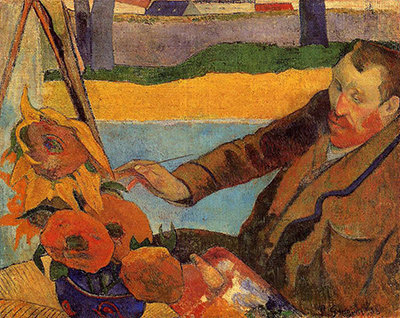
Paul Gauguin's Vincent van Gogh Painting Sunflowers looks like a scene caught in the act: Van Gogh sits at an easel, brush raised, with five sunflowers in a vase before him. Yet the portrait was made in December 1888, after the flowers' growing season. It is not a record of Van Gogh painting a live bouquet. Gauguin constructed the scene from remembered paintings, household objects and preparatory drawings to identify his companion through the subject most closely associated with him. [1]
At a Glance
- ArtistPaul Gauguin [1]
- TitleVincent van Gogh Painting Sunflowers [1]
- Date1888 [1]
- Mediumoil on canvas [1]
- Dimensions / object size73 by 91 centimetres [1]
- Object recordPainted at Arles in oil on canvas, it measures 73 by 91 centimetres, bears the inscription P. [1]
- FocusPaul Gauguin's Vincent van Gogh Painting Sunflowers looks like a scene caught in the act: Van Gogh sits at an easel, brush raised, with five sunflowers in a vase before him.
Contents
- Vincent van Gogh Painting Sunflowers: Introduction
- A portrait planned in December
- Why sunflowers identify Van Gogh
- Familiar objects, uncertain quotations
- What the surface reveals
- Tribute, argument or both?
The current Van Gogh Museum catalogue gives the work its governing title. Painted at Arles in oil on canvas, it measures 73 by 91 centimetres, bears the inscription P. Gauguin 88 and has inventory number s0225V1962. Technical examination identifies the canvas more specifically as coarse burlap, or jute. The painting belongs to the Van Gogh Museum in Amsterdam through the Vincent van Gogh Foundation. [1] [2]
A portrait planned in December
The chronology is unusually precise. Around 1 December, Van Gogh told his brother Theo that Gauguin was working on a portrait of him and considered it one of his companion's promising undertakings. About 20 December, Gauguin reported to Theo that he had completed a no. 30 canvas portraying Vincent as “the painter of sunflowers.” The historical phrase describes the portrait's idea; it is not the museum's present title. [1] [3]
Gauguin prepared the image in the sketchbook he used at Arles. Two black-chalk studies are known: one isolates Van Gogh's facial features, while another lays out the composition as a whole. The second is already close to the finished canvas. Infrared examination has revealed very few changes made during painting, and no underdrawing has been detected. Although scholars have proposed that a more detailed study once existed, none is known. [1]
This evidence makes a sustained pose in front of the depicted still life unlikely. Gauguin had decided the relationship among Van Gogh, easel, brush, vase and background before he began applying paint. The scene represents painting as an attribute of the sitter rather than documenting one December session. [1]
Why sunflowers identify Van Gogh
The flowers refer back to Van Gogh's still lifes of August 1888. He had painted them to decorate the Yellow House while waiting for Gauguin's arrival, and two large versions hung in the guest's room. Gauguin already knew earlier Paris sunflower pictures: in late 1887 he had received two of them in exchange for a Martinique landscape. Shortly after reaching Arles, he praised the Sunflowers among the works in Van Gogh's decoration. [1] [4]
His admiration continued after the shared stay ended. Gauguin called the yellow-background Sunflowers a perfect expression of an essentially Vincent style and sought one of the Arles canvases. Van Gogh resisted parting with the original but considered making a repetition for exchange. The documentary pattern is consistent: Gauguin regarded the motif as distinctively Van Gogh's. [1] [5] [6] [7]
The portrait turns that association into a role. Van Gogh is not simply a man whose face Gauguin records; he is an artist defined through subject, tool and action. Gauguin acknowledged to Theo that the likeness might not be exact in a conventional sense, but believed it conveyed something inward about his companion. The five remembered flowers therefore function less as botanical still life than as a compressed account of artistic identity. [1]
One flower contains a form resembling an eye. The Van Gogh Museum connects it to the eye-like centres in Van Gogh's yellow-background Sunflowers, which Gauguin later described as having crimson eyes. A further possible association with an Odilon Redon lithograph remains more speculative. The secure point is the reference to Van Gogh's flower paintings; the precise reach of the image's other allusions is less certain. [1]
Familiar objects, uncertain quotations
The chair, dark blue vase and painter's coat all resemble things seen elsewhere in Van Gogh's pictures of the Yellow House period. The chair appears in his Chair and Bedroom; comparable vases occur in flower still lifes; the coat recalls the self-portrait he had sent Gauguin before the Arles visit. These echoes make the portrait feel assembled from Van Gogh's visual world. [1]
But resemblance does not prove that every object is a quotation. The chair and vase were also ordinary household effects available to both painters. The landscape-like field behind Van Gogh has affinities with Gauguin's broad colour zones, yet the museum cannot connect it to a specific known painting. Reading the canvas as a deliberate catalogue of coded references would go beyond the evidence. [1]
What the surface reveals
Gauguin and Van Gogh used the same inexpensive burlap during their weeks together, but they made its coarse weave behave differently. For this portrait, Gauguin laid down a thin ground containing lead white and applied relatively thin layers of colour. The absorbent fabric helped create a matte surface while leaving the network of threads visible. Raking light nevertheless shows some local impasto, so the picture is not entirely without relief. [1]
The painting has never been varnished or relined. Its surface is dirty, but those absences have protected unusually direct evidence of Gauguin's material procedure from later coating or structural intervention. They are conservation facts, not automatic proof of an aesthetic programme. In combination with the sketches and infrared findings, however, they reveal an artist who fixed the design early and controlled the paint closely. [1]
Van Gogh generally responded to the resistant burlap by using more paint and obscuring more of its weave. Gauguin let the support remain active beneath a thinner layer. The current catalogue relates that contrast to their disagreement about impasto and artistic method. The material evidence securely establishes different handling; turning it into a complete judgement on either painter's art would be more speculative. [1]
Tribute, argument or both?
The Van Gogh Museum proposes that the portrait may combine admiration with criticism. Gauguin presents Van Gogh focused on a familiar external motif while a more invented field extends behind him. In that reading, the canvas stages their disagreement over painting from visible nature and composing through memory. Yet the catalogue also acknowledges the tension in this interpretation: Gauguin repeatedly praised the Sunflowers and wanted to own one. [1]
The strongest conclusion is therefore not that the work is either affectionate tribute or hostile caricature. It is a portrait made inside an artistic argument. Gauguin celebrates the subject that he believed expressed Van Gogh most powerfully, but restates that identity through his own planned composition and thin surface. Admiration and rivalry do not cancel one another. [1]
Two early responses reinforce that complexity. Theo called the gift a great work and valued its inward likeness. In September 1889, Van Gogh asked whether Theo had seen the portrait and wrote that, although his face had since brightened, it truly showed him as he had been—extremely tired and electrically charged. [1] [8]
That contemporary recognition is firmer evidence than Gauguin's much later story that Van Gogh called the image a picture of himself “gone mad.” The museum states that the later remark cannot be verified. The portrait needs no retrospective diagnosis to carry psychological force. Its meaning rests on documented preparation, remembered Sunflowers, shared materials and one artist's attempt to define another while their ideas were still in collision. [1] [8]
Related Pages
Frequently Asked Questions
Paul Gauguin's Vincent van Gogh Painting Sunflowers looks like a scene caught in the act: Van Gogh sits at an easel, brush raised, with five sunflowers in a vase before him.
The chair, dark blue vase and painter's coat all resemble things seen elsewhere in Van Gogh's pictures of the Yellow House period.
That contemporary recognition is firmer evidence than Gauguin's much later story that Van Gogh called the image a picture of himself “gone mad.” The museum states that the later remark cannot be verified.
Discussion
Paul Gauguin's Vincent van Gogh Painting Sunflowers looks like a scene caught in the act: Van Gogh sits at an easel, brush raised, with five sunflowers in a vase before him.
Reader Insights
Paul Gauguin's Vincent van Gogh Painting Sunflowers looks like a scene caught in the act: Van Gogh sits at an easel, brush raised, with five sunflowers in a vase before him.
A further possible association with an Odilon Redon lithograph remains more speculative.
Its meaning rests on documented preparation, remembered Sunflowers, shared materials and one artist's attempt to define another while their ideas were still in collision.
Join the Conversation
Share the visible detail or source that most changed your reading.
References
- Joost van der Hoeven, Paul Gauguin, Vincent van Gogh Painting Sunflowers, 1888, Contemporaries of Van Gogh 1, Van Gogh Museum, 2023/current View source
- Van Gogh Museum, catalogue-entry PDF, object details for Vincent van Gogh Painting Sunflowers, inventory s0225V1962 View source
- Vincent van Gogh, Letter 723 to Theo van Gogh, about 1 December 1888, Vincent van Gogh: The Letters View source
- Vincent van Gogh, Letter 715 to Theo van Gogh, about 29 October 1888, Vincent van Gogh: The Letters View source
- Paul Gauguin, Letter 734 to Vincent van Gogh, between 8 and 16 January 1889, Vincent van Gogh: The Letters View source
- Vincent van Gogh, Letter 736 to Theo van Gogh, 17 January 1889, Vincent van Gogh: The Letters View source
- Vincent van Gogh, Letter 741 to Theo van Gogh, 22 January 1889, Vincent van Gogh: The Letters View source
- Vincent van Gogh, Letter 801 to Theo van Gogh, 10 September 1889, Vincent van Gogh: The Letters View source
 Paul Gauguin.jpg)