 by Tom Gurney
Tom Gurney BSc (Hons) is an art history expert with over 20 years experience
Published on August 14, 2026 / Updated on August 14, 2026
Email: tomgurney1@gmail.com / Phone: +44 7429 011000
Washerwomen at the Roubine du Roi, Arles: Introduction
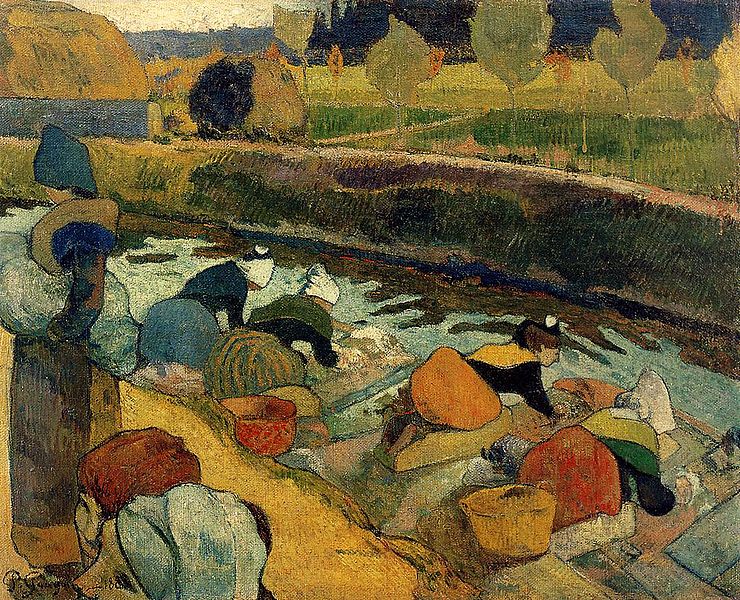
The title Washerwomen at the Roubine du Roi, Arles hides an identity problem. Paul Gauguin painted the canal subject twice in late 1888, and historical catalogues have used almost the same name for both works. This page concerns the canvas now called simply Washerwomen by the Museum of Modern Art in New York: object SPC15.1990, not the separate painting in Bilbao. [1] [2] [3]
At a Glance
- ArtistPaul Gauguin [1]
- TitleWasherwomen at the Roubine du Roi, Arles [1]
- Date1888 [1]
- Mediumoil on burlap [1]
- Dimensions / object size75.9 by 92.1 centimetres [1]
- Object recordPainted in oil on burlap, it measures 75.9 by 92.1 centimetres and belongs to the William S. [1]
- FocusThe title Washerwomen at the Roubine du Roi, Arles hides an identity problem.
Contents
- Washerwomen at the Roubine du Roi, Arles: Introduction
- Two paintings, one recurring title
- Labour arranged across the canal bank
- A local motif before Gauguin
- From observed scene to constructed surface
- The MoMA canvas after Arles
MoMA dates its work to Arles in 1888. Painted in oil on burlap, it measures 75.9 by 92.1 centimetres and belongs to the William S. Paley Collection. The Art Institute of Chicago's specialist chronology places it in early December, shortly after the Bilbao version. That sequence is useful, but MoMA's current title, support, measurements and object number govern the identification. [1] [3]
Two paintings, one recurring title
The Bilbao Fine Arts Museum owns Washerwomen in Arles, inventory 82/18. It is an oil-on-canvas work measuring 74 by 92 centimetres, signed and dated 1888. The museum records that it entered through a contribution from the Provincial Council of Biscay in 1919. [2]
Those details show why dimensions and collection matter. The Chicago exhibition list calls both works Washerwomen at the Roubine du Roi Canal: Bilbao's canvas is dated to late November, while MoMA's is placed in early December and described there as oil on jute. A familiar title can therefore point to either picture. The difference is not a minor catalogue variation but evidence that Gauguin returned to the subject and reorganised it. [3]
Contemporary testimony confirms that washerwomen occupied him at this moment. Around 1 December, Vincent van Gogh told his brother Theo that Gauguin had a good washerwomen canvas—“even very good” in the official English translation. The letter's scholarly note links the remark to both known paintings, so the praise should not be assigned to SPC15.1990 with false certainty. What it establishes is that Van Gogh saw the motif as one of Gauguin's successful current undertakings. [5]
Labour arranged across the canal bank
In the MoMA picture, four women kneel in a receding line at the edge of the Roubine du Roi. Other figures move away at the left, as if their work has finished. Across the canal, a row of slender trees repeats the upright accents made by the standing and departing women. The result is not a scattered inventory of activity. Bodies, bank, water and trees are fitted into a deliberate sequence. [4]
The pattern makes repetition visible without making the workers identical. Bent backs and lowered heads record the posture demanded by washing at the water's edge. The work is physical, but Gauguin does not supply names, individual histories or a social report. To invent them would turn an observed occupation into fiction. The picture instead asks how labouring bodies can hold a landscape together. [4]
Magdalena Dabrowski's MoMA catalogue describes the arrangement as nearly classical and strongly geometric. That reading is persuasive at the level of structure: the women diminish into depth, the far-bank trees answer their spacing, and an upright figure at the left checks the repeated downward movement. Gauguin gives the scene order without relying on a naturalistic sweep into distance. [4]
The catalogue also compares the women's traditional Arles clothing with garments Gauguin had encountered earlier in Brittany. That resemblance may have helped him translate a new regional subject into forms he had recently studied. It does not make Breton and Arles women interchangeable. Dress identifies a place and community here; it should not be used to convert the workers into one timeless, picturesque rural type. [4]
A local motif before Gauguin
Washerwomen were already part of Van Gogh's visual record of Arles. In March 1888, months before Gauguin arrived, he wrote to Theo about a drawbridge scene containing washerwomen in multicoloured bonnets and another landscape with washerwomen by a rustic bridge. The works joined water, infrastructure, colour and everyday activity rather than treating labour as an isolated figure study. [7]
Van Gogh also drew laundry beside this particular canal in July. The Kröller-Müller Museum's Laundry on 'La Roubine du Roi' Canal, KM 112.856, is a pen-and-reed-pen drawing dated about 15–17 July 1888. Gauguin therefore encountered a subject that his host had already explored in both the wider canal system and at the Roubine itself. [6] [7]
That chronology does not prove that Gauguin copied the Kröller-Müller drawing. It establishes a shared local motif and gives the two versions a place within the artists' exchange of subjects. Van Gogh's earlier attention helps explain why he could judge Gauguin's washerwomen so readily in December; Gauguin's response is distinctive because it turns the canal bank into a compact, patterned construction. [3] [4] [5] [6]
From observed scene to constructed surface
The painting retains recognisable work, clothing, water and trees, yet its surface resists the idea of a visual snapshot. Relatively flat areas of colour are held by simplified contours. The repeated women and trunks read across the canvas as shapes before they open into conventional depth. Gauguin had developed this kind of pictorial compression in Brittany, but at Arles he applied it to a subject drawn from the town's working life. [4]
That balance matters. Calling the figures mere decorative units would erase the labour represented; calling the canvas documentary would ignore how thoroughly the scene has been reordered. The women are both the people doing the work and the formal axis of the design. Gauguin's construction depends on their bent postures, while the departures at the left prevent the line from becoming completely static. [4]
The 1999 MoMA catalogue goes further, reading the kneeling women as almost hieratic and comparing their poses to religious observance. It also casts them as symbols of a proud rural tradition living in harmony with nature. Those phrases reveal an older interpretive habit as much as they explain the painting. Kneeling at a canal is required by the task; it is not evidence that laundry has become worship. Nor should difficult manual work be softened into an ideal of timeless harmony. [4]
The safer and richer conclusion is that Gauguin translated work into order without removing its visible demands. Rhythm comes from repeated effort. Regional dress supplies colour and contour, but also locates the workers in Arles. The canal creates a horizontal stage, while the trees and upright figures keep the broad canvas structurally alert. Abstraction and observation operate together rather than cancelling one another. [4]
The MoMA canvas after Arles
MoMA's provenance record traces the painting through Gustave Fayet and several European collections and dealers before Wildenstein & Co. sold it to William S. Paley in January 1958. It entered MoMA through the Paley Collection in 1990. Some intermediate names on the museum's record remain bracketed, a reminder that provenance is an evolving research trail rather than a perfectly continuous biography. [1]
That later history reinforces the need to attach collection and identifier to the title. Washerwomen at the Roubine du Roi can describe two related paintings; Washerwomen, SPC15.1990, fixes the object considered here. Its importance lies not in being a generic image of regional life, but in its precise transformation of an Arles workplace: repeated by Gauguin, praised cautiously by Van Gogh, and structured so that the act of washing becomes the organising force of the landscape. [1] [3] [5]
Related Pages
Frequently Asked Questions
The title Washerwomen at the Roubine du Roi, Arles hides an identity problem.
Washerwomen were already part of Van Gogh's visual record of Arles.
That later history reinforces the need to attach collection and identifier to the title.
Discussion
The title Washerwomen at the Roubine du Roi, Arles hides an identity problem.
Reader Insights
The title Washerwomen at the Roubine du Roi, Arles hides an identity problem.
That resemblance may have helped him translate a new regional subject into forms he had recently studied.
Washerwomen at the Roubine du Roi can describe two related paintings; Washerwomen, SPC15.1990, fixes the object considered here.
Join the Conversation
Share the visible detail or source that most changed your reading.
References
- Museum of Modern Art, Paul Gauguin. Washerwomen. Arles 1888, current collection and provenance record View source
- Bilbao Fine Arts Museum, Washerwomen in Arles, inventory 82/18, current collection record View source
- Art Institute of Chicago, Van Gogh and Gauguin: The Studio of the South, complete list of works, 2001 exhibition archive View source
- Magdalena Dabrowski, French Landscape: The Modern Vision, 1880–1920, Museum of Modern Art, 1999, pp. 86, 106 View source
- Vincent van Gogh, Letter 723 to Theo van Gogh, about 1 December 1888, Vincent van Gogh: The Letters View source
- Kröller-Müller Museum, Laundry on 'La Roubine du Roi' Canal, c. 15–17 July 1888, KM 112.856 View source
- Vincent van Gogh, Letter 585 to Theo van Gogh, about 16 March 1888, Vincent van Gogh: The Letters View source

 Paul Gauguin.jpg)