 by Tom Gurney
Tom Gurney BSc (Hons) is an art history expert with over 20 years experience
Published on August 14, 2026 / Updated on August 14, 2026
Email: tomgurney1@gmail.com / Phone: +44 7429 011000
Market Gardens of Vaugirard: Introduction
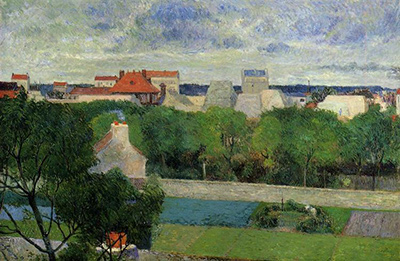
Market Gardens of Vaugirard belongs to a Paul Gauguin who can disappear behind the fame of his later work. Painted in 1879, it predates Pont-Aven, Arles and his voyages to Polynesia. The canvas is valuable precisely because it does not yet present the broad outlines, compressed symbolic spaces or invented island imagery most often associated with him. It shows an artist learning inside the Impressionist circle and testing how an observed suburban landscape could become a finished painting. [1] [2] [3]
At a Glance
- ArtistPaul Gauguin [1]
- TitleMarket Gardens of Vaugirard [1]
- Date1879 [1]
- Mediumoil on canvas [1]
- Object recordIt identifies an oil on canvas dated 1879, lent by the Smith College Museum of Art, with the credit Purchased and accession SC 1953.55. [1]
- FocusMarket Gardens of Vaugirard belongs to a Paul Gauguin who can disappear behind the fame of his later work.
Contents
- Market Gardens of Vaugirard: Introduction
- A productive landscape at the edge of Paris
- What technical analysis reveals
- Pissarro's unofficial pupil and patron
- Before the later Gauguin
The Cincinnati Art Museum's recent exhibition label calls the work Market Gardens at Vaugirard. It identifies an oil on canvas dated 1879, lent by the Smith College Museum of Art, with the credit Purchased and accession SC 1953.55. The familiar of Vaugirard wording also appears in the University of Michigan's academic visual-resource record. At and of are English title variants for the same object, not two different paintings. [1] [4]
A productive landscape at the edge of Paris
Cincinnati identifies the painting as a view from Gauguin's studio on the edge of Paris. Below that vantage point lay a patchwork of market gardens supplying produce to the city. The subject was therefore neither untouched countryside nor a conventional urban street. It was cultivated land embedded in the daily economy of the capital. [1]
Vaugirard had been incorporated into Paris in 1860. By the time Gauguin painted the scene, the museum explains, the former quasi-rural hamlet was becoming more urban as the city's population grew. Garden plots and houses belonged to the same transition. The painting preserves their proximity without proving that Gauguin meant to mourn development or make a political statement about it. [1]
The broad format lets cultivation spread laterally. Low plots divide the foreground and middle distance, while buildings—documented in a left-side detail by the Michigan record—mark the pressure of settlement. Vegetation interrupts the constructed edges, and the expanse above the gardens keeps the view open. Instead of one dramatic landmark, the subject is an arrangement of adjoining parcels, roofs and planted ground. [1] [4]
That structure makes the title unusually exact. A market garden is not merely a pleasant garden near a market: it is productive land whose crops are grown for sale. Gauguin's elevated view turns the plots into a set of coloured intervals, but their economic function remains part of the place. The modern subject lies in the convergence of food supply, suburban residence and expanding Paris. [1]
What technical analysis reveals
The painting's relation to Camille Pissarro is more than a resemblance perceived in reproduction. Vojtech Jirat-Wasiutynski's research for the National Gallery of Art's Center for Advanced Study in the Visual Arts reports that analysis of Market Gardens at Vaugirard demonstrates Gauguin's adoption of Pissarro's technique and palette shortly after entering the Impressionist exhibiting society in April 1879. [2]
This conclusion comes from material comparison, not from assuming that every broken brushmark must be Impressionist. A dedicated conservation investigation of the Smith painting, recorded by the Smithsonian, used methods including x-ray fluorescence, infrared reflectography, x-radiography and paint cross-sections. The study compared Gauguin's pigments and working procedures with Pissarro's and with other early Gauguin paintings. [5]
Jirat-Wasiutynski places the object within an early preference for matte paint surfaces, the avoidance of varnish and thin, often absorbent chalk grounds. Such preparation changes how paint sits on the support: a lean ground can take up binding medium and reduce surface gloss, while a lack of varnish leaves colour without a later unifying sheen. These material choices help explain why an apparently open-air subject can still possess a restrained, deliberately finished surface. [2]
The scope of that evidence matters. It supports a Pissarro-related procedure in this phase; it does not establish a fixed recipe for every landscape Gauguin painted. Nor does it prove that the entire canvas was executed outdoors in one session. The same report stresses Gauguin's preference for a finished tableau over the rapidly completed study and places him within an active Impressionist debate about studio and plein-air work. [2]
Pissarro's unofficial pupil and patron
The Metropolitan Museum of Art describes Gauguin by 1879 as Pissarro's unofficial pupil and also his patron. Both halves of that relationship are important. Gauguin learned through contact with Pissarro's work and methods, but he was also buying modern pictures and participating as a collector with financial resources. Unofficial rules out the misleading image of formal academy instruction. [3]
The NGA report adds a useful caution to the chronology: its author found no documentary evidence that Gauguin had contact with the Impressionist group before April 1879. Technical analysis then detects the rapid change in palette and procedure after he joined. The canvas thus records formation in unusually concrete terms. Documents establish when the association becomes visible; materials show how quickly it entered the work. [2]
Pissarro's example did not make Gauguin a passive copyist. The long garden view requires choices about grouping, interval and finish. Its cultivated strips could invite flickering atmospheric description, yet they also form a stable framework across the canvas. Looking at those decisions alongside the technical evidence replaces a vague claim of influence with a more useful question: which procedures did Gauguin adopt, and how did he organise them into a complete picture? [1] [2]
Before the later Gauguin
It is tempting to search this early painting for signs of everything that followed. Broad divisions of land can be made to look like embryonic Synthetist colour fields; a matte surface can be treated as the inevitable beginning of his later aesthetic. That backwards reading flattens a decade of experiments and exchanges. [2] [3]
In 1879, matte handling and a finished composition were already meaningful within Impressionist practice. The market gardens mattered because they joined observation, modern suburban change and an artist's rapidly developing technique. Their importance does not depend on predicting Brittany or Tahiti. [1] [2]
The title variation makes a final useful distinction. At Vaugirard locates the act of looking; of Vaugirard identifies the district represented. Both lead to the same Smith canvas, SC 1953.55. What survives is an early Gauguin grounded in a specific place and network: a studio-edge view of land still feeding Paris, painted as the city was beginning to absorb it and as Pissarro's example was becoming materially visible in Gauguin's own work. [1] [2] [4]
Related Pages
Frequently Asked Questions
Market Gardens of Vaugirard belongs to a Paul Gauguin who can disappear behind the fame of his later work.
Jirat-Wasiutynski places the object within an early preference for matte paint surfaces, the avoidance of varnish and thin, often absorbent chalk grounds.
The title variation makes a final useful distinction.
Discussion
Market Gardens of Vaugirard belongs to a Paul Gauguin who can disappear behind the fame of his later work.
Reader Insights
Market Gardens of Vaugirard belongs to a Paul Gauguin who can disappear behind the fame of his later work.
The study compared Gauguin's pigments and working procedures with Pissarro's and with other early Gauguin paintings.
Both lead to the same Smith canvas, SC 1953.55.
Join the Conversation
Share the visible detail or source that most changed your reading.
References
- Cincinnati Art Museum, Farm to Table: Food and Identity in the Age of Impressionism, large-print label for Market Gardens at Vaugirard, 2025 View source
- Vojtech Jirat-Wasiutynski, Studies in the Painting Procedures of Paul Gauguin, 1873–1891, National Gallery of Art, Center for Advanced Study in the Visual Arts, Center 14, p. 75 View source
- Cindy Kang, Paul Gauguin (1848–1903), Metropolitan Museum of Art, Heilbrunn Timeline of Art History, 2011 View source
- University of Michigan History of Art, Visual Resources Collections, The Market Gardens of Vaugirard. Detail: Left portion, houses, record 876896 View source
- Smithsonian Museum Conservation Institute, bibliography record for Elizabeth L. Leto, A technical examination of the Market Gardens at Vaugirard by Paul Gauguin, 1994 View source
 Paul Gauguin.jpg)