 by Tom Gurney
Tom Gurney BSc (Hons) is an art history expert with over 20 years experience
Published on August 14, 2026 / Updated on August 14, 2026
Email: tomgurney1@gmail.com / Phone: +44 7429 011000
Two Tahitian Women: Introduction
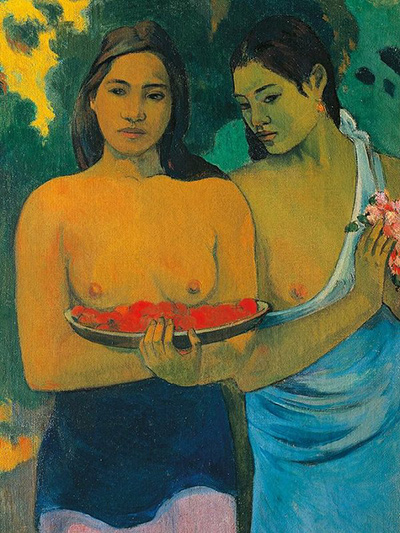
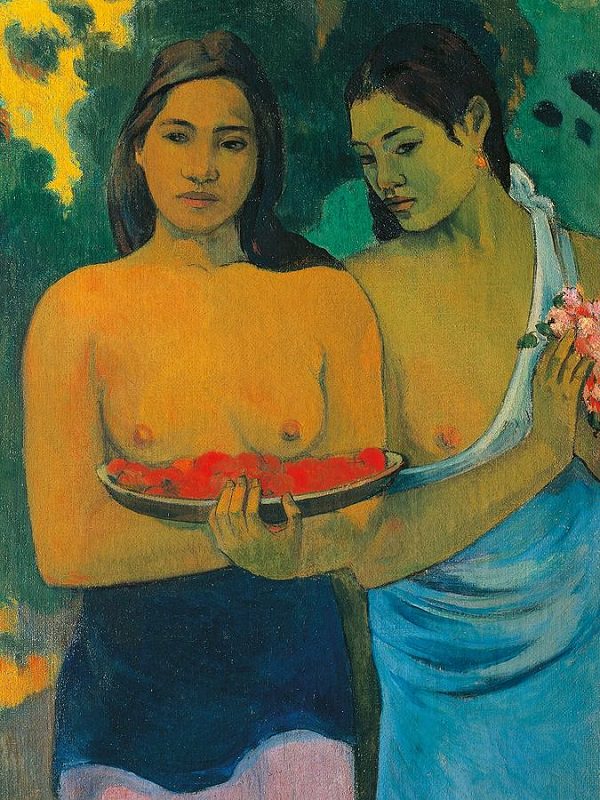
Paul Gauguin brings two women so close to the front of Two Tahitian Women that their bodies seem to occupy almost the whole field. One holds fruit on a pale cloth or shallow support; the other raises red flowers against her torso. The setting is present only in compressed bands and fragments. What first looks like a direct encounter is therefore also a highly managed arrangement of bodies, colour and still life.
At a Glance
- ArtistPaul Gauguin [1]
- TitleTwo Tahitian Women [1]
- Date1899 [1]
- Mediumoil on canvas [1]
- Dimensions / object size94 by 72.4 centimetres [1]
- Object recordIt is an oil on canvas measuring 94 by 72.4 centimetres, with the object number 49.58.1. [1]
- FocusPaul Gauguin brings two women so close to the front of Two Tahitian Women that their bodies seem to occupy almost the whole field.
Contents
- Two Tahitian Women: Introduction
- The Met painting
- Fruit, flowers and the picture plane
- Is anyone making an offering?
- Gauguin's invented “Tahitian Eve”
- From charcoal study to repeated figure
- Why the sitter names remain open
- A constructed closeness
The painting is not a documentary record of a conversation or ceremony. The women's names are not securely established in current museum scholarship, and their relationship is unknown. Those limits are essential to the picture's interpretation: Gauguin gives the viewer a powerful image of closeness while withholding the evidence needed to turn it into a biography.
The Met painting
The Metropolitan Museum of Art dates Two Tahitian Women to 1899. It is an oil on canvas measuring 94 by 72.4 centimetres, with the object number 49.58.1. William Church Osborn gave it to the museum in 1949. [1]
Its tall format distinguishes it from Gauguin's horizontal Tahitian Women on the Beach of 1891 and from several three-figure compositions with similar titles. Here the figures are shown at close range rather than placed within an expansive shore or landscape. Their heads approach the upper edge; their arms and the still-life objects press against the lower part of the canvas.
The left figure turns towards the viewer but does not become a conventional portrait. The right figure is slightly behind and angled across her companion. Their shoulders overlap spatially, yet their faces and gestures remain separate. Gauguin uses proximity to build a compact design, not to document how two known people related to one another.
Fruit, flowers and the picture plane
The fruit occupies an unusually assertive position. Its pale support runs close to the lower edge, so that rounded forms seem pushed outward rather than settled on a table receding into depth. The Met's account of Post-Impressionism singles out this painting for its simplified colours, solid forms and flat still-life construction, in which conventional perspective gives way to a foreground pressed towards the viewer. [4]
That pressure changes how the figures are seen. The left woman's arm descends beside the fruit, joining body and still life through a chain of rounded shapes. On the right, red flowers sit near the figure's hand and chest. Fruit, blossoms and bodies are made to echo one another, but the exact species of the plants need not be guessed. Their pictorial function is clear without attaching uncertain botanical names.
The background offers little release from this closeness. Broad colour areas and dark contours stabilise the bodies, while the shallow interval between them makes the right figure appear to rise behind the left. Gauguin preserves enough modelling to give the faces and arms weight, but he refuses a fully consistent illusion of deep space. The result is neither a naturalistic portrait group nor a weightless pattern. Volume and surface remain in deliberate tension.
Is anyone making an offering?
The fruit and flowers can look ceremonial because both are brought forward and displayed. The Met's current interpretation plays on the idea of offerings and forbidden fruit, and imagines the women in a tropical Eden. [1] These are productive metaphors, but they are not evidence of a documented rite. The painting supplies neither an altar nor a named recipient, and it does not tell us why either object is held.
The same caution applies to gesture. Physical nearness has encouraged a suggestion of exchanged confidences, but no words are recorded and neither figure can be securely identified as friend, relative or companion. A close reading can say that Gauguin arranged the heads and hands to create an air of private communication. It cannot recover an actual conversation from the painted poses.
This distinction matters because the picture's apparent intimacy is one of its strongest effects. Gauguin invites the viewer close while keeping the figures' own knowledge inaccessible. Treating the scene as a transparent slice of Tahitian life would erase that imbalance between what the European painter displays and what the depicted women are allowed to disclose.
Gauguin's invented “Tahitian Eve”
The Met relates the painting's nudity to classicising European conventions and to the ideal of a “Tahitian Eve” that Gauguin developed in his writings. [1] This does not mean that the women illustrate an Indigenous account of Eve. It identifies a category made by Gauguin: biblical temptation, the classical nude and his fantasy of an unashamed Polynesian body are combined for viewers already familiar with European art.
The curators consequently describe the setting as an Eden of the artist's invention and make the male gaze part of the interpretation. [1] That framing corrects the notion that the canvas simply records natural innocence. Gauguin chose the degree of undress, the close crop, the poses and the pairing of breasts with fruit and flowers. Nudity here cannot demonstrate local custom, sexual availability or consent. It is part of an image constructed for looking.
The figures still command attention rather than dissolving into allegory. Their substantial arms, level expressions and monumental scale give them a presence that exceeds the fragile story of paradise arranged around them. Yet presence is not the same as self-representation. The painting lets us examine Gauguin's decisions; it does not let us speak for the women.
From charcoal study to repeated figure
A related drawing makes Gauguin's process unusually visible. The Met's Tahitian Faces (Frontal View and Profiles), dated about 1899, is a charcoal sheet measuring 41 by 31.1 centimetres. The museum considers it a likely preparatory study for the painting's left figure. [2]
The sheet does not establish her identity. Instead, it shows a head being worked through several views. Blank eye sockets give the faces a mask-like appearance, while smudged charcoal contours—made through stumping—model the forms into a sculptural mass. [2] In the painting, colour and firmer edges replace much of that charcoal modelling, but the study helps explain why the face feels both solid and withheld. It was built as an adaptable pictorial form before it became part of the finished pair.
The figures did not remain confined to this canvas. The Met identifies both in the monumental Faa Iheihe (Tahitian Pastoral) of 1898 and Rupe Rupe (The Fruit Harvest) of 1899. [1] Its broader Gauguin study describes this late practice as repeated drawing and painting of the same figures, rearranged in different configurations and settings. [3]
That reuse is more informative than a search for a continuous story. The related works do not show three consecutive moments in two women's lives. They reveal an artist maintaining a store of bodies, heads and gestures that could be enlarged, reversed, paired or embedded in new compositions. A figure might begin in charcoal, enter a close double image, and reappear within a much larger pastoral without carrying a fixed narrative between them.
Why the sitter names remain open
The Met's current painting record, related-drawing record and overview of Gauguin supply no sitter names. [1] [2] [3] Current Art Institute scholarship connects further head-study material with the 1899 picture but likewise provides no identification. [5] Naming either woman would therefore create a confidence the evidence does not support. Both are best described as unidentified.
The restraint is especially important because Gauguin's repeated motifs can tempt viewers to treat resemblance as biography. A face used in several pictures may record sustained study, memory or a practical preference for a successful design. Repetition alone does not identify a sitter, preserve her words or establish her relationship with the artist.
A constructed closeness
Two Tahitian Women joins the immediacy of a close view to the distance of an invented scene. Fruit and flowers approach the picture plane; two bodies overlap; solid forms remain bound to broad colour areas. The image feels intimate because Gauguin has compressed every element, not because it gives unmediated access to the women's lives.
The related charcoal and monumental paintings show how deliberately this closeness was made. Heads and gestures were studied, stored and recombined. The Edenic suggestion belongs to Gauguin's European artistic and literary construction, while the current museum's emphasis on the male gaze identifies the power behind that construction.
Looking carefully therefore requires two acts at once: attending to the remarkable formal coherence of the painting and refusing the unsupported story it appears to offer. The women are highly visible, but they are not fully knowable through Gauguin's arrangement. That gap is not an inconvenience to be filled with romance. It is one of the work's central historical facts.
Related Pages
Frequently Asked Questions
Paul Gauguin brings two women so close to the front of Two Tahitian Women that their bodies seem to occupy almost the whole field.
The Met relates the painting's nudity to classicising European conventions and to the ideal of a “Tahitian Eve” that Gauguin developed in his writings.
Looking carefully therefore requires two acts at once: attending to the remarkable formal coherence of the painting and refusing the unsupported story it appears to offer.
Discussion
Paul Gauguin brings two women so close to the front of Two Tahitian Women that their bodies seem to occupy almost the whole field.
Reader Insights
Paul Gauguin brings two women so close to the front of Two Tahitian Women that their bodies seem to occupy almost the whole field.
It identifies a category made by Gauguin: biblical temptation, the classical nude and his fantasy of an unashamed Polynesian body are combined for viewers already familiar with European art.
It is one of the work's central historical facts.
Join the Conversation
Share the visible detail or source that most changed your reading.
References
- Metropolitan Museum of Art, Two Tahitian Women, 49.58.1, current object record View source
- Metropolitan Museum of Art, Tahitian Faces (Frontal View and Profiles), 1996.418, current object record View source
- Cindy Kang, Paul Gauguin (1848–1903), Heilbrunn Timeline of Art History, Metropolitan Museum of Art View source
- James Voorhies, Post-Impressionism, Heilbrunn Timeline of Art History, Metropolitan Museum of Art View source
- Art Institute of Chicago, Heads of Tahitian Women, Frontal and Profile Views (recto), Portrait of Tehamana (verso), cat. 49, Gauguin Paintings, Sculpture, and Graphic Works View source
 Paul Gauguin.jpg)