 by Tom Gurney
Tom Gurney BSc (Hons) is an art history expert with over 20 years experience
Published on August 14, 2026 / Updated on August 14, 2026
Email: tomgurney1@gmail.com / Phone: +44 7429 011000
Tahitian Women on the Beach: Introduction
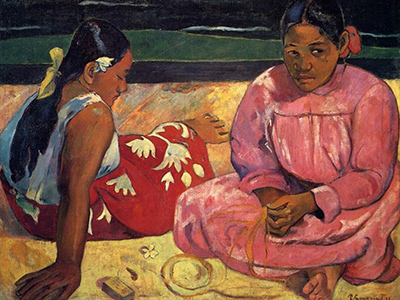
Two women sit close together, yet Paul Gauguin's painting gives no secure account of who they are or what passes between them. One turns into profile and looks down; the other faces more nearly forward but does not meet the viewer. Their bodies share a narrow strip of beach while their poses, clothing and gaze keep their spaces distinct. The result invites narrative but refuses to confirm one.
At a Glance
- ArtistPaul Gauguin [1]
- TitleTahitian Women on the Beach [1]
- Date1891 [1]
- Dimensions / object size69 by 91.5 centimetres [1]
- Object recordGauguin painted the work in oil on a canvas measuring 69 by 91.5 centimetres. [1]
- FocusTwo women sit close together, yet Paul Gauguin's painting gives no secure account of who they are or what passes between them.
Contents
- Tahitian Women on the Beach: Introduction
- The object and its early journey
- Two figures and three strips of shore
- Clothing records a colonial present
- The limits of gaze
- A variant, not a sequel
- Looking without supplying the missing story
The Musée d'Orsay calls the canvas Femmes de Tahiti and lists Sur la plage as an alternate title. Tahitian Women on the Beach is the familiar English form used here, not a phrase inscribed across the picture. Orsay dates the work more precisely to November–December 1891, during the opening months of Gauguin's first stay in Tahiti. [1]
The object and its early journey
Gauguin painted the work in oil on a canvas measuring 69 by 91.5 centimetres. He signed and dated it at the lower right, P. Gauguin 91; its Musée d'Orsay accession number is RF 2765. [1] The horizontal format matters. Instead of presenting each figure as an isolated portrait, it binds two seated bodies to a sequence of long landscape bands.
The picture also has an unusually informative early provenance. Gauguin gave it in Tahiti to Captain Arnaud. It remained in Papeete with Arnaud's daughter, Mme Wilmot, until 1920, then passed to Vicomte Guy de Cholet. In 1923 Countess Vitali gave it to the French national museums in memory of her brother. The painting subsequently moved through the Louvre, Musée du Luxembourg and Jeu de Paume before its assignment to the Musée d'Orsay in 1986. [1]
That chain does not identify either sitter, but it prevents a common misconception that the painting's history began only when Gauguin's Tahitian work reached a European audience. The canvas first changed hands in Tahiti; its later museum life came through a sequence of family and state collections.
Two figures and three strips of shore
The National Gallery of Australia describes the setting as simplified bands of dark ocean, green lagoon and creamy yellow sand. [2] [3] Gauguin uses them less to map a specific shoreline than to organise depth. The nearly unbroken horizontal divisions press the foreground figures forward, while small white touches in the distance are enough to indicate breaking water. [1]
Against those horizontal bands, the bodies generate a more complex rhythm. The left figure's bare arm drops almost vertically to support her weight. Her shoulder and inclined head lead the eye towards her companion. The right figure's back curves in the opposite direction, while her bent arms hold a bundle close to her lap. Each body occupies a legible contour; their shared outline never quite becomes a single group.
Orsay describes the composition as an arrangement of arabesques and rigid poses, and considers it closer to a genre scene than a true double portrait. [1] That is a useful distinction. A double portrait normally asks us to recognise particular people and some element of their relationship. Here no names are securely supplied. The painting shows a constructed encounter, not enough evidence to recover two biographies.
The foreground contributes another interruption. A low, nearly monochrome cluster of objects runs along the bottom edge, neither fully developed as still life nor absorbed into the sand. It slows the approach to the figures. The beach therefore works as a set of compressed zones—foreground objects, seated bodies and distant water—rather than as an open view into deep space.
Clothing records a colonial present
The figures' dress is not incidental decoration. The woman on the left wears a floral pareu, or wraparound garment, with a white flower placed behind her ear. Her companion wears a long-sleeved pink dress of the type associated with Christian missions. The contrast is heightened by posture: one bare arm becomes a structural axis, while the pink sleeves enclose the other figure's hands and torso. [3] [4]
Such clothing belongs to Tahiti's colonial present in 1891. The National Gallery of Australia notes that missionaries had introduced cotton textiles to a society in which clothing had traditionally been made from tapa, or barkcloth. Religion, trade and French rule all altered what was worn and how Europeans interpreted it. [3] [4]
Yet the painting does not support a simple opposition between European corruption and an untouched local culture. The material held by the woman in pink has been identified by the National Gallery of Australia as likely pandanus leaves for weaving. The qualification matters: it is an informed museum identification, not botanical certainty. Within the painting, introduced dress and a continuing local practice occupy the same figure. [2] [3]
That coexistence is historically more useful than a search for authenticity. Tahitian people did not cease to possess culture when they wore imported cotton, nor did a pareu make its wearer an emblem of a timeless past. Clothing and work could register adaptation, coercion, choice, commerce and continuity at once. The painting records visible signs of this changed world, although it cannot tell us what either woman thought about them.
The limits of gaze
Neither figure meets the viewer's gaze. The left profile looks downward; the right face remains turned away from direct contact. Their physical proximity has encouraged descriptions of introspection, melancholy or quiet tension. Orsay uses melancholy, while the National Gallery of Australia emphasises the ambiguity created by hunched, foreshortened postures and averted eyes. [1] [2]
These readings describe effects produced for a viewer. They are not diagnoses of the women. A lowered head can shape a composition without proving sadness; two people sitting together need not be conversing, estranged, related or in conflict. Gauguin has given enough visual information to stimulate such stories, but not enough historical evidence to choose among them.
The imbalance of representation also matters. Gauguin controls the framing, the pose as painted, and the object's circulation as art. The women do not look back at the European viewer, but that refusal of eye contact does not automatically grant them independence from his construction. It creates an area the painting cannot fully translate: they remain present without becoming transparent personalities.
A variant, not a sequel
Gauguin returned to the arrangement in the 1892 Dresden painting Parau Api. Orsay notes one conspicuous alteration: a floral sarong replaces the mission dress on the right figure. [1] The change shows him treating a figure group as adjustable pictorial material. Dress could be exchanged while the broader pairing and its formal tensions remained available for reuse.
That variant should not be read as the next scene in the women's lives. It is evidence of Gauguin revising an artistic arrangement. Orsay also relates the simplified shapes and contrasting outlines to his admiration for Édouard Manet. [1] The comparison locates the canvas within European art-making even as its subject and first ownership belong to Tahiti.
Looking without supplying the missing story
Tahitian Women on the Beach is compelling because its formal clarity does not produce narrative certainty. The shore is reduced to colour bands; the figures are brought close and made monumental; clothing distinguishes them; posture joins and separates them. Mission dress and probable pandanus leaves place colonial change beside cultural continuity.
A responsible reading can describe all of this without deciding that the women are melancholy friends, silent rivals or symbols of an entire society. Their names and relationship remain unknown. What can be examined is Gauguin's construction: a carefully ordered scene in which two people are highly visible, yet their inner lives remain beyond the painter's—and the viewer's—authority.
Related Pages
Frequently Asked Questions
Two women sit close together, yet Paul Gauguin's painting gives no secure account of who they are or what passes between them.
Such clothing belongs to Tahiti's colonial present in 1891.
A responsible reading can describe all of this without deciding that the women are melancholy friends, silent rivals or symbols of an entire society.
Discussion
Two women sit close together, yet Paul Gauguin's painting gives no secure account of who they are or what passes between them.
Reader Insights
Two women sit close together, yet Paul Gauguin's painting gives no secure account of who they are or what passes between them.
The contrast is heightened by posture: one bare arm becomes a structural axis, while the pink sleeves enclose the other figure's hands and torso.
What can be examined is Gauguin's construction: a carefully ordered scene in which two people are highly visible, yet their inner lives remain beyond the painter's—and the viewer's—authority.
Join the Conversation
Share the visible detail or source that most changed your reading.
References
- Musée d'Orsay, Femmes de Tahiti, RF 2765, current object record and provenance View source
- National Gallery of Australia, Gauguin's World: Tōna Iho, Tōna Ao, audio stop 308, Tahitian women (Femmes de Tahiti) View source
- National Gallery of Australia, Paul Gauguin — Tahitian women, Appropriation and Reclamation learning resource View source
- National Gallery of Australia, Gauguin's World: Tōna Iho, Tōna Ao media kit View source
 Paul Gauguin.jpg)