 by Tom Gurney
Tom Gurney BSc (Hons) is an art history expert with over 20 years experience
Published on August 14, 2026 / Updated on August 14, 2026
Email: tomgurney1@gmail.com / Phone: +44 7429 011000
Three Tahitians: Introduction
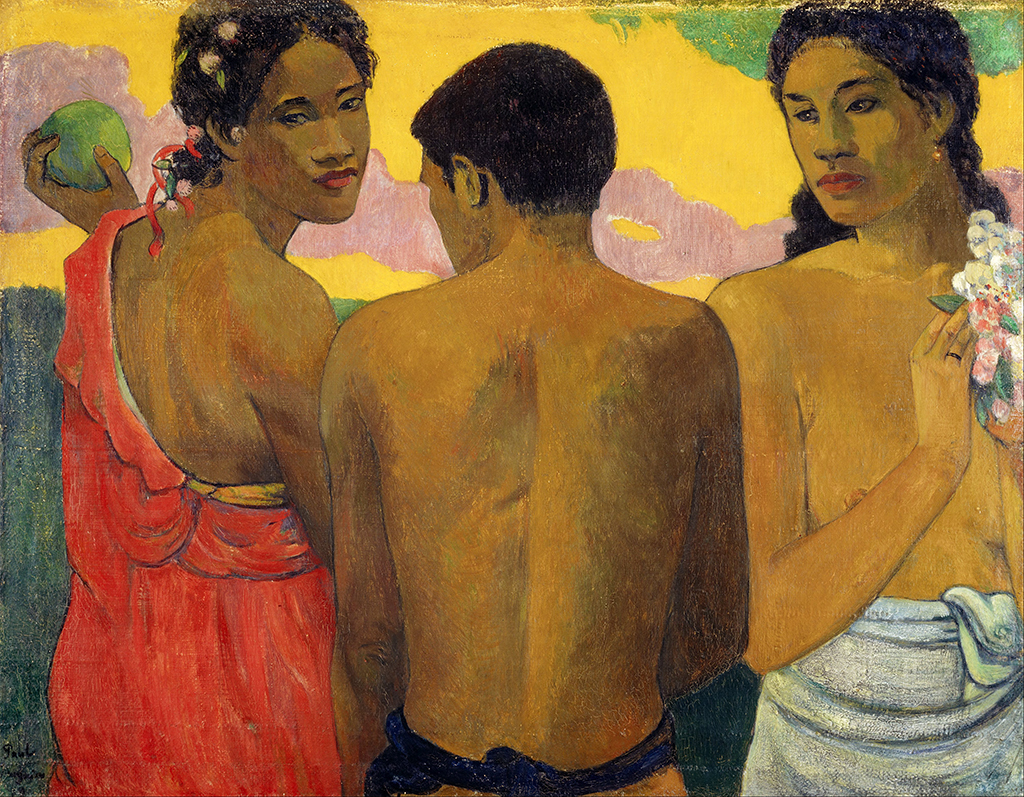
Three figures fill the horizontal canvas of Paul Gauguin's Three Tahitians. A person at the centre turns away, presenting a broad back. On either side, a figure faces more nearly outward: one raises a green fruit near the shoulder, while the other holds pale flowers against the body. Their physical closeness suggests an encounter, but the painting never confirms what kind.
At a Glance
- ArtistPaul Gauguin [1]
- TitleThree Tahitians [1]
- Date1899 [1]
- Mediumoil on canvas [1]
- Dimensions / object size73 by 94 centimetres [1]
- Object recordThe work is an oil on canvas measuring 73 by 94 centimetres. [1]
- FocusThree figures fill the horizontal canvas of Paul Gauguin's Three Tahitians.
Contents
- Three Tahitians: Introduction
- The Edinburgh canvas
- Three bodies across a horizontal field
- A landscape reduced to bands
- What fruit and flowers do not prove
- Distance from the people represented
- An encounter that remains unresolved
That uncertainty is not a puzzle with a single hidden answer. Fruit, flowers and glances can encourage stories of courtship, offering, refusal or jealousy, yet none is documented by the object. Gauguin has arranged three bodies to generate tension while leaving names, relationships and motives unavailable.
The Edinburgh canvas
The National Galleries of Scotland dates Three Tahitians to 1899, during Gauguin's second period in Tahiti. The work is an oil on canvas measuring 73 by 94 centimetres. Its accession number is NG 2221, and Sir Alexander Maitland presented it in memory of his wife Rosalind in 1960. [1]
The credit line is the secure public collection history supplied by the museum. It does not establish who owned the painting before 1960, and the three figures cannot be identified through its modern accession. The current record gives no sitter names.
The title also needs care. This is not the Metropolitan Museum of Art's Three Tahitian Women, a separate 1896 oil on wood measuring only 24.4 by 43.2 centimetres, object 1997.60.3. [4] The similar English names conceal different dates, supports, dimensions, collections and compositions. The Edinburgh canvas alone governs the description here.
Three bodies across a horizontal field
Gauguin uses the width of the canvas to establish a sequence: outward-facing figure, turned back, outward-facing figure. The central body is both the group's largest uninterrupted shape and its barrier. It blocks a clear view into the middle of the encounter, separating the two flanking faces even as it binds all three people together.
The left figure's red wrap forms a strong vertical and diagonal accent. A bent arm lifts a green fruit towards shoulder height. Across the canvas, the right figure's pale wrap gathers at the lower edge, while pale flowers rise near the shoulder and chest. Fruit and blossoms therefore occupy opposite sides like visual counterweights. Their colours distinguish them from the bodies, but their purposes remain unknown.
The directions of gaze are equally resistant to a fixed story. The centre figure turns the head slightly towards the left but remains seen largely from behind. The flanking faces angle across or out of the group rather than meeting in a demonstrable exchange. Gauguin has made looking important without drawing an unambiguous line from one person's eyes to another's.
This structure differs from the paired formats Gauguin also used. With two figures, proximity can be organised as parallel poses or an overlap. Here the third body creates interruption. No single pair can be isolated without the remaining figure altering the relationship. The canvas works less like three portraits placed side by side than like a compact circuit of bodies, objects and incomplete sightlines.
A landscape reduced to bands
Behind the figures, the setting is compressed into narrow colour zones. Yellow occupies much of the upper field; mauve forms pass horizontally behind the heads; darker green lies lower down. These bands offer the suggestion of sky, distant forms and ground, but they do not open into a conventionally deep landscape.
The shallowness gives the bodies unusual weight. Their shoulders and backs fill the foreground, while contours hold each form against the bright setting. Gauguin simplifies without making everything uniformly flat: the central back is modelled enough to feel solid, but the landscape behind it behaves like a sequence of coloured strips.
The National Galleries of Scotland records how such simplification divided early British responses. John Singer Sargent questioned whether Gauguin's paintings could be considered art, while other viewers believed that bold colour and flattened form made his vision of Tahiti appear more authentic. [1] The disagreement reveals the expectations Gauguin disrupted, but authenticity here belongs to reception history. Formal simplification cannot verify the cultural truth of what is represented.
What fruit and flowers do not prove
The green fruit and pale blossoms are conspicuous because Gauguin lifts both near the figures' upper bodies. They may look like gifts or choices presented within a social drama. Yet the canvas supplies no recipient and no confirmed act of exchange. Even the word offering would need qualification: it describes how an object appears to be displayed, not a known ceremony.
Nor can the figures' degrees of undress settle the narrative. Nudity does not establish a timeless local custom, sexual availability or consent. The painter controlled the poses, crop and arrangement. The current NGS interpretation states directly that Gauguin viewed Tahitian people and culture through a decidedly western male lens. [1]
That lens is visible not because every formal choice has a single sexual meaning, but because the image turns unidentified people into an encounter designed for an outside viewer. Fruit, flowers and exposed bodies become available as signs in Gauguin's composition, while the depicted people provide no names or accounts of their own. A responsible reading can analyse this imbalance without inventing thoughts for them.
Distance from the people represented
The painting's present location adds another kind of distance. In a 2024 National Gallery of Australia symposium, Miriama Bono observed that Gauguin remains unfamiliar to many Tahitians because original works are held far from the islands and are often encountered locally through postcards or reproductions. She connected the exhibition of those works with questions about circulation, local heritage and decolonisation. [2]
This is one named perspective, not a single response on behalf of all Tahitians. It nevertheless changes the conditions of looking. Three Tahitians has long circulated as an important European museum painting, while people in the place named by its title may know it chiefly through copies. The work cannot be treated as transparent access to a culture whose own relationship to the object has been shaped by that separation.
The National Gallery of Australia's exhibition Gauguin's World: Tōna Iho, Tōna Ao placed the painting within a presentation that openly recognised Gauguin as a polarising artist and stated that his late nineteenth-century interactions in Polynesia would not be accepted today. [3] Such framing does not replace close looking. It makes clear why beauty, formal invention, colonial power and unequal circulation must be considered together.
An encounter that remains unresolved
Three Tahitians derives its force from careful distribution rather than narrative clarity. A red wrap and pale cloth anchor opposite edges. Fruit and flowers answer one another. The central back interrupts access, and the flanking glances never resolve into a confirmed exchange. Bright landscape bands keep all three bodies near the surface.
Those decisions make the group appear socially charged, but they do not tell us whether the people are courting, quarrelling, refusing, giving or merely posing. Supplying one of those stories would convert ambiguity into stereotype. The more defensible conclusion concerns Gauguin's construction: he used three unidentified figures and a few highly visible objects to make viewers search for a relationship that the painting does not document.
Looking responsibly means preserving that limit. The picture can be admired as a tightly balanced experiment in colour, bodies and gaze while its western male framing is recognised. What it cannot provide is unmediated knowledge of the people it shows—or a Tahitian voice that Gauguin's arrangement never records.
Related Pages
Frequently Asked Questions
Three figures fill the horizontal canvas of Paul Gauguin's Three Tahitians.
The shallowness gives the bodies unusual weight.
Looking responsibly means preserving that limit.
Discussion
Three figures fill the horizontal canvas of Paul Gauguin's Three Tahitians.
Reader Insights
Three figures fill the horizontal canvas of Paul Gauguin's Three Tahitians.
The shallowness gives the bodies unusual weight.
What it cannot provide is unmediated knowledge of the people it shows—or a Tahitian voice that Gauguin's arrangement never records.
Join the Conversation
Share the visible detail or source that most changed your reading.
References
- National Galleries of Scotland, Three Tahitians, NG 2221, current object record View source
- National Gallery of Australia, Gauguin's World Symposium, video transcript, published 3 October 2024 View source
- National Gallery of Australia, Gauguin's World: Tōna Iho, Tōna Ao, 2024 exhibition record View source
- Metropolitan Museum of Art, Three Tahitian Women, 1997.60.3, current object record View source
 Paul Gauguin.jpg)