 by Tom Gurney
Tom Gurney BSc (Hons) is an art history expert with over 20 years experience
Published on August 14, 2026 / Updated on August 14, 2026
Email: tomgurney1@gmail.com / Phone: +44 7429 011000
Nave nave moe (Sacred Spring: Sweet Dreams): Introduction
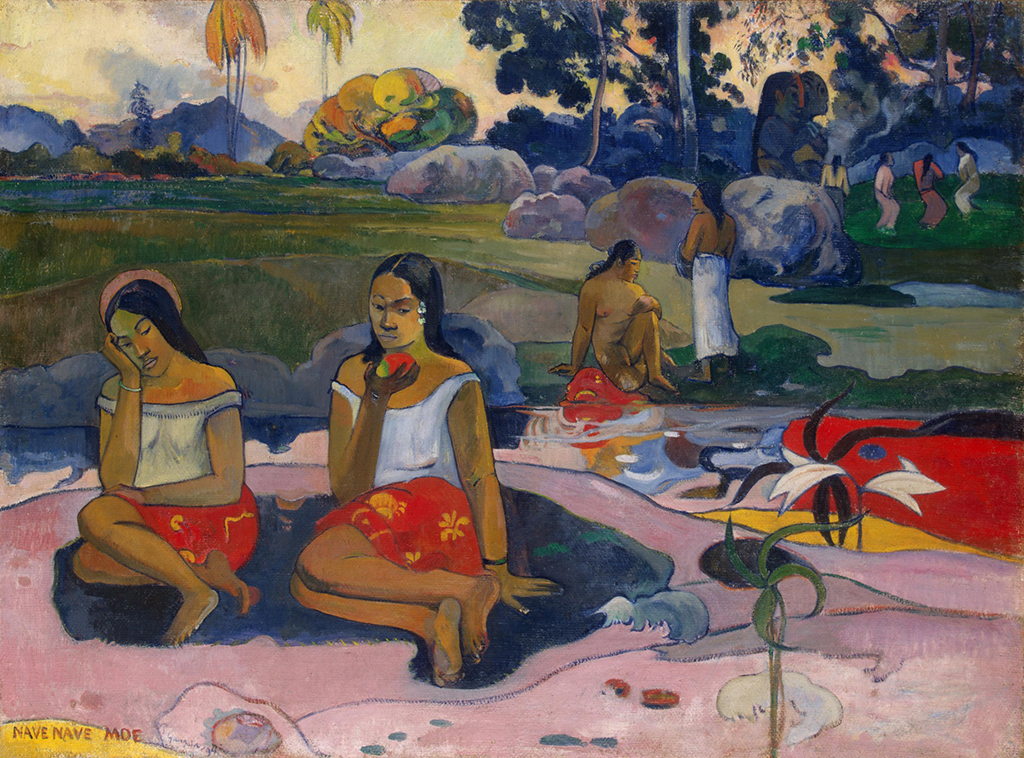
Two women sit beside a dark, curving pool in Paul Gauguin's Nave nave moe. The figure on the left leans her head into one hand. Her companion holds a small red object near her mouth. Pink ground spreads around their bodies, while enormous red-and-white flowers rise at the right. Beyond the pool, other figures occupy successive bands of landscape; in the far distance, a group appears to dance near an upright image.
At a Glance
- ArtistPaul Gauguin [1]
- TitleNave nave moe (Sacred Spring: Sweet Dreams) [1]
- Date1894 [1]
- Mediumoil on canvas [1]
- Dimensions / object size74 by 100 centimetres [1]
- Object recordThe current holder supplies the firm physical identity: oil on canvas, 74 by 100 centimetres, museum number ГЭ-6510. [1]
- FocusTwo women sit beside a dark, curving pool in Paul Gauguin's Nave nave moe.
Contents
- Nave nave moe (Sacred Spring: Sweet Dreams): Introduction
- One painting, several titles
- Two seated figures, not one sleeper
- Water and the decorative field
- A Paris composition made from remembered parts
- From Gauguin's sale to the Hermitage
- Reading without forcing the dream
The scene can look dreamlike, but the painting does not prove that either foreground woman is asleep. Nor is it a record of one observed ceremony. Gauguin painted it in France in 1894, after returning from his first stay in Tahiti. The current State Hermitage Museum record presents it as a work of recollection and romantic invention. [1] Its title history and repeated figures make that construction unusually visible.
One painting, several titles
The present Hermitage title is Sacred Spring: Sweet Dreams (Nave nave moe). [1] An official Hermitage collection catalogue uses the shorter combination Nave Nave Moe (Sacred Spring) and records the lower-left inscription and signature as NAVE NAVE MOE / P Gauguin 94. [2] The Tahitian words therefore belong to the painted object; the English phrases belong to later acts of cataloguing and interpretation.
There is a further layer. When the canvas appeared as lot 23 in Gauguin's Hôtel Drouot sale on 18 February 1895, the French title was Eau délicieuse—delicious or delightful water. The Museum of Modern Western Art reconstruction traces later alternatives: Georges Wildenstein offered Joie de se reposer, while the work of Bouge and Bengt Danielsson led to renderings such as Sweet Dreams or Sweet Thoughts. [3]
These phrases overlap without becoming interchangeable. Eau délicieuse directs attention to water; Sacred Spring adds a religious function; Sweet Dreams turns towards a state of mind. The painted NAVE NAVE MOE does not require one English phrase to be chosen while the rest are suppressed. The title is best understood as a history of how the picture has been framed.
The current holder supplies the firm physical identity: oil on canvas, 74 by 100 centimetres, museum number ГЭ-6510. [1] [2] This is not Nave nave mahana, the separate 1896 Lyon painting, and it is not one of Gauguin's other works beginning with Nave nave.
Two seated figures, not one sleeper
The foreground is organised around a pair. Both women wear pale upper garments and patterned red wraps, but their poses do not mirror each other. The left figure folds inward: crossed legs, inclined head, hand at the temple. The right figure sits more upright and brings a red, fruit-like form towards her lips. Their bodies are enclosed by a dark pool and by the pale-pink band that runs beneath them.
The Hermitage interprets the first figure as sleeping, with a halo that makes her an emblem of virgin purity. It reads the second as an Eve-like figure preparing to bite fruit, and treats the pair as different stages of life. [1] That is a coherent iconographic proposal, not a list of neutral visual facts. A bent head cannot establish sleep, the round object cannot be botanically identified as an apple from appearance alone, and a bright arc near a head need not settle a person's identity as Mary.
This distinction does not empty the objects of meaning. It reveals how the composition invites Christian associations without turning the women into securely identified biblical characters. Gauguin places ordinary-looking bodies beside forms that can be read as halo, fruit and spring. The viewer moves between visible object and inherited symbol; the painting does not close the gap.
The women are also not portraits with recoverable names. Nothing in the current Hermitage evidence identifies them. Their postures supply pictorial contrast, but not age, consent, belief or private thought. Sweet Dreams remains an institutional subtitle, not access to what a represented person experiences.
Water and the decorative field
The spring is less a deep opening in the earth than a chain of dark, curving shapes. It threads behind the figures and along their bodies, sometimes reading as water, sometimes as a strong border. Pink ground presses forward against dark blue-green, while pale ripples and small rounded forms interrupt the edge.
At the right, a cluster of flowers is almost as assertive as the seated women. The Art Institute of Chicago identifies the recurring flowers in Nave nave moe as amaryllis. [5] Gauguin enlarges them until their striped red-and-white petals and looping stems become a decorative structure. They occupy the near surface yet also screen the figures and water behind.
The lower half of the canvas consequently alternates between bodies, pool, flower and patterned ground without supplying a consistent depth. Contours separate the forms, but those same contours bind them into a continuous rhythm. The spring is simultaneously a depicted place and a device for drawing around the seated pair.
This is why Sacred Spring should not be treated as straightforward documentation. The title gives the water a possible symbolic charge; it does not prove that Gauguin recorded a named holy site or a recognised ritual at that spot. What can be established is how the painted water organizes the invented scene.
A Paris composition made from remembered parts
The current Hermitage record states that Gauguin painted the canvas in Paris after his 1891–93 stay in Tahiti. [1] The Museum of Modern Western Art reconstruction dates it to early 1894 and relates much of the arrangement to earlier first-stay works, particularly Women at the River Bank. [3] The Art Institute of Chicago likewise treats the seated pair as recurring figures that appear in Te fare maorie, Nave nave moe and other 1894 works in different media. [4]
Such recurrence changes the status of the scene. The figures need not have sat together beside this pool while dancers moved behind them. Gauguin could retain a pose, reposition a body, enlarge a flower and add a distant group. The finished painting creates a persuasive landscape from elements with separate pictorial histories.
The upper-right dancers belong to that repertory. The Hermitage describes islanders dancing around an idol and calls the image a mysterious ancient god. [1] AIC places dancing figures in Nave nave moe within Gauguin's repeated use of the dance motif across works of 1892–94. [5] Neither account establishes that this particular dance occurred before this particular image.
The Museum of Modern Western Art reconstruction proposes a printed travel-book source for the double idol, but its accessible page does not identify the exact book or illustration. [3] Without that chain, the stronger source claim should remain outside the public account. The important supported point is that a distant sculptural image was inserted into a composition made in Paris, not recovered as self-explanatory evidence of Tahitian religion.
From Gauguin's sale to the Hermitage
The title's changes accompanied a significant movement through collections. Eugène Schuffenecker bought the painting at the 1895 Drouot sale for 340 francs. Ivan Morozov acquired it from Ambroise Vollard in 1908 for 8,000 francs. [3] The contrast in prices is not a simple measure of quality, but it registers how the market for Gauguin's work changed.
Morozov's collection was nationalised in 1918. The painting entered the Second, or Morozov, museum branch in 1919 and the merged State Museum of New Western Art in 1928, where it carried inventory 293. It was transferred to the Hermitage in 1931. [3] The current Hermitage record confirms that entry, the transfer from the State Museum of New Western Art and the Morozov origin. [1]
This history matters because Sacred Spring: Sweet Dreams is not an untouched label transmitted from Tahiti. Painting, sale title, scholarly translations and museum titles all travelled through European and Russian systems of display. Each title encourages a different approach to the same surface.
Reading without forcing the dream
Nave nave moe does not need one decoded story. Its foreground pair can carry Christian echoes without becoming factually Mary and Eve. The pool can suggest sacred water without documenting a shrine. The dancers and upright image can establish a ritual distance without proving a ceremony. Even Sweet Dreams can describe the painting's suspended mood without diagnosing sleep.
What holds the canvas together is the conversion of recollected motifs into colour and line: seated bodies against dark water, pink ground around strong contours, giant flowers screening depth, and a far group reduced to emphatic movement. Gauguin's Paris studio turned these parts into an imagined Tahiti. The title history preserves several ways of approaching that construction; none should be mistaken for the only story the picture can tell.
Related Pages
Frequently Asked Questions
Two women sit beside a dark, curving pool in Paul Gauguin's Nave nave moe.
At the right, a cluster of flowers is almost as assertive as the seated women.
What holds the canvas together is the conversion of recollected motifs into colour and line: seated bodies against dark water, pink ground around strong contours, giant flowers screening depth, and a far group reduced to emphatic movement.
Discussion
Two women sit beside a dark, curving pool in Paul Gauguin's Nave nave moe.
Reader Insights
Two women sit beside a dark, curving pool in Paul Gauguin's Nave nave moe.
The Art Institute of Chicago identifies the recurring flowers in Nave nave moe as amaryllis.
The title history preserves several ways of approaching that construction; none should be mistaken for the only story the picture can tell.
Join the Conversation
Share the visible detail or source that most changed your reading.
References
- State Hermitage Museum, Sacred Spring: Sweet Dreams (Nave nave moe), current digital collection record, museum number ГЭ-6510 View source
- State Hermitage Museum, Western European Art: Paintings, 19th and 20th Centuries, collection catalogue, entry 221, Nave Nave Moe (Sacred Spring) View source
- Museum of Modern Western Art reconstruction, Nave nave moe. Sacred Spring: Sweet Dreams, object, title and provenance history View source
- Art Institute of Chicago, Noa Noa (Fragrant), cat. 51, descriptive analysis and related works View source
- Art Institute of Chicago, Mahna no varua ino (The Devil Speaks), cat. 57, related flowers, dancers and works View source
 Paul Gauguin.jpg)