 by Tom Gurney
Tom Gurney BSc (Hons) is an art history expert with over 20 years experience
Published on August 14, 2026 / Updated on August 14, 2026
Email: tomgurney1@gmail.com / Phone: +44 7429 011000
Vairumati: Introduction
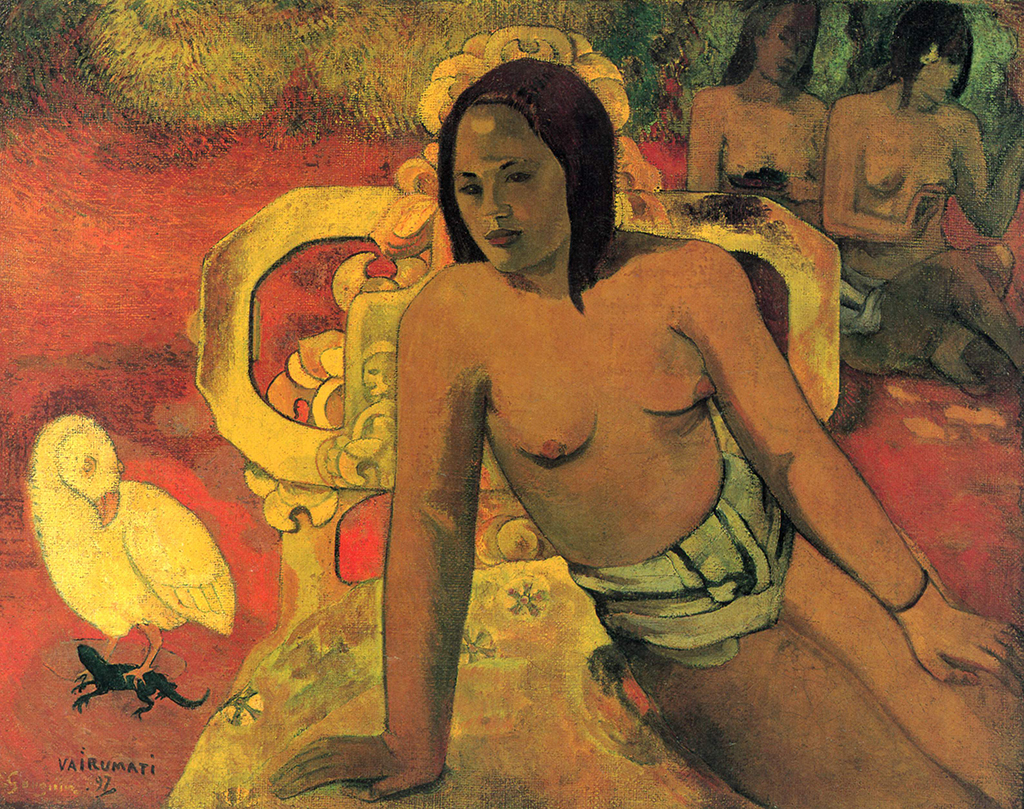
Paul Gauguin placed the painted name Vairumati beneath a startling encounter. At lower left, a white bird pins a small green lizard close to the words and the artist's signature. Above them, a large bare-breasted woman sits or half reclines against an ornate yellow-gold support. Its looping back and flower-like forms surround her head and shoulders. One arm drops towards the lower edge; the other cuts diagonally across the right half of the canvas. Two smaller bare-chested figures occupy the upper-right distance. [1]
At a Glance
- ArtistPaul Gauguin [1]
- TitleVairumati [1]
- Date1897 [1]
- Mediumoil painting on canvas [1]
- Dimensions / object size73.5 by 92.5 centimetres [1]
- Object recordThe Musée d'Orsay records Vairumati as an oil painting on canvas from 1897, measuring 73.5 by 92.5 centimetres. [1]
- FocusPaul Gauguin placed the painted name Vairumati beneath a startling encounter.
Contents
- Vairumati: Introduction
- The Orsay painting: title, date and inscription
- A figure made monumental
- Whose story is Vairumati?
- The historical `‘arioi` and Gauguin's retrospective image
- The bird and lizard do not form a fixed code
- What the 2017 restoration establishes
- From Vollard to Orsay
- Looking without decoding
The arrangement is at once frontal and unstable. The woman's body dominates the horizontal field, yet her leaning pose directs attention away from the centre. Red ground and wall-like bands press forward rather than recede. Mottled green and yellow passages across the top suggest vegetation without opening a continuous landscape. The white bird is conspicuous against the red, but it does not look towards the woman. Gauguin made the objects share a picture; he did not supply a visible story linking every part.
That distinction matters because the title has encouraged the painting to be read as an illustration of mythology. Vairumati does invoke a named narrative, but it is also a constructed image made in colonial Tahiti, assembled from recurring figures, written sources and Gauguin's own claims to the past.
The Orsay painting: title, date and inscription
The Musée d'Orsay records Vairumati as an oil painting on canvas from 1897, measuring 73.5 by 92.5 centimetres. It carries inventory number RF 1959 5. The museum transcribes the lower-left inscription as Vairumati 97 P. Gauguin. [1] The Wildenstein Plattner Institute identifies the same canvas as W559 and transcribes the painted title more diplomatically as VAÏRUMATI, followed by P. Gauguin. 97. Its catalogue date is 1897–98, but the holder's 1897 date and the painted 97 provide the clearest public object line. [2]
This is not the only Gauguin painting attached to the name. WPI W450 is a separate vertical canvas painted in 1892, Vaïraumati tei oa, with the French secondary title Vaïraumati elle se nommait. It measures 91 by 68 centimetres and has its own painted title, signature and date. [3] The 1892 and 1897 works share a subject field; they are not two names for one object.
The spelling also changes with the record. Orsay uses Vairumati, WPI preserves VAÏRUMATI on W559 and Vaïraumati on W450, while specialist scholarship often writes Vairaumati when discussing the recurring figure or idea. [4] These variants should remain attached to their sources. Regularising them into one form would conceal rather than solve the object's history.
A figure made monumental
The woman is neither fully upright nor conventionally reclining. Her torso rises before the seat while her body extends towards the lower right. A striped pale-and-blue cloth wraps her lower body. The broad limbs and dark contours give her weight, while the support behind her behaves less like ordinary furniture than a painted frame within the frame.
Early viewers also struggled to name that structure. The WPI catalogue preserves reviews of Vollard's 1898 exhibition in which critics compared it to an altar, a sacerdotal bed or an elaborate and unfamiliar couch. Others praised the painting's colour and line. [5] Those descriptions reveal how the work first registered in Paris. They do not prove that Gauguin depicted a particular ritual object.
Nor does the woman's pose identify her. Neither Orsay nor WPI names a sitter. Resemblance to a person in another picture cannot securely make her Teha'amana, Pau'ura or anyone else. What the canvas establishes is a role: the title places this unnamed woman within Gauguin's Vairumati programme. Her expression, thoughts and response to that assignment remain unavailable.
Whose story is Vairumati?
Grand Palais traces the narrative used for this painting to Gauguin's Ancien culte mahorie and Noa Noa. In the version it summarises, the god ‘Oro seeks a mortal woman. Vairumati is found at Bora Bora; a rainbow joins divine and earthly realms; their son is connected to the origin of the Areoi. [6] This is useful evidence for what Gauguin wanted the title to evoke, but it is not a direct transcript of an untouched oral tradition.
Art Institute of Chicago scholarship identifies Ancien culte mahorie as a compilation of passages from Jacques-Antoine Moerenhout's 1837 Voyages aux îles du grand océan, copied and illuminated by Gauguin in 1892–93. It also notes that his later claim to have learned Tahitian lore from the literary “Tehura” does not remove that printed European source. [7] The Vairumati story reached the canvas through selection, copying, rewriting and visual invention.
This source history also calls for care with cultural labels. Grand Palais's 2017 feature uses the phrase “Maori myth,” reflecting a longstanding French usage around Gauguin. Māori in Aotearoa New Zealand, Mā'ohi/Maohi terminology and the history of the Society Islands are not interchangeable. The painting was made in Tahiti and its title points towards a Society Islands narrative as Gauguin reconstructed it.
The historical `‘arioi` and Gauguin's retrospective image
The historical ‘arioi were not simply the erotic sect found in many European accounts. Anthropologist Deborah Elliston describes a stratified Society Islands religious association dedicated to ‘Oro. Membership conferred status and privileges; travelling groups gave dance and theatrical performances in exchange for hospitality and gifts, and those performances could carry political criticism. [8]
Elliston also shows how voyagers and missionaries interpreted Polynesian religion and sexuality through a racialising division between “civilization” and “savagery.” The ‘arioi became a particular focus of that moralising archive. Meanwhile, missionisation and chiefly politics transformed Society Islands religious life. Conversions accelerated after Pomare II embraced Christianity; by the 1830s, the archipelago was nominally Christian. [8]
Gauguin therefore did not witness the social world his title claimed to revive. He painted in 1897, more than six decades after that religious transformation and within French colonial rule. Vairumati is not a record of a surviving ceremony. It is evidence of how he imagined an earlier world through European texts and the bodies of contemporary Polynesian people.
The bird and lizard do not form a fixed code
The white bird and green lizard are precisely painted but not self-interpreting. WPI preserves an 1899 account in which the picture was described as a woman with a pelican holding a lizard, while Orsay's current indexing stays with the safer terms bird and lizard. [1] [5] The historical name can be reported; species cannot be established from the current record alone.
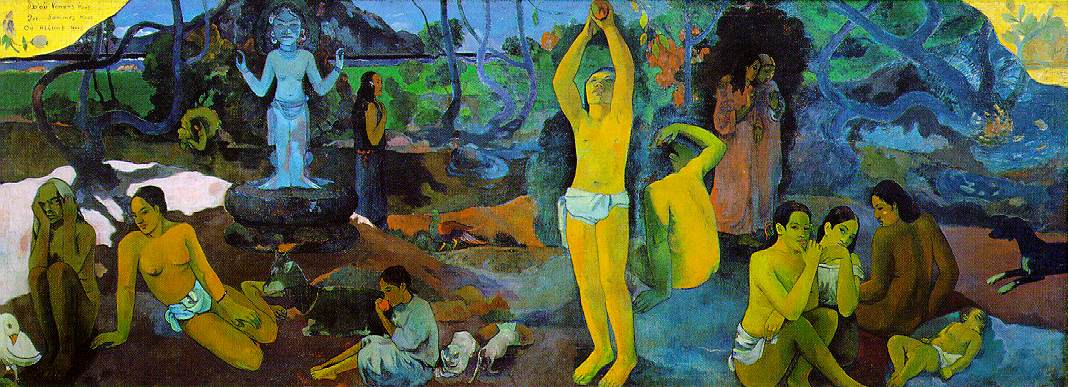
The motif travelled. Grand Palais connects the white bird and related female figure to Gauguin's three-question canvas now in Boston, also shown in Vollard's 1898 exhibition. [6] The Art Institute documents similar birds in both 1897 oils and traces the bird-with-lizard group into Plate with the Head of a Horned Devil and the later imagery around Love, and You Will Be Happy. [9] [10]
Recurrence shows Gauguin reusing and transforming a visual unit. It does not make the works replicas, prove that the women are one sitter or deliver a universal equation in which bird and lizard must always mean life and death, speech and silence, or spirit and body. Here the pair pulls the eye towards the painted title. Its strongest secure function is compositional: image, name and signature occupy the same charged corner.
What the 2017 restoration establishes
The painting was restored in 2017 for Gauguin the Alchemist. Grand Palais reports that the Centre for Research and Restoration of the Museums of France created scientific documentation and studied Gauguin's painting technique. [6] The public text does not specify pigment, underdrawing, layering, reworking or coating results. Orsay's current material description remains simply oil on canvas. [1]
That limited conclusion is preferable to filling the gap with plausible-sounding technique. The picture's muted, rubbed-looking surface may affect present viewing, but appearance alone cannot determine how it was built or how later treatments changed it. The documented fact is the conservation investigation, not a technical result absent from the published record.
From Vollard to Orsay
WPI's chronology places the painting among works Gauguin sent to George-Daniel de Monfreid in 1898. They passed through Georges-Alfred Chaudet to Ambroise Vollard, whose exhibition ran from 17 November to 10 December. Vollard bought nine canvases from the group for 1,000 francs on 8 December. [5] The show placed Vairumati beside that much larger Boston work, helping contemporary viewers recognise shared figures and motifs without collapsing the two compositions.
The later chain is unusually bound to twentieth-century political history. After Levy Galleries, Kōjirō Matsukata acquired the painting in September 1921 under the title Souvenir de Tahiti. WPI records its sequestration by the French government in 1944 and an assignment to the Musées nationaux under the San Francisco Peace Treaty in 1952. [5] Orsay's current record gives the formal French-state acceptance by treaty cession in 1959, followed by allocation to the Louvre, display at the Jeu de Paume until 1986 and transfer to the Musée d'Orsay that year. [1]
The route complicates any simple story of a masterpiece moving naturally towards its present museum. The canvas changed titles, markets and national custody. Its painted name stayed in place while the institutional meanings around it shifted.
Looking without decoding
Vairumati is most compelling when title and image are held together without treating either as complete proof. The title points towards a story Gauguin had copied and rewritten. The visual structure gives an unnamed Polynesian woman exceptional scale and stillness, yet assigns her a role authored by a European settler artist. The bird and lizard join that construction without surrendering one stable meaning.
Close looking therefore does not end in a solved symbol chart. It reveals how the yellow support encloses the figure, how the diagonal body unsettles a frontal pose, how two distant figures remain outside her psychological space, and how the bright bird directs attention to the painted word below. Historical looking adds the missing pressure: the gap between a complex Society Islands past and Gauguin's late-colonial claim to picture it.
Related Pages
Frequently Asked Questions
Paul Gauguin placed the painted name Vairumati beneath a startling encounter.
The historical ‘arioi were not simply the erotic sect found in many European accounts.
Close looking therefore does not end in a solved symbol chart.
Discussion
Paul Gauguin placed the painted name Vairumati beneath a startling encounter.
Reader Insights
Paul Gauguin placed the painted name Vairumati beneath a startling encounter.
The Vairumati story reached the canvas through selection, copying, rewriting and visual invention.
Historical looking adds the missing pressure: the gap between a complex Society Islands past and Gauguin's late-colonial claim to picture it.
Join the Conversation
Share the visible detail or source that most changed your reading.
References
- Musée d'Orsay, Vairumati, current object record, RF 1959 5 View source
- Wildenstein Plattner Institute, Vairumati, W559, current object record View source
- Wildenstein Plattner Institute, Vaïraumati tei oa, W450, current object record View source
- June Hargrove, Woman with a Fan: Paul Gauguin's Heavenly Vairaumati—a Parable of Immortality, The Art Bulletin 88, no. 3 (2006), abstract and bibliographic record View source
- Wildenstein Plattner Institute, W559 cataloguing record: provenance, exhibitions, contemporary reviews and publications View source
- Grand Palais, Tous les secrets de l'oeuvre de Gauguin “Vairumati”, 30 October 2017 View source
- Art Institute of Chicago, The Noa Noa Suite, 1893/94, discussion of Ancien culte mahorie and Moerenhout View source
- Deborah Elliston, Navigating “Race” at Tahiti: Polynesian and European Encounters, Comparative Studies in Society and History 66, no. 2 (2024), published online 22 December 2023 View source
- Art Institute of Chicago, Cat. 105, Soyez amoureuses, vous serez heureuses (Love, and You Will Be Happy), 1899, related-work discussion View source
- Art Institute of Chicago, Cat. 99, Plate with the Head of a Horned Devil, 1898/99, related-work discussion View source
 Paul Gauguin.jpg)