 by Tom Gurney
Tom Gurney BSc (Hons) is an art history expert with over 20 years experience
Published on August 14, 2026 / Updated on August 14, 2026
Email: tomgurney1@gmail.com / Phone: +44 7429 011000
Les Alyscamps: Introduction
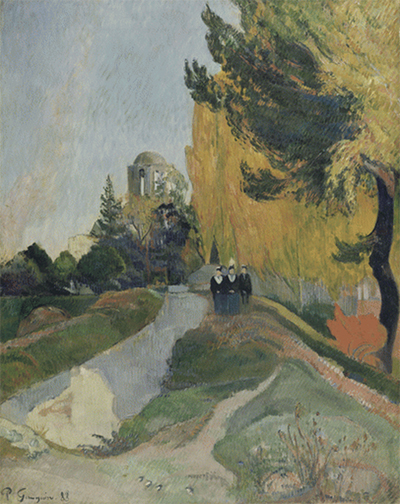
Paul Gauguin made more than one painting at the Alyscamps in Arles, and their nearly interchangeable names still cause confusion. The work considered here is the upright canvas in the Musée d'Orsay: Les Alyscamps, inventory RF 1938 47. It is not the horizontal L'Allée des Alyscamps, Arles now recorded by the Sompo Museum of Art. [1] [2]
At a Glance
- ArtistPaul Gauguin [1]
- TitleLes Alyscamps [1]
- Date1888 [1]
- Mediumoil on canvas [1]
- Dimensions / object size91.5 by 72.5 centimetres [1]
- Object recordThe work considered here is the upright canvas in the Musée d'Orsay: Les Alyscamps, inventory RF 1938 47. [1]
- FocusPaul Gauguin made more than one painting at the Alyscamps in Arles, and their nearly interchangeable names still cause confusion.
Contents
- Les Alyscamps: Introduction
- A cemetery with its history withheld
- Building an upright landscape
- The ironic Three Graces title
- Gauguin, Van Gogh and one shared site
- The second Gauguin canvas
- From Gauguin's sale to Orsay
Orsay dates its painting to 1888. It is oil on canvas, measures 91.5 by 72.5 centimetres and bears P. Gauguin - 88 at lower left. Those facts do more than complete a catalogue entry. The second Gauguin canvas reverses the measurements—72.5 by 91.5 centimetres—and has its own identifier, LO0179. Orientation, collection and number are therefore the safest way to tell the objects apart. [1] [2]
A cemetery with its history withheld
The Alyscamps carried layers of meaning before Gauguin arrived. Orsay describes it as a Roman necropolis consecrated for Christian burial by Saint Trophime in the third century. By the nineteenth century, avenues of cypresses and a reduced number of empty sarcophagi survived. Yet the painting does not inventory the site as an antiquarian monument. [1]
No sarcophagus is visible in the Orsay canvas. The domed tower and part of the Romanesque church of Saint-Honorat supply the limited architectural reference, while fields, woods and a canal occupy most of the space. Gauguin chose a historic place and then withheld the most obvious proof of its history. The result depends on selection and omission rather than on a panoramic description of famous ruins. [1]
Three walkers pass through this remade setting. The current museum account identifies two women in Arles dress and a man. They are small but structurally important: the procession supplies an oblique movement across the lower landscape while the taller forms above them pull the eye upward. Their clothing locates the scene without turning them into named portraits. [1]
Building an upright landscape
The vertical format changes what an avenue picture can do. Instead of extending a road deep into the distance, Gauguin stacks zones of ground, figures, canal, field and trees. The landscape rises in broad, uneven stages. Paths and banks do not converge into a single stable vanishing point; they press one coloured area against another. [1]
Orsay describes the composition in terms of juxtaposed masses and hatched surfaces. That account fits the way short directional marks give texture to water, earth and foliage without dissolving the larger design. The eye can recognise a wooded place, but it is repeatedly returned to the constructed surface—to diagonals, bands and colour boundaries. [1]
The palette intensifies that construction. Russets, yellow-greens and deeper blue-green passages need not be read as a meteorological report of one autumn afternoon. Orsay calls the colour subjective and decorative, and connects aspects of the brushwork with Cézanne. These are curatorial interpretations, not objective labels, but they clarify a visible priority: hue and handling organise the canvas as actively as the represented topography. [1]
That does not make observation irrelevant. Arles dress, the Saint-Honorat structure and the configuration of cultivated and wooded land keep the picture attached to a particular place. Gauguin's abstraction operates by editing those elements and changing their relative force, not by abandoning the site altogether. [1]
The ironic Three Graces title
The painting has carried a much more elaborate name. Orsay reports that Gauguin sent it to Theo van Gogh as Landscape or Three Graces with the Temple of Venus. The French Ministry of Culture records the alternative Les trois Grâces au temple de Vénus and explicitly calls it an ironic title given by the artist. [1] [3]
The irony is a warning against literal interpretation. The current Orsay description sees two women and one man, not three female mythological figures. Nor does the building shown belong to a Temple of Venus: it is associated with Saint-Honorat. The classical language overlays an Arles procession and a Christianised burial ground, creating a deliberate mismatch rather than revealing a hidden mythological subject. [1] [3]
An older Art Institute of Chicago exhibition text calls the group three Arlésiennes. That wording should not quietly replace the current museum identification. The disagreement is useful because it shows how readily the historical subtitle has guided later description. Close reading must begin with what the governing record now distinguishes, then keep the Three Graces as evidence of Gauguin's self-conscious naming rather than proof that every figure corresponds to an ancient goddess. [1] [5]
Gauguin, Van Gogh and one shared site
The Art Institute places the Orsay painting at about 29 October 1888 and the horizontal Gauguin canvas around 1 November. Its exhibition account also sets Gauguin's work beside Vincent van Gogh's rapid study of the avenue, describing Gauguin's response as more deliberate and abstracted. The dates are specialist estimates; both owning museums use the broader year 1888. [1] [2] [4] [5]
This comparison helps explain choices, but it should not become a personality test. A compressed, carefully ordered surface does not prove calmness, just as urgent marks in a Van Gogh canvas do not diagnose distress. What the paired activity demonstrates is that the Alyscamps could support markedly different acts of selection: an avenue can become an advancing corridor in one picture and a layered field of shapes in another. [5]
Van Gogh's letter edition identifies two of his own Alyscamps ('Leaf-fall') canvases as F 486/JH 1620 and F 487/JH 1621. Its scholarly notes add that Gauguin told Émile Bernard the paintings were hanging in his room. The evidence places the motif inside the artists' immediate visual exchange, but those Van Gogh works form a third object group. Their titles and catalogue numbers must never migrate into Gauguin's record. [6]
The second Gauguin canvas
Sompo's L'Allée des Alyscamps, Arles is a separate oil-on-canvas work, also signed and dated 1888. It is horizontal, 72.5 by 91.5 centimetres, and catalogued as LO0179; the museum states that it is held by the Sompo Museum of Art and deposited by Sompo Japan Insurance. [2]
The Chicago archive lists the same work with older oil on jute terminology. For present identification, Sompo's current record governs. This small difference matters because overlapping titles, transposed dimensions and changing catalogue language can otherwise make two works look like one unstable entry. They are related paintings, not interchangeable reproductions. [2] [4]
From Gauguin's sale to Orsay
The vertical canvas appeared as lot 12 in Gauguin's 1891 sale at the Hôtel Drouot. Orsay then traces it through the vicomte Guy de Cholet and his sister, the Countess Vitali, who donated it to the French state in 1923 in her brother's memory. Subsequent allocations took it through the Musée des Arts Décoratifs, the Louvre and the Jeu de Paume before it entered the Musée d'Orsay collection in 1986. [1]
That history fixes the object which the short title alone cannot. Les Alyscamps, RF 1938 47, is the vertical painting that suppresses sarcophagi, sets an ordinary procession against Saint-Honorat and rebuilds the cemetery as ascending colour. Its irony lies in calling that altered Arles scene a meeting of Graces and Venus; its pictorial force lies in needing neither myth nor ruins to make the place strange. [1] [3]
Related Pages
Frequently Asked Questions
Paul Gauguin made more than one painting at the Alyscamps in Arles, and their nearly interchangeable names still cause confusion.
The painting has carried a much more elaborate name.
That history fixes the object which the short title alone cannot.
Discussion
Paul Gauguin made more than one painting at the Alyscamps in Arles, and their nearly interchangeable names still cause confusion.
Reader Insights
Paul Gauguin made more than one painting at the Alyscamps in Arles, and their nearly interchangeable names still cause confusion.
Gauguin's abstraction operates by editing those elements and changing their relative force, not by abandoning the site altogether.
Its irony lies in calling that altered Arles scene a meeting of Graces and Venus; its pictorial force lies in needing neither myth nor ruins to make the place strange.
Join the Conversation
Share the visible detail or source that most changed your reading.
References
- Musée d'Orsay, Les Alyscamps, RF 1938 47, current object, interpretation and provenance record View source
- Sompo Museum of Art, L'Allée des Alyscamps, Arles, LO0179, current collection record View source
- French Ministry of Culture, POP/Joconde, Les Alyscamps ; Les trois Grâces au temple de Vénus, notice 000PE003848 View source
- Art Institute of Chicago, Van Gogh and Gauguin: The Studio of the South, complete list of works, 2001 exhibition archive View source
- Art Institute of Chicago, The Studio of the South, exhibition synthesis View source
- Vincent van Gogh: The Letters, Letter 717, scholarly notes identifying the separate Van Gogh Alyscamps works View source
 Paul Gauguin.jpg)