 by Tom Gurney
Tom Gurney BSc (Hons) is an art history expert with over 20 years experience
Published on August 14, 2026 / Updated on August 14, 2026
Email: tomgurney1@gmail.com / Phone: +44 7429 011000
Paul Gauguin in Arles with Vincent van Gogh: Introduction
Paul Gauguin and Vincent van Gogh lived and worked together in Arles for only nine weeks, from 23 October to 25 December 1888. The period is often reduced to the crisis in which Van Gogh injured his ear. Yet the more revealing story is an artistic experiment. The two painters shared a house, materials, models and motifs while testing sharply different ideas about how a modern picture should be made. Their collaboration produced neither a common style nor the artists' community Van Gogh had imagined. It made their differences newly visible. [1] [2]
At a Glance
- ArtistPaul Gauguin
- GuidePaul Gauguin in Arles with Vincent van Gogh
- Focusin Arles with Vincent van Gogh
- Key topicsThe plan for the Yellow House; Working together without becoming alike; Observation, memory and invention; Pressure inside the experiment
- OverviewPaul Gauguin and Vincent van Gogh lived and worked together in Arles for only nine weeks, from 23 October to 25 December 1888.
Contents
- Paul Gauguin in Arles with Vincent van Gogh: Introduction
- The plan for the Yellow House
- Working together without becoming alike
- Observation, memory and invention
- Pressure inside the experiment
- The rupture of 23 December
- After Arles
The plan for the Yellow House
Van Gogh had moved to Arles in February 1888 and rented the Yellow House on Place Lamartine as a home and studio. He hoped that other painters would join him in the south, share costs and work in mutual support. By October he was describing Gauguin to his brother Theo as the natural leader of a future group. This was Van Gogh's aspiration rather than a constitution that Gauguin had accepted. It nevertheless explains why he furnished the house and decorated it with paintings, including the Sunflowers and pictures intended for Gauguin's room. [1] [2]
The arrangement also depended on Theo. As an art dealer and Vincent's principal financial support, he helped fund the household and worked to sell Gauguin's paintings. Gauguin was struggling with money and health in Brittany, while Van Gogh wanted an experienced companion and a first member for his projected studio. Their reasons for agreeing were therefore connected but not identical. Van Gogh imagined a durable collective; Gauguin accepted a practical opportunity to work in the south. [1] [3]
Gauguin reached Arles at about four in the morning on 23 October after travelling from Pont-Aven. Van Gogh's first report was hopeful. He told Theo that Gauguin seemed in good health and that he expected them both to produce a great deal. The letter also shows the material reality beneath the ideal: they planned to economise on colours, prepare canvas themselves and use less expensive supports. Both artists soon painted on coarse jute from a roll Gauguin bought in Arles. [3] [4]
Working together without becoming alike
The early weeks were genuinely collaborative. On 1 or 2 November the two men took turns writing a letter to Émile Bernard. The Van Gogh Museum identifies it as the only surviving letter Van Gogh co-wrote with another artist. It records a conversation that extended beyond the studio: the artists discussed pictures, books, colleagues and the direction of modern painting, sometimes in markedly different voices. [5] [16]
They also went out to work on related subjects. At the Alyscamps, the ancient cemetery outside the old city walls, each painted the avenue and its figures. They returned to the public garden opposite the Yellow House and worked with people in their immediate Arles circle. The point was not to copy one another. Van Gogh had already explained that collaboration could mean divergent works that complemented each other rather than several painters contributing to one canvas. [6]
Arlésiennes (Mistral) makes the productive distance clear. The Art Institute of Chicago describes it as one of seventeen canvases Gauguin completed during the visit. Its planned arrangement, broad areas of colour, tilted space and enigmatic figures transform the public garden into something more constructed than an immediate view. The museum contrasts that deliberation with Van Gogh's response to the same setting. Shared access to a motif became a way of clarifying separate pictorial languages. [7]
The same pattern appeared in portraiture. When Marie Ginoux, proprietor of the Café de la Gare with her husband Joseph, sat for the artists, Van Gogh painted rapidly in oils while Gauguin made a drawn study that he later inserted into the more complex composition now titled Cafe at Arles. The works arose from the same encounter, but Gauguin treated observation as material to be stored, rearranged and combined. That difference matters more than a simple competition over who produced the better likeness. [8]
Observation, memory and invention
In mid-November Van Gogh told his sister Willemien that he and Gauguin were happy together and that his companion encouraged him to work from imagination. A week later he told Theo that he was beginning to compose from memory and could use earlier studies to recall things he had seen. Gauguin's presence therefore widened Van Gogh's practice, at least temporarily, by making an alternative method unavoidable. [9] [4]
This should not be simplified into Van Gogh painting only what he saw and Gauguin painting only what he imagined. Van Gogh changed colour, scale and rhythm to express what a motif meant to him. Gauguin drew people and places from observation, then reused those records within carefully prepared compositions. The disagreement concerned emphasis: how far a painter should remain answerable to the visible occasion, and how freely a picture could be rebuilt through memory, symbols and previous studies. [4] [6]
Their materials made the contrast visible too. Gauguin often applied relatively thin paint that allowed the texture of coarse jute to remain active. Van Gogh tended to load the same resistant fabric more heavily. The support was shared, but their treatment of it was not. Technical difference and artistic argument reinforced one another without becoming a neat opposition. [4]
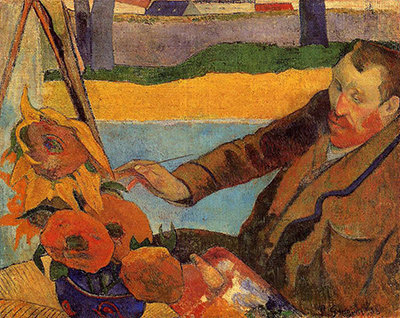
Gauguin's Vincent van Gogh Painting Sunflowers concentrates these exchanges in a single image. He worked on it during December, after sunflowers had ceased blooming, and prepared the composition in sketches. The flowers therefore refer from memory to Van Gogh's earlier still lifes rather than documenting a live December sitting. Gauguin constructed his companion as “the painter of sunflowers,” identifying an artist through his characteristic subject while also presenting painting itself as a staged act. [4]
The portrait was both tribute and argument. Gauguin admired the Sunflowers as distinctly Van Gogh's, yet represented him through Gauguin's own controlled composition and thin surface. The familiar chair, vase and clothing belong to the Yellow House, although the Van Gogh Museum cautions that not every resemblance to Van Gogh's pictures can be proved a deliberate quotation. The painting records intimacy without agreement: one artist defined the other in his own visual language. [4]
Pressure inside the experiment
The letters show that the household did not move in a straight line from harmony to catastrophe. Enthusiasm, rivalry, dependence and irritation coexisted. Bad weather restricted outdoor work, money remained a pressure, and the Yellow House placed two forceful painters in close quarters. Their debates could be productive, but neither man obtained the peace or stable community he wanted. [1] [6]
By about 11 December, Van Gogh told Theo that Gauguin had become discouraged by Arles, the house and himself. An editorial note in the letters preserves Gauguin's separate message to Theo: he said that incompatible temperaments made it impossible for the two to live side by side without trouble and that both needed tranquillity for work. Vincent nevertheless thought the decision to leave was still being reconsidered. [10]
On 17 or 18 December, Van Gogh described their discussions of Delacroix, Rembrandt and other artists as “excessively electric.” He said they sometimes emerged mentally tired, like a discharged battery. This is contemporaneous evidence of strain, but it is not proof that one debate caused what followed. It shows an intense intellectual relationship approaching exhaustion. [4]
The rupture of 23 December
After a quarrel on the evening of 23 December, Van Gogh experienced an acute crisis and injured his left ear. Gauguin spent the night away from the Yellow House and sent a telegram to Theo the next day. Theo travelled from Paris, saw his brother in hospital and returned with Gauguin on 25 December. The shared household was over. [11] [12]
The limits of the evidence are important. Gauguin later wrote that Van Gogh had approached or pursued him with a razor before turning back. That retrospective story became central to popular accounts, but the secure contemporary record does not establish every dramatic detail. Nor does it support making Gauguin the single cause of Van Gogh's crisis. Artistic conflict, difficult living conditions and personal strain belong to the context; none amounts to a medical explanation. [11] [12]
The episode should not be allowed to interpret every picture made in Arles. Arlésiennes (Mistral), Cafe at Arles and Vincent van Gogh Painting Sunflowers are not coded forecasts of the injury. They are evidence of sustained looking, collecting, drawing, remembering and disputing during a compressed period of work. Their value lies partly in showing how much happened before the collaboration broke down. [4] [7] [8]
After Arles
The personal and artistic connection did not end cleanly on the train to Paris. On 4 January 1889, during his first authorised trip out of hospital, Van Gogh wrote Gauguin words of friendship and asked him not to speak badly of the Yellow House before both had reflected. Later that month they corresponded about studies, sketchbooks, fencing equipment and possible exchanges. Van Gogh still considered repeating a Sunflowers painting for Gauguin, and on 30 January reported receiving a friendly letter from him. [13] [14]
They never met again, but their correspondence and collection histories kept the exchange alive. Works passed between the brothers, Gauguin and their circle; Theo later acquired Arlésiennes (Mistral). Both painters continued to define their own aims partly against what the other had demonstrated in Arles. [2] [14] [15]
The collaboration failed if measured by Van Gogh's hope for a permanent Studio of the South. As an artistic encounter, however, it was remarkably productive. Sharing a house did not reconcile the painters' methods. It forced each to test those methods beside an equally ambitious alternative. The strongest account of Arles is therefore neither a sentimental story of friendship nor a countdown to crisis. It is the history of two artists working close enough to change, resist and sharpen one another. [2] [6]
Related Pages
Frequently Asked Questions
Paul Gauguin and Vincent van Gogh lived and worked together in Arles for only nine weeks, from 23 October to 25 December 1888.
Gauguin's Vincent van Gogh Painting Sunflowers concentrates these exchanges in a single image.
The collaboration failed if measured by Van Gogh's hope for a permanent Studio of the South.
Discussion
Paul Gauguin and Vincent van Gogh lived and worked together in Arles for only nine weeks, from 23 October to 25 December 1888.
Reader Insights
Paul Gauguin and Vincent van Gogh lived and worked together in Arles for only nine weeks, from 23 October to 25 December 1888.
Gauguin often applied relatively thin paint that allowed the texture of coarse jute to remain active.
It is the history of two artists working close enough to change, resist and sharpen one another.
Join the Conversation
Share the visible detail or source that most changed your reading.
References
- Vincent van Gogh, Letter 694 to Theo van Gogh, 3 October 1888, Vincent van Gogh: The Letters View source
- Art Institute of Chicago, Van Gogh and Gauguin: The Studio of the South, publication page View source
- Vincent van Gogh, Letter 712 to Theo van Gogh, on or about 25 October 1888, with editorial notes, Vincent van Gogh: The Letters View source
- Joost van der Hoeven, “Paul Gauguin, Vincent van Gogh Painting Sunflowers, 1888,” Contemporaries of Van Gogh 1, Van Gogh Museum, current catalogue entry View source
- Vincent van Gogh and Paul Gauguin, Letter 716 to Émile Bernard, 1 or 2 November 1888, Vincent van Gogh: The Letters View source
- Art Institute of Chicago, “Studio of the South,” archived exhibition interpretation View source
- Art Institute of Chicago, “Arlésiennes (Mistral),” object record, reference 1934.391 View source
- Van Gogh Museum, “Study Sheet with Portraits of Camille Roulin,” Contemporaries of Van Gogh 1 View source
- Vincent van Gogh, Letter 720 to Willemien van Gogh, on or about 12 November 1888, Vincent van Gogh: The Letters View source
- Vincent van Gogh, Letter 724 to Theo van Gogh, on or about 11 December 1888, with editorial note quoting Gauguin's message to Theo, Vincent van Gogh: The Letters View source
- Van Gogh Museum, permanent-collection gallery texts, “Van Gogh and Gauguin in Arles.” View source
- Vincent van Gogh and Félix Rey, Letter 728 to Theo van Gogh, 2 January 1889, with editorial reconstruction, Vincent van Gogh: The Letters View source
- Vincent van Gogh, Letter 730 to Paul Gauguin, 4 January 1889, Vincent van Gogh: The Letters View source
- Vincent van Gogh and Paul Gauguin, Letters 736, 737, 741 and 744, January 1889, Vincent van Gogh: The Letters View source
- Joost van der Hoeven, “The Genesis of the Collection of Art Assembled by Theo and Vincent van Gogh,” Contemporaries of Van Gogh 1, Van Gogh Museum View source
- Van Gogh Museum, Annual Report 2020, acquisition note for Letter 716 View source
 Paul Gauguin.jpg)