 by Tom Gurney
Tom Gurney BSc (Hons) is an art history expert with over 20 years experience
Published on August 14, 2026 / Updated on August 14, 2026
Email: tomgurney1@gmail.com / Phone: +44 7429 011000
Breton Girls Dancing, Pont-Aven: Introduction
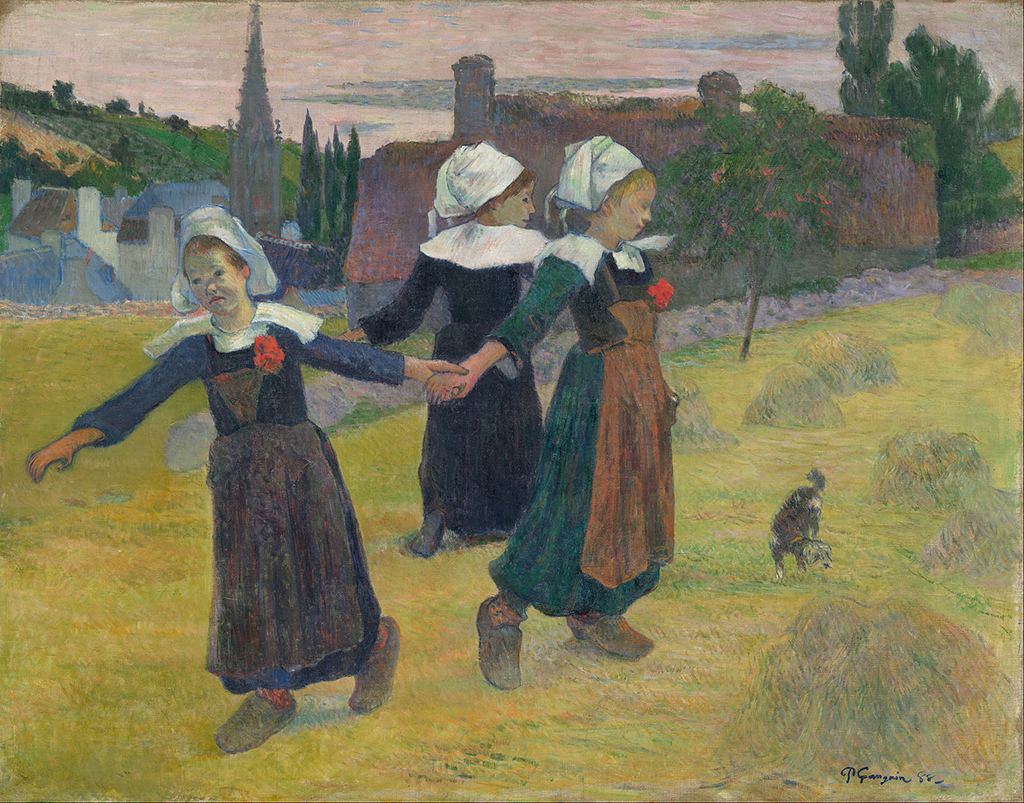
Paul Gauguin's Breton Girls Dancing, Pont-Aven turns linked movement into a firm pictorial structure. Three figures hold one another's hands in a grassy field, yet the painting is not mainly a charming record of a rural dance. The arms make a chain, the dresses form broad colour masses, and the figures press forward so strongly that the town behind them appears almost miniaturised. [1] [2]
At a Glance
- ArtistPaul Gauguin [1]
- TitleBreton Girls Dancing, Pont-Aven [1]
- Date1888 [1]
- Mediumoil painting on canvas [1]
- Dimensions / object size73 by 92.7 centimetres [1]
- Object recordThe object is an oil painting on canvas, not a drawing. [1]
- FocusPaul Gauguin's Breton Girls Dancing, Pont-Aven turns linked movement into a firm pictorial structure.
Contents
- Breton Girls Dancing, Pont-Aven: Introduction
- Object, Date and Provenance
- The Dancing Group
- Pont-Aven and Regional Dress
- Scale, Depth and Structure
- Relation to Vision after the Sermon
- Representation and the Limits of Regional Type
Object, Date and Provenance
The object is an oil painting on canvas, not a drawing. Gauguin made it in 1888, and the National Gallery of Art in Washington records its overall dimensions as 73 by 92.7 centimetres, or 28 3/4 by 36 1/2 inches. It is in the Collection of Mr. and Mrs. Paul Mellon, accession number 1983.1.19, and the artist signed and dated it at the lower right, P. Gauguin 88. [1] Those details matter here because the approved planning record had carried a medium error. The painting discussed here is the Washington canvas.
Its recorded history also keeps the work tied to Gauguin's 1888 professional world. The NGA provenance traces the painting from the artist to Boussod, Valadon et Cie. in November 1888, then through Montandon, Ambroise Vollard, possibly Etienne Bignou, William A. Cargill's Scottish collection and Paul Mellon, whose gift brought it to the National Gallery of Art in 1983. [1] It was not a private village relic. It entered the dealer, exhibition and collecting circuits through which Gauguin's Brittany pictures reached broader audiences.
The Dancing Group
The scene is easy to grasp at first glance and more deliberate on second looking. The three girls wear white headdresses, long dresses, clogs and wide collars. Two figures facing us have dark aprons with red flowers pinned to them; the third is seen mostly from behind, turning her head in profile. A small dog sniffs at the grass to the right. Low heaps of cut grass or grain interrupt the bright field, and a stone wall separates the dancing group from the buildings beyond. [1] [2]
Colour keeps the group from dissolving into anecdote. Navy, green and black dresses are edged and activated by strong blue contours, while red stockings, flowers and warm roofs answer one another across the canvas. [1] The field is bright rather than atmospheric, and the sky is only a narrow band. Gauguin gives the scene air and place, but he denies the background the authority it would have in a conventional village view.
Pont-Aven and Regional Dress
Pont-Aven is not merely a label in the title. The National Gallery of Art's teaching material notes that the town and its church spire are visible behind the girls, and that Parisian audiences would have recognised the bonnets, collars and wooden shoes as Breton markers. [2] The painting therefore begins with signs of a particular place and regional dress. It does not, however, give the viewer names, family histories, exact ages, an occasion, music or a secure record of a specific dance step. The sources support a linked dance; they do not authorise a scene-by-scene biography.
Scale, Depth and Structure
The scale is the crucial distortion. Gauguin makes the girls loom in front of the stone wall, while the houses, spire, trees and hillside sit lower and smaller in the distance. [1] [2] That difference does not read as optical accident. It changes the subject from an observed village moment into a designed rhythm of bodies. The girls' arms pull the eye laterally; their feet step in alternating directions; the headdresses punctuate the group with repeated white shapes. Movement becomes pattern.
This is why Breton Girls Dancing, Pont-Aven belongs beside Gauguin's broader 1888 transformation in Brittany, while remaining distinct from the visionary works of the same year. Pont-Aven already had a history as an artists' colony, and the later phrase Pont-Aven School gathers a varied group rather than a formal academy. [3] Gauguin's work there, especially in exchange with Emile Bernard, moved away from Impressionist naturalism toward flatter colour, stronger contours and more deliberate construction. [4] This painting shows that shift through a modest subject rather than a visionary one.
Relation to Vision after the Sermon
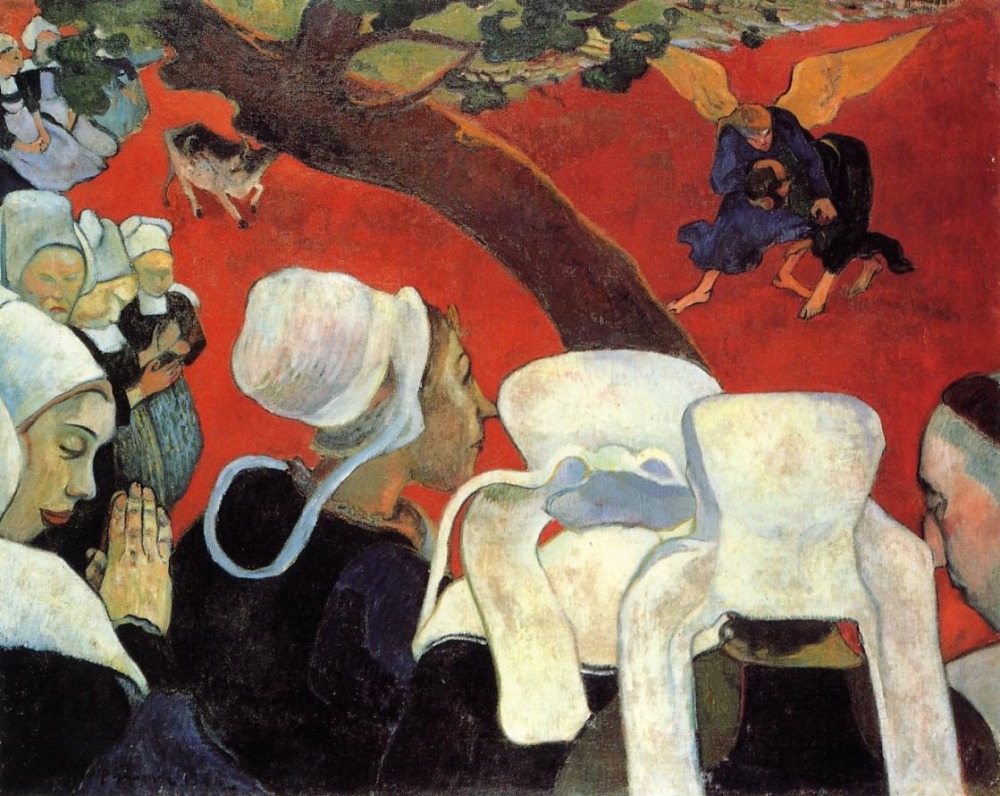
The difference from Vision after the Sermon is useful. In that work, Breton worshippers and a biblical vision occupy a deliberately impossible red field. Here, the field is still recognisably grassy, the buildings remain legible and the group is engaged in visible human activity. Yet naturalistic space is still under pressure. The girls are too large for the background, and the lines around their clothing give each figure a hard visual edge. [1] [2] Gauguin is not abandoning observation; he is making observation serve design.
Representation and the Limits of Regional Type
That formal strength should not flatten the people represented. Regional clothing can locate the scene socially, but it should not turn the girls into timeless emblems or decorative proof of an unchanging Brittany. The painting depends on their presence, and it also transforms that presence for Gauguin's artistic purposes. Holding both facts together gives a more accurate account: this is a place-specific image of dancers, and it is also a constructed modern painting about rhythm, scale and surface.
The closing force of the canvas comes from that double status. The hands connect, the white caps repeat, the town recedes, and the dog remains a small ordinary counterpoint at the edge. Gauguin gives us enough local detail to keep Pont-Aven visible, then enlarges the linked group until the dance becomes the painting's architecture.
Related Pages
Frequently Asked Questions
Paul Gauguin's Breton Girls Dancing, Pont-Aven turns linked movement into a firm pictorial structure.
Pont-Aven is not merely a label in the title.
The closing force of the canvas comes from that double status.
Discussion
Paul Gauguin's Breton Girls Dancing, Pont-Aven turns linked movement into a firm pictorial structure.
Reader Insights
Paul Gauguin's Breton Girls Dancing, Pont-Aven turns linked movement into a firm pictorial structure.
The painting therefore begins with signs of a particular place and regional dress.
Gauguin gives us enough local detail to keep Pont-Aven visible, then enlarges the linked group until the dance becomes the painting's architecture.
Join the Conversation
Share the visible detail or source that most changed your reading.
References
- National Gallery of Art, "Breton Girls Dancing, Pont-Aven." View source
- National Gallery of Art, Picturing France 1830-1900, especially the section on Breton Girls Dancing, Pont-Aven View source
- Musée de Pont-Aven, "Histoire du musée et de l'école de Pont-Aven." View source
- The Metropolitan Museum of Art, Cindy Kang, "Paul Gauguin (1848-1903)." View source
 Paul Gauguin.jpg)