 by Tom Gurney
Tom Gurney BSc (Hons) is an art history expert with over 20 years experience
Published on August 14, 2026 / Updated on August 14, 2026
Email: tomgurney1@gmail.com / Phone: +44 7429 011000
Still Life: Wood Tankard and Metal Pitcher: Introduction
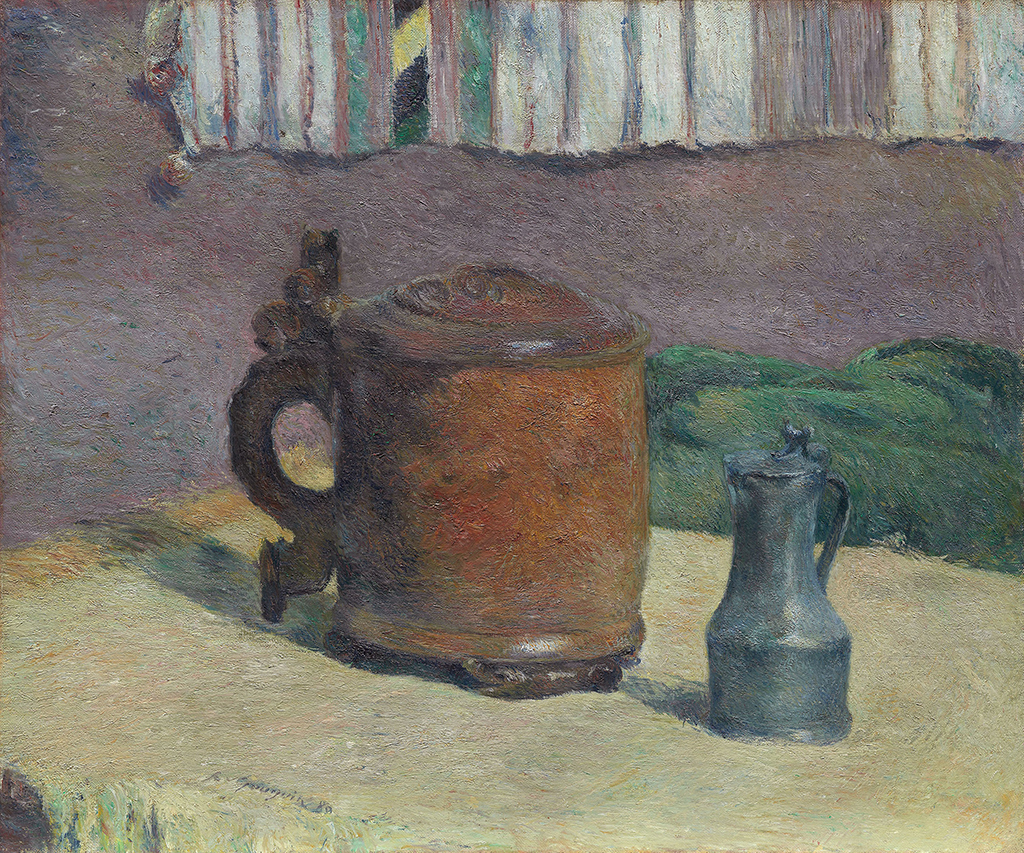
Paul Gauguin gave two vessels radically unequal shares of this small still life. A lidded wooden tankard occupies much of the centre, its orange-brown body resting on stubby feet. A blue-grey metal pitcher stands near the right edge, less than half its neighbour's height, but turns its spout towards the larger object. Their long shadows stretch together across a creamy table covering. [1]
At a Glance
- ArtistPaul Gauguin [1]
- TitleStill Life: Wood Tankard and Metal Pitcher [1]
- Date1880 [1]
- Mediumoil on linen canvas [1]
- Dimensions / object size54 by 65 centimetres [1]
- Object recordThe Art Institute of Chicago dates Still Life: Wood Tankard and Metal Pitcher to 1880 and catalogues it as oil on linen canvas, 54 by 65 centimetres. [1]
- FocusPaul Gauguin gave two vessels radically unequal shares of this small still life.
Contents
- Still Life: Wood Tankard and Metal Pitcher: Introduction
- The current object record
- A sparse arrangement of opposites
- What technical examination reveals
- A family object and a later fable
The pairing looks simple until the room begins to tilt around it. The tabletop falls towards the lower right, while the bottom of the striped wall hanging inclines in the opposite direction. A crumpled green textile pushes forward behind the vessels. Warm colour enters the pitcher; cooler green and blue-grey appear on the tankard. Gauguin made difference visible, then prevented it from becoming absolute.
The current object record
The Art Institute of Chicago dates Still Life: Wood Tankard and Metal Pitcher to 1880 and catalogues it as oil on linen canvas, 54 by 65 centimetres. The painting entered the museum as a Millennium Gift of Sara Lee Corporation and carries reference number 1999.362. Gauguin signed and dated it in pale-purple paint at the lower left, running P. Gauguin 80 diagonally along the table edge. [1] [2]
The current title is descriptive, but it has a documentary foundation. Art Institute scholarship bases it on a letter sent by Maurice Joyant to Georges-Daniel de Monfreid on 24 March 1893, which lists a nature-morte, pot et cafetière—a still life with a vessel and coffee pot—identified with the Chicago canvas. [2]
The work may have appeared much earlier, as Nature morte, no. 58, in the fifth Impressionist exhibition of April 1880. The identification is not certain: specialists have proposed two other Gauguin still lifes for that catalogue entry. Probably exhibited is therefore more accurate than treating the title as an established 1880 label. [2]
A sparse arrangement of opposites
The painting contains no overflowing fruit, flowers, game or tableware. Its interest lies in a sparse and slightly off-balance arrangement. The tankard is almost, but not exactly, central. Its lid, handle, feet and broad front give it considerable visual weight. The pitcher is pushed outward yet points back into the picture. The long leftward shadows connect objects that scale and placement keep apart. [2]
Three textiles complicate their setting. Pale yellow fabric covers the table and ends in fringe. Green cloth gathers behind the vessels. Across the upper wall hangs a striped textile whose pale vertical bands are broken by green, mauve and yellow. The wall itself appears as a muted purple field. These layers make the still life feel furnished and domestic without turning it into a room portrait.
The colours also cross boundaries. Orange and red reflected from the tankard enter the pitcher, while the tankard's lower right carries cooler notes from the smaller vessel. Yellow table covering and purple wall form another opposition. The result is not a diagram of complementary colours: each large contrast is softened by mixed and repeated hues. [2]
This 1880 experiment belongs to Gauguin's early engagement with Impressionism. In 1879 he was still working as a stockbroker while collecting and making art. Degas and Pissarro invited him to the fourth Impressionist exhibition, and that summer he worked beside Pissarro at Pontoise. The Chicago catalogue connects the following year's still life with the short, varied brushwork and unconventional composition he was then absorbing. [2]
What technical examination reveals
The apparent casualness was planned. Technical imaging reveals probable graphite outlines for the principal objects, cloths and table edge. The shadows were painted directly onto the prepared ground before Gauguin laid in the tablecloth, showing that their direction and the vessels' diagonal placement were early structural decisions. [2]
He revised the relationship as he worked. During drawing, the left side of the pitcher was narrowed. In paint, he adjusted the bottoms and facing edges of both vessels. Earlier angular projections were rounded, opening a gentler interval between them. These changes do not prove hesitation or emotional symbolism; they show sustained attention to shape and the space separating the objects. [2]
Gauguin built much of the surface from very short, crossing strokes applied in several directions, often wet-in-wet. On the wooden tankard these strokes form a rough crust. Where green and orange had blended into a muddy tone, he placed white beneath later orange-red paint to recover brightness. The visible colour is therefore the product of layering and adjustment, not simply a local label applied to wood. [2]
The hanging is handled differently. Its paint is thinner, and the prepared ground supplies part of one pale stripe. Gauguin began some marks with thicker paint, drew the brush out and finished by pouncing it. He also pressed his thumb and a coarse cloth into the soft surface. Across one canvas, paint can imitate worn timber, dented metal, loose cloth and heavy weave without smoothing them into the same texture. [2]
A family object and a later fable
The large vessel was not anonymous studio furniture. It came from the family of Mette Gad, Gauguin's Danish wife. The Art Institute describes the object as a wooden Norwegian stein, also called a tine. It reappears in later pictures as the family moved from Paris to Rouen and Copenhagen. Gauguin did not paint it again after leaving Copenhagen in 1885, and the catalogue concludes that it most likely remained with Mette. [2]
The smaller vessel is metal, probably pewter. Its earlier history is unknown. That asymmetry of knowledge is important: the tankard has a family provenance, while the pitcher's proposed French or Gauguin-family origin remains speculation. [2]
From 1946 the painting was exhibited under a title borrowed from the objects in a La Fontaine fable: Le Pot de terre et le pot de fer. In English, that title means The Clay Pot and the Iron Pot. The story, adapted from Aesop, follows a fragile clay pot that accepts an iron pot's invitation to travel and is broken by its stronger companion. Yet Gauguin painted wood and probably pewter, not clay and iron. Any correspondence is indirect and may owe as much to later titling as to an intention formed in 1880. [1] [2]
Art Institute scholars have asked whether the unequal vessels might allude to Paul and Mette Gauguin: different origins, materials and scales made uneasy partners. The reading is suggestive because the tankard belonged to Mette's family. It remains conditional because no document says Gauguin designed the still life as a marriage portrait, and the metal pitcher's origin is not known. [2]
The technical evidence offers a firmer conclusion. Gauguin repeatedly altered the two shapes and the interval between them while allowing each to carry some of the other's colour. Whatever personal associations the objects held, their relationship was constructed in drawing and wet paint. The space between them is not empty; it is one of the painting's most carefully made forms.
Related Pages
Frequently Asked Questions
Paul Gauguin gave two vessels radically unequal shares of this small still life.
The apparent casualness was planned.
The technical evidence offers a firmer conclusion.
Discussion
Paul Gauguin gave two vessels radically unequal shares of this small still life.
Reader Insights
Paul Gauguin gave two vessels radically unequal shares of this small still life.
The Chicago catalogue connects the following year's still life with the short, varied brushwork and unconventional composition he was then absorbing.
The space between them is not empty; it is one of the painting's most carefully made forms.
Join the Conversation
Share the visible detail or source that most changed your reading.
References
- Art Institute of Chicago, “Still Life: Wood Tankard and Metal Pitcher”, 1880, 1999.362, current object record: View source
- Richard R. Brettell, Genevieve Westerby and Kristin Hoermann Lister, “Still Life: Wood Tankard and Metal Pitcher, 1880”, Cat. 1, Gauguin Paintings, Sculpture, and Graphic Works at the Art Institute of Chicago, current online scholarly catalogue: View source
 Paul Gauguin.jpg)