 by Tom Gurney
Tom Gurney BSc (Hons) is an art history expert with over 20 years experience
Published on August 14, 2026 / Updated on August 14, 2026
Email: tomgurney1@gmail.com / Phone: +44 7429 011000
Aha oe feii? (Are You Jealous?): Introduction
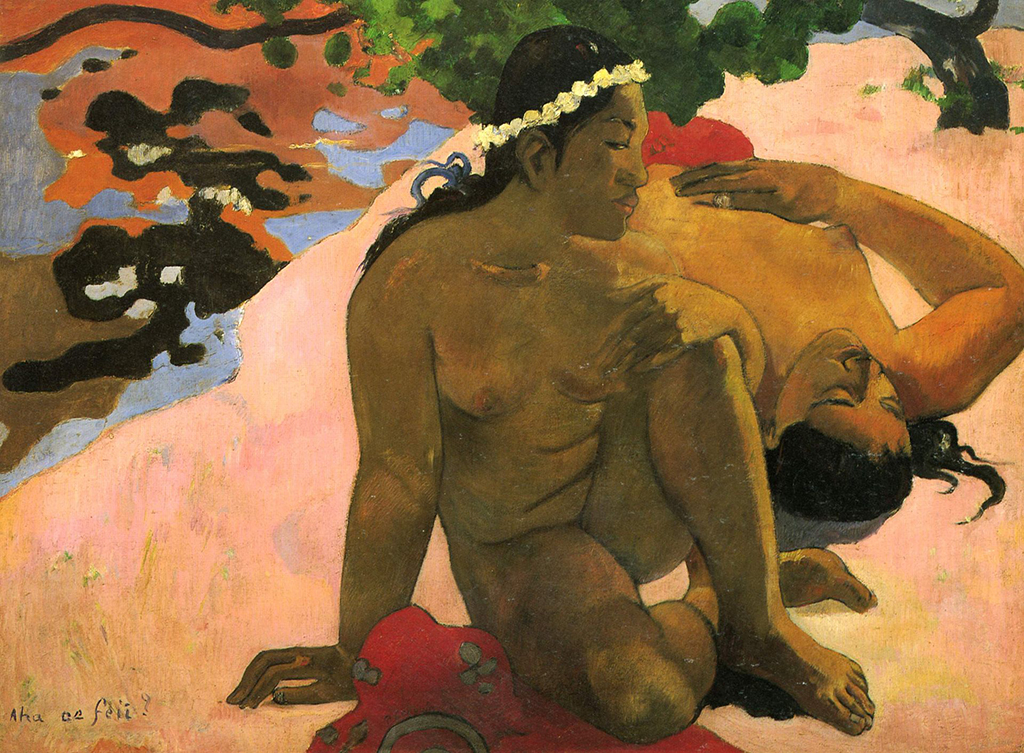
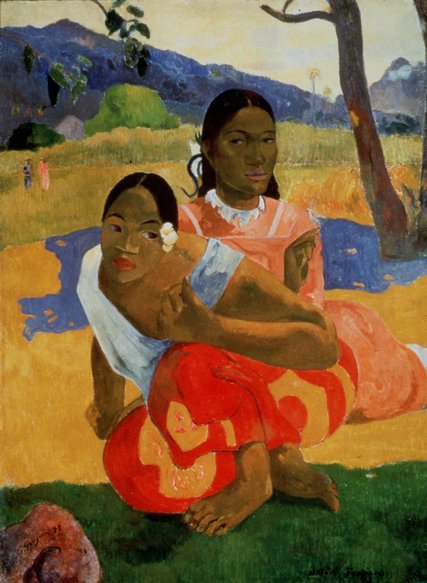
Two women occupy almost the entire foreground of Paul Gauguin's Aha oe feii? One sits upright, bracing a hand on the ground as she turns towards the other. Her companion reclines across the right side of the canvas, head lowered and body angled away. A red patterned pareu runs beneath them. Above, dark branches compress the scene; behind, pink, blue and brown areas make the boundary between beach and water hard to fix. [1] [2]
At a Glance
- ArtistPaul Gauguin [1]
- TitleAha oe feii? (Are You Jealous?) [1]
- Date1892 [1]
- Mediumoil on canvas [1]
- Dimensions / object size66.2 by 89.3 centimetres [1]
- Object recordIts collection number is Ж-3269, and its medium is oil on canvas. [1]
- FocusTwo women occupy almost the entire foreground of Paul Gauguin's Aha oe feii?
Contents
- Aha oe feii? (Are You Jealous?): Introduction
- The painting in Moscow
- A question before a plot
- What the bodies do—and do not say
- Drawn, remembered and borrowed
- The later story in *Noa Noa*
- A painting transformed into prints
- Jealousy as Gauguin's frame
The title supplies the question that the figures do not visibly perform. Their eyes do not meet, and their bodies neither touch nor form an obvious conversational pair. Nothing in a flower wreath, a lowered face or a turned torso proves jealousy. The painting invites a story, but it also withholds the evidence needed to settle one.
The painting in Moscow
The Pushkin State Museum of Fine Arts records the work under the English title What, are you Jealous? Its collection number is Ж-3269, and its medium is oil on canvas. [1] The Art Institute of Chicago's scholarly catalogue identifies the same object as an 1892 oil painting on coarse canvas, measuring 66.2 by 89.3 centimetres and catalogued as Wildenstein 461. [2] [3]
There is a small but real discrepancy in the published measurements. Two object-specific AIC entries give 66.2 by 89.3 centimetres, while the catalogue's broader essay on the Noa Noa suite gives 68 by 92 centimetres for the Pushkin canvas. [3] [4] The more specific and independently corroborated figure is preferable; the variant should be recorded, not averaged into a false precision.
The work later belonged to Sergei Shchukin. The Museum of Modern Western Art research project records its 1918 transfer from his collection and preserves the connected numbers Ж-3269 and GMNZI 26. [5] That history explains one stage in its route to Moscow, while the live Pushkin record governs where it is held now.
A question before a plot
The title existed before Gauguin's elaborate published story. In a December 1892 shipment letter, he listed Eaha Oe Feii and glossed it, in the historic English translation, as “What, you are jealous?” [6] For the Durand-Ruel exhibition in Paris the following year, the catalogue used the French Eh quoi! Tu es jalouse? AIC renders that as What! Are You Jealous? [2]
These versions preserve a shifting record of punctuation, spelling and translation. They agree that a question frames the picture, but not that modern English can recover every shade of the Tahitian words without linguistic mediation. Keeping those forms distinct is more accurate than silently selecting one as the definitive translation.
Gauguin also described the composition to Georges-Daniel de Monfreid in 1892. In the wording transcribed by AIC, it was “a nude without using a model, two women at the edge of the sea”; he then judged it his best work so far. [2] That is a brief account of subject and method, not a report of jealousy. Even the claim about working without a model remains the artist's statement rather than independent proof.
What the bodies do—and do not say
The seated figure makes the composition pivot. One arm bears her weight, while the opposite knee rises near the centre. White flowers edge her dark hair. The reclining figure bends across a different axis, her face partly withdrawn and her lower body difficult to separate from the neighbouring colour. AIC notes that land and sea are hard to distinguish and that the two bodies appear spatially disconnected. [2]
That disconnection matters. The title encourages viewers to translate pose into emotion: a sideways turn becomes accusation, a lowered head becomes resentment, physical distance becomes rivalry. None of those equations is secure. The women could be resting; the moment could precede or follow speech; the question might not belong to either one. Visual description reaches the limit of what the canvas supports.
Nor does the red pareu establish a shared episode. It anchors both bodies in a strong colour shape, but compositional connection is not biographical evidence. The same caution applies to the white flowers. They sharpen the seated profile and repeat pale accents near the shoreline; they do not disclose her name, age, relationship or social status.
Drawn, remembered and borrowed
“Without using a model” did not mean without preparation or visual resources. In a Tahitian sketchbook sheet, AIC identifies hands, feet and a faint seated torso related directly to Aha oe feii? The studies form part of a larger store of figures that Gauguin could reuse and alter. [3]
The catalogue also traces the seated pose to a crouching silenus in a relief from the Theatre of Dionysus in Athens, known to Gauguin through a photograph. [2] The comparison does not reduce the figure to one borrowed template. It does show why the canvas cannot be treated as an unfiltered record of two people observed on a beach. Anatomical studies, remembered bodies, a photographed classical form and the demands of the rectangle all participate in its construction.
This is also why identifying either woman through Gauguin's private relationships would be unsafe. The picture provides no names. Repeated poses in his work demonstrate the mobility of a pictorial resource, not the repeated presence of one securely identified person.
The later story in *Noa Noa*
After most works in the 1893 Durand-Ruel exhibition failed to sell, Gauguin developed Noa Noa partly to help a French audience interpret his Tahitian pictures. [2] His prose gives Aha oe feii? a much fuller setting: distant canoes and laughter, two sisters resting after bathing, talk of past and future lovers, a quarrel and finally the jealous question. [2]
That narrative is richer than the visible canvas. AIC explicitly contrasts its intimacy with figures who look disconnected in the painting. [2] It therefore cannot be used backwards as neutral evidence that the women were sisters, that they had discussed lovers or that one felt jealous. It records how Gauguin later directed interpretation.
The source itself is unstable in productive ways. AIC's study of the Noa Noa project distinguishes an initial draft, a materially revised manuscript and Charles Morice's later contribution to publication. [4] The book is neither Indigenous testimony nor an untouched diary entry written beside the easel. It is a retrospective, European-facing construction whose revisions belong to the history of the artwork's reception.
A painting transformed into prints
Back in France, Gauguin returned to the two figures in an 1894 watercolor monotype, another monotype and the wood-block design Auti te pape (Women at the River). These are related images, not duplicate records of the Pushkin painting. The AIC monotype alone has its own paper support, glass-matrix process, dimensions, accession and object history. [2]
Digital comparison by the AIC catalogue shows close correspondence when the painting is reduced and reversed against the later works. The authors propose that Gauguin may have traced through glass or from a photograph before modifying the forms. [2] In the woodcut, the reclining woman is nearly absorbed into a mound, pushing the uncertainty between body, land and water further. The sequence confirms that the motif remained editable; every new medium could alter the relationship suggested by the title.
Jealousy as Gauguin's frame
The canvas was made in French-colonial Tahiti and prepared for viewers and buyers abroad. Its Tahitian title offered European audiences an apparent fragment of local speech, while Gauguin's later prose supplied a sensual narrative around two unnamed women's bodies. A current National Gallery of Australia account argues that his Polynesian work must be considered alongside colonial history and conduct that requires reassessment today. [7]
That context does not tell us what these two women thought. It tells us to distinguish their representation from Gauguin's authority to narrate it. The image cannot establish their identities, kinship, consent or emotional lives, and no private relationship should be made a universal key to them.
Aha oe feii? remains compelling because the question never becomes an answer. The bodies share a narrow foreground yet occupy separate visual states; land shades into water; a literary quarrel arrives only after the painted encounter. Gauguin's title makes jealousy available as a reading. Careful looking shows that it is his frame, not a fact spoken by the canvas.
Related Pages
Frequently Asked Questions
Two women occupy almost the entire foreground of Paul Gauguin's Aha oe feii?
“Without using a model” did not mean without preparation or visual resources.
Aha oe feii? remains compelling because the question never becomes an answer.
Discussion
Two women occupy almost the entire foreground of Paul Gauguin's Aha oe feii?
Reader Insights
Two women occupy almost the entire foreground of Paul Gauguin's Aha oe feii?
They sharpen the seated profile and repeat pale accents near the shoreline; they do not disclose her name, age, relationship or social status.
Careful looking shows that it is his frame, not a fact spoken by the canvas.
Join the Conversation
Share the visible detail or source that most changed your reading.
References
- Pushkin State Museum of Fine Arts, What, are you Jealous?, current collection record, Ж-3269 View source
- Art Institute of Chicago, Cat. 65 Aha oe feii? (What! Are You Jealous?), 1894, online scholarly catalogue, including the 1892 source painting, title and letter history, Noa Noa comparison and cross-media study View source
- Art Institute of Chicago, Cat. 32 Seated Tahitian Women and Other Sketches; Sketches of Figures, Hands, and Feet, 1891/93, online scholarly catalogue View source
- Art Institute of Chicago, The Noa Noa Suite, 1893/94, online scholarly catalogue View source
- NeWestMuseum / Museum of Modern Western Art research project, Aha Oe Feii? (What? Are You Jealous?), collection and provenance record View source
- Paul Gauguin, The Letters of Paul Gauguin to Georges Daniel de Monfreid, 1922 English edition, December 8, 1892 letter and shipment-title list View source
- National Gallery of Australia, Gauguin's World: Tōna Iho, Tōna Ao, current exhibition overview and contemporary-context statement View source
 Paul Gauguin.jpg)